How a North Macedonian air quality scientist secured EB-1A approval by turning locally influential urban air quality modeling, health impact research, policy documentation, EU environmental network roles, pollution crisis media visibility, and immigration-specific profile building into a petition-ready record of extraordinary ability.
Key facts at a glance
| Petition outcome | Form I-140 approved under EB-1A on September 18, 2024. |
| Professional profile | North Macedonian air-quality scientist and atmospheric researcher confronting some of Europe’s worst urban air pollution through modeling, measurement, policy translation, and public-health research. |
| Field niche | Urban air-quality modeling in Balkan valley cities. |
| Starting weakness | The data and modeling work influenced local pollution policy, but the scientist’s international visibility remained limited because the impact was regional, technical, and often absorbed into public agency work. |
| Profile-building focus | Policy-influence documentation, publication record, EU environmental-network roles, health-impact study leadership, media platform on pollution crises, expert letters, and ethical immigration-specific profile building. |
| EB-1A criteria supported | Original contributions, scholarly articles, published material, leading role, and judging. |
| Central issue | Showing that locally influential air-quality data and modeling had field level significance, even though the scientist was not yet widely known outside the Balkans. |
| Approval lesson | Regional environmental science can support EB-1A when profile building connects policy influence, public health relevance, publications, network roles, media visibility, and expert validation into a clear immigration profile. |
The approval
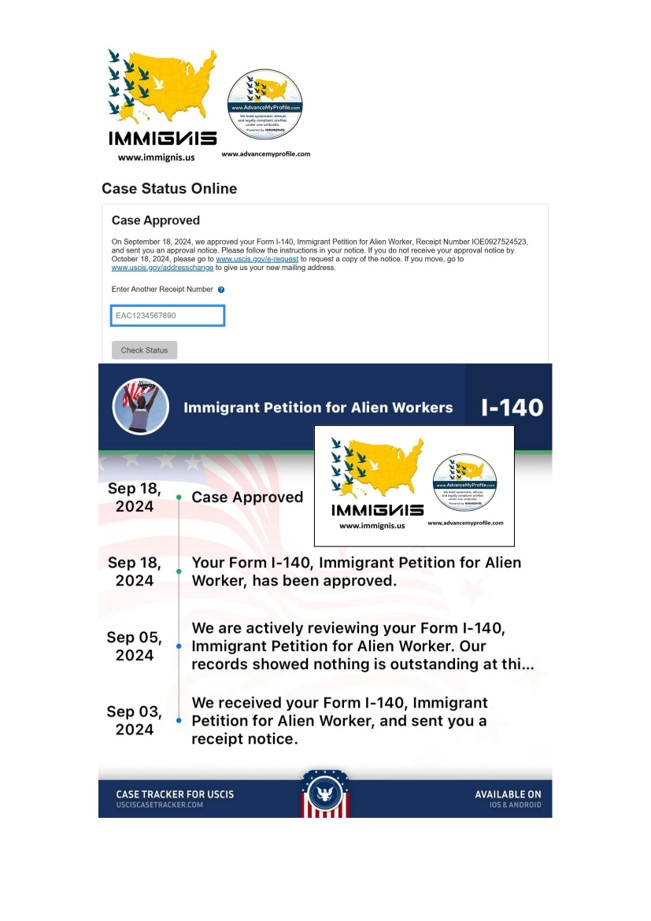
On September 18, 2024, USCIS approved the Form I-140 petition of a North Macedonian air-quality scientist whose work focused on urban air-quality modeling in Balkan valley cities.
The approval was important because the petitioner did not start with a globally famous academic profile. Her strongest evidence was regional: air-pollution modeling, monitoring data, health impact analysis, policy support, and public communication in cities where winter pollution crises had become a serious public concern.
That created a familiar evidence problem for environmental scientists. The work mattered to public agencies, health researchers, city planners, and affected communities, but it did not automatically translate into international name recognition. The data was influential locally, yet the scientist behind it remained nearly invisible to a U.S. immigration officer.
Immignis and Advance My Profile helped organize the case through ethical profile building, professional profile building, and immigration specific profile building. The strategy turned policy influence documentation, publication work, EU environmental-network roles, health impact study leadership, media visibility, and expert letters into a coherent EB-1A record.
The evidence problem in Balkan air quality science
Urban air-quality modeling in Balkan valley cities is a highly specialized field. It requires atmospheric science, emissions analysis, meteorology, topography, public health interpretation, and the ability to explain technical results to policymakers and the public.
The petitioner’s starting weakness was that her research had strong local influence but weak international packaging. Local agencies used the data. Pollution crisis coverage relied on the science. Public health conversations changed because of the evidence. But those signals were scattered across reports, local media, policy discussions, and technical datasets rather than collected in one visible profile.
The petition therefore defined the field carefully as urban air-quality modeling in Balkan valley cities. It did not present her as a generic environmental scientist. It showed that she worked in a narrow but nationally important niche where geography, winter inversions, emissions sources, public-health exposure, and policy response all interact.
That field definition became central to EB-1A profile building. It helped USCIS understand why regional policy influence, health impact studies, environmental network roles, and media explanation could be strong evidence in an atmospheric science case.
Policy influence documentation converted local use into original contribution
Policy-influence documentation became one of the main evidence pillars. In environmental science, original contribution is often proven not only by citations, but by how governments, agencies, municipalities, and public health actors use the scientist’s work to make decisions.
The profile building strategy documented how the petitioner’s modeling, pollution analysis, monitoring interpretation, or exposure findings informed air-quality planning, emissions discussion, public warnings, or urban environmental policy. The goal was to connect her work to actual decisions and professional reliance rather than leaving it as abstract data.
This supported the original contributions criterion because the record showed practical adoption. When pollution models help shape policy, health impact assessment, or mitigation planning, the contribution is no longer confined to a laboratory or journal article. It becomes part of how a city understands and responds to risk.
For professionals searching for EB-1A profile building, EB-2 NIW profile building, immigration profile building, profile improvement, or USCIS evidence building, this case shows that policy influence can be powerful when it is documented with attribution, not just described generally.
Publication record and health impact study leadership made the science legible
The publication record helped make the petitioner’s atmospheric science work legible to USCIS. Publications allowed the petition to show that her research was not only useful locally, but also organized, reviewed, and communicated through recognized scientific channels.
The case emphasized studies connected to air-quality modeling, pollutant exposure, emissions behavior, valley-city meteorology, seasonal pollution episodes, health risk, or mitigation planning. These publications helped translate regional data into scientific authorship and technical credibility.
Health impact study leadership was especially important because air pollution is not merely an environmental problem. It is also a public-health problem. By showing leadership in health impact analysis, the petition connected the petitioner’s work to respiratory risk, vulnerable populations, exposure reduction, and policy urgency.
As part of immigration-specific profile building, publications and health impact studies helped prove that the petitioner’s work had a measurable scientific and public health purpose, not just local administrative use.
EU environmental network roles showed professional recognition beyond one country
EU environmental network roles helped move the case beyond a purely local frame. For a scientist from a smaller country, this kind of evidence can be critical because it shows that the professional community outside the home institution recognizes and relies on the person’s expertise.
The petition used participation in European environmental networks, cross-border research initiatives, air-quality collaborations, technical groups, or regional environmental platforms to show that the petitioner was not isolated inside one agency or university.
These roles supported leading role, membership, and final merits because they placed the petitioner in broader professional conversations about pollution, monitoring, data standards, public-health impact, and environmental policy in Europe.
For profile building and professional profile development, this type of evidence is valuable because it gives USCIS a recognized framework for evaluating a regional scientist. It shows that the work belongs to a larger field and that the petitioner has a visible role inside that field.
Media visibility turned pollution crises into published material evidence
Media visibility was another important part of the strategy. In air-quality cases, public communication matters because pollution crises affect daily life, school attendance, public health planning, transportation choices, and political debate.
The petition used media coverage to show that the petitioner’s expertise helped explain pollution episodes, winter smog, valley city stagnation, monitoring results, health concerns, or policy responses. The media evidence made a technical field understandable to a non-specialist officer.
This supported published-material evidence when coverage discussed the petitioner, her work, or the significance of her scientific findings. It also strengthened final merits by showing that her expertise mattered outside the academic setting.
For SEO and profile building purposes, this point is important. Immigration profile building is not just document collection. It is the careful development of a public-facing record that helps search engines, AI systems, readers, and immigration officers understand why a professional’s work matters.
Expert letters and judging evidence tied recognition to the scientist
Expert letters helped tie the case back to the individual scientist. In public sector and environmental research settings, achievements often appear under agency names, project names, or institutional reports. Expert letters can explain who actually designed the models, led the analysis, interpreted the data, or influenced the policy conversation.
The strongest letters described the petitioner’s specific role in urban air-quality modeling, health-impact work, environmental policy support, or pollution-crisis communication. They also explained why Balkan valley-city pollution is a difficult and specialized scientific problem.
Judging evidence was framed through scientific review, technical evaluation, project assessment, journal peer review, conference abstract review, or environmental program evaluation where available. These responsibilities helped show that others trusted the petitioner to evaluate work in her field.
Together, expert letters and judging evidence helped transform regional influence into attributable professional recognition. They made the record less dependent on generalized claims about air pollution and more focused on the petitioner’s personal standing.
How Immignis built the petition ready profile
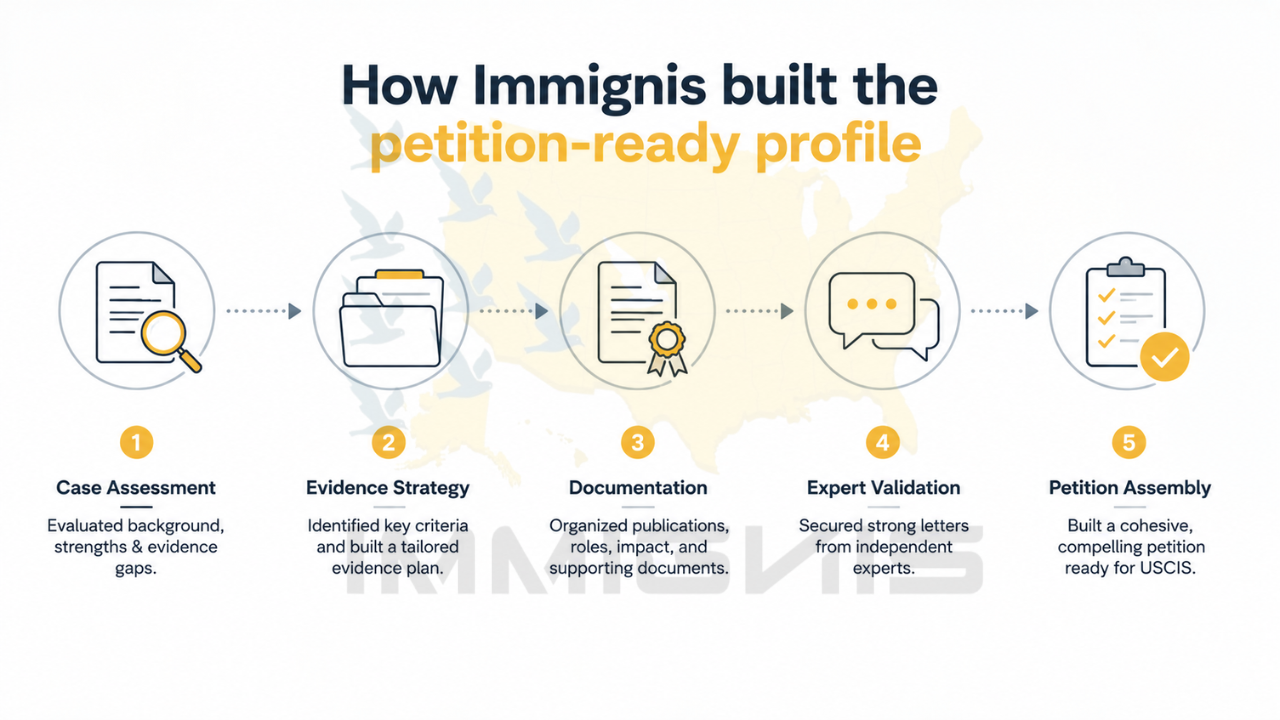
The Immignis and Advance My Profile strategy focused on turning a locally important but internationally under visible career into a petition-ready immigration profile. The team organized the evidence around original contributions, scholarly articles, published material, leading role, and judging.
This type of profile building is different from generic publicity. The goal was not to make the petitioner appear famous in a broad public sense. The goal was to document field-specific recognition, policy reliance, scientific authorship, and public-health relevance in a format USCIS could evaluate.
The petition used immigration-specific profile building to show why an atmospheric scientist from a smaller European country could still meet EB-1A standards. The record explained that significance may appear through policy adoption, health impact leadership, and crisis communication rather than only through high citation counts.
The approval hook was simple and persuasive: Europe’s worst-air headlines gave a regional scientist an international stage. The petition showed that the petitioner’s work mattered because it addressed a visible public crisis with real scientific tools.
Why this case worked
The case worked because the petition did not treat limited international visibility as fatal. Instead, it explained that urban air-quality science often becomes influential through city planning, health impact studies, public warnings, and policy decisions before it becomes globally famous in academic literature.
The record combined policy influence documentation, publications, health-impact study leadership, European network participation, media coverage, expert letters, and judging evidence. This gave USCIS multiple independent ways to see the petitioner’s standing in the field.
The petition also avoided overclaiming. It did not argue that every European reader knew the petitioner’s name. It showed that her science helped explain and respond to one of the region’s most urgent environmental and public-health problems.
Most importantly, the case showed the value of ethical profile building for regional scientists. A record that may appear local at first can become highly persuasive when the petition connects the local work to recognized field standards, policy influence, public-health consequences, and independent validation.
Conclusion
The North Macedonian air-quality scientist’s EB-1A approval shows that regional environmental science can support a strong extraordinary ability petition when the evidence is organized around real influence, not just global fame.
Her case succeeded because policy influence documentation, publications, EU environmental network roles, health impact study leadership, pollution crisis media visibility, expert letters, and judging evidence were brought together through a careful professional profile building strategy.
The broader lesson is clear: when a scientist’s models help a city, agency, or public health community understand pollution risk, that work should not remain buried in local reports. With the right immigration profile building, regional environmental impact can become a legally persuasive EB-1A record.
Frequently asked questions
Can an air-quality scientist qualify for EB-1A?
Yes. An air-quality scientist can qualify for EB-1A when the record shows original contributions, scholarly articles, published material, leading roles, judging, and final-merits evidence showing that the person has risen to the top of the field.
Can regional environmental policy influence support EB-1A?
Yes. Regional policy influence can support EB-1A when the petition documents how the scientist’s work was used by agencies, municipalities, public-health stakeholders, environmental networks, or decision-makers.
Do pollution-crisis media appearances help an EB-1A petition?
Yes. Media coverage can help when it discusses the petitioner, the petitioner’s work, or the scientific importance of the petitioner’s research. It can also make a technical field easier for USCIS to understand.
Are health-impact studies useful in an atmospheric-science EB-1A case?
Yes. Health-impact studies can strengthen an EB-1A case because they connect environmental modeling to public-health consequences, exposure assessment, policy urgency, and practical significance.
Can a scientist from a smaller country qualify with limited international visibility?
Yes. A scientist from a smaller country can qualify if the petition carefully documents field-specific significance, independent validation, policy use, publications, leadership roles, and professional recognition.
Can Immignis and Advance My Profile help environmental scientists with immigration profile building?
Yes. Immignis and Advance My Profile help scientists, engineers, healthcare professionals, researchers, and policy experts build ethical immigration profiles by organizing evidence, strengthening visibility, documenting field impact, and preparing petition-ready EB-1A or EB-2 NIW records.
Build an EB-1A record around environmental science, policy influence, and public-health impact
Many environmental scientists already have strong impact, but their evidence may be buried in agency reports, datasets, policy memos, project records, media interviews, technical models, or regional collaborations. Ethical profile building can turn that scattered record into a clear EB-1A or EB-2 NIW profile-building strategy.
Start with a free EB-1A profile assessment and find out whether your air-quality, climate, environmental-science, public-health, policy, or atmospheric-research record may already support profile building for U.S. immigration.