EB-1A Demand in 2026: Why the Extraordinary Ability Green Card Has Become More Competitive
Last Updated on July 9, 2026 by Amelia
Written by Emily Carter, Immigration Law Specialist Reviewed by Jonathan Miller, Esq., Licensed U.S. Immigration Attorney
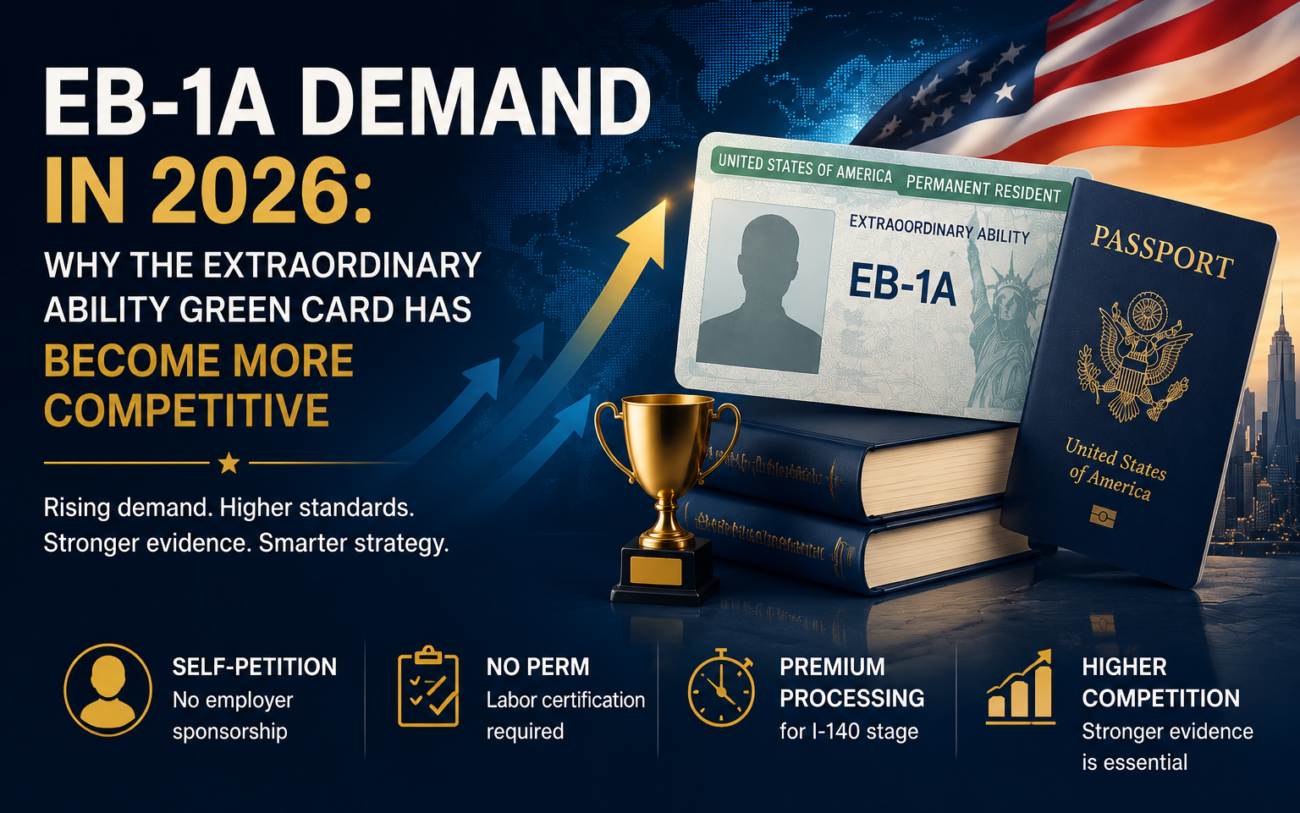
The EB-1A extraordinary ability green card has become one of the most discussed U.S. immigration options for high achieving professionals, researchers, founders, executives, artists, athletes, and technical specialists. It is attractive because it allows a qualified applicant to self-petition, avoid PERM labor certification, and move through the Form I-140 stage with premium processing.
However, the same features that make EB-1A attractive have also made the category more competitive. More professionals now view EB-1A as a possible route after years of demand pressure in EB-2 and EB-3 categories, slower labor certification routes, and growing interest in self directed immigration strategies. At the same time, USCIS continues to evaluate EB-1A petitions through a detailed evidence review and final merits analysis.
In 2026, applicants should not think of EB-1A as a simple “fast green card” or a category that can be won by checking three boxes. EB-1A remains a high standard immigrant classification for individuals who can prove sustained national or international acclaim and show that they are among the small percentage at the very top of their field.
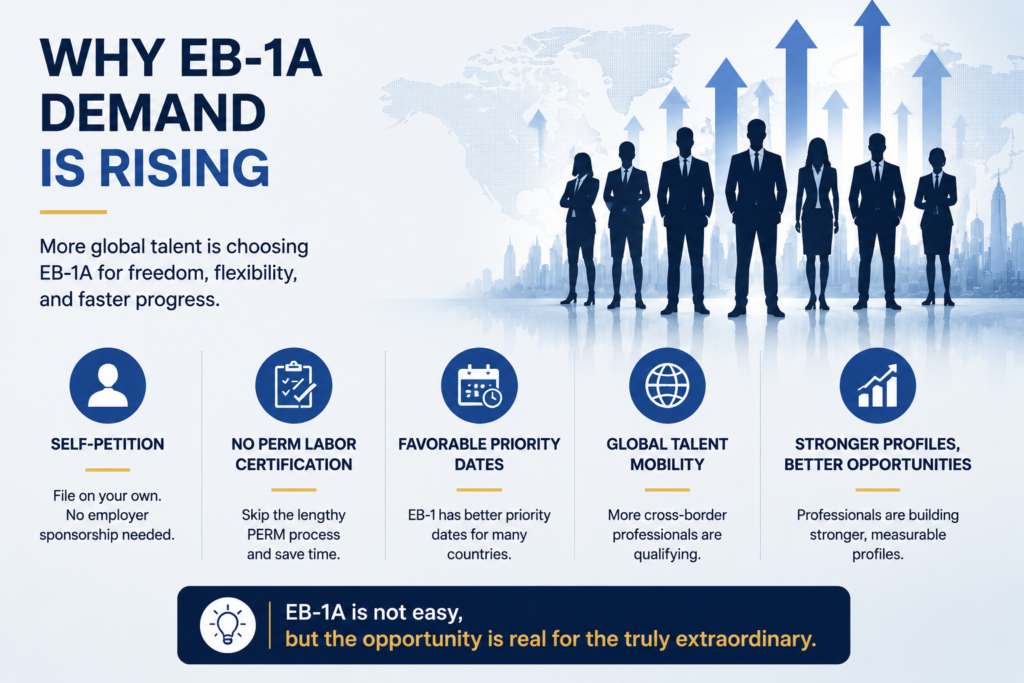
| EB-1A demand is rising because the category offers self-petitioning, no PERM labor certification, premium processing for the I-140 stage, and often a better priority date position than EB-2 for some applicants. But competition is also rising because USCIS expects strong, independent, well contextualized proof of extraordinary ability, not only impressive employment history or recommendation letters. |
Why EB-1A Demand Is Rising
1. EB-1A Allows Self-Petitioning
EB-1A is especially attractive because a qualified applicant may file the petition without a U.S. employer sponsor. This gives professionals more flexibility than employer-sponsored categories that depend on a specific job offer, employer willingness, and labor-market procedures.
For founders, researchers, consultants, independent experts, physicians, artists, athletes, and executives, this self-petition feature can be highly valuable. It allows the case to focus on the applicant’s record of achievement and intended future work in the United States.
2. EB-1A Avoids the PERM Labor Certification Process
Many employment-based green card cases require the employer to complete PERM labor certification before filing the immigrant petition. That process can be time-consuming, document-heavy, and dependent on employer participation.
EB-1A does not require PERM. This makes it attractive for high level applicants who can prove extraordinary ability and who do not want their permanent-residence strategy tied to a single employer-controlled process.
3. Priority-Date Pressure Has Made EB-1A More Strategic
Visa availability changes every month through the U.S. Department of State Visa Bulletin. EB-1 is often more favorable than EB-2 or EB-3 for many applicants, but it is not always current for every country. In July 2026, for example, EB-1 remained current for many countries but had cut-off dates for China and India, while India EB-2 was listed as unavailable for the month.
This means applicants must look at both sides of the strategy: whether the EB-1A petition can be approved and whether a visa number is available when they are ready to complete adjustment of status or consular processing.
4. Global Talent Mobility Has Expanded the Applicant Pool
The global economy has produced more professionals whose work crosses borders. Fields such as artificial intelligence, biotechnology, cybersecurity, healthcare technology, climate science, energy systems, advanced manufacturing, fintech, aerospace, and digital infrastructure now produce evidence that can travel across national markets.
More professionals are publishing, patenting, judging, speaking, founding companies, leading technical teams, and receiving media attention. This has expanded the number of people exploring EB-1A as a serious immigration option.
5. EB-2 NIW Success Has Encouraged Some Applicants to Consider EB-1A
Many applicants first file EB-2 NIW because their work has national importance. After that, some continue building evidence and later evaluate EB-1A. This is especially common among applicants from countries facing long EB-2 wait times.
However, an approved EB-2 NIW does not automatically mean the applicant qualifies for EB-1A. NIW focuses on national importance and whether the applicant is well positioned to advance a proposed endeavor. EB-1A focuses on extraordinary ability, sustained acclaim, and recognition at the top of the field.
The 2026 EB-1A Competitive Landscape
The EB-1A category is competitive for two reasons: visa number demand and petition quality scrutiny. These are different issues, and applicants should understand both.
| Issue | What it means for applicants |
| Visa-number demand | Even if an I-140 is approved, the applicant can only complete the green card stage when the priority date is current under the applicable Visa Bulletin chart. |
| Country of chargeability | Applicants from countries with high demand, especially India and China, must check EB-1 cut-off dates carefully each month. |
| Final merits review | USCIS may agree that an applicant meets three regulatory criteria but still decide that the total record does not prove extraordinary ability. |
| Evidence context | Awards, judging, media, citations, salary, and leadership evidence must be explained with context, selectivity, field relevance, and independent importance. |
| Premium processing | Premium processing can speed the I-140 action, but it does not guarantee approval and does not make a priority date current. |
Policy Trend: USCIS Is Looking for Quality, Context, and Sustained Acclaim
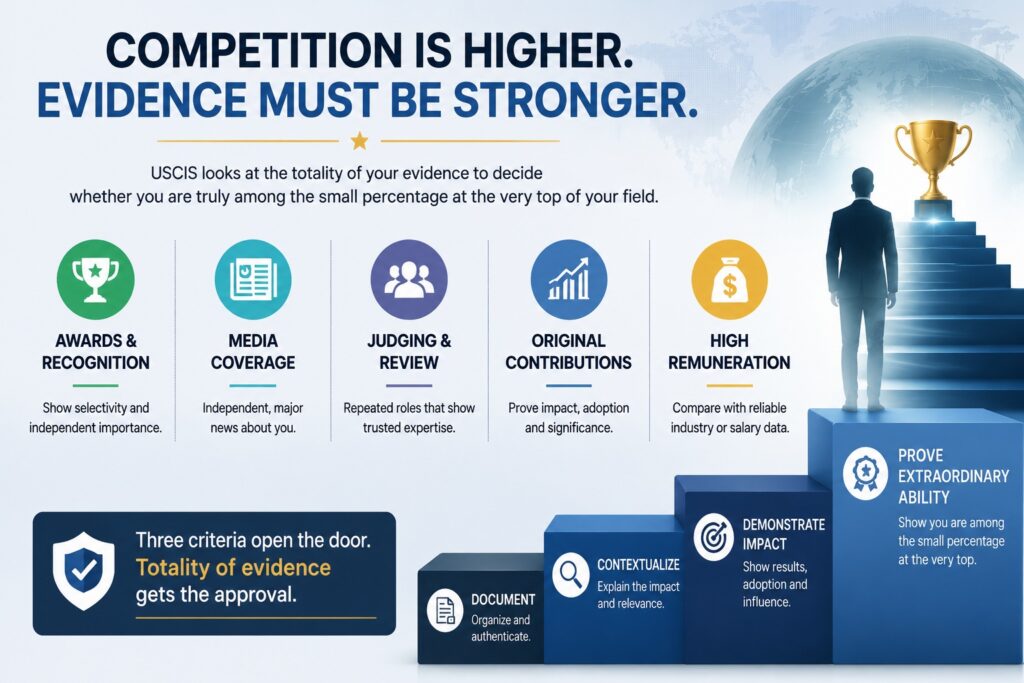
Recent USCIS guidance makes clear that EB-1A evidence is evaluated in two stages. First, USCIS reviews whether the submitted documents satisfy at least three regulatory evidence categories or show a one-time major internationally recognized achievement. Second, USCIS conducts a final merits review to decide whether the record as a whole proves extraordinary ability.
This second step is where many weak EB-1A cases fail. The question is not only whether the applicant has awards, publications, media, judging work, or leadership roles. The deeper question is whether those items prove that the applicant has sustained national or international acclaim and belongs to the small percentage at the top of the field.
For that reason, applicants should avoid treating EB-1A as a document counting exercise. A strong petition explains why each item matters, who recognized the applicant, how independent that recognition is, how selective the achievement was, and how the applicant’s work has influenced the field.
Evidence That Matters More in 2026
| Evidence type | Weak presentation | Stronger 2026 presentation |
| Awards | Listing an award without explaining its importance. | Explain eligibility, selection rate, judging body, field reputation, and why the award is nationally or internationally recognized. |
| Media coverage | Submitting promotional articles or company announcements. | Use independent coverage about the applicant and explain the publication’s reach, audience, and relevance. |
| Judging or peer review | Showing isolated reviews without context. | Show repeated judging, editorial review, grant review, conference judging, award judging, or review activity that reflects trusted expertise. |
| Original contributions | Claiming the work is innovative because colleagues say so. | Show adoption, citations, patents, standards use, customer deployment, clinical or technical implementation, policy use, measurable results, or independent expert validation. |
| Scholarly articles | Listing publications only. | Add citation data, journal ranking, conference selectivity, independent discussion, and evidence that the work influenced others. |
| Leading or critical role | Submitting job descriptions. | Show the distinguished reputation of the organization and why the applicant’s role was critical to an important project, product, research line, or institutional outcome. |
| High salary | Providing a salary slip only. | Compare remuneration to credible wage, industry, geographic, or peer data for the same field and level. |
Impact on Applicants
1. More Applicants Need a Profile-Building Strategy Before Filing
A professional may be excellent in their field but still lack enough EB-1A ready evidence. In such cases, the correct strategy may be to build missing evidence before filing. This can include publications, peer review, awards, selective memberships, speaking engagements, media coverage, independent adoption evidence, patents, policy papers, technical reports, or documented leadership outcomes. The goal is not to manufacture a false profile. The goal is to document real expertise in ways that USCIS can evaluate.
2. Timing Matters, But Evidence Matters More
Premium processing is useful when the case is ready. It is not a substitute for evidence. A weak case can receive a fast Request for Evidence or denial. A strong case should be prepared as if the officer will test every claim.
3. Applicants Must Understand the Difference Between Reputation and Recognition
A person may be respected inside a company but not yet recognized in the field. EB-1A usually needs evidence that reaches beyond the applicant’s employer, immediate supervisors, or private client base. Independent recognition is especially valuable.
Impact on Employers and U.S. Organizations
Although EB-1A does not require employer sponsorship, U.S. employers can still be affected by EB-1A demand. Companies, universities, hospitals, research centers, and startups increasingly compete for professionals who can qualify for self-petition routes. These individuals often have options in multiple countries and may evaluate employers based on career freedom, research resources, leadership opportunities, compensation, immigration support, and long-term stability.
Employers cannot “sponsor” EB-1A in the same way they sponsor many other employment based categories, but they can help strong employees document important work. Useful support may include detailed role letters, project impact letters, evidence of distinguished organizational reputation, documentation of internal adoption, product or research outcomes, patents, publications, media, awards, and objective performance data.
Strategies for EB-1A Success in a More Competitive Environment
1. Define the Field Carefully
The field should be specific enough to show expertise but not so narrow that the applicant appears to be the only person in it. A clear field definition helps USCIS understand who the applicant is being compared against.
2. Select the Strongest Criteria, Not the Easiest Criteria
Applicants should not rely only on the criteria that are easiest to document. The strongest case uses criteria that prove real recognition and field level standing.
3. Build Independent Evidence
USCIS gives more weight to evidence that comes from sources outside the applicant’s immediate employer or personal network. Independent adoption, third party discussion, citations, awards, media, judging roles, and expert letters can strengthen the case.
4. Explain Significance, Not Only Achievement
The petition should explain why the evidence matters. A publication, award, patent, project, or leadership role is stronger when the petition explains its selectivity, reach, impact, and relevance to the field.
5. Use Expert Letters Correctly
Expert letters should not be generic praise. Strong letters explain the applicant’s specific contribution, why it matters, how it affected the field, and why the author is qualified to assess the work.
6. Connect the U.S. Benefit Requirement
EB-1A applicants must show that they intend to continue working in their area of extraordinary ability and that their work will substantially benefit the United States. This should be addressed clearly, especially for applicants changing roles, moving into entrepreneurship, or shifting from research to commercial implementation.
7. Check the Visa Bulletin Before Planning the Green Card Timeline
I-140 approval and green card availability are separate. Applicants should check the latest Visa Bulletin and USCIS adjustment of status chart before planning timelines, travel, employment changes, or dependent filings.
Common Mistakes to Avoid
- Assuming EB-1A is easy because it does not require an employer sponsor.
- Assuming that meeting three regulatory criteria guarantees approval.
- Submitting recommendation letters without independent documentary support.
- Using awards, memberships, or media coverage that are not selective or not field-relevant.
- Failing to explain why the applicant’s original contribution is of major significance.
- Relying only on employment history without proving recognition beyond the employer.
- Ignoring the Visa Bulletin and assuming EB-1A is always current.
- Using premium processing before the case is fully prepared.
- Overstating claims that cannot be supported by objective evidence.
How Immignis Can Help
Immignis helps high-achieving professionals evaluate whether EB-1A is realistic, premature, or strategically worth building toward. The goal is not to force every strong professional into EB-1A. The goal is to identify the strongest immigration route based on the person’s actual achievements, evidence, country of chargeability, timeline, and long-term U.S. plans.
For EB-1A matters, Immignis can assist with profile evaluation, evidence mapping, petition strategy, expert letter planning, evidence organization, RFE strategy, and long-term profile building coordination where the applicant’s record needs more independent recognition before filing.
In a more competitive EB-1A environment, preparation matters. A strong petition should tell a clear, evidence backed story of extraordinary ability, sustained acclaim, and future benefit to the United States.
Conclusion
The EB-1A extraordinary ability green card remains one of the most valuable U.S. immigration options for top professionals because it allows self-petitioning, avoids PERM labor certification, and can move quickly at the I-140 stage with premium processing. But demand and competition have changed the way applicants should approach the category.
In 2026, applicants should treat EB-1A as a serious evidence project. The strongest cases are built around independent recognition, sustained acclaim, field level impact, and a well explained final merits argument. Visa Bulletin movement must also be considered carefully because EB-1A approval does not automatically mean immediate green card availability for every country.
For professionals who are ready, EB-1A can be a powerful path. For those who are close but not yet ready, a careful profile-building and evidence-development strategy may be the smarter first step.
Why is EB-1A demand increasing?
EB-1A demand is increasing because the category allows self-petitioning, avoids PERM labor certification, offers premium processing for the I-140 stage, and may provide a better priority date position than EB-2 or EB-3 for some applicants. It is especially attractive to high achieving professionals in STEM, business, healthcare, research, arts, sports, and entrepreneurship.
Is EB-1A still current in 2026?
It depends on the applicant’s country of chargeability and the monthly Visa Bulletin. EB-1 may be current for many countries while still having cut off dates for India or China. Applicants should check the latest Department of State Visa Bulletin and USCIS adjustment of status chart before planning timelines.
Does premium processing make EB-1A faster?
Premium processing can speed up USCIS action on the Form I-140 stage, but it does not guarantee approval and does not make a priority date current. If USCIS issues an RFE or NOID, the case can still take longer.
Is EB-1A easier after an EB-2 NIW approval?
Not automatically. EB-2 NIW approval can show that a person has important work, but EB-1A requires a different and higher showing: extraordinary ability, sustained national or international acclaim, and recognition at the top of the field.
Can entrepreneurs qualify for EB-1A?
Yes, some entrepreneurs can qualify if they can prove extraordinary ability through strong evidence such as major funding, awards, media coverage, original contributions, patents, commercial success, industry recognition, judging, high remuneration, or leading roles in distinguished ventures. A business idea alone is not enough.
What evidence is most important for EB-1A in 2026?
The strongest evidence is independent, contextualized, and field-relevant. Examples include recognized awards, selective judging roles, major media coverage about the applicant, scholarly influence, original contributions of major significance, adoption of the applicant’s work, high remuneration data, and leading or critical roles supported by objective proof.
Do recommendation letters matter in EB-1A?
Yes, but letters should support the evidence, not replace it. Strong letters explain specific contributions, field-level significance, independent recognition, and why the writer is qualified to evaluate the applicant’s work.
Should I file EB-1A now or build my profile first?
That depends on the current evidence. If the record already shows sustained acclaim and strong field-level recognition, filing may be realistic. If the evidence is promising but thin, profile-building before filing may reduce RFE and denial risk.