How a South Korean silicon photonics engineer secured EB-1A approval by turning patent attribution, disclosure cleared device performance records, photonics publications, conference roles, technical committee service, supplier validation, compensation evidence, and ethical immigration specific profile building into a petition ready record of extraordinary ability.
Key facts at a glance
| Petition outcome | Form I-140 approved under EB-1A on November 1, 2024. |
| Professional profile | South Korean engineer designing optical interconnects that move data between advanced computing systems while reducing the energy and thermal burden associated with conventional electrical links. |
| Field niche | Silicon photonics for data center and artificial intelligence hardware. |
| Starting weakness | The devices entered high value semiconductor programs, but the engineer’s contribution disappeared behind chipmakers, foundries, suppliers, product teams, and confidential development roadmaps. |
| Profile-building focus | Patent and invention attribution records, cleared device performance documentation, photonics publications, international conference roles, technical committee participation, supplier validation letters, project attribution, peer evaluation evidence, and compensation benchmarking. |
| Principal EB-1A evidence areas developed | Original contributions of major significance, authorship of scholarly articles, leading or critical role, judging the work of others, and high salary or other significantly high remuneration where supported. |
| Central issue | Showing that the petitioner was not merely assigned to a sophisticated semiconductor program, but exercised identifiable creative and technical authority over optical interconnect solutions used in advanced computing environments. |
| Approval lesson | Confidential semiconductor work can support EB-1A when inventorship, measurable performance, technical authorship, external validation, peer trust, organizational importance, and market value are documented separately and then connected to one precise field identity. |
A scrolling product roadmap did not show who solved the bottleneck
The petitioner worked on technology designed to move enormous volumes of data across and between computing systems. Yet the public record did not reveal much about the person behind the optical pathways. Product announcements named companies. Technical roadmaps named platforms. Patent records listed several inventors. Internal reports were confidential. The engineer’s contribution was real, but it was dispersed across systems that were not written for immigration review.
That gap was the starting point of the case. The challenge was not to make silicon photonics sound important in the abstract. The challenge was to show what this engineer personally designed, why the solution was technically difficult, how other professionals relied on it, and why the work exceeded routine participation in a large semiconductor program.
USCIS approved the Form I-140 petition on November 1, 2024. Immignis and Advance My Profile structured the record around one central idea: technology measured in microns still requires person level attribution. The petition therefore separated the engineer from the chipmaker, the foundry, the device, the program name, and the team before arguing the significance of the work.
Why silicon photonics creates a difficult immigration evidence problem
Silicon photonics combines optical physics, semiconductor fabrication, packaging, device design, signal integrity, thermal engineering, reliability, and high volume manufacturing. The field seeks to move information with light through components that can be integrated with established semiconductor processes. That description sounds simple. The engineering is not.
An optical interconnect may depend on waveguides, modulators, photodetectors, couplers, lasers, packaging interfaces, control electronics, alignment tolerances, thermal stability, fabrication yield, and system level integration. A design can perform well in simulation and still fail when process variation, packaging loss, heat, vibration, or manufacturing scale enters the picture.
The petition defined the petitioner’s field as silicon photonics for data center and artificial intelligence hardware. That narrow definition prevented the case from becoming a generic semiconductor or optical engineering narrative. It also explained why patents, device measurements, publications, technical review, conference roles, supplier letters, and compensation all belonged to the same professional story.
Patent attribution showed invention, but the petition did not stop there
Patents were one of the clearest public records available. They identified the petitioner as an inventor and provided a lawful way to discuss technical solutions without reproducing restricted internal materials. Each patent was mapped to a specific engineering problem, such as optical loss, thermal behavior, coupling efficiency, integration density, manufacturability, reliability, or control of signal performance.
The petition did not treat the existence of a patent as automatic proof of a contribution of major significance. Inventorship established originality. Significance required additional evidence. The record therefore connected protected inventions to device validation, product program use, supplier reliance, subsequent design work, or other professionally meaningful outcomes where the underlying case materials supported those links.
This distinction strengthened credibility. The argument was not that every named invention transformed the industry. It was that the petitioner repeatedly solved technically important barriers and that independent records showed the solutions mattered beyond an isolated exercise in patent drafting.
Cleared performance records translated confidential device work into reviewable evidence
The strongest technical proof often appeared in restricted test reports. Optical insertion loss, bandwidth, power consumption, bit-error performance, thermal drift, reliability, yield, packaging tolerance, and environmental testing could not simply be copied into a public facing petition.
The profile building strategy used disclosure cleared summaries, authorized role descriptions, redacted records, and letters from professionals familiar with the work. These materials identified the type of device, the engineering problem addressed, the petitioner’s responsibility, the validation performed, and the practical importance of the result without exposing unreleased product details or proprietary numerical targets.
Specificity mattered. A letter stating that the engineer was “important” would have added little. A credible record explained what technical decision depended on the petitioner, how the solution was evaluated, and what changed because of that work. This made confidential performance evidence useful without turning the petition into a disclosure risk.
Supplier and foundry letters helped separate one engineer from the semiconductor ecosystem
Silicon photonics devices rarely emerge from one laboratory in isolation. Foundries, packaging houses, component suppliers, test partners, design teams, and system integrators may all contribute to the final result. That makes attribution difficult, but it also creates opportunities for independent validation.
The strongest letters came from professionals who could describe direct reliance on the petitioner’s judgment. They explained the interface problem being solved, the petitioner’s technical authority, the consequences of the design choice, and why the solution mattered to a broader program. Where possible, the letters also distinguished the petitioner’s work from tasks performed by the wider team.
This evidence supported the original contribution and leading role narratives because it showed that other organizations did not merely know the petitioner. They depended on the petitioner’s expertise at points where optical performance, fabrication constraints, packaging, reliability, or schedule risk had to be resolved.
Publications gave the engineering a durable technical identity
Scholarly and technical publications helped move the record beyond confidential product development. The articles addressed non-proprietary questions relevant to silicon photonics, optical interconnects, device integration, packaging, thermal behavior, reliability, or high speed system performance.
The petition documented authorship, venue, subject matter, peer-review process, and connection to the petitioner’s defined field. It did not rely only on publication count. A smaller number of coherent papers can be more persuasive than a scattered record if they show a sustained technical identity and explain work that other specialists can examine, cite, or build upon.
First author or clearly attributable work was especially useful, but collaborative articles were not dismissed. Instead, the record identified the petitioner’s specific contribution through author statements, project records, expert letters, and the technical content itself where appropriate.
Conference roles and technical committees demonstrated peer trust
The petitioner’s conference record was documented by role, not by attendance. Invited talks, competitively selected technical presentations, panel participation, session responsibilities, or other substantive assignments showed that professional audiences considered the engineer’s knowledge worth presenting and discussing.
Technical committee participation required the same care. Ordinary membership was not presented as an achievement based EB-1A criterion. The petition instead focused on responsibilities involving technical review, standards discussion, proposal assessment, manuscript evaluation, or other forms of professional judgment where the evidence supported them.
This distinction allowed judging evidence to remain credible. The record showed what was reviewed, why the petitioner was selected, and how the activity related to the work of other professionals. Titles alone were not enough.
Leading role was proven through decisions, not job titles
A senior title inside a well known company does not automatically establish a leading or critical role. The petition therefore mapped the petitioner’s actual authority within distinguished semiconductor and computing programs. It identified design ownership, technical decisions, cross functional dependencies, escalation responsibilities, and the effect of the petitioner’s work on the program’s success.
The evidence showed where the petitioner’s expertise became difficult to replace. That might involve resolving an optical performance barrier, translating design requirements into foundry constraints, coordinating device and package interfaces, validating a new architecture, or guiding technical choices across multiple teams.
Organizational reputation was documented separately from personal role. This avoided the common mistake of assuming that employment by a respected company proves extraordinary ability. The argument rested on what the petitioner did inside the organization and why that work was important to its distinguished activities.
High remuneration was presented as market evidence, not a standalone conclusion
Compensation can support EB-1A when it is significantly high in relation to others in the field. The petition therefore used comparisons matched to occupation, location, experience, technical specialization, industry segment, and total remuneration. Base salary, bonuses, equity, allowances, and other compensation were considered only where reliable records allowed a fair comparison.
This was important because semiconductor compensation varies widely across countries, company types, career stages, and technical functions. A general engineering average would not necessarily reflect the market for a specialist trusted with advanced optical interconnect development.
The remuneration evidence reinforced the broader record. It showed that the market placed unusual value on the petitioner’s expertise, but it did not substitute for proof of invention, technical contribution, critical responsibility, authorship, or peer trust.
Energy efficient data movement made the technical significance understandable
The petition explained why optical interconnects matter without claiming that the importance of artificial intelligence or data centers automatically established extraordinary ability. Advanced computing systems must move vast amounts of information. Electrical connections face increasing challenges involving power, heat, bandwidth, and distance as systems become denser and faster.
Silicon photonics offers a path to transmit data using optical signals while leveraging semiconductor manufacturing methods. The petitioner’s work was therefore placed within a practical engineering problem: how to move more data without allowing interconnect power and thermal demands to become an unacceptable system bottleneck.
That context helped a non-specialist adjudicator understand the work. The evidence then returned to the petitioner: which device barriers were addressed, which methods were original, which programs relied on the solutions, and how the professional record showed recognition beyond ordinary employment.
The final merits argument relied on convergence
No single patent, paper, letter, presentation, committee role, or compensation record carried the entire petition. Patents established inventorship. Cleared test records showed measurable engineering. Publications established technical authorship. Supplier letters demonstrated reliance. Conference and review roles showed peer trust. Program documentation established critical responsibility. Compensation showed market recognition.
These different forms of evidence converged on one conclusion: the petitioner had developed a sustained record of advanced silicon photonics work, and the field relied on the petitioner as an inventor, technical author, evaluator, and engineering leader rather than as a routine participant in large product teams.
Why this case worked
The case began with attribution. Before arguing importance, the petition identified the petitioner’s individual work inside confidential, team based semiconductor programs.
The field was defined narrowly enough to make the record coherent. Silicon photonics for data center and artificial intelligence hardware connected optical device design, foundry integration, packaging, reliability, publications, technical review, and compensation without stretching the professional identity too broadly.
The evidence categories were kept legally and factually distinct. Patents were not treated as automatic proof of major significance. Publications authored by the petitioner were separated from coverage about the petitioner. Technical committees were examined for actual review duties. Organizational prestige was separated from personal role. Compensation was benchmarked rather than merely stated.
Most importantly, the petition turned invisible engineering into a person centered record. The devices were microscopic. The programs were confidential. The data moved at enormous scale. The case showed whose judgment helped make that movement possible.
What semiconductor and photonics professionals can learn from this approval
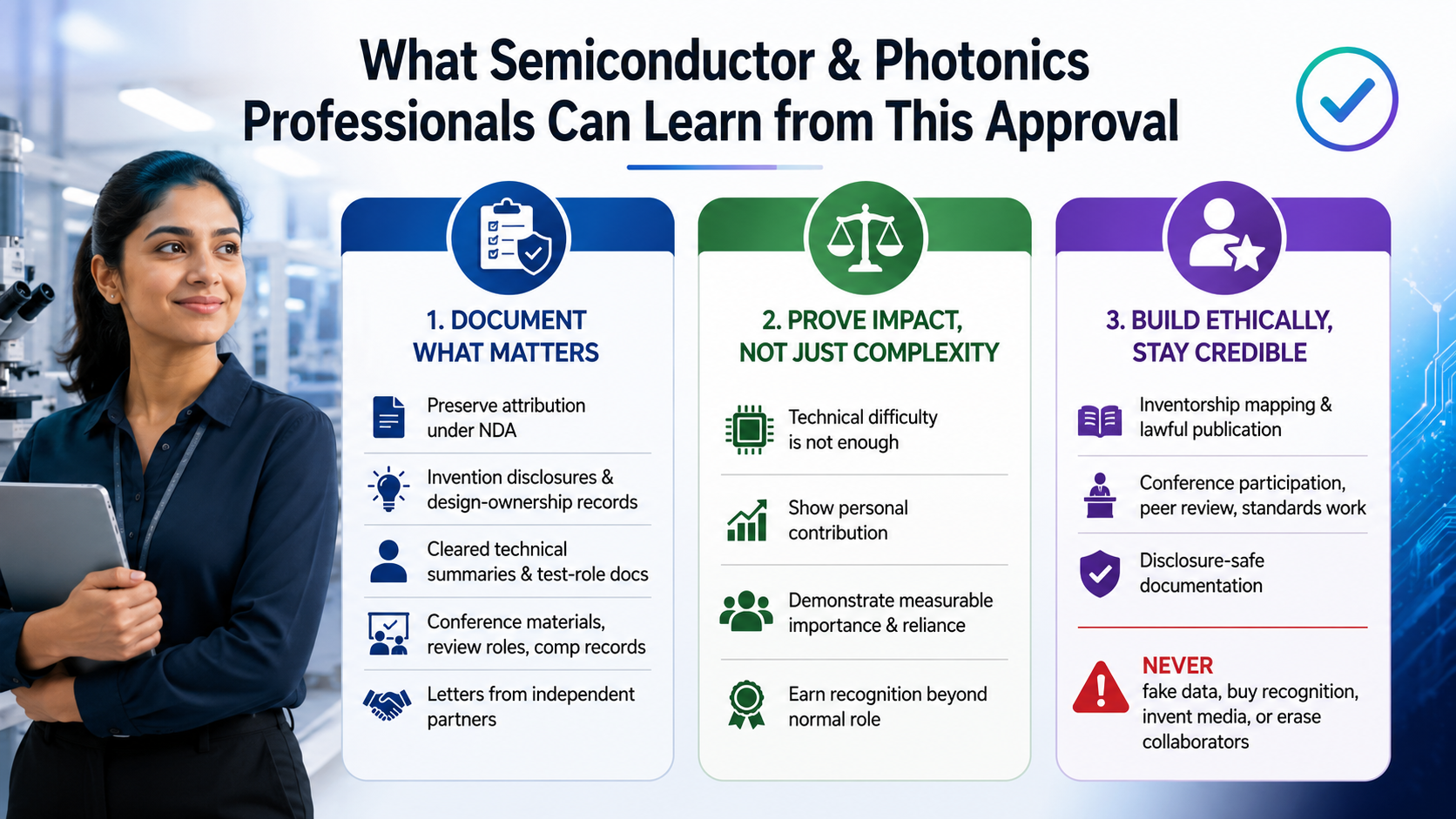
Professionals working under nondisclosure agreements should preserve attribution while projects are active. Invention disclosures, design ownership records, cleared technical summaries, test role documentation, conference materials, review assignments, compensation records, and letters from independent partners are easier to use when created contemporaneously.
They should also distinguish technical difficulty from legal significance. A sophisticated device is not enough by itself. The record must show personal contribution, measurable importance, professional reliance, and recognition beyond the normal expectations of the position.
Ethical profile building can make legitimate work visible through accurate inventorship mapping, lawful technical publication, conference participation, peer review, standards work, and disclosure-safe documentation. It should never depend on fabricated performance data, purchased recognition, invented media, or claims that erase the contributions of collaborators.
Frequently asked questions
Can a silicon photonics engineer qualify for EB-1A?
Yes. Engineers may qualify when the evidence satisfies the regulatory framework and, viewed as a whole, demonstrates sustained acclaim and placement among the small percentage at the top of the defined field.
Can confidential semiconductor work be used in an EB-1A petition?
Potentially. Disclosure cleared summaries, redacted records, authorized role descriptions, patent documents, and letters from knowledgeable professionals may show the work without revealing protected product details.
Does a semiconductor patent automatically prove a contribution of major significance?
No. A patent can establish inventorship and originality. Evidence of use, validation, reliance, licensing, technical impact, or independent professional recognition is generally needed to explain significance.
How can an engineer prove a leading or critical role in a large product program?
The evidence should identify the distinguished organization or program, the petitioner’s actual responsibilities, the decisions that depended on the petitioner, and the consequences of that work for technical performance or program success.
Can supplier or foundry letters support original contribution evidence?
Yes, when the writers have direct knowledge and explain the engineering problem, the petitioner’s specific contribution, the validation performed, and why the result mattered. General praise is less useful.
Do collaborative publications count as scholarly articles?
They can. The record should document authorship and explain the petitioner’s contribution, particularly when the author list is long or the work was produced by a multidisciplinary team.
Can conference presentations help a silicon-photonics EB-1A case?
Yes, especially when the petitioner was invited, competitively selected, assigned a substantive role, or asked to present because of recognized expertise. Attendance alone carries limited weight.
What types of activities may support the judging criterion?
Peer review of manuscripts, proposals, conference submissions, technical designs, or other professionals’ work may qualify when the selection and review duties are properly documented.
Does technical committee membership satisfy the EB-1A membership criterion?
Not automatically. Ordinary or open membership should not be overstated. The admission standards must require outstanding achievements judged by recognized experts for the membership criterion to apply.
How is high remuneration evaluated for a semiconductor engineer?
The comparison should be relevant to the petitioner’s occupation, location, experience, specialization, industry segment, and total compensation. A raw salary figure without context is usually insufficient.
What is the difference between scholarly articles and published material?
Scholarly articles are works authored by the petitioner. Published material generally refers to qualifying coverage written about the petitioner and the petitioner’s work. They should be documented separately.
Does working on artificial intelligence hardware automatically make an EB-1A case strong?
No. The importance of the industry provides context, but the petition must still prove the petitioner’s individual achievements, recognition, and standing in the defined field.
How can ethical profile building help an engineer whose strongest work is proprietary?
It can organize existing evidence, improve attribution, develop lawful technical publications, document peer review and conference roles, preserve inventorship records, and build credible visibility without revealing confidential information or manufacturing acclaim.
Make the engineering behind optical data movement visible
A strong silicon photonics record may already exist across invention disclosures, patents, design ownership records, cleared performance summaries, technical papers, conference programs, committee assignments, supplier communications, compensation documents, and the testimony of professionals who relied on the work.