EB-1A Criteria 2026: All 10 Explained and the 3 That Are Easiest to Prove
EB-1A criteria 2026 require demonstrating that your achievements place you among a small percentage of professionals at the very top of your field. The standard sounds formidable and the label “extraordinary ability” does not help. But the EB-1A criteria in 2026 are evaluated through a structured framework that many accomplished professionals can satisfy with deliberate preparation. Not because the bar is low, but because the bar is specific, and specific evidence can be built and documented intentionally.
This guide explains all ten regulatory criteria in the detail that actually matters for petition preparation, identifies which three are most accessible for most professional profiles, and explains how the final merits determination changes what “meeting the criteria” actually means in adjudication.
How EB-1A Adjudication Works: The Two-Step Kazarian Framework
Every EB-1A petition is evaluated in two distinct steps. Understanding this structure before selecting criteria is the most important thing most petitioners never do.
Step 1 Threshold analysis: The officer determines whether the petitioner has submitted evidence that objectively satisfies at least three of the ten regulatory criteria. This is largely a documentary review does this evidence technically demonstrate this criterion?
Step 2 Final merits determination: After the threshold is cleared, the officer steps back and evaluates whether the full body of evidence, taken as a whole, demonstrates “sustained national or international acclaim” and places the petitioner among the small percentage at the very top of their field. This is a qualitative, holistic judgment.
This two-step structure comes from the Ninth Circuit’s decision in Kazarian v. USCIS (2010), which the AAO adopted nationwide. The court rejected a single step counting approach and required officers to first assess threshold eligibility and then separately evaluate whether the totality of the record demonstrates extraordinary achievement.
The critical implication: passing three criteria does not guarantee approval. Technically satisfying three criteria at a minimal level clears the first gate and immediately sends the case to a more subjective second gate. A petition built around three thin criteria with borderline documentation can pass Step 1 and fail Step 2. A petition built around three specific, well-documented, mutually reinforcing criteria can pass both.
This is why strategic criteria selection matters more than criterion quantity. Three criteria that all point toward the same coherent narrative of above average professional standing carry more weight in final merits than five criteria that describe ordinary professional activity.
All 10 EB-1A Criteria: What Each Requires and How to Document It
Criterion 1: Nationally or Internationally Recognized Prizes or Awards
Awards for excellence in the field, judged competitively at a national or international level. The selectivity and prestige of the award matters not just its existence.
What qualifies: Major industry awards with independent judging panels, competitive grants recognized across the field, government honors, peer-nominated awards requiring demonstrated achievement.
What doesn’t: Internal employer recognition, participation awards, regional awards with small competitive pools, honorary titles from the petitioner’s own organization.
Documentation: Award certificate, official description of the selection criteria and judging process, evidence of the award’s standing in the field (media coverage, prior recipients’ profiles), and any official announcement from the awarding body.
A note on this criterion: It is one of the least accessible to deliberately build in a short timeframe, since prestigious competitive awards typically require years of sustained contribution. Professionals who already have strong awards should use them; those who don’t should typically lead with other criteria.
Criterion 2: Membership in Associations Requiring Outstanding Achievement
Membership in professional associations where admission is judged by recognized experts and requires demonstrating outstanding achievement not just professional qualifications.
What qualifies: Fellowship designations (Fellow of [Professional Society]) where election requires peer nomination and achievement review, elected boards or committees of selective national or international organizations, standards bodies with rigorous membership criteria.
What doesn’t: General professional membership organizations open to any licensed practitioner, associations where membership is automatic upon meeting a credential, paid membership bodies without selective admission.
Documentation: The association’s bylaws or formal membership criteria establishing that outstanding achievement is required, the election or admission process documentation, and evidence of the organization’s standing and selectivity.
Key distinction officers look for: They will check whether the organization actually gates admission on recognized achievement, or simply on credentials and payment. A generic “member of [Professional Society]” is not the same as “elected Fellow of [Professional Society]” the documentation must make this distinction visible.
Criterion 3: Published Material About the Petitioner
Substantive material in professional publications, major trade publications, or major media that describes the petitioner or their work specifically material that treats the petitioner as a subject matter authority.
What qualifies: Feature articles in respected industry trade journals where the petitioner is the subject, profiles in major business or technology media, expert commentary pieces attributed to the petitioner in publications with documented readership and editorial standards, substantive mentions in academic literature about the petitioner’s work.
What doesn’t: Press releases authored by the petitioner’s organization, company blog posts, articles the petitioner submitted for publication, mentions in passing in broader pieces, low distribution self-published content.
Documentation: Full copies of the publications including masthead and publication date, evidence of the publication’s standing (circulation, editorial reputation), and context showing the petitioner was sought out rather than self-promoted.
The independence test: The strongest Criterion 3 evidence shows the publication independently identified the petitioner as an authority worth covering. An editor who sought out the petitioner for an expert interview is more valuable than a publication that ran a submitted byline because the former demonstrates external recognition, and the latter does not.
Criterion 4: Judging the Work of Others
Evidence of participation as a judge of the work of others in the same or allied field peer review, grant evaluation, competition judging, editorial board service, and similar activities.
What qualifies: Peer review for indexed academic or professional journals in the relevant field, grant panel service at federal agencies, foundations, or research institutions, invited review of conference submissions, committee service on professional awards or selection panels, and editorial board membership for recognized publications.
What doesn’t: Routine internal performance reviews, self-organized judging events without external recognition, reviewing applications for the petitioner’s own organization.
Documentation: Invitation letters from the requesting editor, agency, or organization; confirmation of completed review or panel service; evidence of the publication’s or organization’s standing in the field; and where possible, acknowledgment of the service.
Why this criterion is uniquely accessible: Unlike awards or salary levels, judging activity can be deliberately initiated. Journals actively recruit peer reviewers. Conference program committees send open calls. Federal grant panels rotate reviewers. A professional who systematically pursues judging opportunities over 12–18 months before filing can build genuine, documented history that satisfies this criterion from an authentic standing point.
Criterion 5: Original Contributions of Major Significance

Evidence of original scientific, scholarly, artistic, or business related contributions of major significance to the field.
What qualifies: For researchers publications with strong citation records indicating field-wide adoption, novel methodologies that others have implemented, patents with documented industry deployment. For practitioners documented innovations that changed practice at a level above ordinary employment, deployed systems with documented sector wide impact, proprietary methodologies adopted by peer organizations.
What doesn’t: Routine improvements to existing products or processes, contributions that primarily benefit one employer, publications without evidence of field engagement, patents that were filed but never commercialized or cited.
Documentation: Evidence of adoption by others citations, implementation records, industry reports referencing the contribution along with expert letters explaining specifically why the contribution was significant at a field level, not just within one organization.
Criterion 6: Authorship of Scholarly Articles
Scholarly articles in professional journals or widely distributed media in the petitioner’s field.
What qualifies: Peer-reviewed publications in indexed academic journals, substantive analytical pieces in recognized trade publications, widely-read technical reports with documented distribution, authored contributions to recognized field reference works.
What doesn’t: Blog posts, self-published pieces, articles in publications without editorial review, co-authored works where the petitioner’s contribution is unclear.
For non-academics: The regulatory language includes “major media” alongside professional journals, which opens this criterion to industry publications. A senior practitioner with bylined analysis pieces in respected industry outlets satisfies Criterion 6 without a traditional academic record.
Criterion 7: Artistic Displays or Exhibitions
Work displayed or showcased at artistic exhibitions or showcases of distinction. This criterion applies primarily to visual artists, designers, photographers, and creative professionals. For STEM, business, and research applicants, it is typically not applicable and should not be stretched to fit.
Criterion 8: Critical or Essential Role in Distinguished Organizations
Evidence of performing in a critical or leading role not merely a senior role in a distinguished organization or establishment. This is one of the most broadly applicable criteria across industries and career types.
An important distinction officers apply: “Leading” and “critical” are two different concepts under this criterion. A leading role means the petitioner was at the forefront of the organization a director, head, or principal. A critical role means the petitioner’s contribution was essential to the organization’s success, regardless of formal title. Both satisfy the criterion; both require specific documentation.
What qualifies: C-suite and senior director roles at distinguished companies or research institutions; technical lead positions where the petitioner’s specific expertise was determinative to major outcomes; founder roles in organizations that became distinguished; advisory board positions where the petitioner’s guidance was structurally relied upon.
What doesn’t: Standard senior employment, roles where the petitioner was one of many similarly-ranked professionals, titles that describe level but not genuine organizational dependence.
Documentation: Organizational charts establishing the position’s place in the hierarchy; letters from executives or board members specifically describing organizational reliance on the petitioner’s judgment not general employment verification letters; descriptions of specific decisions, projects, or outcomes that would not have occurred or succeeded without the petitioner; evidence of the organization’s standing in its field (awards, rankings, revenue, reputation).
The “what would have been lost” test: The most effective Criterion 8 letters answer a specific question: what specifically would this organization have failed to achieve, avoided, or accomplished differently if this professional had not been in this role? That question, answered with specific examples, is what distinguishes a critical role letter from an employment reference.
Criterion 9: High Salary or Remuneration
Evidence of commanding a salary or other remuneration significantly higher than others in the same field.
What qualifies: Base salary, total cash compensation, and equity compensation that can be valued against field benchmarks. Remote work arrangements are evaluated against the relevant occupation’s national or regional norms.
What doesn’t: Simply providing pay documentation without comparative context. An absolute figure says nothing without establishing what the field considers high.
The comparative analysis requirement: This criterion is only as strong as the comparative data supporting it. The documentation structure that works: total compensation breakdown, the relevant BLS Standard Occupational Classification code and geographic market, BLS wage data showing percentile distributions, supplementary industry salary survey data (Radford, Levels.fyi for tech, Mercer, or similar), and either a narrative analysis in the petition letter or a letter from an independent compensation expert placing the petitioner’s remuneration in field context.
The percentile question: USCIS has not published a specific percentile threshold. In practice, well-documented compensation at or above the 85th-90th percentile for the relevant occupation and market is typically treated as satisfying this criterion. Compensation in the 70th-80th range is more contested and benefits from stronger corroborating criteria.
Equity and total compensation: For startup founders and technology executives, base salary alone may understate total compensation. Total compensation statements that include equity at a documented valuation, carried interest, or other non-base components should be included where they show above-median standing.
Criterion 10: Commercial Success in the Performing Arts
Evidence of commercial success in box office receipts, recording sales, streaming metrics, or similar performance indicators. Like Criterion 7, this applies primarily to performing artists and is not applicable to STEM, business, or research applicants.
Which Three Criteria Are Most Accessible in 2026
Across professional profiles in STEM, business, research, and technology, three criteria consistently offer the best combination of accessibility, evidentiary clarity, and deliberate buildability.
Criterion 4: Judging
Judging is the most consistently accessible criterion across almost all professional backgrounds for one specific reason: it can be proactively initiated without waiting for external validation.
Journals actively recruit peer reviewers. A professional who contacts two or three editorial boards of indexed journals in their core field will, in most cases, receive reviewer invitations within weeks. Conference program committees send open calls for paper reviewers. Federal grant panels rotate reviewers and actively seek domain expertise.
Twelve to eighteen months of systematic judging activity properly documented with invitation letters, confirmation of completed reviews, and evidence of the publication or conference’s field standing creates clean, independent evidence that the petitioner’s expertise is recognized at a level where external organizations trust them to evaluate the work of peers. That is precisely what this criterion tests.
Practical build plan: Contact two editorial boards of indexed journals in your specific subfield (not your general field the more specific, the more credible). Volunteer for two to three conference program committees for conferences that appear in your citation network. Track every invitation and response in a dedicated folder. After 15-20 completed reviews across credible venues, the criterion has real evidentiary depth.
Criterion 8: Critical or Leading Role
Most senior professionals hold roles that can be documented as genuinely critical the documentation challenge is converting the reality of that role into evidence an officer can evaluate.
The gap between “I was the technical lead on our main product” and a well-documented Criterion 8 submission is almost entirely a letter-writing and evidence organization gap, not an achievement gap. Letters from executive leadership that answer the “what would have been lost” test, organizational charts, and descriptions of two or three specific projects where the petitioner’s judgment was determinative create the foundation.
For this criterion, start the documentation process immediately. The people who can write these letters current or former managers, board members, executive stakeholders are most accessible now. Relationships fade and executives move organizations. A letter solicited now from someone who observed genuine organizational reliance is worth substantially more than a letter solicited in two years from someone who has since changed roles.
Criterion 9: High Salary
For senior professionals in competitive fields software engineering, quantitative finance, biotech, data science, product leadership, specialized medicine above median compensation is often already a fact. The criterion is not achieved; it is documented.
The most common failure mode for Criterion 9 is submitting pay stubs without comparative analysis. An officer looking at a $280,000 total compensation figure cannot determine whether that represents the 50th or 95th percentile for a senior ML engineer in San Francisco without the comparative data. Providing that data transforms an unassessable figure into a satisfied criterion.
Assemble this documentation proactively: Pull the BLS Occupational Employment and Wage Statistics report for the relevant SOC code. Identify the 75th and 90th percentile wages for the geographic area. Add relevant industry surveys for the specific role (Levels.fyi for tech compensation, Glassdoor data, specialized industry surveys). Compile total compensation including base, bonus, and annualized equity. Write or commission a one-page analysis situating the petitioner’s compensation in the distribution. That package satisfies the criterion cleanly.
Criteria Combinations by Professional Profile
Different professional backgrounds naturally support different criterion combinations. The following reflects patterns in successful EB-1A petitions across common profiles:
| Professional Profile | Primary Criteria | Supporting Criteria |
| STEM researchers | 5 (original contributions), 6 (scholarly articles), 4 (judging) | 9 (salary) where applicable; 2 (fellowship) if held |
| Senior engineers / technical leads | 8 (critical role), 9 (salary), 4 (judging) | 5 (patents/deployed innovations) if documented |
| Executives and business leaders | 8 (critical role), 9 (salary), 2 (selective membership) | 3 (media coverage as authority) where available |
| Startup founders | 8 (founder as critical role), 9 (compensation), 3 (media/press) | 5 (product innovations) if documented externally |
| Non-STEM professionals | 8 (critical role), 9 (salary), 3 or 4 | Depends on field; 2 (selective association) if held |
| Independent consultants | 3 (publications/media), 4 (judging), 9 (remuneration) | 5 if frameworks or methodologies widely adopted |
The criteria in the “primary” column are those where evidence typically exists or can be built most efficiently. The supporting criteria add depth to the final merits narrative when available.
Common EB-1A Mistakes That Cause RFEs
Several patterns appear consistently in petitions that technically pass the threshold and then receive RFEs or denials during final merits review.
Claiming criteria without establishing the qualifying level. Criterion 2 requires outstanding achievement as the admission standard a general membership certificate without evidence of selective admission criteria fails. Criterion 3 requires material treating the petitioner as an authority a company press release does not. Each criterion has an implicit “at what level” question that the documentation must answer.
No comparative context for Criterion 9. Submitting compensation documentation without a field comparison is one of the most common single-criterion failures. Officers cannot self-research salary norms; the petition must provide the comparative framework.
Critical role letters that describe employment, not reliance. A letter confirming the petitioner worked at an organization in a senior capacity demonstrates employment. A letter explaining what the organization specifically would have lacked or failed to achieve without the petitioner’s presence demonstrates a critical role. Officers recognize the difference immediately.
Criteria that tell inconsistent stories. A critical role in one niche area, a judging history in an adjacent but different field, and media coverage from an unrelated domain do not reinforce each other in final merits. The criteria selected should collectively point toward the same coherent narrative.
Evidence volume substituting for evidence quality. A petition with 15 exhibits of weak or borderline documentation does not create a stronger final merits case than a petition with 7 exhibits of strong, specific, independent evidence. Quality and coherence outperform quantity.
How to Build Missing Criteria Strategically
For professionals who do not yet satisfy three criteria with existing documentation, two categories of activities produce results within a realistic pre-filing timeline.
Immediately buildable (0-3 months):
-
- Criterion 9 documentation: a compensation analysis is a research and writing task, not an achievement task
-
- Criterion 8 documentation: letters from existing leadership contacts who can speak to organizational reliance can be initiated immediately
-
- Criterion 3: identifying two or three industry publications and reaching out to editors with specific, relevant expert angles can produce published material within 2-3 months
Medium-term buildable (3-18 months):
-
- Criterion 4 (judging): a systematic approach to peer review and conference panel participation produces a credible judging history in 12-18 months
-
- Criterion 2 (selective membership): pursuing fellowship candidacy or elected committee positions in professional societies takes time but produces durable evidence
-
- Criterion 6 (scholarly articles): a substantive analytical piece in a respected industry publication is achievable in 3-6 months with focused effort
The strategic principle: always build criteria that are genuinely valuable to the professional’s career independently of their immigration purpose. Judging that builds field relationships and research awareness, published analysis that establishes thought leadership, and advisory roles that expand influence are all worth pursuing on their own merits. The immigration evidence they produce should be a byproduct of substantive professional engagement, not a manufactured credential exercise.
Final Merits Determination: Why the Second Step Is Where Cases Are Won or Lost
Most EB-1A denials and RFEs do not occur because the petitioner failed to meet three criteria. They occur because the officer completed the final merits review and concluded that the totality of the evidence does not demonstrate sustained national or international acclaim.
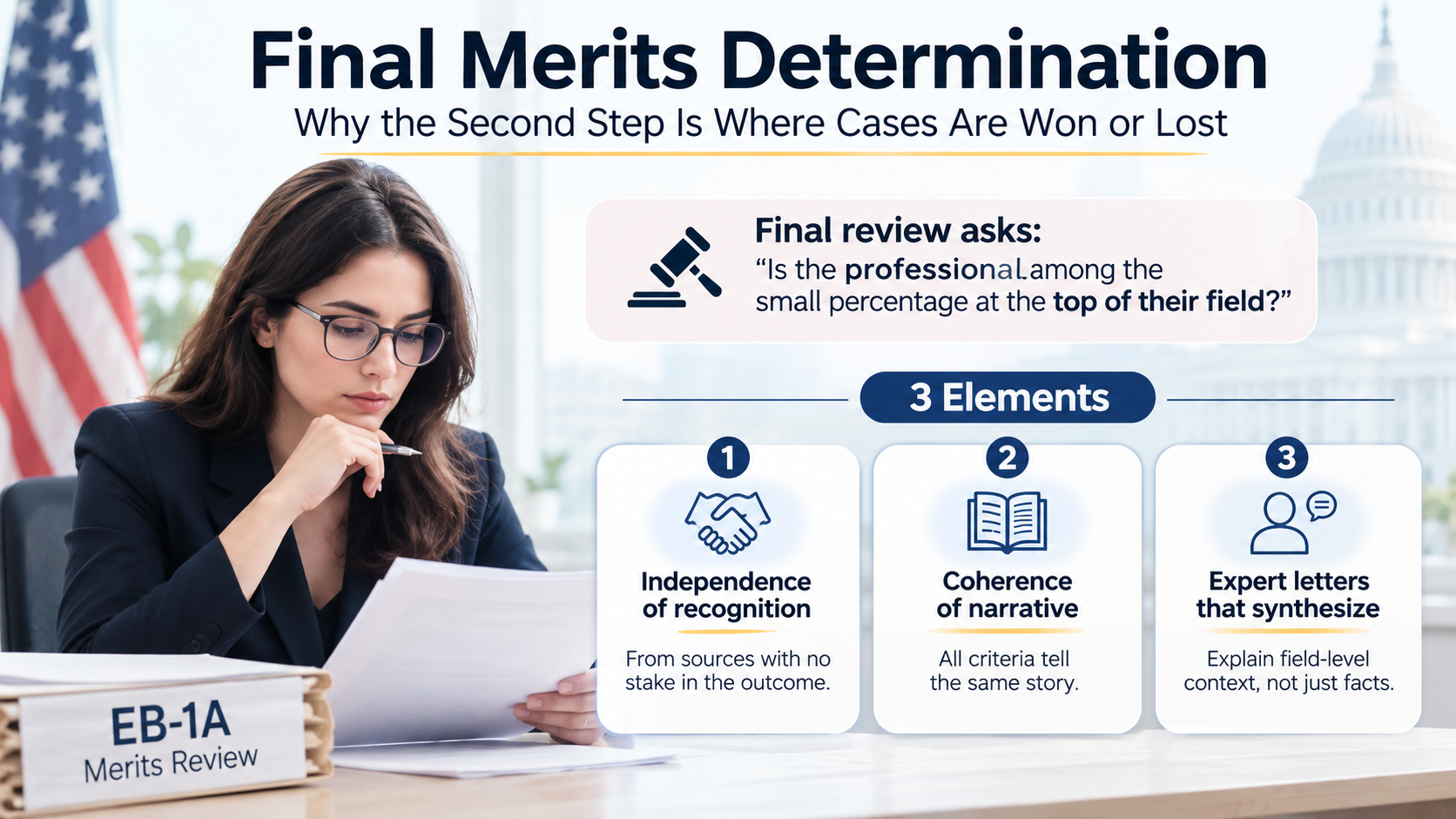
The final merits review asks a different question than the threshold review. It is not “did this evidence technically satisfy these criteria?” It is “does this evidence, as a whole, establish that this professional is among the small percentage at the top of their field?”
Three elements consistently strengthen final merits findings:
Independence of recognition. Evidence from sources with no professional or financial stake in the petitioner’s outcome carries substantially more weight than evidence from colleagues, employers, or collaborators. The more independent the source of recognition, the more credible the evidence.
Coherence of narrative. Criteria that all point toward the same story this professional is sought out for their expertise, compensated above peers, and trusted to evaluate others’ work create a mutually reinforcing argument. Criteria that point in different directions create ambiguity.
Expert letters that synthesize, not summarize. The most effective letters in EB-1A petitions explain the field-level context of the petitioner’s recognition, not just the recognition itself. A letter that explains why being invited to serve on a specific grant panel reflects extraordinary standing in the field is more valuable than a letter that simply confirms the petitioner served on it.
Frequently Asked Questions
What are the 10 EB-1A criteria?
The ten regulatory criteria are: (1) nationally or internationally recognized prizes or awards; (2) membership in associations requiring outstanding achievement; (3) published material about the petitioner; (4) judging the work of others; (5) original contributions of major significance; (6) authorship of scholarly articles; (7) artistic exhibitions or displays; (8) critical or leading role in distinguished organizations; (9) high salary or remuneration; (10) commercial success in the performing arts. At least three must be satisfied as a threshold.
How many EB-1A criteria do I need?
At least three. Satisfying three clears the threshold and triggers the final merits determination, which evaluates the totality of evidence. There is no additional benefit to claiming more criteria if the additional evidence is weak three strong criteria outperform six thin ones in final merits.
What is the Kazarian standard?
The Kazarian standard comes from the Ninth Circuit's 2010 decision in Kazarian v. USCIS and requires a two-step adjudication: threshold review of individual criteria, followed by a final merits determination evaluating whether the totality of the record demonstrates sustained national or international acclaim. Officers cannot conflate the two steps or demand criteria that aren't listed in the regulations.
What is "sustained national or international acclaim"?
Sustained acclaim means the recognition has been ongoing rather than isolated to a single event. National acclaim means the recognition reaches a national level not just within one organization or local area. International acclaim is a higher bar but not required. The evidence should show a consistent pattern of peer recognition, not a one-time achievement.
Which EB-1A criteria are easiest to prove?
Judging (Criterion 4), critical or leading role (Criterion 8), and high salary (Criterion 9) are the most consistently accessible across STEM, business, and technology. Judging can be deliberately built through systematic peer review and conference committee participation. Critical role is often documentable with existing career evidence. High salary requires comparative analysis but is a documentation task rather than an achievement task.
Can I qualify for EB-1A without any awards?
Yes. Criterion 1 (prizes and awards) is one of ten and not required. Many successful EB-1A petitions are built entirely on combinations of critical role, salary, judging, publications, and original contributions. The criteria are flexible; the evidence requirements within each criterion are not.
What if I only meet two criteria?
Two criteria technically fail the threshold. Options: build a third criterion through deliberate professional activities (judging is the most accessible), reassess whether existing evidence satisfies a criterion with better documentation and framing, or evaluate whether the EB-2 NIW is a more appropriate filing at the current stage of the career.
Can I file EB-1A and EB-2 NIW together?
Yes. Pursuing both simultaneously is a common and often strategic approach. An NIW I-140 filed first establishes an early priority date that can be ported to the EB-1A petition when it is filed. For Indian applicants especially, the EB-1 India queue is several years shorter than the EB-2 India queue, making this dual-track approach valuable.
How long does EB-1A adjudication take?
Standard processing for Form I-140 under EB-1A currently runs several months depending on service center. Premium processing is available with a 15-calendar-day guarantee for a decision shorter than the 45-business-day window for NIW petitions.
What is the difference between EB-1A and EB-1B?
EB-1A is for extraordinary ability in any field and is self-petitioned no employer required. EB-1B (Outstanding Researcher or Professor) requires employer sponsorship and applies specifically to research and academic positions. EB-1A is more flexible; EB-1B has a more defined evidentiary standard tied to academic and research activity.
Does EB-1A have a priority date backlog for India?
Yes, though the EB-1 India queue is significantly shorter than the EB-2 India queue. As of 2026, the EB-1 India Final Action Date is in the late 2022 range, representing roughly a 3–4 year wait from a current filing substantially shorter than the 12+ year EB-2 India backlog. This differential makes EB-1A strategically valuable for Indian professionals who qualify.