

EB-2 NIW for Advanced Degree Holders: When Your PhD Is Not Enough
The most common misconception about EB-2 NIW for PhD holders from academic and research backgrounds is also the most damaging one: that an advanced degree particularly a PhD from a well-ranked institution satisfies the threshold for approval. It does not. Understanding the actual EB-2 NIW advanced degree requirements means understanding a fundamental distinction: the degree establishes eligibility to apply. It does not establish the national importance of the proposed work, and it does not demonstrate that the petitioner is well-positioned to advance an endeavor that matters to the United States.
This article addresses the specific ways advanced degree holders, particularly in research and academic settings, misread the evidentiary standard and how to build a petition that actually converts credentials into approvable argument.
What a PhD Actually Does (and Doesn’t Do) for an NIW Petition
The EB-2 classification requires either an advanced degree or exceptional ability in the sciences, arts, or business. A PhD satisfies the degree requirement cleanly. The petitioner has cleared the threshold and can proceed to the Dhanasar three-prong analysis.
That is where the PhD’s role ends.
From Prong 1 onward, USCIS evaluates the proposed endeavor and the petitioner’s positioning to advance it. The degree is background context, not evidence. A petition that leads with the prestige of the institution, the difficulty of the program, or the seniority of the supervisors has not yet begun to satisfy the standard that matters.
The distinction that changes how advanced degree holders should approach the filing:
-
- The degree answers the question ‘does this person qualify for the EB-2 category?’ Yes, with an advanced degree. Done.
-
- The petition answers the question ‘does this person’s proposed work benefit the United States at a national level, and are they positioned to carry it out?’ This requires evidence entirely separate from the degree itself.
Most PhDs who receive RFEs or denials are not rejected because of their credentials. They are rejected because their petitions were built around credentials rather than around the proposed work’s impact and the petitioner’s specific positioning to advance it.
The Evidence USCIS Evaluates for Academic and Research Profiles
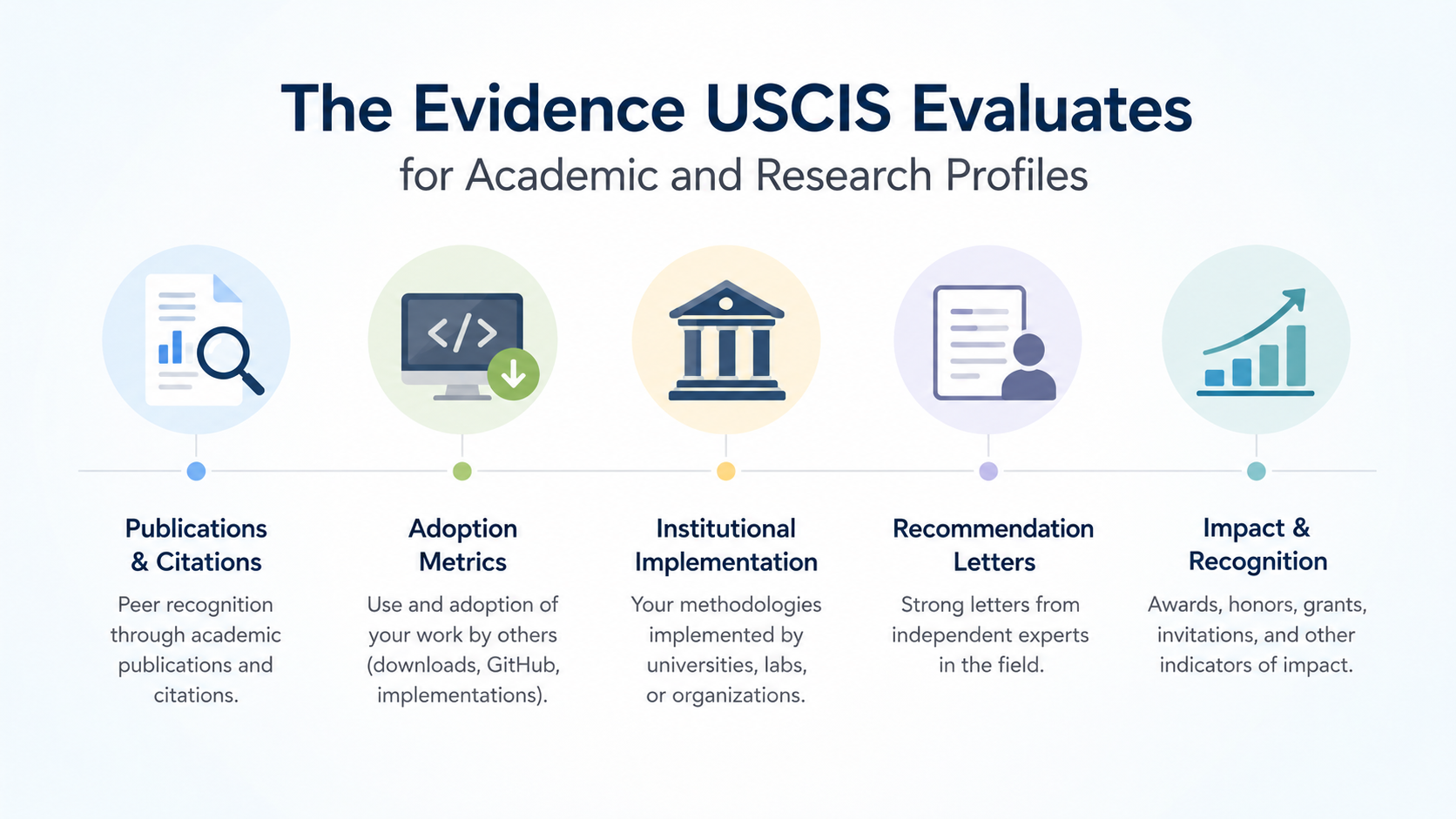
For advanced degree holders coming from research or academic backgrounds, the evidence landscape has both familiar categories and important nuances.
Publications and Citations: What They Actually Demonstrate
Academic publications and citations serve Prong 2 well-positioned by documenting that the petitioner has done credible work in the relevant field and that peers have found it worth engaging with. What they do not automatically establish is national importance.
The common mistake: building the entire Prong 1 argument from publication metrics. A high citation count demonstrates field recognition, not national-level benefit. An officer evaluating a petition dense with publication lists and h-index figures is being given Prong 2 evidence for a Prong 1 argument the wrong tool for the job.
The qualities of citation evidence that matter most: independence of citing works, relevance of the citing journals to the claimed field, and whether the citations reflect the specific subfield of the proposed endeavor. A researcher with 200 citations in a subfield unrelated to their proposed endeavor has weaker Prong 2 positioning than one with 40 citations directly relevant to the endeavor’s core problem.
Adoption Metrics: The Forward Looking Evidence Category
For researchers whose citation records are modest particularly early career applicants adoption metrics are often the most strategically valuable evidence category. Unlike citations, which are retrospective, adoption metrics demonstrate that other researchers, institutions, or organizations have found the work valuable enough to actively use it.
In technical fields, adoption metrics include:
-
- Open-source repository metrics: GitHub stars, forks, and downstream repositories that have incorporated the petitioner’s code or methodology
-
- Download counts: software packages, datasets, or tools with documented third-party usage
-
- Institutional implementation: documented use of the petitioner’s methodologies by research groups at universities, government labs, or commercial organizations
-
- Invited adoption: other research groups specifically choosing the petitioner’s approach over available alternatives, with documentation of why
These metrics serve Prong 2 by demonstrating traction and momentum the Dhanasar decision explicitly names the “interest of potential users or other relevant entities” as a factor in the well-positioned analysis. They also contribute to Prong 1 when they demonstrate that the work’s benefit is reaching other organizations, not confined to a single lab or employer.
For non-STEM researchers and practitioners, the equivalent evidence categories are documented adoption of frameworks, methodologies, or programs by other organizations; letters of interest from stakeholders; investor validation; and signed agreements with implementing partners.
Recommendation Letters: The Evidence Category Most Underutilized by Academics
Academics often approach recommendation letters as they would letters for academic appointments: written by senior colleagues in the same subfield, emphasizing the petitioner’s scholarly standing. For NIW purposes, this approach produces letters that serve Prong 2 modestly and Prong 1 barely at all.
The distinction between a useful recommendation letter and a transformative one:
-
- Useful: a senior professor describes the petitioner’s research quality and technical ability
-
- Transformative: an independent expert connects the petitioner’s specific contributions to a documented national priority an NIH strategic plan, a DARPA research agenda, an NSF-identified gap and explains why waiving the standard employment process serves the public interest
The most effective letters in academic NIW petitions come from: government researchers or agency officials who can speak to the national relevance of the work, independent scientists at peer institutions who can describe the field-level influence of the petitioner’s contributions, and industry practitioners who can explain why the academic work translates into applied national-level value.
Why Strong Academics Still Receive RFEs and Denials
Several patterns appear consistently in academic profile denials that are unrelated to the quality of the underlying research.
Leading with credentials, not impact. The petition front-loads degree achievements, prestigious institutional affiliations, and a long publication list before ever stating what the petitioner will do in the United States and who will benefit. By the time the proposed endeavor appears, the officer has been given a biography, not an argument.
Conflating substantial merit with national importance. A technically sophisticated piece of research that advances the literature in a specific subfield has substantial merit. It does not automatically have national importance unless the petition demonstrates that its benefit extends to a national level with a portability mechanism and a federal priority anchor. Many academic petitions establish the former and assume the latter.
Abstract proposed endeavors. “To continue my research in computational biology at a U.S. university” is a location and an activity, not an endeavor. Officers cannot evaluate it against the Dhanasar standard because it describes neither the specific problem being addressed nor any mechanism of national benefit.
Mismatched evidence and endeavor. A petitioner who describes a proposed endeavor in applied AI health diagnostics but whose publications are primarily in theoretical machine learning has a coherence problem. The evidence argues for one kind of positioning; the endeavor argues for a different one.
Prong 3 treated as self-evident for academics. Senior researchers sometimes believe that USCIS will infer that a job offer would be impractical for a researcher pursuing independent work. The petition must still state and support the Prong 3 argument explicitly.
The Two Layer Explanation: Technical and Layman’s Impact
One of the most practical and underused strategies in academic NIW petitions is drafting the national importance argument in two distinct registers: a technical layer and a layman’s layer.
USCIS officers adjudicating NIW petitions are not field specialists. An officer reviewing a petition about hypersonic propulsion, computational genomics, or distributed cryptographic systems must be able to evaluate the claim that the work has national importance. If the petition explains the work only in the technical vocabulary of the field, the officer must either rely on expert letters or make assumptions. Both outcomes create risk.
The technical layer establishes that the work is real, sound, and specialized. It demonstrates Prong 2 positioning the petitioner has genuine domain expertise. It uses field-specific terminology, cites peer-reviewed support, and demonstrates that the methodology is credible.
The layman’s layer translates the technical work into national-level benefit that a non-specialist can understand and credit. It serves Prong 1 national importance. It explains who benefits beyond the petitioner’s institution, how the work connects to a recognized federal priority, and what the country gains specifically.
The critical rule: the layman’s explanation must follow the chain of effects explicitly. Every inferential step between the technical work and the national benefit must be stated in the petition. Officers are not expected to fill in logical gaps; they are evaluating what the petitioner has argued.
The table below illustrates what weak framing and strong layman-layer framing look like across different fields.
| Field | Weak Framing (Narrow) | Strong Framing (National Impact) |
| Cybersecurity | I will develop AI-driven encryption algorithms for private client databases. | Strengthening infrastructure resilience across regional healthcare networks, protecting patient data and national public trust. |
| Civil Engineering | I will provide structural consulting services for local construction firms. | Addressing the shortage of licensed engineers in underserved regions to support national infrastructure safety and compliance. |
| Supply Chain / Logistics | My platform will increase efficiency for individual shipping clients. | Improving supply chain transparency to strengthen national economic resilience and reduce systemic vulnerabilities. |
| Healthcare Research | I will manage a clinical program and treat patients locally. | Driving innovation in health delivery systems that address documented national challenges and can be scaled across U.S. healthcare networks. |
| Aerospace / STEM | I am developing numerical methods for hypersonic airflow calculation. | Maintaining U.S. technological leadership and national security by advancing knowledge essential to hypersonic and civil space competitiveness. |
In each strong example, the framing moves from “what I do” to “what changes for the country as a result.” The technical work is the same. The argument structure is different.
Industry Researchers vs. Academic Researchers
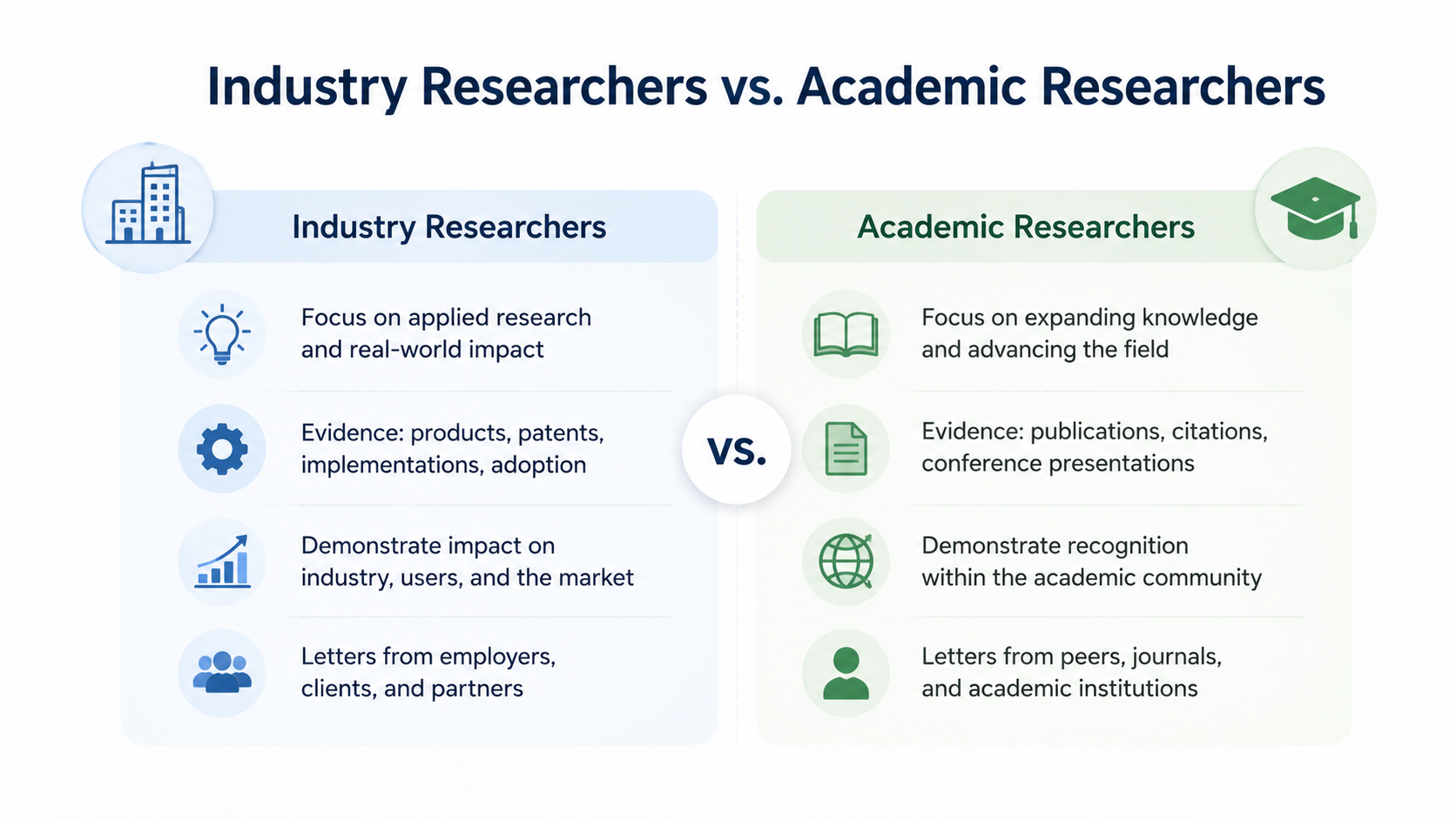
An important distinction that NIW petitions sometimes miss: the evidentiary path for an industry researcher differs from that of an academic researcher, even when both hold PhDs and work in the same technical field.
Academic researchers typically demonstrate impact through publications, citations, conference presentations, peer recognition, and grant funding. The chain of effects from academic research to national benefit often runs through industry adoption, policy influence, or applied deployment pathways that must be explicitly argued.
Industry researchers often lack academic publication records but have deployment evidence, commercial impact data, and sector-level influence. Their challenge is the reverse: the work has demonstrable real-world value but the petition must explain why that value reaches a national level rather than simply benefiting the employer.
The strongest petitions from industry researchers use:
-
- Deployment records showing the work is used outside the petitioner’s organization
-
- Patent filings with demonstrable industry adoption
-
- Standards participation involvement in technical standard-setting bodies that set industry-wide practice
-
- Federal contracts or government interest letters that validate the national-level relevance of the research
A hybrid approach, where an industry researcher also publishes or contributes to open research outputs, provides both academic credibility and deployment evidence often the strongest evidence package for Prong 2.
Early Career Researchers: The Forward Looking Advantage
One of the most important features of the Dhanasar framework for early-career applicants is that it is explicitly prospective. Prong 2 evaluates whether the petitioner is positioned to advance the proposed endeavor not whether they have already done so at an extraordinary level.
This means that an early career researcher with a limited publication record can build a credible Prong 2 case if they can demonstrate:
-
- A specific, credible proposed endeavor with a clear execution pathway
-
- Forward-looking traction evidence adoption metrics, institutional interest, deployment history
-
- Alignment of the proposed work with federally documented national priorities (NIH, NSF, DOE, DARPA, NIST, or equivalent)
-
- Expert validation from independent researchers who can speak to the field’s need for the specific contribution
For early-career applicants, adoption metrics and policy alignment often carry more weight than citation counts because they speak to trajectory and future benefit, which is precisely what the standard measures. A software tool downloaded 40,000 times by researchers at credible institutions makes a stronger Prong 2 argument than a citation count of 15, even though the citation is the more traditional academic signal.
The risk for early-career filers is filing too early, with a proposed endeavor that reads as aspirational rather than grounded. The proposed work must have enough concrete execution infrastructure to be credible under Prong 2 institutional access, collaborators, funding, or at minimum a specific and documented plan with realistic milestones.
Not sure whether your research profile is ready? Get a free research profile evaluation from Immignis and find out where your record stands against current adjudication standards.
How to Strengthen an Academic Profile Before Filing
For advanced degree holders whose current record would not support a strong petition, deliberate profile-building over a reasonable period can meaningfully improve the case. The activities below produce evidence that matters under the Dhanasar standard, not just credentials on a CV.
Publications Targeting Influence
Publishing specifically in journals or venues where work is likely to be cited by applied practitioners, not just academic peers, creates stronger Prong 1 evidence. A paper cited by engineers, clinicians, or policy researchers at institutions outside the petitioner’s field is better evidence of portable national benefit than a paper cited only within one theoretical subfield.
Open-Source and Technical Outputs
Releasing research code, datasets, or tools publicly with proper documentation creates adoption metric potential. A well-maintained GitHub repository that other researchers use and build on can develop into one of the strongest Prong 2 evidence categories available.
Federal Alignment
Identifying the specific agency strategy, grant program, or legislative framework most relevant to the research area, and aligning publications and subsequent work to address those priorities explicitly, creates the federal anchor that most petitions lack. Applying for SBIR, STTR, NIH R21, NSF SBIR, or DARPA proposals even if not awarded creates a documented record of engaging with federal priorities.
Cross Institutional Collaboration
Collaborations with researchers at other universities, national laboratories, or government research agencies create evidence that the work’s significance is recognized outside the petitioner’s own institution. These collaborations also produce potential recommendation letter sources who are genuinely independent.
Building Toward Expert Letter Writers
The most valuable recommendation letters come from people who understand both the technical work and the national level context and who have no professional or financial stake in the petitioner’s outcome. Building relationships across institutional lines, attending conferences where government researchers and agency officials are present, and contributing to federal research programs all create the connections that produce letters in this category.
Evidence Mapped to the Dhanasar Standard
The table below maps the evidence categories most relevant to advanced degree holders across the specific Dhanasar prongs they serve.
| Evidence Type | Primary Prong Served | When It Carries Weight |
| Academic publications and citations | Prong 2 (well-positioned) | Quality and independence of citing works; field relevant journals; not raw count alone |
| Adoption metrics (downloads, forks, implementations) | Prong 2 + Prong 1 | Especially strong for early-career researchers; quantified third-party use by credible institutions |
| Expert recommendation letters | Prong 1 + Prong 2 | Independent, specific, field-bridging to national-level significance |
| H-1B specialty occupation history | Prong 2 (positioning) | Demonstrates active contribution to a nationally important sector |
| Business plan / execution roadmap | Prong 2 (for entrepreneurs/practitioners) | Specific milestones, realistic timeline, partnerships; not a generic template |
| Letters of interest from partners or users | Prong 1 (portability + demand signal) | Third-party validation from entities with no stake in the petitioner’s immigration outcome |
| Media and trade press coverage | Prong 1 (national significance) | Substantive coverage treating petitioner as a field authority |
| Federal grants or government citations | Prong 1 (national importance anchor) | Strongest single category; direct government validation of the work’s national relevance |
| Industry leadership / advisory roles | Prong 2 (recognition) | External organizations; not self-designated titles |
A petition built from the right column in this table, with evidence selected for each prong rather than assembled indiscriminately, produces the coherent argument structure that survives scrutiny.
Frequently Asked Questions
Is a PhD enough for an EB-2 NIW petition?
Why do PhD holders get NIW denials?
Can a master’s degree professional qualify for EB-2 NIW?
How many citations are enough for an NIW petition?
What are adoption metrics in NIW petitions?
Does USCIS care more about impact than degrees?
Can industry researchers qualify for NIW without academic publications?
What is the technical vs layman’s explanation strategy for NIW?
How should early-career researchers approach an NIW filing?
Should academic researchers submit a business plan for NIW?
Credentials open the door to the NIW category. Building the argument that wins approval is a different kind of work. Book a strategic NIW consultation with Immignis for a profile assessment that evaluates your research record against current adjudication standards and identifies the evidence architecture your petition needs.



Comment
EB-2 Exceptional Ability vs Advanced Degree: Best NIW Route
August 31, 2026 - 6:47 am[…] EB-2 exceptional ability vs advanced degree is the first distinction professionals should understand when evaluating whether they qualify for an EB-2 National Interest Waiver. Most start from a single assumption: that a PhD or master’s degree is the entry point. That assumption misses one of the two qualifying pathways. This distinction matters significantly, not because the pathways lead to different outcomes, but because the exceptional ability route is genuinely available to senior professionals, entrepreneurs, engineers, healthcare practitioners, and industry leaders who have built expert level standing through experience, recognition, and documented impact rather than graduate-level credentials. […]