
EB-1A Extraordinary Ability: The Evidence That Makes or Breaks Cases
Every EB-1A petition lives or dies in the final merits determination where officers evaluate not whether criteria were technically checked off but whether the evidence, read as a whole, demonstrates sustained national or international acclaim. The most consequential insight in building a strong petition is not which criteria to claim. It is understanding what EB-1A evidence actually persuades an officer at the merits level, and what fills pages without moving the case.
This guide draws the distinction between evidence that carries weight and evidence that doesn’t, shows how framing the same achievement differently produces different adjudicative outcomes, and explains how officers psychologically read and credit a petition package.
How USCIS Weighs Evidence: Threshold vs Final Merits
Two separate questions govern how officers evaluate each piece of evidence, and most petitions confuse them.
Threshold question: Does this evidence technically satisfy the claimed criterion? An invitation to review a journal article technically satisfies the judging criterion. A certificate from an organization’s open admission membership technically satisfies the membership criterion. This is a binary assessment yes or no.
Final merits question: Does this evidence, in the context of the whole record, demonstrate that this professional stands among the small percentage at the top of their field? An invitation from an editorial board that independently identified the petitioner through publication searches demonstrates that the field recognizes their expertise. A mass recruiter email from a journal database demonstrates ordinary professional activity at best.
The gap between these two questions is where most denials occur. A petition can check every threshold box and still fail because the evidence, collectively, describes a competent senior professional rather than someone with extraordinary standing. Officers are trained to hold both questions simultaneously and when they sense a petition is built to satisfy the threshold without building the merits case, that suspicion shapes how they read every subsequent piece of evidence.
Understanding this distinction changes how evidence is selected, documented, and presented from the first page.
Why Some Evidence Helps and Some Actively Hurts
Evidence that passes threshold review can actually damage the final merits case when it signals that the petitioner’s evidence is being stretched or inflated.
Consider open-admission memberships. Including a general professional membership under Criterion 2 technically claims the criterion and then invites the officer to evaluate whether the admission standard genuinely required outstanding achievement. When it didn’t, the officer is now looking at a petition that misrepresents ordinary professional activity as extraordinary recognition. That skepticism extends to everything else in the package.
The same effect applies to awards from the petitioner’s own organization, salary evidence without comparative context that turns out to be slightly above average, and media coverage that is clearly self-generated. Each of these passes threshold review on a technical reading and simultaneously tells the officer something about the quality of the overall case.
The principle: every piece of evidence either supports or undermines the coherence of the final merits argument. Weak evidence doesn’t just fail to add; it actively costs.
The practical implication: it is almost always better to claim three criteria well than to claim five criteria where two are thin. The two thin criteria signal to the officer that the petitioner was stretching.
The Same Achievement, Framed Two Ways
The most important insight in EB-1A evidence strategy is that the same career fact can satisfy or fail to satisfy a criterion depending entirely on how it is documented and framed. Below are real examples across common evidence categories.
Judging Two Documentation Approaches
Weak version: “Dr. [Name] has reviewed articles for several journals in the field of computational biology.”
Supporting documentation: a list of journals the petitioner has reviewed for, with no documentation of the invitation process, the journals’ impact factors, or how the petitioner was identified.
What the officer sees: The petitioner reviews papers. Many credentialed professionals do this. Nothing here suggests the field specifically sought this person out.
Strong version: “Dr. [Name] has served as a peer reviewer for [Journal A] (impact factor 8.4, top-10 cited journal in computational biology per Clarivate) and [Journal B] (impact factor 6.2), each of which independently identified Dr. [Name] through publication search after her 2021 paper on genomic sequence modeling garnered 340 citations. Documentation includes the invitation correspondence from each editor identifying this selection process, along with confirmation of 14 completed reviews over 18 months.”
Supporting documentation: invitation letters, completed review confirmation, journal impact rankings, the citation record that triggered the invitations.
What the officer sees: A field specific journal with documented prestige independently identified this petitioner as a qualified reviewer based on her recognized prior work. That is what extraordinary standing looks like in practice.
Critical Role Two Documentation Approaches
Weak version: “As VP of Engineering at [Company], [Petitioner] led a team of 45 engineers and was responsible for the company’s core platform infrastructure.”
Supporting letter: employment verification from HR describing the role title and general responsibilities.
What the officer sees: A senior title. Many companies have VPs of Engineering. This does not establish that this specific person was critical to organizational success.
Strong version: “[Petitioner] was the sole architect of [Company]’s real-time fraud detection infrastructure, which processes $4.2 billion in annual transaction volume. In 2022, when [Petitioner] identified a zero-day vulnerability 11 days before a planned major deployment, their decision to halt and re-engineer the authentication layer prevented what our security team later estimated as $200-400M in potential fraud exposure. No other engineer on the team had the combination of cryptographic expertise and systems architecture background to have made that assessment. [Petitioner]’s departure would have required us to either halt the platform or operate with materially elevated risk for an estimated 18-24 months while a replacement was recruited and onboarded.”
Supporting documentation: technical records of the incident, a board level memo acknowledging the outcome, the executive VP’s letter that includes this specific narrative.
What the officer sees: A specific, verifiable instance where this person’s unique expertise was critical to organizational survival. This is what organizational reliance means.
Salary Two Documentation Approaches
Weak version: Total compensation statement showing $380,000 for a senior software engineer in Seattle.
What the officer sees: An absolute figure. Without context, this is unassessable. Is $380K high for this occupation and market? The officer doesn’t know, and it is not their job to research it.
Strong version: Total compensation statement showing $380,000, accompanied by:
-
- BLS Occupational Employment and Wage Statistics for SOC Code 15-1252 (Software Developers) in the Seattle-Tacoma-Bellevue MSA, showing the 90th percentile wage at $189,250 base
-
- Levels.fyi data for senior software engineers at the company’s peer-group companies, showing P90 total compensation at $340,000-$360,000
-
- A one-page analysis explaining that the petitioner’s total compensation (base + RSU + bonus) of $380,000 places them above the 90th percentile for the occupation and market
-
- A letter from an independent compensation consultant confirming the analysis and contextualizing the figure
What the officer sees: Compensation at the 90th+ percentile for the relevant occupation and geographic market, documented against multiple independent data sources and verified by an expert. Criterion 9 satisfied cleanly.
Evidence That Consistently Moves EB-1A Cases

Across criteria and professional backgrounds, the evidence that most consistently advances final merits cases shares one defining characteristic: it comes from independent sources with no professional or financial stake in the petitioner’s outcome, and it contextualizes the petitioner’s standing relative to field norms.
Substantive peer review invitations from indexed journals. Not mass-recruited database invitations direct invitations from editors who identified the petitioner’s expertise through publications or professional reputation. These demonstrate that the field’s gatekeepers recognize the petitioner’s standing.
Expert features and profiles in respected publications. Articles where the publication sought out the petitioner as an authority, not pieces the petitioner submitted or that their organization arranged. The difference is visible in the article itself: was the petitioner interviewed, or did they submit?
Adoption and deployment records with named third parties. For original contributions, the most persuasive evidence names specific organizations, research groups, or institutions that implemented the petitioner’s methodology with documentation of the adoption. Generic claims of “widespread adoption” carry far less weight than a list of five named institutions with letters confirming use.
High-authority expert letters that synthesize, not summarize. The strongest letters explain the field-level context of the criteria evidence. Not “Dr. [Name] is a recognized leader in the field” but “The fact that [Journal] sought Dr. [Name] as a reviewer while she was still a junior researcher signals something unusual [Journal] rarely invites reviewers without 10+ years of publication history in the specific subfield. Her inclusion in that pool reflects the degree to which her 2020 paper became a reference point for the field.”
Government validation. Federal grants, citations in agency reports, advisory appointments to government panels, or letters from federal program officers carry significant weight because they represent validation by entities whose mandate is national benefit precisely what the final merits determination is evaluating.
Evidence Patterns That Trigger RFEs or Fail Final Merits
The following patterns appear consistently in petitions that technically pass the threshold and then fail or receive RFEs during final merits review.
Open-admission memberships submitted as Criterion 2. Officers can identify organizations with selective admission from those with open admission. A general professional membership certificate without documentation of the admission criteria signals that the petitioner is stretching.
Salary documentation without comparative analysis. Submitting pay stubs without establishing what the field considers above-median compensation is the most common Criterion 9 failure. The absolute figure is unassessable without context.
Awards from the petitioner’s organization. “Employee of the Year” and internally-generated recognition do not satisfy Criterion 1. Officers look for selection by panels external to the petitioner’s organization.
Critical role letters describing job scope rather than organizational reliance. A letter that lists the petitioner’s responsibilities without explaining what specifically the organization would have lost without them describes employment, not extraordinary standing.
Generic expert letters. Letters that describe the petitioner as “exceptional,” “among the best,” or “widely recognized” without specific examples are recognized and discounted. One letter with three specific, verifiable examples carries more weight than five letters with general praise.
Evidence volume without coherence. A large exhibit package where the criteria point in different directions creates fragmentation rather than strength. Officers are looking for a coherent picture of above average standing, and a disorganized package makes that picture harder to form.
Evidence by Criterion: What Carries Weight and What Doesn’t
| Criterion | Evidence That Carries Weight | Evidence That Doesn’t |
| Prizes/Awards | Major competitive awards with documented selection criteria, independent judging panels, national/international reach | Internal company recognition, participation awards, awards from organizations with open or unclear admission |
| Memberships | Elected fellowships, committee leadership in selective organizations with documented outstanding-achievement admission | General professional memberships open to any qualified practitioner |
| Published material | Feature coverage where publication independently sought petitioner as authority; profiles in respected trade/professional/academic outlets | Press releases, submitted byline articles, company blog posts, tangential mentions |
| Judging | Peer review for indexed journals where petitioner was independently identified; competitive conference review; major grant panels | Mass-database review recruitment; competitions with no documented selectivity; internal review processes |
| Original contributions | Highly cited work with citation context; patents with named industry adoption; deployed methodologies with third-party verification letters | Publications without citation evidence; patents without adoption documentation; internal innovations without external impact |
| Scholarly articles | Peer-reviewed work in indexed journals; substantive analytical pieces in respected trade publications with documented readership | Blog posts, self-published work, articles without editorial review |
| Critical role | Letters specifically establishing organizational reliance, naming what would have been lost or compromised without the petitioner | Job description letters listing responsibilities without establishing criticality or consequences |
| High salary | Total compensation with BLS percentile analysis and supplementary industry survey data | Pay stubs or offer letters without comparative field context |
Evidence Examples by Professional Profile
Researchers and Scientists
The natural evidence architecture for researchers is Criteria 5 (original contributions), 6 (scholarly articles), and 4 (judging) but the execution details matter.
For Criterion 5, citation count without context is the most common weakness. An h-index of 14 or 200 citations means different things in particle physics versus applied machine learning versus clinical medicine. The evidence must establish what the citation level means in the specific subfield. An expert letter from a senior researcher in the same subfield who explains “In this area, a paper with 340 citations within three years of publication places it in the top 5% of published work” provides the context that makes the citation data meaningful.
For Criterion 6, the indexing status of the journals matters. Papers in unindexed or predatory journals do not satisfy the criterion meaningfully. PubMed, Web of Science, Scopus, and equivalent indexing for the specific field is what USCIS looks for.
For Criterion 4, the journals where the petitioner reviews should overlap with the journals where the petitioner publishes. A reviewer for neuroscience journals who is filing EB-1A based on a machine learning career creates a coherence problem.
Senior Engineers and Technical Leaders
For engineers, the three-criterion combination of Criterion 8 (critical role), Criterion 9 (salary), and Criterion 4 (judging) is often the cleanest path but Criterion 8 is where most engineering petitions succeed or fail.
The critical test for Criterion 8 in engineering: can the petitioner describe a specific technical decision that had organizational-level consequences, that required expertise no one else in the organization possessed, and that another engineer would have made differently or not made at all? If yes, the criterion can be built around that specific example. If every project described could have been done by any senior engineer with the relevant stack, the criterion will not survive final merits.
For engineers with patents, Criterion 5 is available but only with adoption evidence. A patent that was filed and never deployed or cited is a legal document, not evidence of major significance. Named licensees, GitHub repositories built on the patent, or industry implementations documented by third parties transform the patent into genuine Criterion 5 evidence.
Executives and Business Leaders
Executives face a specific challenge: the most impressive-sounding titles are also the most commonly claimed, and officers review many petitions from VPs, directors, and C-suite officers. Title alone does not establish a critical role.
For executives, the most effective Criterion 8 documentation is outcome-based rather than role-based. The letter that describes the petitioner’s title and responsibilities is weaker than the letter describing a specific strategic decision a market entry, a product pivot, a risk management call and its measurable organizational consequence. The more the letter reads as a business case study rather than a job reference, the more effectively it establishes critical standing.
For Criterion 3 (media coverage), executives often have the most accessible path to published material. Industry publications regularly profile executives, especially around significant company milestones, strategic moves, or market developments. A proactive outreach campaign to two or three respected industry publications with a substantive narrative not a press release can produce genuine Criterion 3 evidence within a few months.
Startup Founders
Founders occupy a unique position under Criterion 8: the founder role is inherently critical to any organization they created, making the “organizational reliance” question easier to establish. The challenge shifts to demonstrating that the organization itself is distinguished.
Evidence of organizational distinction for startups: credible venture funding with named institutional investors, acceptance into competitive accelerators with documented acceptance rates, significant customer or revenue traction, media coverage treating the company as a significant player in its market, and industry awards or rankings recognizing the company. The organization’s distinction supports the critical role; the founder’s role supports the petitioner’s personal standing.
For founder salary evidence under Criterion 9, equity compensation requires particular documentation. An independent valuation of the equity stake, tied to the most recent funding round’s implied valuation, combined with base compensation creates a documentable total remuneration figure.
How to Build Missing Evidence Strategically
When an existing record does not yet satisfy three criteria with strong documentation, the question is which activities produce the most usable evidence most efficiently.
Highest return on time investment:
Judging history is the most deliberately buildable evidence category. Contact two to three editorial boards of indexed journals in your specific subfield not your general field and express interest in serving as a reviewer. Most journals with active publication pipelines will respond positively to credentialed researchers or senior practitioners. Begin attending and presenting at the one or two conferences most central to your subfield, then volunteer for the program review committee. This activity is substantively valuable independent of its immigration purpose and creates clean, documentable evidence within 12-18 months.
Expert publications in trade outlets are achievable within 3-6 months. Identify two or three respected industry publications that regularly publish analytical pieces written by practitioners. Pitch a specific, substantive topic where you have genuine expertise and a perspective that differs from existing coverage. An accepted bylined piece in a publication with editorial standards and documented readership satisfies Criterion 3 and simultaneously positions the petitioner as a field authority.
Documentation that is often already available but not organized:
Critical role evidence frequently exists but has never been assembled as immigration documentation. Emails from leadership describing specific contributions, project retrospective documents, board meeting minutes where outcomes were credited to specific decisions, and performance reviews with outcome-specific language are often already in existence. The task is identifying which documents establish organizational reliance and organizing them around the “what would have been lost” framework.
Salary comparative analysis is a one-time research and writing task. The underlying compensation already exists; what is missing is the BLS data, the supplementary survey data, and the analytical document that situates the petitioner’s compensation in the distribution. This can be assembled in two to four weeks.
The Psychology of Persuasive EB-1A Petitions
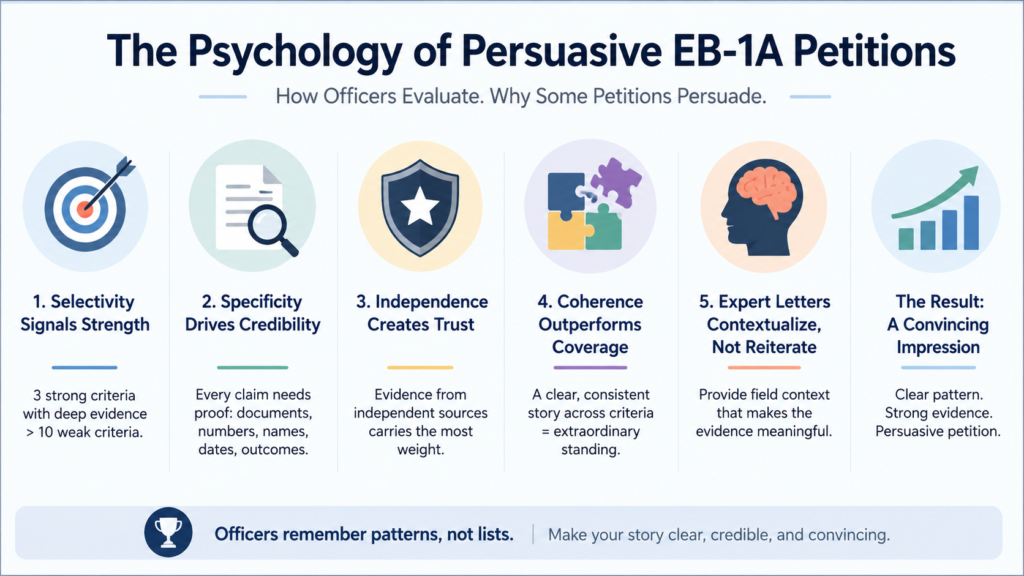
Officers reading EB-1A petitions form initial impressions quickly and look for evidence that confirms or challenges those impressions. Understanding how this reading process works helps in designing the evidence architecture.
The first credibility signal comes from how criteria are chosen. A petition that claims ten criteria with thin evidence on each signals that the petitioner was stretching to reach the threshold. A petition that claims three criteria with deep, specific, well-documented evidence signals that the petitioner was selective because the evidence is genuinely strong. Selectivity reads as confidence.
Specificity is the primary credibility driver. Vague claims “widely recognized,” “major contributions,” “significant impact” do not advance the merits case and can create skepticism when unsubstantiated. Every claim in the petition should be accompanied by something that makes it verifiable: a document, a number, a named organization, a specific date and outcome.
Independence creates trust. When an officer reads evidence from sources that have nothing to gain from the petitioner’s approval a journal editor who found the petitioner through a publication search, a government panel that invited the petitioner to review grants, a trade publication that sought the petitioner out as a source the credibility of that evidence is substantially higher than equivalent evidence from employers, colleagues, or professional contacts. Structure the evidence package so that independent sources carry the most important claims.
Coherence of narrative outperforms coverage of criteria. A petition where the judging history, the critical role, and the salary evidence all describe the same person doing the same kind of work at a recognizably above-average level creates a coherent picture. A petition where the criteria describe the petitioner as a leader in three unrelated domains creates fragmentation. Officers are pattern-matching for “extraordinary standing”; a clear, consistent pattern is easier to credit.
Expert letters should contextualize, not reiterate. The most common expert letter failure is restating evidence that the officer can already see. A letter that says “Dr. [Name] has published 28 peer-reviewed papers and has an h-index of 14” is describing what the officer already read in the exhibit list. A letter that says “An h-index of 14 within seven years of the PhD, in a field where the median h-index for assistant professors with equivalent time-in-field is 6-8, places Dr. [Name] in the top 10-15% of her cohort” is providing the field context that makes the evidence meaningful. The second letter does something the documentation alone cannot do.
Frequently Asked Questions
What evidence is strongest for EB-1A?
Evidence from independent sources with no stake in the petitioner's outcome: substantive peer review invitations from credible indexed journals where the petitioner was independently identified, unsolicited expert features in respected publications, government validation (grants, advisory appointments, citations in agency reports), quantified impact data corroborated by third parties, and high-authority expert letters that contextualize the criteria evidence within field norms.
What weak evidence causes EB-1A denial?
Open-admission memberships presented under Criterion 2; salary documentation without comparative field analysis; internally generated awards; critical role letters describing job scope rather than organizational reliance; generic recommendation letters from colleagues and supervisors; and large volumes of thin evidence without a coherent narrative.
How much evidence is enough?
There is no prescribed quantity. The final merits determination evaluates quality, independence, specificity, and narrative coherence. Three well-documented, mutually reinforcing criteria from independent sources consistently outperform six barely-satisfied criteria from internal sources.
What counts as independent recognition?
Recognition from sources with no professional or financial relationship to the petitioner. Editorial boards that selected the petitioner based on their published work. Publications that interviewed the petitioner for their expertise. Professional organizations that elected the petitioner to roles requiring documented achievement. Government agencies that awarded grants or invited advisory participation. The common thread: the recognizing entity had no obligation to recognize the petitioner and did so anyway.
What if most of my evidence comes from my employer?
Employer-generated evidence is not disqualifying, but it is consistently discounted relative to independent evidence. The typical solution is to treat employer-generated evidence as corroboration for criteria established through independent sources, not as the primary evidence for any criterion. Even one strong independent piece of evidence per criterion changes the character of the overall case.
How do I document judging properly?
Retain: the invitation letter from the editor or organization identifying you and requesting your participation; confirmation of completed reviews or panel service; any acknowledgment of your contribution from the organization; and evidence of the publication's or organization's standing (impact factor for journals, acceptance rate for conferences, funding level for grant panels). The documentation must show both that you were selected and that the selecting body is credible.
What is the best single criterion to build if I'm starting from nothing?
Judging (Criterion 4). It is the most deliberately buildable, creates clean documentation, and is inherently independent the invitation comes from an external entity. Begin with peer review requests to indexed journals in your specific subfield. A credible 12–18 month review history across two or three respected venues satisfies the criterion and simultaneously builds professional standing in the field.
How does citation count help EB-1A?
Citations support Criterion 5 (original contributions of major significance) and can contribute to Criterion 6 (scholarly articles) in the final merits context. Raw citation count matters less than citation count in context what does this number mean for this specific subfield and career stage? An expert letter from a senior field researcher explaining the citation level's significance relative to field norms transforms a raw number into evidence of major significance.
Does USCIS verify EB-1A evidence?
Officers evaluate internal credibility and consistency rather than independently verifying claims. Inconsistencies between evidence items, implausible claims, or evidence from sources whose standing is unclear are flagged. This is why documentation of the credibility context the journal's impact factor, the organization's admission criteria, the award's selection process is the petitioner's responsibility to provide. Officers do not research it independently; they evaluate what is presented.
Can recommendation letters alone satisfy EB-1A?
No. Letters support the final merits determination by contextualizing the documentary evidence and synthesizing it into a field-standing narrative. They are most effective when written by independent experts who can explain the field-level significance of the documentary evidence. A petition built primarily on letters without documentary evidence is vulnerable to skepticism about letter quality and independence.