EB-1A RFE Trends 2026: What USCIS Is Scrutinizing Most
Requests for evidence on EB-1A extraordinary ability petitions have followed a clear pattern in recent adjudication cycles: officers are not rejecting strong petitions more often, but they are scrutinizing the gap between evidence that technically satisfies regulatory criteria and evidence that actually demonstrates extraordinary standing at the final merits level. Understanding the current EB-1A RFE trends 2026 means understanding this gap and the specific evidence patterns that consistently trigger the follow-up requests that delay or derail otherwise viable cases.
This guide analyzes the three core areas drawing the most scrutiny, the evidence patterns most likely to generate RFEs across different professional profiles, and how to build and respond to cases that hold up under current adjudication standards.
Why EB-1A RFEs Are Increasing
The increase in EB-1A RFE frequency is not primarily a product of policy change. It is a product of filing volume and petition composition. As the EB-1A pathway has become more widely understood and pursued, the pool of petitions entering the queue has shifted. A higher proportion of filings arrive with evidence that satisfies the threshold criteria technically enough review invitations, a high citation count, a senior title without building the qualitative case that the final merits determination requires.
Officers reviewing these petitions face a specific adjudication question: the criteria may technically be met, but does the totality of this evidence demonstrate sustained national or international acclaim? When the answer is uncertain, an RFE is the procedural response. The frequency of that uncertainty has increased because the volume of technically-adequate-but-merits-thin petitions has increased.
A second factor is heightened scrutiny on the independence of evidence. Officers are applying more consistent analysis to whether citations, media coverage, and recognition come from genuinely independent external sources or from the petitioner’s own professional network, employer, and collaborators. Evidence that might have passed with less examination in an earlier filing environment is now evaluated more carefully against an independence standard.
The result is a specific and predictable set of RFE triggers that appear repeatedly across current adjudication patterns.
The Three Things USCIS Is Scrutinizing Most
1. Final Merits Coherence: The Narrative Gap
The most consistent current RFE pattern is not a specific criterion problem. It is a structural problem with how the evidence package tells or fails to tell a coherent story about extraordinary standing.
A petition that presents evidence for five criteria independently, without drawing an explicit argument about what that evidence collectively demonstrates, leaves the final merits evaluation to the officer’s inference. Officers are not required to assemble the argument for the petitioner. When the evidence is strong but the narrative connecting it is absent, an RFE requests clarification of what the petitioner is claiming the evidence establishes.
The specific pattern: an officer acknowledges that threshold criteria appear satisfied and then issues an RFE asking the petitioner to explain why the totality of their record demonstrates sustained national or international acclaim. This is a final merits RFE not a criterion documentation problem, but a narrative coherence problem. The response must do what the original petition failed to: synthesize the criteria evidence into an explicit standing argument, grounded in field context that explains what the evidence means relative to peers.
Expert letters are where this narrative typically gets built or fails. Letters that summarize the petitioner’s credentials rather than contextualizing them against field norms do not address the final merits question. Letters that explain specifically why a given citation record, salary level, or judging history places this professional above most practitioners in their specific area in language that makes field context legible to a generalist officer directly serve the final merits argument.
2. Independence of Recognition: The Network Problem
Officers are increasingly applying an independence analysis to the recognition evidence in EB-1A petitions. The core question: is the recognition coming from sources with no professional stake in the petitioner’s outcome, or does it primarily reflect the petitioner’s own organizational ecosystem?
This scrutiny shows up in three specific evidence categories.
Citation records: A raw citation count that includes significant self-citations, citations from co-authors, or citations from collaborators within the same research group signals provincial impact rather than field-wide recognition. Officers use the same tools researchers use Web of Science, Scopus and apply their own independence filter. When the filtered count is substantially lower than the claimed total, the petition loses credibility on the one evidence category it was relying on most heavily.
Recommendation letters: Letters from supervisors, employers, co-authors, and close professional contacts carry less weight than letters from genuinely independent experts. This is not because the writers are dishonest. It is because their professional relationship with the petitioner means they cannot credibly speak to how the broader field regards the work. A petition that consists primarily of endorsements from people with direct professional ties to the petitioner is missing the independent external validation that makes the final merits argument credible.
Media coverage: Officers are trained to identify paid placement, sponsored content, and press releases reprinted as editorial coverage. When coverage reads like marketing material language that duplicates company promotional content, disclaimers indicating commercial placement, or pieces that are clearly derived from the petitioner’s own communications it does not establish independent recognition. It raises questions about the authenticity of all other media evidence in the petition.
3. Effort vs Consequence: The Impact Measurement Problem
A third pattern that draws consistent scrutiny is what might be called the effort-consequence gap: petitions that document complex, substantial, and technically sophisticated work without demonstrating what changed in the field because that work existed.
USCIS is not primarily evaluating the difficulty of what was done. It is evaluating the consequence whether the work has been adopted, cited, implemented, built upon, or otherwise engaged with by the field in a way that establishes genuine influence above the ordinary.
The specific evidence problem: detailed technical descriptions of innovative work, accompanied by no third-party evidence that anyone outside the petitioner’s organization has engaged with, adopted, or built on that work. A sophisticated AI system, a novel clinical protocol, a proprietary platform described in technical depth but without external deployment evidence, government validation, third-party citations, or documentation of adoption at other organizations. The work may genuinely be innovative; the petition provides no evidence that the field knows it.
This gap generates RFEs that ask for documentation of impact beyond the petitioner’s own description. The response must provide what the original filing lacked: external evidence of consequence, not internal evidence of effort.
The Citation Independence Problem: A Deeper Analysis
For research and academic profiles, citation evidence is typically the primary basis for original contributions claims under Criterion 5. The independence scrutiny applied to citation records has become more specific and more consequential.
The 30% Threshold and What It Means
Practitioners have identified a practical threshold at which self-citation rates begin attracting heightened scrutiny: when self-citations and dependent citations (from co-authors, advisors, advisees, and close laboratory collaborators) exceed approximately 30% of the total citation count, officers are more likely to issue RFEs questioning whether the remaining independent count reflects genuine field-wide engagement.
The underlying concern is coherent: if a significant portion of citations come from the petitioner’s own professional circle, the citation record may be measuring network activity rather than independent field recognition. A work cited 500 times, where 300 of those citations are from co-authors, former advisors, and direct collaborators, is a different evidentiary claim than a work cited 500 times independently by researchers at diverse institutions who had no professional relationship with the petitioner.
Proactive Independent Citation Analysis
The most effective response to this risk is to address it before it becomes an RFE. A petition that proactively provides an independent citation analysis explicitly showing the total count, the dependent count, and the independent count with institutional diversity context is demonstrating transparency rather than inviting scrutiny.
A well-constructed independent citation analysis includes:
- The total citation count with source
- The methodology for identifying dependent citations (self-citations, co-author citations, citations from direct collaborators)
- The filtered independent count
- Institutional diversity evidence: the range and caliber of organizations whose researchers independently cite the work
Example framing: Dr. [Name] has received 480 total citations. Of these, 420 are from independent researchers at institutions with no professional relationship to the petitioner, including groups at [Institution A], [Institution B], and [Agency C]. The independent citation count of 420 places this work in the top 8% of publications in this subfield for the publication period, as established by field-normalized data from Web of Science.
This framing is more persuasive than a raw citation count because it anticipates the officer’s analysis and presents the evidence on terms favorable to the petition.
Evidence Patterns That Consistently Trigger RFEs

Beyond the three primary scrutiny areas, several specific evidence patterns appear repeatedly in petitions that receive RFEs.
Internal Recognition Presented as Field-Level Standing
Awards, recognitions, and accolades generated within the petitioner’s employer employee recognition programs, internal innovation awards, divisional leadership designations are employment benefits, not extraordinary ability evidence. They reflect a professional’s standing within their organization, not their standing in the field. Officers recognize these patterns and their presence in a petition can signal to the officer that the petitioner does not have sufficient external recognition.
The same applies to letters from the employer or direct supervisors that describe how valuable the petitioner is to the organization. These letters establish employment value. They do not establish field-level extraordinary standing. A petition that relies primarily on employer-generated evidence for multiple criteria is vulnerable across the entire final merits argument.
Title-Based Critical Role Claims
A senior job title is not evidence of a critical role. An officer reading a Criterion 8 claim supported only by an organizational chart showing a director-level position and a letter from HR confirming the title has received no substantive evidence of organizational reliance. What makes a role critical is documented in what would have been different in specific, measurable terms if this professional had not held it. Titles describe hierarchy; the criterion requires evidence of actual criticality.
Paid and Self-Arranged Media Coverage
The published material criterion requires independent editorial recognition coverage where the publication independently decided that the petitioner’s work was worth covering. Press releases distributed through wire services and published verbatim on aggregator sites, advertorials with placement fees, sponsored content, and company arranged profiles do not satisfy this standard. The independence of the coverage source is what gives media evidence its evidentiary value.
Data Dumping Without Narrative
A large evidence package without a coherent narrative argument is a common and specific vulnerability. Officers are not researchers; assembling the petitioner’s argument from hundreds of pages of exhibits is not their role. When the petition letter and expert letters do not explain what the evidence means and how it collectively establishes extraordinary standing, the final merits evaluation has no argument to credit.
The volume of the evidence package is not correlated with the strength of the final merits argument. A petition with 50 targeted exhibits and a clear narrative frequently outperforms one with 200 exhibits and no through-line.
Sector-Specific RFE Patterns
| Professional Profile | Primary RFE Trigger | What Works in 2026 |
| Academic researchers | Citation inflation high raw count with significant self-citation or dependent citations | Independent citation analysis showing field-wide adoption from diverse institutions qualitative citations from leading international research groups |
| AI / ML professionals | Generic field-importance claims without specific subfield differentiation | Subfield specific evidence: adoption of proprietary code, government or institutional deployment, citations from independent research groups at diverse organizations |
| Technical leaders (no PhD) | Senior title without proof of actual individual influence on outcomes | Specific technical contributions tied to measurable organizational results high compensation at or above the 90th percentile with benchmarked comparison |
| Startup founders | Projected rather than demonstrated impact | Documented funding, external media coverage tied to specific results, independent adoption metrics, and measurable market outcomes |
| Biotech / life sciences | Regulatory and safety research framed as internally important only | Government citations, FDA adjacent program relevance, adoption by peer institutions, or documented influence on clinical practice standards |
| Creative and media professionals | Self-promotion materials without independent editorial recognition | Documented awards with selection criteria, third-party press coverage that sought the petitioner out, industry body recognition |
How to Respond Strategically to an EB-1A RFE
An EB-1A RFE is not a preliminary denial. It is a specific set of questions that the officer could not answer from the original petition. The response should answer each question specifically and completely not with additional volume, but with targeted evidence that directly resolves the stated concern.
| RFE Trigger | What USCIS Is Really Asking | Strategic Response |
| Threshold evidence thin criteria barely met | Does this evidence actually demonstrate extraordinary standing, or does it technically satisfy the criterion with weak documentation? | Replace borderline evidence with specific, independently sourced documentation that clearly satisfies the criterion at the merits level, not just technically |
| Final merits narrative absent | If we accept all criteria are met, why does this record as a whole demonstrate extraordinary standing above most practitioners? | Add an expert letter that synthesizes the criteria evidence into an explicit field-standing argument with comparative field context |
| Citation analysis reveals inflation | How much of this citation record reflects independent field engagement versus internal network activity? | Provide a proactive independent citation analysis explicitly separating dependent from independent citations, with institutional diversity evidence |
| Recognition sources are internal or dependent | Where is the evidence that the broader field outside this petitioner’s employer and immediate professional circle has recognized this work? | Document adoption by external organizations, independent media coverage, government citations, or third-party institutional use |
| Critical role evidence describes employment | Why was this role critical specifically, and what would the organization have lacked without this exact person? | Replace job description letters with letters from leadership that answer the organizational reliance question with specific outcomes |
| Published material appears self-generated | Was this coverage editorially independent, or was it arranged, paid for, or submitted by the petitioner? | Document the outreach sequence showing the publication independently identified the petitioner; provide editorial correspondence |
| Evidence package lacks coherence | What is the through-line here what specific professional standing does all this evidence collectively establish? | Restructure the response around a clear narrative argument in the cover letter before presenting criteria evidence |
Several general principles apply across all EB-1A RFE responses.
Address every question, not just the ones you find easiest. An officer who issued five concerns and receives a response addressing three of them has three unresolved grounds for denial. The response must be complete.
Do not resubmit the original petition with minor additions. A response that sends the original evidence package again, with a few new exhibits appended, rarely resolves the concerns that generated the RFE. The response must directly engage the officer’s specific questions.
Lead with the narrative, then the evidence. The cover letter should explain, for each concern the officer raised, exactly how the response resolves it and where in the exhibits the relevant evidence is found. Officers reading RFE responses should be able to understand the resolution before they encounter the supporting documents.
New expert letters should address the RFE directly. A letter that provides more general endorsement of the petitioner does not help an RFE response. New letters should be written with the specific RFE concerns in mind, addressing those concerns from the writer’s independent expert perspective.
Can EB-1A Be Approved After an RFE?
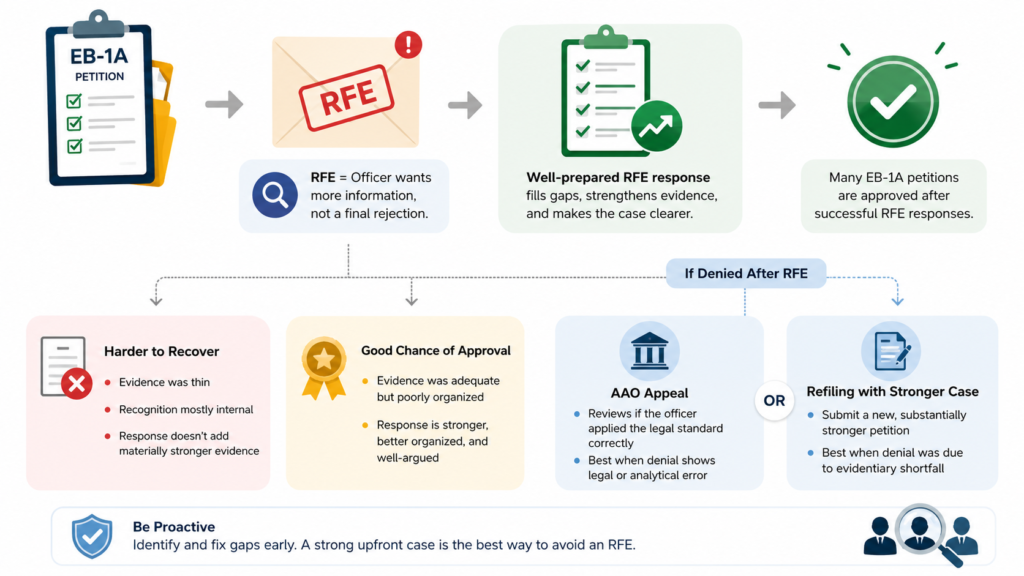
Yes, and many EB-1A petitions are approved after well-constructed RFE responses. An RFE signals that the officer found the case worth developing not that the underlying eligibility is absent. A petition that receives an RFE due to a narrative gap, a thin criterion, or a final merits argument that was never made can address all of those issues in the response.
The petitions that tend not to recover after an RFE are those where the underlying record was genuinely insufficient: the criterion evidence was thin, the recognition was primarily internal, and the response does not produce materially stronger evidence than the original filing. When the original evidence was structurally adequate but poorly organized and argued, a well-prepared response frequently achieves approval.
After a denial, the AAO appeal is available as an administrative review of whether the officer applied the legal standard correctly. Separately, refiling with a substantially strengthened petition is available as an independent path. The right choice between these options depends on whether the denial reflects a legal error in the officer’s analysis or a genuine evidential shortfall in the petition. Counsel familiar with current AAO reasoning patterns is well-positioned to evaluate this.
Received an EB-1A RFE or want to prevent one? Get a free extraordinary ability evidence audit from Immignis to identify gaps before USCIS does.
Frequently Asked Questions
Why is USCIS issuing more EB-1A RFEs in 2026?
The primary driver is an increase in petitions that satisfy the threshold criteria technically but do not build a coherent final merits case demonstrating extraordinary standing. As EB-1A filings have grown, the proportion of technically-adequate but merits-thin petitions has increased, producing more RFEs requesting clarification of what the evidence collectively establishes.
What triggers an EB-1A RFE?
The most common triggers are: threshold evidence that barely satisfies criteria without establishing credible field-level standing; final merits arguments that are absent or implicit rather than explicit; citation records with high rates of self-citation or dependent citations; recognition that is primarily internal to the petitioner's employer; and published material that appears self-generated rather than editorially independent.
Is an EB-1A RFE a bad sign?
Not necessarily. An RFE signals the officer found the case worth developing rather than denying outright. Many EB-1A petitions are approved after well-constructed responses. The most important factor is whether the RFE identifies a structural gap that can be addressed with new or reorganized evidence, or a fundamental eligibility problem that the record cannot resolve.
What is a final merits RFE?
A final merits RFE acknowledges that threshold criteria may have been met and then asks the petitioner to explain why the totality of the evidence establishes sustained national or international acclaim. It is a narrative coherence request, not a criterion documentation problem. The response must synthesize the criteria evidence into an explicit field-standing argument with comparative context.
What is citation inflation and why does it trigger RFEs?
Citation inflation refers to a high raw citation count that includes significant self-citations and citations from co-authors, advisors, and close collaborators. Officers apply independence filters using the same tools researchers use. When the independent count is substantially lower than the claimed total, the petition loses credibility. Self-citation rates exceeding approximately 30% of the total draw heightened scrutiny.
How do I respond to an EB-1A RFE about final merits?
Address the final merits question directly in the cover letter by synthesizing what the criteria evidence collectively establishes about the petitioner's field standing. Add new expert letters from genuinely independent sources that contextualize the criteria evidence against field norms explaining not just that criteria were met, but why the record demonstrates extraordinary standing relative to most practitioners.
Can generic recommendation letters cause an EB-1A RFE?
Yes. Letters that summarize credentials and describe the petitioner as exceptional without specific examples, field context, or explanation of how the work stands relative to peers are recognized and discounted. When all letters in a petition come from the petitioner's employer, supervisors, or close collaborators, the absence of independent external voices is itself a scrutiny signal.
What evidence does USCIS actually trust for EB-1A?
Evidence from independent external sources with no stake in the petition outcome: peer review invitations from credible journals that independently identified the petitioner; government or institutional citations of the work; adoption by organizations with no relationship to the petitioner; published material where an editor independently sought the petitioner out; and expert letters from senior field authorities who can contextualize the petitioner's standing within the field.
Does having strong criteria but a weak narrative cause RFEs?
Yes. A petition that satisfies three or more criteria with credible evidence but presents each independently, without connecting them into a final merits argument, can receive an RFE despite technically strong underlying evidence. The final merits determination evaluates the totality, and if that totality is not argued explicitly, the officer cannot credit an argument that was never made.
Can EB-1A be approved after an RFE?
Yes. Many EB-1A petitions receive approvals after well-constructed RFE responses that directly address the officer's concerns with targeted evidence. Petitions where the RFE reflects a narrative or organizational gap often recover fully. Petitions where the underlying record was genuinely insufficient face a harder response task but are not automatically lost.
Understanding what USCIS is looking for in the final merits review and where current adjudication patterns are finding petitions short is the most practical way to avoid an RFE before filing and recover from one after. Book a strategic EB-1A consultation with Immignis to evaluate your evidence against current adjudication standards and identify exactly where the final merits argument needs strengthening.