Getting Media Coverage for EB-1A: What “Published About You” Actually Means
Of the ten EB-1A extraordinary ability criteria, the EB-1A published material criterion is the one most commonly misunderstood and the one where applicants most often submit evidence that appears strong on the surface and fails completely under USCIS review. The phrase “published about you“ in the regulatory language is more specific than it sounds. USCIS applies a consistent and particular standard to this criterion, and the evidence that satisfies it is meaningfully different from the evidence most professionals assume will work.
This guide explains what the published material criterion actually requires, the distinction between earned and paid coverage that determines whether media evidence succeeds or fails, how different types of media coverage are evaluated, and how to build a genuine media record that advances both the criterion and the final merits argument.
What “Published About You” Actually Means
The regulatory language requires material in professional publications, major trade publications, or major media that is about the petitioner or the petitioner’s work. Three interpretive principles govern how this standard is applied.
Primarily About the Petitioner
The coverage must be primarily about the petitioner or their specific contributions not merely mentioning them in passing, not describing their organization with a reference to their role, and not covering a project where the petitioner was one of many contributors without individual attribution.
A news article that covers an organization’s product launch and mentions that the petitioner was a team lead is not coverage about the petitioner. A feature piece examining the petitioner’s specific technical approach, the methodology they developed, or the perspective they bring to a recognized problem is coverage about the petitioner.
The practical test: if the petitioner’s name and contributions were removed from the piece, would the article lose its primary subject matter? If yes, the coverage is about the petitioner. If the article would still make complete sense without them, it is not.
By an Independent Source
The publication must be genuinely independent it must not have been arranged by the petitioner, funded by the petitioner’s organization, or based on materials supplied by the petitioner’s company communications team. The independence of the source is what gives this criterion its evidentiary value.
An editor who called or emailed the petitioner because they independently identified their work as newsworthy is producing independent coverage. A communications team that drafted a press release that was republished by a news aggregator is not producing independent coverage. The former says something about how the field regards the petitioner. The latter says something about how the petitioner’s organization manages its public relations.
In a Major or Recognized Publication
The publication itself must have recognized professional standing demonstrated by documented circulation, editorial standards, field recognition, or readership profile. USCIS officers are generalists evaluating professional evidence across many fields; they cannot independently assess whether a given publication is considered authoritative in a specific industry. The petition must supply this context.
A publication’s standing can be established through circulation data, editorial information about the publication’s scope and audience, independent rankings or recognition within the field, or reference to the publication’s role in the professional community. Without this documentation, even coverage in a publication that practitioners in the field would immediately recognize as authoritative may receive less credit than it deserves.
Why USCIS Values This Evidence
The published material criterion carries evidentiary weight for the same reason all independent recognition evidence matters in EB-1A cases: when a credible publication independently decides that a professional is worth covering, that decision is a form of external validation. The editor or journalist had no obligation to cover this person, no professional relationship that might explain a favorable treatment, and no stake in the outcome of their immigration case.
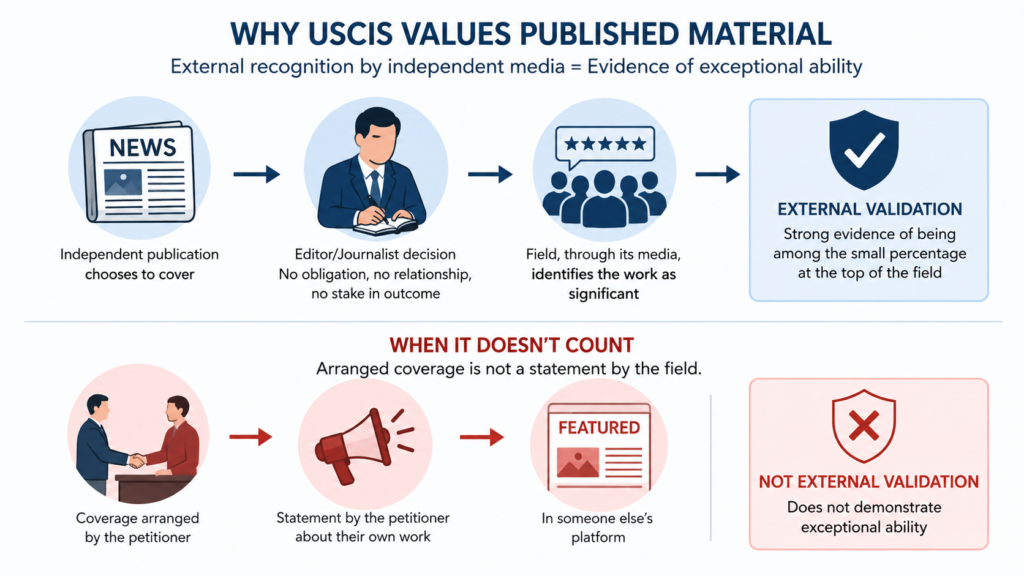
For the final merits determination where officers evaluate whether the totality of evidence establishes that the petitioner is among the small percentage at the top of their field published material provides something specific: it documents that external sources with no connection to the petitioner have identified their work as significant enough to bring to their readership’s attention. That is not an internal organizational judgment. It is the field, speaking through its media, about what matters.
This is why the criterion fails when coverage is arranged rather than earned. Arranged coverage is not a statement by the field. It is a statement by the petitioner about their own work, in someone else’s platform.
Earned Media vs Paid or Arranged Media: The Most Important Distinction
The difference between earned media and paid or arranged media is the most consequential question in this criterion, and it is assessed with more precision than many applicants expect.
Earned Media
Earned media is coverage produced by an independent editorial decision the publication decided, without payment or arrangement by the petitioner, that covering this professional’s work serves their readership. A journalist who reaches out to a researcher after reading their paper. A trade editor who profiles a technical leader after seeing their talk at a conference. A business publication that covers a founder’s approach to a recognized industry problem because the approach is genuinely novel.
The signals that distinguish earned media:
- The outreach originated with the publication, not the petitioner
- The editorial angle reflects the publication’s independent assessment of newsworthiness
- The coverage could not have been predicted or controlled by the petitioner
- The publication has editorial standards that govern what gets covered
Paid, Sponsored, and Arranged Media
Paid coverage includes advertorials, sponsored content, and branded content placements where the petitioner or their organization provided consideration to secure placement. Officers are trained to identify indicators of commercial placement: disclaimer language stating the content is “supported by” or “sponsored,” content that closely mirrors promotional materials, or articles that appear across multiple outlets in identical form (the typical pattern of wire-distributed press releases).
Arranged media is more subtle and more common. It includes profiles that result from a company PR team’s outreach to a journalist with a pre-packaged story, press releases distributed to industry outlets and republished without editorial intervention, and “contributed content” bylined to the petitioner that the publication accepted as a submission rather than initiated as editorial coverage.
Arranged media is not inherently deceptive. It is how most professional communications work. But it does not establish the independent recognition that the published material criterion is designed to document. Its presence in an EB-1A petition, without disclosure, risks damaging credibility when officers identify the arranged nature of the coverage.
Example of what doesn’t work: A CTO’s company PR team pitched a story to TechCrunch. TechCrunch published a piece about the company’s latest funding round that mentioned the CTO as a key architect. The CTO’s name appears in a recognized publication, but the coverage is about the funding round, was initiated by the company, and does not treat the CTO as the primary subject.
Example of what works: A data science editor at Wired reached out to a researcher after reading their preprint on privacy-preserving federated learning. The resulting profile focused on the researcher’s specific methodology, its implications for healthcare data, and their perspective on the field’s direction. The researcher did not arrange the coverage; the publication sought it out.
Media Coverage Types: What Qualifies and What Doesn’t
| Media Type | Criterion Satisfied? | Independence Level | Key Documentation Needed |
| Feature article in recognized trade journal treating petitioner as primary subject | Yes strong | High | Full article copy editorial masthead circulation readership profile; evidence that publication sought petitioner out |
| Profile piece in major business or technology media (Forbes, TechCrunch, Wired, etc.) | Yes strong | High | Full article with URL publication’s readership statistics; evidence of editorial selection |
| Expert commentary piece bylined to petitioner in recognized publication | Partial Criterion 6 primarily (scholarly articles) | Moderate | Full article evidence of editorial acceptance process; publication profile |
| Interview or Q&A in professional association publication | Yes useful supplemental | Moderate-High | Full article association membership and standing; interview correspondence showing outreach direction |
| Podcast or interview series appearance as featured subject-matter expert | Potentially comparable evidence | Moderate | Episode listing with petitioner as expert podcast’s documented audience and professional reach editorial outreach correspondence |
| Press release distributed by the petitioner’s organization | No | None | Not applicable fails independence test entirely |
| Paid advertorial or sponsored content | No | None | Not applicable fails independence test; may signal lack of genuine media recognition |
| Aggregator republication of company press release | No | None | Not applicable not editorial coverage |
| Company blog post authored by petitioner | No | None | Not applicable self-authored, not ‘about’ petitioner by an independent source |
| Wikipedia entry about the petitioner or their work (third-party authored) | Potentially supplemental only | High | Stable article history third-party authorship citations within article to independent sources |
Digital and NonTraditional Media: Where the Lines Are
Online Only Publications
Print vs online is not the relevant distinction for USCIS. Many online-only publications have readership and editorial standards that exceed print counterparts, and officers evaluate the substance of the publication, not its medium. An exclusive online technology publication with millions of monthly readers, a documented editorial process, and bylined coverage by staff journalists satisfies the major media standard. A low-traffic blog with no editorial structure does not, regardless of whether it was ever in print.
Documentation of the online publication’s standing is essential since officers cannot independently verify audience size from a URL. Alexa rank equivalents, Similarweb data, or information about the publication’s editorial history, awards, and professional recognition should be included as supporting documentation.
Podcasts and Audio/Video Interviews
Podcast appearances and video interviews can qualify under a comparable evidence framework the regulatory provision allowing evidence of similar significance when a standard criterion does not directly fit an applicant’s professional context. The qualification depends on: the podcast or channel treating the petitioner as the primary expert subject (not merely one of several guests on a general topic), the platform’s documented audience scale and professional reach, and the editorial selection reflecting independent recognition of expertise.
An appearance on a widely listened-to industry podcast with a documented professional audience, where the host independently sought the petitioner’s perspective on their specific work, is stronger comparable evidence than traditional articles from low-circulation publications. The documentation challenge is establishing the platform’s scale and professional standing in the same way a print publication would need to be documented.
LinkedIn Articles and Social Media
Content authored by the petitioner on LinkedIn, Twitter X, Substack, or personal platforms does not satisfy this criterion regardless of reach. The criterion requires material published about the petitioner by an independent source. Self-authored content is not coverage of the petitioner; it is content by the petitioner. High follower counts and engagement metrics do not transform self-authored content into independent recognition.
An important distinction: a journalist or publication that covers the petitioner’s LinkedIn post or Substack newsletter as a news item is providing independent coverage of the petitioner’s work. The source content is the petitioner’s; the coverage is the publication’s. The coverage is what satisfies the criterion, not the underlying post.
How to Get Legitimate Media Coverage Strategically
Identify Publications That Cover Your Specific Area
The most effective media strategy targets publications whose readership specifically overlaps with the petitioner’s professional community. A cybersecurity professional should identify the three to five publications where cybersecurity practitioners actually learn about developments in the field not general technology press, but the specific outlets whose coverage shapes professional conversation in that niche.
These are the publications whose coverage USCIS officers will recognize as field-significant when they see the documentation, and they are also the publications most likely to produce coverage that genuinely serves the final merits argument.
Build Relationships Before You Need Coverage
Journalists and editors who cover a specific industry maintain ongoing relationships with sources. A professional who has been a reliable expert source for a reporter answering questions, providing context, explaining technical developments before they need a feature profile is far more likely to receive genuine coverage than one who approaches media for the first time with an explicit coverage request.
Providing expert commentary for articles on topics related to the petitioner’s expertise builds exactly this kind of relationship. An expert quoted in three industry articles is on a journalist’s source list. A journalist with a source on their list who then writes a piece that needs a primary expert subject will naturally consider who they’ve worked with.
Pitch Substantive Stories, Not Profiles
Editors at industry publications receive many requests for coverage. A pitch that begins “I’d like to be featured” is an unusual request that most editors do not respond to. A pitch that says “I’ve been working on [specific problem], and my approach [describes something genuinely new or counterintuitive] here’s why it matters to your readers” is a story pitch, and story pitches are what editors respond to.
The coverage that results from a story pitch where the angle was the substance of the work, not the profile of the person naturally produces the kind of article that satisfies the criterion: a piece that is primarily about the petitioner’s specific contributions, produced through an editorial decision to cover that contribution as newsworthy.
Pitch framing that works: I’ve been developing a method for training federated learning models that preserves privacy across healthcare institutions without centralizing data. We’ve now deployed this at three hospital systems. I think there’s a story here about what this means for the practical future of clinical AI would that be relevant for [Publication] readers?
Pitch framing that doesn’t work: I am an expert in AI and would love to be featured in [Publication]. I have worked on some very interesting projects. Please let me know if you’d like to profile me.
Leverage Speaking and Conference Presence
Professionals who speak at major conferences in their field are regularly covered by industry media attending those events. A well-received talk on a significant technical problem creates the kind of event-based news hook that journalists use to identify profile subjects. The coverage that follows if it profiles the speaker and their work specifically satisfies the criterion without any active media outreach by the petitioner.
Use HARO and Expert Source Platforms Strategically
Help A Reporter Out (HARO) and similar journalist-source matching platforms connect reporters looking for expert sources with professionals in relevant fields. Responding to relevant queries with specific, substantive expert perspective occasionally leads to features and profiles, not just quotes. The coverage that results from a HARO response meets the independence standard the journalist initiated the search, and the editorial decision to cover the petitioner is the journalist’s.
How to Document Media Coverage for USCIS
Strong media evidence without proper documentation is a common and avoidable petition weakness. Officers cannot investigate the standing of a publication they are not familiar with; the petition must supply the context that establishes why the coverage is significant.
What a Complete Media Exhibit Contains
Each media exhibit should include:
- The full article text, not a screenshot or URL alone. Print the full text of the article with the headline, byline, publication name, and date visible. If the article is behind a paywall, include the full text in a properly formatted exhibit.
- The URL and publication masthead information, showing the publication’s name, editorial description, and scope.
- The publication’s circulation, readership, or audience documentation. For print publications: circulation statistics. For online publications: Similarweb or equivalent audience data, plus any available editorial description of the publication’s professional readership.
- The publication’s recognition in the field, if it is not a nationally recognized outlet. Industry awards, references in other recognized publications, or descriptions of its editorial role in the professional community.
- Evidence of editorial independence where available: correspondence showing the publication reached out to the petitioner, not vice versa. Where this is not available, the article itself should make clear that the coverage was journalist initiated through its framing and angle.
Explaining Why Coverage Is About the Petitioner
For each piece of media evidence, the petition letter should briefly explain its significance: what publication it appeared in, why that publication is recognized in the field, and specifically how the coverage treats the petitioner as its primary subject rather than a supporting reference. Officers reading fifty or a hundred pages of media exhibits benefit from a clear map of what each piece establishes.
Field Specific Media Strategies
Researchers and Scientists
Academic and research professionals often underestimate their media opportunities because they associate press coverage with business news. Science journalists and editors at publications like Scientific American, MIT Technology Review, Nature News, and specialized academic trade media actively seek researchers with significant findings to cover. A preprint or publication that addresses a significant unsolved problem, challenges existing consensus, or has clear application implications is a natural media story.
The most effective path for researchers: identify the two or three publications that cover developments in their specific research area for a professional-but-non-specialist audience, and develop a relationship with editors there by providing expert commentary on others’ work before seeking coverage of their own.
Engineers and Technical Leaders
Technical professionals whose work produces deployed systems, infrastructure, or platforms are well positioned for trade press coverage when the deployment has measurable scale or significance. An engineer who architected a system processing billions of transactions annually, or a technical leader whose security protocol was adopted across a major industry segment, has a story that technology trade publications cover regularly.
The pitch approach for technical professionals: lead with the scale and impact of the deployed work, explain what technical problem was solved that hadn’t been solved before, and connect it to a broader industry question the publication’s readership cares about. The technical depth of the underlying work is what makes the story credible; the framing around impact is what makes it publishable.
Executives and Business Leaders
Business executives often have access to multiple media pathways industry publications covering strategic decisions in their sector, business media covering organizational growth, and leadership-focused publications covering executive perspectives. The challenge for executives is distinguishing coverage that is about their individual professional standing from coverage that is primarily about their organization.
Coverage that profiles an executive’s specific management philosophy, technical expertise, or strategic approach rather than announcing a company milestone with them mentioned satisfies the criterion. Developing relationships with editors at executive focused publications (Harvard Business Review, MIT Sloan Management Review, and their industry specific equivalents) and offering substantive perspectives on industry developments, rather than company news, produces the right kind of coverage.
Startup Founders
Founders are frequently covered in startup and technology media, but much of that coverage is funding announcement-driven: a round closes, a press release goes out, and coverage follows. This is arranged media. The coverage that satisfies the criterion is different: it focuses on the founder’s approach, the problem they are solving, the technical or strategic insight that distinguishes their work.
The distinction matters for petition building. Three funding announcement mentions do not create the same evidence profile as one feature piece examining the founder’s specific innovation and its significance. Building a media strategy around substantive coverage of the work rather than company milestones produces better evidence and better final merits positioning simultaneously.
How Much Media Coverage Is Enough?
There is no prescribed quantity. The regulatory standard requires evidence that the petitioner has been the subject of published material in major media, professional publications, or major trade publications. The final merits determination evaluates the quality and independence of that coverage more than its volume.
In practice, two to four strong pieces of genuinely independent coverage in recognized publications typically create more persuasive media evidence than ten pieces from marginal sources. A profile in a widely-read industry trade journal that treats the petitioner as a primary authority, combined with expert-commentary coverage in two other recognized outlets, creates a coherent picture of a professional whose work the field’s media considers worth covering.
Quantity becomes relevant when coverage is thin individually but collectively establishes a pattern. Multiple expert commentary appearances in recognized publications, each covering different aspects of the petitioner’s work, can together establish a picture of consistent field-level recognition even without a single major profile piece.
How Published Material Serves the Final Merits Determination
For the final merits determination, published material evidence contributes a specific and valuable element: third-party proof that the field’s information infrastructure its journals, trade press, and professional media has independently identified this professional as worth covering.
This is distinct from what other criteria provide. Salary evidence establishes compensation standing. Critical role evidence establishes organizational importance. Citation evidence establishes field engagement with scholarly work. Published material evidence establishes that external media gatekeepers, with no professional relationship to the petitioner and no stake in the immigration outcome, independently assessed the petitioner’s work as worthy of their readership’s attention.

When combined with other criteria, strong media evidence reinforces the coherence of the final merits narrative. A professional who commands above-median compensation, holds a critical role in a distinguished organization, and has been independently covered in recognized field publications as an expert authority presents three mutually reinforcing types of independent recognition. Each criterion independently supports the standing claim; together, they build a case that is substantially more persuasive than any single criterion alone.
Need help building or evaluating your media evidence for EB-1A? Get a free extraordinary ability profile audit from Immignis for an evidence level assessment of your media record.
Frequently Asked Questions
What does “published about you” mean for EB-1A?
What media coverage does USCIS accept for the published material criterion?
Does a press release or company-arranged media count for EB-1A?
Do podcast appearances count for EB-1A?
Can blog posts or LinkedIn articles satisfy the published material criterion?
How many media pieces do I need for EB-1A?
How do I get legitimate media coverage for EB-1A?
Does USCIS verify whether media coverage was paid for?
How do I document media coverage for USCIS?
How does media coverage contribute to the final merits determination?
The published material criterion is ultimately a documentation exercise about independence proving that sources with no stake in the outcome have independently recognized the petitioner as worth covering. Getting that coverage is a professional development process; documenting it properly for USCIS is a petition strategy process. Book a strategic EB-1A consultation with Immignis to evaluate your existing media record and identify the most effective coverage-building strategy for your specific background.