
A Development Lead at a U.S. government-sponsored enterprise – already in the United States, already leading the cloud migration, already deployed – approved for an EB-2 NIW to extend that work into a nationally scalable platform for secure modernization and responsible AI governance.
In short: A computer scientist holding a Master of Science in Computer Science and a Bachelor of Computer Engineering, with more than 14 years of continuous professional experience inside U.S. regulated institutions – entirely within the United States since January 2010 – was approved for an EB-2 National Interest Waiver as a self-petitioner, making this an EB-2 NIW for Software Engineers case. Indian national, based in Virginia. She currently serves as Development Lead at a major U.S. government-sponsored enterprise in the secondary mortgage market, where she leads a cloud-migration initiative deployed in November 2025 and supervises a team of four engineers. Her proposed endeavor is to develop and implement a unified Cloud-Native Digital Core and Responsible AI Governance Infrastructure for U.S. housing finance and other highly regulated sectors. Approved under Matter of Dhanasar. This EB-2 NIW for Software Engineers approval highlights software leadership in cloud modernization, responsible AI governance, and regulated U.S. systems.
The petitioner’s name and employer details have been withheld for privacy. Career record, current role, deployed project, and outcome are real.
A Different Kind of EB-2 NIW for Software Engineers Case
Most EB-2 NIW petitions are filed by people from outside the United States who intend to come here and contribute. This one is different. She arrived in January 2010 as a graduate student. She has been working in the United States ever since. Every job on her resume is a U.S. institution. Her employer right now is one of the most significant financial institutions in the U.S. economy – a government-sponsored enterprise that sits at the center of the secondary mortgage market.
The cloud migration she has been leading for the past several years was deployed to production in November 2025. The thing she is proposing to do at national scale is something she has already been doing, inside the system that matters most, for fourteen years.
That is what the national interest case is built around: not a promise, but a record.
The Problem She Is Solving
The U.S. federal government spends more than $100 billion annually on IT and cyber-related investments. Approximately 80% of that goes to operating and maintaining legacy systems – old, XML-based, on-premises infrastructure that was built for a different era. In July 2025, the Government Accountability Office identified the 11 most critically at-risk legacy federal IT systems and warned that most agencies lack structured, auditable plans for modernizing them. The GAO found persistent patterns: cost overruns, missed milestones, cybersecurity exposure, and the kind of fragmented compliance processes that make real-time oversight effectively impossible.
The housing-finance sector sits at the center of this national challenge. The systems that support mortgage origination, servicing, and loss mitigation are regulated by frameworks including FHFA, CFPB, FedRAMP, FISMA, NIST 800-53, and others. Those frameworks exist. What often does not exist is the operational infrastructure to enforce them continuously rather than retrospectively — the difference between compliance that happens in real time and compliance that gets reconstructed months later for an audit.
She has spent 14 years working on exactly this problem, at one of the institutions where it matters most.
Fourteen Years Inside Regulated Digital Systems
She arrived at a New York state university in January 2010 as a graduate student in computer science. By April 2011, she was already working professionally in the U.S., first at a major financial services firm developing rules-based policy systems, then at a major telecommunications company building enterprise applications and data-driven operational monitoring. This EB-2 NIW for Software Engineers case is grounded in that long U.S.-based technology record.
In August 2013, she joined a major U.S. government-sponsored enterprise in the secondary mortgage market – initially through staffing engagements, then as a direct employee from October 2019 onward, where she now serves as Development Lead. In that role, she supervises development and testing teams, directs cloud-migration initiatives, and ensures the reliable delivery of mission-critical systems that support the housing-finance ecosystem and the millions of U.S. households that depend on it. That makes the EB-2 NIW for Software Engineers argument directly tied to federally regulated financial infrastructure.
Her technical specialization, developed and applied throughout this career, is IBM Operational Decision Manager (ODM) – the enterprise platform used to design and execute transparent, auditable, rules-based decision logic. She has architected Business Object Models (BOM) and Executable Object Models (XOM), built rule flows and decision services, and translated complex mortgage policies and regulatory requirements into testable, auditable system logic. This is the technical foundation of her proposed AI governance pillar: not abstract AI safety principles, but engineered rule-driven guardrails running inside production systems. This strengthens the EB-2 NIW for Software Engineers positioning around compliance automation and responsible AI governance.
Her current flagship project is a large-scale migration of legacy housing-finance systems to the AWS cloud, including the complete rewrite of core components, the transition of enterprise data schemas from XML to JSON, and the redesign of object models to support modern interoperable architectures. The migration deployed to production in November 2025. She holds an AWS Certified Developer – Associate credential, a Professional Scrum Product Owner certification, and a Professional Scrum Master certification. This production deployment adds strong practical evidence to the EB-2 NIW for Software Engineers petition.
Every other story in this series is about someone proposing to bring their expertise to the United States. This story is about someone who has been building the technology inside a federally regulated U.S. institution for 14 years, and who is proposing to scale what she’s already doing.
The Three-Pillar Proposed Endeavor
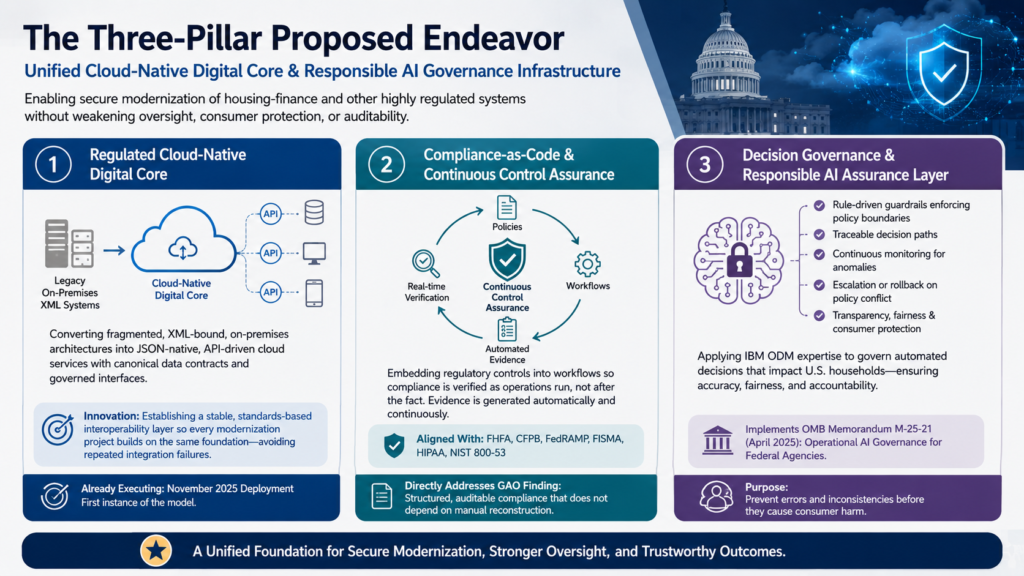
Her proposed endeavor is a Unified Cloud-Native Digital Core and Responsible AI Governance Infrastructure – a platform designed to enable secure modernization of housing-finance and other highly regulated systems without weakening oversight, consumer protection, or auditability. It has three integrated components. This EB-2 NIW for Software Engineers case connects that proposed endeavor to secure modernization, compliance automation, and AI governance.
The first is a regulated cloud-native digital core – converting fragmented, XML-bound, on-premises architectures into JSON-native, API-driven cloud services with canonical data contracts and governed interfaces. The innovation is not the use of APIs alone. It is establishing a stable, standards-based interoperability layer so that every subsequent modernization project can build on the same foundation rather than repeating the same integration failures. She is already executing this: the November 2025 deployment is the first instance of the model. For an EB-2 NIW for Software Engineers petition, this pillar shows how software architecture can support nationally important regulated infrastructure.
The second is compliance-as-code and continuous control assurance. Traditional compliance in regulated institutions depends on manual documentation, periodic audits, and retrospective reconstruction of what happened. This system embeds regulatory controls into workflows so compliance is verified as operations run, not after the fact. Evidence of approvals, policy application, and exceptions is generated automatically and continuously – aligned with FHFA, CFPB, FedRAMP, FISMA, HIPAA, and NIST 800-53 frameworks. This directly addresses what the GAO identified as missing: structured, auditable compliance that does not depend on manual reconstruction.
The third is a decision governance and responsible AI assurance layer. Automated decisions increasingly influence outcomes that affect U.S. households: borrower-assistance pathways, eligibility determinations, servicing actions. When those decisions operate without continuous governance, errors and inconsistencies often surface only after consumer harm. Her IBM ODM expertise is the direct technical foundation here. She will implement rule-driven guardrails that enforce policy boundaries on automated decisions, generate traceable decision paths, monitor outcomes for anomalous patterns, and trigger escalation or rollback when the system detects a policy conflict. The OMB memorandum M-25-21 (April 2025) directs federal agencies to implement exactly this kind of operational AI governance. Her proposed layer operationalizes that directive. This strengthens the EB-2 NIW for Software Engineers argument around responsible AI assurance in regulated U.S. systems.
Why the Policy Moment Makes This Urgent
The federal policy alignment for this proposed endeavor is unusually direct and unusually recent.
– GAO-25-107795 (July 2025): 11 most critical legacy federal IT systems identified; agencies called to establish documented, structured modernization plans. The proposed digital core addresses this directly.
– OMB Memorandum M-25-21 (April 2025): Federal directive to accelerate AI adoption through rigorous governance, accountability, and public trust. The proposed AI assurance layer operationalizes this mandate.
– OMB Memorandum M-24-10 (March 2024): Federal-wide AI governance framework requiring lifecycle risk assessment, documentation, and monitoring for AI systems affecting public services and regulatory outcomes.
– FHFA OIG Audit 2025: Identified cybersecurity governance weaknesses in housing-finance oversight environments, including gaps in governance, identity and access management, and contingency planning.
– FedRAMP reform: FedRAMP authorizations historically exceeded one year on average; the compliance-as-code model targets this bottleneck by replacing document-heavy authorization with continuous, operational evidence.
– CFPB 2024: Approximately 26,100 mortgage-related consumer complaints, highlighting persistent friction in borrower-facing mortgage servicing processes – the exact workflows the proposed platform’s dashboards and governance layer will make more transparent.
These are not background statistics. They are the current regulatory and oversight environment of the institution where she works every day. Her proposed endeavor is a direct, technically specific response to each of them.
How the Petition Was Built
This was a direct petition. The career record, the technical specialization, and the deployed project were already in place. This EB-2 NIW for Software Engineers case was built around an existing record of regulated software modernization and production deployment.
- National importance sourcing: GAO-25-107795, OMB M-25-21, OMB M-24-10, White House AI Action Plan, Presidential Action on Removing Barriers to AI Leadership, White House Cybersecurity Reprioritization Fact Sheet (June 2025), FHFA OIG Audit 2025, NIST CSF 2.0, NIST AI RMF, NIST IR 8011 (continuous control monitoring), FedRAMP reform data, CFPB 2024 consumer complaint data, IBM breach cost data, FBI IC3 $16B cybercrime losses.
- Well-positioned evidence: 14+ years of continuous U.S.-based experience in regulated enterprise systems, current Development Lead role at a federally supervised GSE, IBM ODM specialist across BOM/XOM/rule-flows for 10+ years, large-scale cloud migration deployed November 2025, AWS Certified Developer, team leadership of four engineers, production support experience in 24/7 audit-sensitive environments.
- Proposed endeavor precision: three integrated technical pillars each tied to named federal policy, documented national gaps, and existing work the petitioner is already executing in production.
I-140 filed as a self-petition without a separate employer sponsorship. The EB-2 NIW for Software Engineers petition connected her technical record directly to cloud modernization, compliance automation, and responsible AI governance.
The Outcome
Approved.A self-petitioned EB-2 NIW for a computer scientist and Development Lead who has spent 14 years working inside the U.S. housing-finance ecosystem, leading the modernization of the exact systems the federal government has identified as national priorities, with a deployed cloud migration as the most direct possible form of well-positioned evidence.
The strongest well-positioned argument is not a list of credentials. It is a production deployment. She shipped it in November 2025. The NIW acknowledges that the work she has been doing matters, and should continue at scale.
For Technology Professionals Already Working Inside U.S. Regulated Systems
If your career is in enterprise software, cloud modernization, compliance automation, or AI governance and you have been working inside U.S. regulated institutions for years, building systems that affect financial stability, consumer protection, or federal oversight, your well-positioned argument may already be as strong as it gets. This EB-2 NIW for Software Engineers pathway is especially relevant for professionals whose technical work already supports regulated U.S. infrastructure. The Dhanasar test is not about nationality or residency. It is about national importance and positioning. Fourteen years of work inside a federally supervised institution, with a cloud deployment already live, is a direct answer to both. For an EB-2 NIW for Software Engineers case, that kind of production-level evidence can strongly support the national interest argument.
Questions Technology Professionals in U.S. Regulated Institutions Ask Us
Can someone already living and working in the United States file for an EB-2 NIW?
Yes. Residency and current employment status in the United States do not affect NIW eligibility. The I-140 petition is evaluated on the national importance of the proposed endeavor and the petitioner’s positioning to advance it – not on where the petitioner currently lives. For someone already working in the U.S. in a relevant field, the well-positioned argument often benefits from a domestic track record of directly applicable work, which can be stronger than equivalent work done abroad.
Does working at a U.S. government-sponsored enterprise or federally regulated institution strengthen an NIW petition?
Yes. When a petitioner’s existing work directly advances the operations of a federally supervised institution, the national importance argument is grounded in current operational reality, not in future projections. Working as a Development Lead at a GSE in the secondary mortgage market – on systems that support housing access for millions of U.S. households – places the petitioner inside one of the most nationally significant institutional environments available. That proximity to mission-critical federal infrastructure is directly relevant to the Dhanasar well-positioned analysis.
Does having a deployed cloud migration (already in production) help the NIW case?
A production deployment is among the strongest forms of well-positioned evidence available. USCIS evaluates whether the petitioner can advance the proposed endeavor — not whether they have the qualifications to try. A large-scale cloud migration that has already been deployed to production, with the petitioner as the technical lead, is direct evidence of execution capability. The gap between ‘qualified to modernize housing-finance systems’ and ‘has already modernized housing-finance systems at scale’ is decisive in the well-positioned analysis.
What is IBM ODM, and why is expertise in it relevant to a national interest argument?
IBM Operational Decision Manager is the enterprise platform used to design, execute, and govern rules-based decision logic in regulated environments. It enables organizations to encode complex policies as transparent, testable, and auditable rules rather than burying decision logic in application code. For a proposed endeavor focused on compliance automation and responsible AI governance, IBM ODM expertise is directly applicable: it is the specific technical mechanism through which policy intent becomes enforceable operational behavior. Documented specialization across BOM, XOM, rule flows, and decision services – applied in production systems — supports both the technical feasibility of the proposed endeavor and the well-positioned argument.
How does the GAO’s July 2025 report on legacy IT systems support a national importance argument?
The GAO-25-107795 report established, at the federal level, that legacy IT modernization is a national priority with specific documented gaps: agencies lacking structured plans, 80% of federal IT spend going to maintenance of vulnerable systems, and identified cybersecurity risks. Citing GAO findings is not just background context – it is independent federal documentation that the problem the proposed endeavor addresses is real, documented, urgent, and nationally consequential. When the national importance argument rests on a specific, named GAO report from the year of filing, it is grounded in exactly the kind of governmental recognition the Dhanasar first prong asks for.
If you work in software engineering, cloud modernization, compliance automation, or AI governance, Immignis can help assess your EB-2 NIW potential. We help connect your technical record to national importance, real implementation, and a focused U.S. endeavor.