An EB-2 NIW startup founder from Turkey came with funding, a working prototype, early customer interest, a trademark, and a patent pathway. The draft petition treated the startup like an investor pitch. We stopped the filing, rebuilt the case around modular grid-scale storage technology, answered a business-viability RFE, and secured EB-2 NIW approval.
| Nationality / chargeability | Turkish |
| Professional field | Founder and engineer in grid-scale energy-storage systems for renewable integration |
| Career stage | Approximately 10 years; founder and technical lead |
| Initial issue | Draft petition focused too heavily on jobs, revenue, investment, and market size |
| Profile-building period | Approximately 10 months |
| Result | RFE on business viability answered; EB-2 NIW approved |
Privacy note: This public version is anonymized. Names, private company identifiers, confidential funding terms, customer details, and personal information are intentionally omitted. The story is written as an educational success story based on the case study supplied by the client.
The approval result
This EB-2 NIW startup founder case ended with the result the founder needed: an EB-2 National Interest Waiver approval after an RFE. The approval mattered because the original draft was close to filing but pointed the case in the wrong direction. It made the company sound promising, yet it did not make the technology itself the center of the national-interest argument.
The corrected case did not abandon the business evidence. It placed that evidence where it belonged. Funding, customer interest, pilot results, staffing plans, and revenue projections became proof that the EB-2 NIW startup founder could execute the technology. They were not presented as the reason the United States should waive the job-offer and labor-certification requirement.
The reason became the technology: modular grid-scale energy-storage systems designed to help the U.S. grid absorb more solar and wind power by reducing the intermittency barrier that limits renewable deployment at scale.
The national problem: renewable power needs storage before it can scale reliably
Solar and wind generation can expand quickly, but they do not produce power continuously. A modern electric grid needs reliable storage so excess clean generation can be captured when available and released when demand rises. Without scalable storage, renewable-energy projects face curtailment, interconnection challenges, reliability concerns, and limits on how much clean power the grid can actually use, making this directly relevant to an EB-2 NIW startup founder case.
The founder’s work sat directly inside that problem. His startup had built modular storage technology intended for grid-scale use with solar and wind projects. The system was designed to smooth intermittent generation, support grid reliability, and make renewable power more usable for utilities and project developers.
That was the real national-interest theory. The case was not “a startup will create jobs.” The case was “an EB-2 NIW startup founder has developed storage technology that addresses a specific infrastructure barrier in the clean-energy transition, and the company record shows he can move that technology toward U.S. deployment.”
The mistake we corrected: founder evidence is not the same as investor evidence
The draft petition he brought to us was written like a business pitch for an EB-2 NIW startup founder. It emphasized jobs, investment, market size, projected revenue, and economic growth. Those facts were useful, but they could not carry the NIW by themselves.
For an entrepreneur NIW, USCIS is not deciding whether the company might become valuable. The officer is deciding whether the proposed endeavor has substantial merit and national importance, whether the petitioner is well positioned to advance it, and whether the United States benefits from waiving the job-offer and labor-certification requirement.
We therefore changed the role of the same facts. Funding became external validation. Pilot results became technical readiness. Customer discussions became market need. Hiring plans became execution capacity. Revenue projections became sustainability. The national-interest center remained the technology’s contribution to renewable integration and grid reliability for an EB-2 NIW startup founder.
The proposed endeavor that became the center of the case
Proposed endeavor: To develop and commercialize modular grid-scale energy-storage systems that enable reliable, large-scale integration of solar and wind power onto the U.S. electric grid - advancing the United States’ clean-energy transition, strengthening domestic energy independence, and addressing the specific intermittency barrier that currently limits renewable deployment at the scale national policy requires.
What Immignis and AdvanceMyProfile built
We organized the case around the evidence that makes sense for an EB-2 NIW startup founder: intellectual property, product identity, pilot validation, funding, independent expert review, public positioning, and a serious U.S. operating plan. The goal was not to make him look like an academic researcher. The goal was to prove that his technology and his execution record supported a national-interest clean-energy endeavor.
First, the patent application was positioned as evidence of original technical contribution tied to the storage-module architecture. It was not overstated as a granted patent at filing. Later, the patent was granted, which strengthened his long-term record. The distinction mattered: a pending patent can document originality and priority; a granted patent carries additional weight after examination.
Second, the trademark was used to show product identity and commercialization. A trademark does not prove technical novelty, but it helps show that the invention had moved beyond a concept and into a named product with market-facing development.
Third, the pilot deployment became central to the well-positioned prong. We documented what had been tested, what the system demonstrated, and how those results supported a path toward U.S. deployment. The pilot did not need to prove national rollout. It needed to show that the technology was beyond the slide-deck stage.
Fourth, the seed funding and investor evidence were reframed as execution proof for an EB-2 NIW startup founder. Investor letters explained why outside parties believed in the technology, what problem the storage system addressed, and why the founder’s engineering role was necessary to deployment.
Fifth, we built independent expert support from people who could assess the technology outside the company: a grid engineer familiar with renewable-integration limits, an energy-policy researcher who understood storage as a clean-energy bottleneck, and a clean-energy technical evaluator who had reviewed the company’s approach.
Sixth, we created a focused public profile through expert commentary and clean-energy visibility. The media work discussed grid storage economics, renewable curtailment, utility adoption barriers, and the practical requirements of modular storage. The aim was professional credibility, not publicity for its own sake.
Seventh, we prepared a targeted technical white paper on modular storage for renewable integration. It was shared with relevant clean-energy and grid-modernization audiences, including an energy-storage association, a renewable-integration working group, a utility innovation forum, and a clean-technology research network. This created a credible evidence trail for the EB-2 NIW startup founder before the audiences most likely to understand the technology.
How the profile-building evidence supported Dhanasar
For Prong 1, the proposed endeavor for this EB-2 NIW startup founder was tied to a documented national infrastructure problem: renewable intermittency and the need for grid-scale storage. The business was not presented as important merely because it could grow. The technology was presented as important because it addressed clean-energy deployment, grid reliability, and domestic energy independence.
For Prong 2, the evidence showed the EB-2 NIW startup founder was not describing a future wish. He had a working prototype, a pilot deployment, funding, a product mark, a patent pathway, customer discussions, technical leadership, and independent expert support. These facts showed capacity to advance the endeavor.
For Prong 3, the waiver argument was built around the speed and flexibility needed for a founder-led technology deployment. Requiring a traditional labor certification for an EB-2 NIW startup founder advancing his own clean-energy technology would not fit the nature of the work. The evidence showed that his value came from leading the technology and company strategy together.
The RFE: business viability, not a rejection of national importance
USCIS issued an RFE focused on whether the founder and company were positioned to execute the endeavor in the United States. This was a serious but answerable question. The officer did not reject the clean-energy theory. The concern was whether the company had enough funding, validation, planning, and operational structure to make the endeavor realistic.
That type of RFE is common in entrepreneur cases. A founder can describe a nationally important technology, but USCIS may still ask whether the company has the resources and plan to carry it forward. The response needed to show execution capacity without turning the case back into a generic business pitch.
The business plan that answered the officer’s concern
We drafted a formal business plan for immigration purposes. It was not a pitch deck. It was evidence. Every section answered the well-positioned concern: funding history, current capitalization, pilot results, product-readiness stage, U.S. entity structure, proposed operating locations, utility and project-development discussions, staffing plan, technical milestones, regulatory issues, and the pathway from pilot deployment to U.S. commercialization.
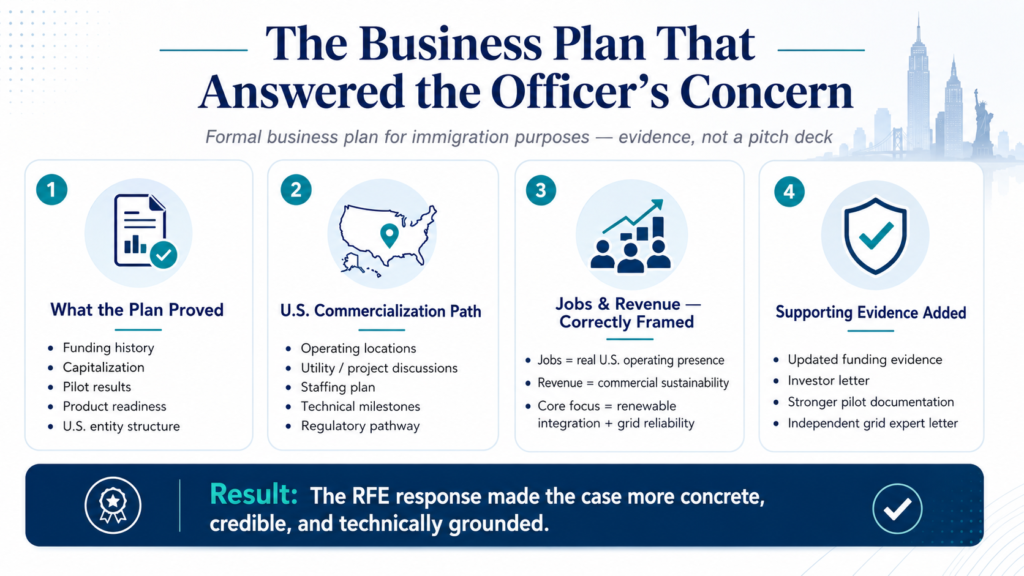
Jobs and revenue appeared in the plan, but in the correct role. Jobs showed that execution required a real U.S. operating presence. Revenue showed commercial sustainability. Neither was treated as the national-interest core. The technology’s contribution to renewable integration and grid reliability remained the center.
We also submitted updated funding evidence, a supplemental investor letter, stronger pilot documentation, and an independent grid expert letter explaining why the founder’s technical involvement was essential to the storage approach. The RFE response made the case more concrete and more credible.
The approval and what followed
USCIS approved the petition after the RFE response. Because Turkey did not present a significant EB-2 backlog, the approved I-140 placed him on a practical path forward, with later timing controlled by normal USCIS and post-approval processing rather than a long visa-number queue.
The professional outcome also grew. After filing, the U.S. entity was incorporated, a first U.S. partnership agreement was signed, and discussions began with utilities and project developers. The patent that had been pending during the NIW process was later granted, strengthening the company’s intellectual-property position as it moved toward U.S. commercialization.
The founder later moved into a more visible executive role with greater responsibility for U.S. commercialization and strategic partnerships. He said the turning point was understanding that the investor story and the immigration story were not the same. Investors needed to understand market growth. USCIS needed to understand national value and execution capacity.
What this case teaches founders
• Job creation can help, but it should not be the center of the entrepreneur NIW. The strongest national-interest argument usually comes from the technology, infrastructure need, public benefit, or field-level problem the founder is addressing.
• A business plan for an NIW is not a pitch deck. It should connect funding, team, product readiness, partnerships, market entry, and operations to the proposed endeavor and the Dhanasar framework.
• Patents and trademarks have different roles. A patent supports originality. A trademark supports product identity and commercialization. Together, they can make a founder’s record more concrete.
• White papers should be targeted to the right audience. In this case, clean-energy associations, utility innovation forums, renewable-integration groups, and technical research networks made sense because those audiences could evaluate the relevance of modular storage.
• An RFE can clarify what USCIS needs. Here, the officer did not require a new theory. The officer required stronger proof that the founder and company could execute the theory already presented.
• Ethical profile building does not manufacture a founder’s story. It identifies the real technology, removes weak framing, documents execution capacity, and presents the evidence in a way an officer can evaluate.
For startup founders considering EB-2 NIW
Founders often ask whether projected jobs, revenue, and investment are enough. Usually, they are not enough alone. They can support a petition, but the first question is different: what national problem does the technology address, and what evidence shows the founder can advance that solution?
For clean-energy founders, the answer may lie in grid reliability, energy independence, emissions reduction, critical infrastructure, domestic manufacturing, or utility-scale deployment. For other founders, the answer may be in healthcare access, cybersecurity, advanced manufacturing, food security, or another field-specific national need. The evidence must match the actual technology and the actual founder.
If you are a startup founder considering EB-2 NIW, start with an honest assessment of the technology before focusing on revenue or job creation. A strong entrepreneur NIW begins by identifying the national-interest value of what the technology does, then building the evidence that proves you can execute it. Submit your free assessment request. immignis