

EB-2 NIW Proposed Endeavor: How to Write One That USCIS Cannot Deny
Last Updated on August 8, 2026 by Amelia
Written by Emily Carter, Immigration-Law Specialist
Reviewed by Jonathan Miller, Esq., Licensed U.S. Immigration Attorney
The EB-2 NIW proposed endeavor sits at the structural center of every EB-2 National Interest Waiver petition. It is the lens through which an officer interprets your credentials, your evidence, and your argument for waiving the labor certification requirement. Strong EB-2 NIW proposed endeavor examples share a specific architecture: they read as forward looking missions tied to identifiable U.S. priorities, not as job descriptions or vague aspirations. When the endeavor is written poorly, the rest of the petition rarely recovers even with credible publications, patents, or recommendation letters behind it. This guide breaks down what USCIS officers are actually reading for, why so many otherwise qualified petitioners receive Requests for Evidence on Prong 1, and how to construct an endeavor statement that holds up under the tightened scrutiny seen across recent adjudication cycles.
What USCIS Actually Means by “ EB-2 NIW proposed endeavor”

A EB-2 NIW proposed endeavor is the specific work the petitioner intends to perform in the United States and the impact that work is expected to generate. It is not a résumé summary, not a job title, and not a recap of past achievements. In adjudication terms, it is the object being analyzed under all three prongs of the Dhanasar framework. The agency treats the endeavor as a single unit of analysis. Every claim about substantial merit, every argument about national level impact, and every link between the petitioner’s background and the work itself must connect back to a clearly defined endeavor. If that definition is vague, the rest of the petition has nothing solid to attach to. A working definition that holds up well in petitions: a proposed endeavor is a bounded area of work defined by field, methodology, and intended outcome that the petitioner is qualified to advance and
that benefits the United States in ways extending beyond a single employer or local geography.
Endeavor Statement vs. Petition Letter vs. Personal Statement:
A common source of confusion for first time filers is the difference between three documents that all describe the petitioner and their work but serve very different functions in the eyes of an adjudicator.
The proposed endeavor is a defined claim about what the petitioner intends to do in the United States and why it matters at a national level. It is typically articulated in a few sentences and then developed throughout the petition. It is a legal claim that must be substantiated by evidence.
The petition letter is the legal brief. It analyzes the case under each Dhanasar prong, walks the officer through the evidence, and explicitly argues why the petition meets each statutory requirement. The endeavor lives inside the petition letter but is not the same thing the letter is the argument; the endeavor is the subject of the argument.
The personal statement is the petitioner’s own narrative their background, motivation, and trajectory supports the petition but cannot stand on its own. A personal statement that retells the same content as the endeavor adds little value; a personal statement that explains why the petitioner is positioned to advance the endeavor drawing on their training, experience, and prior work strengthens Prong 2 directly.
Officers treat these documents as complementary, not redundant. When they overlap too much, the petition reads as repetitive. When they say different things, it raises credibility concerns. The discipline is to make each document carry a specific weight that the others do not.
The Anatomy of a Strong EB-2 NIW Proposed Endeavor:
A well built endeavor sentence follows a predictable structure. Once you can see the components, the difference between strong and weak versions becomes immediately recognizable. A strong proposed endeavor contains four functional elements:
1. The action verb and scope
The opening verb signals what the petitioner will do not what they have done. Strong verbs: develop, design, advance, build, implement, deploy, architect. Weak verbs: continue, work on, research, study. The verb is followed by the bounded scope of the work. Example: “To advance domestic semiconductor packaging through.”
2. The methodology or output
This specifies how the work will be carried out and what concrete outputs it will produce. Without it, the endeavor is just a topic, not a plan.
Example: “Through the development and deployment of advanced thermal interface materials.”
3. The national importance anchor
This is the explicit link to a federal priority, agency strategy, or legislative framework. It transforms the work from interesting to nationally relevant.
Example: “Addressing reliability bottlenecks identified in the CHIPS and Science Act implementation
strategy.”
4. The portability or scalability element
This shows how the impact extends beyond a single organization or location. It does not need to live in the headline sentence it can be developed in the surrounding paragraphs but the petition must contain it somewhere.
Example: “The work is structured for adoption by U.S. fabrication facilities expanding under federal incentives, with measurable improvements in chip yield and life cycle performance.”
When all four components are present, the officer can evaluate the endeavor without inferring missing pieces. When any one is absent, the petition forces the adjudicator to fill in gaps and adjudicators do not fill gaps in the petitioner’s favor. A useful self-audit: take your draft endeavor and label each clause with one of these four functions. If you cannot label every clause, you have either filler that adds nothing or missing components that need to be added.
Why Most EB-2 NIW Proposed Endeavors Fail:
Across denial and RFE patterns visible in publicly available AAO decisions, the same structural weaknesses keep appearing:
- Endeavors written as job descriptions. Listing duties “I will conduct cardiovascular research at X hospital” gives an officer nothing to evaluate at the national level.
- Conflating merit with importance. The petitioner explains why the work matters scientifically but never connects that value to broader U.S. interests.
- Single employer framing. Describing work that primarily benefits one company, one clinic, or one university lab.
- Generic field level claims. Statements like “AI is important to the U.S. economy” without identifying what specifically the petitioner will do or who outside their immediate organization will benefit.
- No implementation pathway. Theoretical contributions presented with no indication of how the work moves from concept to real world deployment.
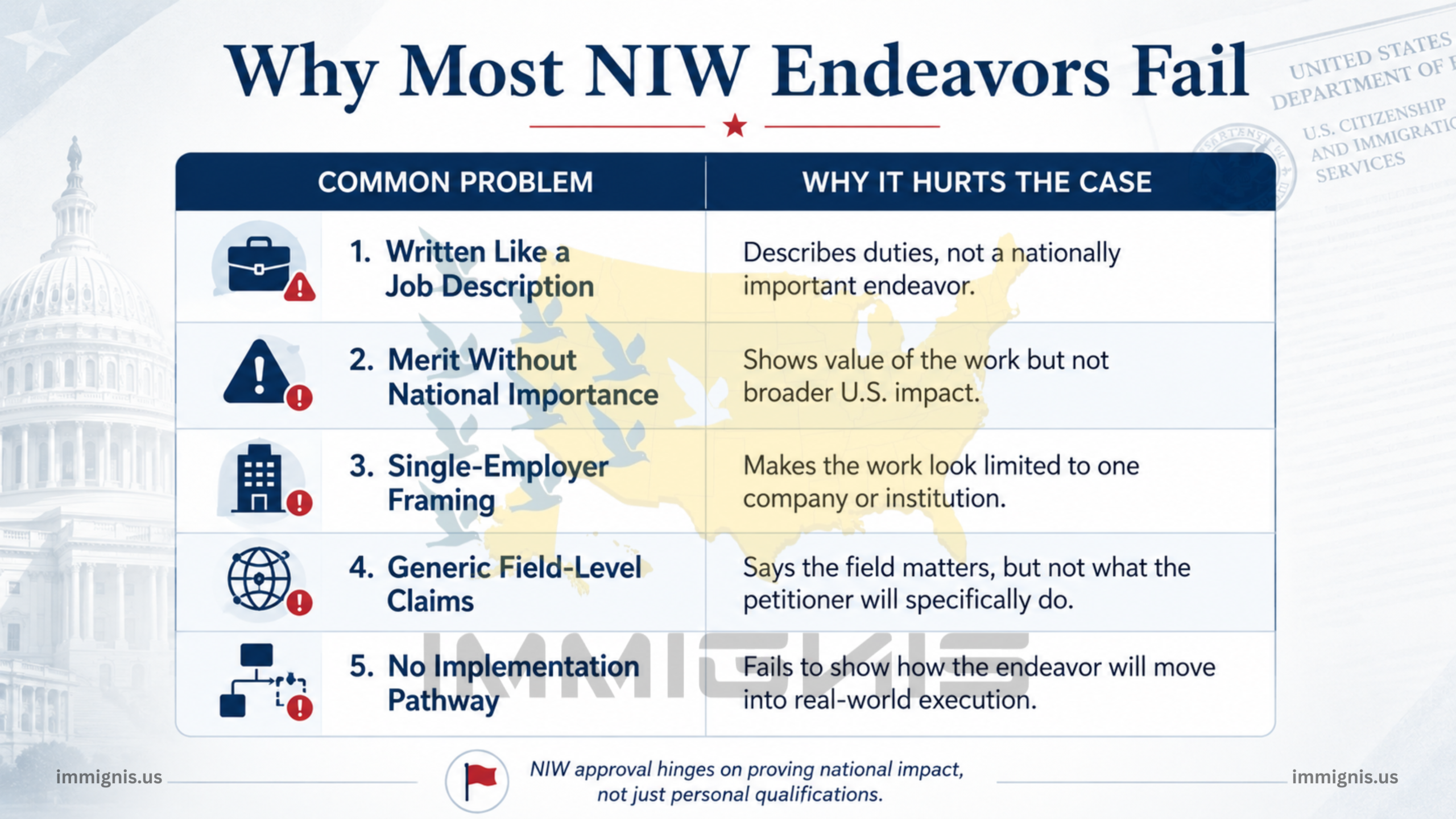
The implementation gap deserves particular attention. Officers have grown noticeably more demanding about evidence that an endeavor will actually be carried out that the petitioner has the role, resources, collaborators, or funding pipeline to translate research or innovation into practice. A beautifully written endeavor that reads as purely aspirational now invites scrutiny that did not exist a few years ago.
The Dhanasar Connection for EB-2 NIW Proposed Endeavors:
The endeavor is the spine running through all three prongs of the Dhanasar test, but each prong examines a different attribute of that same body of work.
Prong 1 Examines the endeavor itself its inherent value and its national reach. The question is whether the work, if successful, would matter to the United States at large.
Prong 2 Shifts focus to the petitioner whether their education, skills, prior record, and engagement with relevant stakeholders show they are positioned to advance the specific endeavor described. A mismatch between endeavor and credentials is fatal: an endeavor centered on national defense systems, pursued by a candidate with no defense sector experience, will not survive review.
Prong 3 Is the balancing analysis whether, on the whole, it benefits the country to waive the job offer and labor certification requirements for this particular endeavor pursued by this particular person.
Because these prongs interlock, the endeavor must be written with all three in view from the first draft. A common drafting error is to write Prong 1 in isolation, then attempt to bolt Prong 2 evidence onto it. The result reads as two disconnected arguments rather than one coherent case.
Real Examples of Strong EB-2 NIW Proposed Endeavors:
The patterns below illustrate how successful endeavors are framed across different fields. They are written in the style officers respond to: specific, bounded, and tied to identifiable national interests.
Semiconductor manufacturing
To advance domestic semiconductor packaging through the development and deployment of advanced thermal interface materials, addressing reliability bottlenecks identified in the CHIPS and Science Act implementation strategy. The work is structured for adoption by U.S. fabrication facilities expanding under federal incentives, with measurable improvements in chip yield and lifecycle performance.
Healthcare data infrastructure
To design and implement interoperable data architectures for U.S. hospital systems, reducing the diagnostic latency and data fragmentation flagged in recent NIH strategic priorities. The endeavor produces open specification frameworks that hospital networks beyond the petitioner’s employer can adopt, with the intended effect of reducing misdiagnosis rates in cardiovascular care.
Renewable energy and grid integration
To develop grid integration methodologies for distributed solar generation in rural U.S. utility territories, addressing the curtailment and interconnection bottlenecks identified in the Department of Energy’s grid modernization initiative. The methodology is designed for replication by cooperative utilities across multiple states.
Non-STEM public health policy
To build evidence based intervention models for opioid use disorder in underserved U.S. counties, contributing to the federal substance use response strategy. The endeavor produces transferable program designs intended for adoption by state health departments beyond the initial implementation site.
Entrepreneurship AI infrastructure
To establish and scale a U.S. based platform providing privacy preserving infrastructure for federally regulated AI deployment, addressing data governance bottlenecks flagged in recent NIST AI Risk Management Framework guidance. The endeavor produces compliance ready tooling adopted by regulated industries healthcare, finance, defense beyond any single customer.
Cybersecurity critical infrastructure
To develop intrusion detection methodologies tailored to U.S. operational technology environments in the energy and water sectors, addressing the critical infrastructure vulnerabilities identified in CISA’s National Cyber Strategy. The methodology is designed for adoption by regional utilities and is being piloted across multiple state level grid operators.
Each example demonstrates four elements: a specific area of work, a methodology or output that is portable beyond a single organization, an explicit tie to a federal priority, and a plausible mechanism for impact above the local level.
Need a second set of eyes on your draft? Get a free EB-2 NIW proposed endeavor review from Immignis before you commit to a final petition structure.
STEM vs Non-STEM Endeavor Strategies:
The Dhanasar framework is field neutral, but the evidentiary path differs in practice.
STEM endeavors benefit from quantifiable outputs citations, patents, deployed systems, measurable economic effects. The strategic risk is over relying on technical depth without translating it into national level impact. A petition full of equations and benchmarks but light on policy connection often stumbles on Prong 1.
Non-STEM endeavors in fields such as public health policy, education systems, finance, the arts, urban planning, and legal scholarship require more deliberate framing because impact is rarely measured in citation counts. These petitions succeed when they:
- Identify concrete federal or state policy frameworks the work supports
- Demonstrate adoption or replication of methods beyond the petitioner’s immediate organization
- Quantify reach where possible populations served, jurisdictions adopting the framework, measurable economic indicators
- Use expert letters that translate qualitative contributions into measurable influence
Early career petitioners across both categories can lean on a “future design” framing: anchoring the endeavor to documented agency agendas NIH, DOE, NSF, FDA, NASA, DoD, or the SBA, depending on the field to establish national importance even when the personal citation record is thin.
Common USCIS Red Flags:
Petitions that draw heightened scrutiny tend to share recognizable features:
- Boilerplate national importance language copied across multiple petitions, with no specific federal references
- Scope mismatch an endeavor framed as transformative for the U.S. economy, pursued by a petitioner whose evidence shows only a junior or narrowly specialist record
- Single employer dependency work described as entirely contingent on one company’s continued operation
- Speculative plans with no foothold no contracts, no collaborators, no funding, no published work in the area
- Geography only arguments claiming national importance because the work happens “in the United States” rather than because of what the work actually does
- Letters that contradict the endeavor’s scope for example, letters describing the petitioner as essential to one employer when the endeavor itself is framed as industry wide
Officers reading the petition as a whole notice when the endeavor narrative and the supporting evidence describe two different careers.
How to Align Evidence With Your Endeavor:
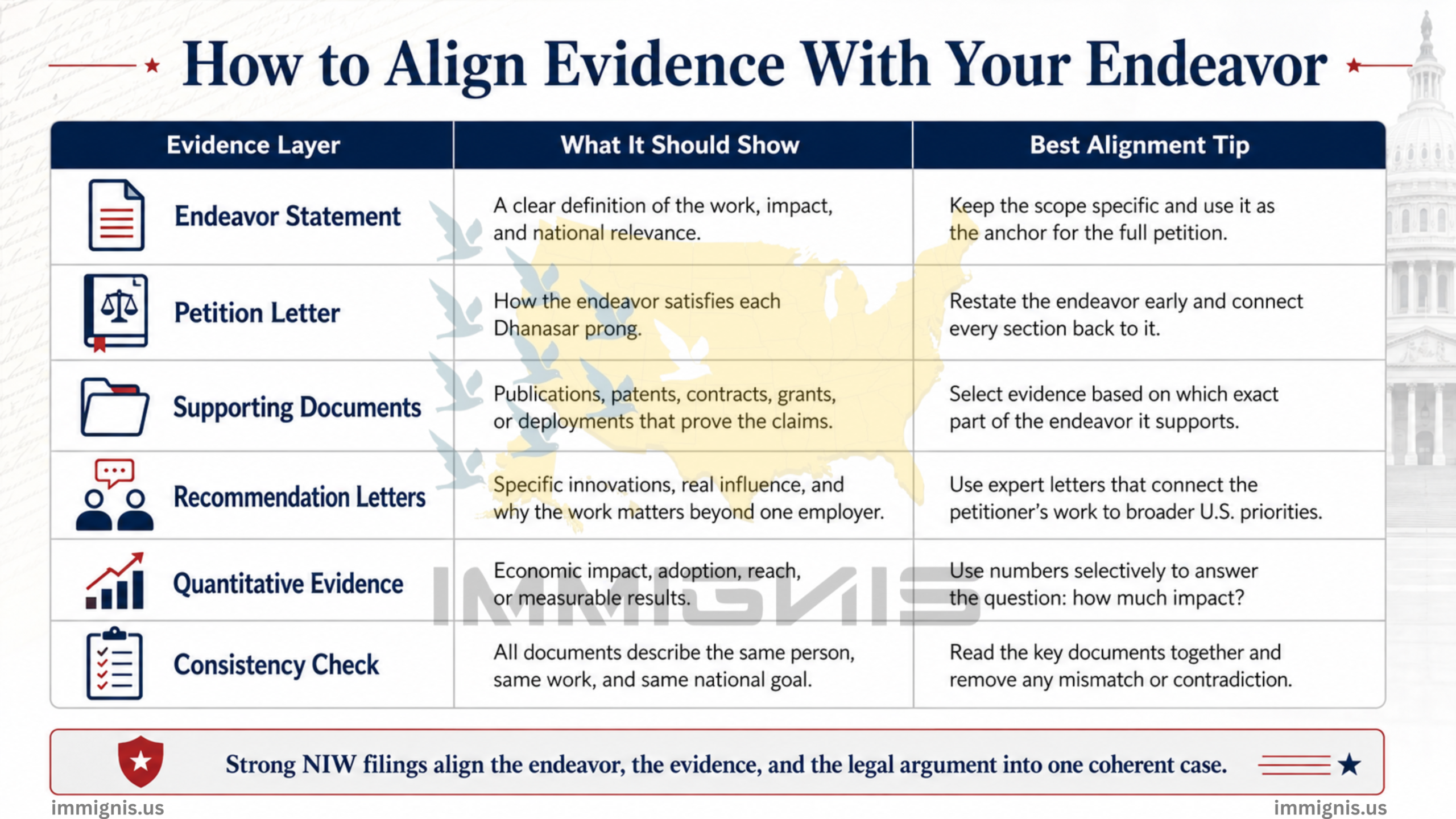
The strongest petitions read as a single coherent argument across four layers: the endeavor statement, the petition letter, the supporting documents, and the recommendation letters. Misalignment between any two layers undercuts the entire filing.
The petition letter should restate the endeavor early and then return to it as the organizing principle of the legal analysis. Each Dhanasar prong section should explicitly name the endeavor rather than drifting into general claims.
Supporting documents publications, patents, deployment records, grants, contracts, media coverage, government reports should be selected and labeled according to the specific element of the endeavor they support. A document that does not advance an argument about either the endeavor’s importance or the petitioner’s positioning to advance it adds noise.
Recommendation letters carry disproportionate weight when they describe specific innovations and concrete influence rather than offering generalized praise. The most effective letters are written by experts who can credibly bridge the petitioner’s technical work and the federal or industry level priorities cited in the endeavor.
For quantitative reinforcement, the Bureau of Economic Analysis’s RIMS II model can generate government validated estimates of regional and national economic impact useful for endeavors involving entrepreneurship, infrastructure, or industrial innovation. Used selectively, these figures answer the “how much” question that vaguer petitions leave open.
A practical drafting test: read the endeavor sentence aloud, then read the strongest paragraph of the petition letter, then the most substantive recommendation letter. If a stranger could not tell from those three pieces that they describe the same person and the same work, the petition needs realignment before filing.
When Your Endeavor Needs to Evolve During the Process:
The EB-2 NIW proposed endeavor is filed at a single point in time, but petitions can spend many months sometimes longer in adjudication. During that window, petitioners’ professional lives continue to evolve. A common question: what happens if the work shifts, the employer changes, or the funding picture moves before adjudication concludes?
The short answer is that proportional, well documented changes are usually manageable. The longer answer depends on the type of change.
Changes that generally do not require action
- New publications, citations, or recognitions related to the same endeavor
- Additional collaborators or contracts within the existing scope of work
- Promotions or expanded responsibilities at the same employer, when the underlying endeavor is unchanged
Changes that require careful documentation
- A move to a different employer where the substantive work remains aligned with the original endeavor
- A pivot in methodology while the field and intended impact stay the same
- New funding sources or partnerships that materially strengthen the implementation case
Changes that may require a strategic decision
- A shift to a substantially different field or area of work
- A move from active practice into something tangential administration, sales, or an unrelated industry
- Loss of the institutional or funding anchor that the original endeavor was built around
When meaningful changes occur, the typical response is to file a supplemental letter or, in some cases, to address the shift in an RFE response if one is issued. The guiding principle is consistency: the petition’s core claim that the petitioner is advancing the EB-2 NIW proposed endeavor in a way that benefits the United States must remain credible. Changes that strengthen that claim are an asset. Changes that contradict it are worth discussing with counsel before filing supplemental materials.
The takeaway: an endeavor is not a static job title. It is a claim about a body of work, and the work can evolve as long as the underlying claim continues to be supported by the petitioner’s actions.
Frequently Asked Questions
What is a proposed endeavor in EB-2 NIW?
A proposed endeavor is the specific work the petitioner intends to perform in the United States, defined by field, methodology, and intended impact. It functions as the object of analysis under the Dhanasar framework and must benefit the country in ways extending beyond a single employer or local area.
How long should a EB-2 NIW proposed endeavor statement be?
The endeavor itself is typically defined in one to three sentences within the petition letter, then developed in detail across the Prong 1 and Prong 2 analyses. Length matters less than precision a tightly scoped two sentence endeavor outperforms a vague two page version.
Can a weak endeavor cause an NIW denial even with strong credentials?
Yes. Credentials inform Prong 2, but if the endeavor itself does not establish substantial merit and national importance under Prong 1, the petition fails regardless of how distinguished the petitioner’s record may be.
Does the endeavor need to be tied to a current job?
No. Self-petitioners, entrepreneurs, and those between positions can pursue an NIW based on an endeavor they are positioned to advance. The petition must show how the work will actually be carried out through founded entities, collaborations, funding, or other concrete pathways.
How specific does the endeavor need to be?
Specific enough that an officer can evaluate its merit and its impact without having to infer missing details. “Advancing AI” is not an endeavor. “Developing privacy preserving machine learning methods for federally regulated healthcare data systems” is.
Should the endeavor cite specific federal agencies?
Where genuinely relevant, yes. Connecting the work to NIH, DOE, NSF, FDA, NASA, DoD, or SBA priorities through actual published strategic documents strengthens the national importance argument materially. Generic name dropping without document references is recognized and discounted.
What is the “implementation prong”?
It is not a formal fourth prong but a strong adjudicative pattern: officers increasingly expect evidence that the endeavor will move from concept to real world execution. Showing collaborators, infrastructure, funding pipelines, or existing deployments addresses this expectation directly.
Can I change my proposed endeavor after filing the I-140?
Material changes to the endeavor after filing are difficult and may require amendment or, in some scenarios, refiling. Minor evolution within the same field and scope is typically manageable through supplemental documentation. The closer a change is to a pivot in industry or function, the more cautious the strategic response needs to be.
How is a proposed endeavor different from a business plan?
A business plan is an operational document describing how a venture will run markets, products, revenue model, team. A proposed endeavor is an immigration law construct describing the work the petitioner will do and why it matters to the United States. Entrepreneurial NIW filings often draw on business plan content, but the endeavor itself must be framed for legal evaluation under Dhanasar, not for investor evaluation.
What if my endeavor spans multiple fields or disciplines?
Cross disciplinary endeavors are viable but require careful framing. Officers struggle with petitions that read as two separate projects loosely combined. The fix is to articulate the endeavor at the level of the unifying contribution the methodology, framework, or problem area that integrates the disciplines rather than listing them in parallel.
Where should the proposed endeavor appear in the petition?
The endeavor should be stated clearly within the first two pages of the petition letter, before the Dhanasar analysis begins. Officers should not have to hunt for it. A common structure: a brief introduction, the statement of the proposed endeavor, then the prong-by-prong legal argument with the endeavor restated at each prong for continuity.
If you are evaluating whether your endeavor will hold up against current adjudication standards, an attorney level petition review is the most efficient way to surface weaknesses before filing.
Contact us for NIW petition strategy guidance to map your endeavor, evidence, and Dhanasar argument into a single, coherent filing.



Comments
EB-2 NIW vs PERM: The Ultimate Guide to the Best Green Card Path in 2026
August 6, 2026 - 11:55 am[…] and an EB-2 National Interest Waiver has shifted meaningfully over the past two years. Pursuing an EB-2 NIW without employer sponsorship is no longer the niche path it once was it has become the default strategy for a […]
EB-2 NIW for Non-STEM Professionals: 2026 Success Guide
August 8, 2026 - 12:39 pm[…] policy and population health. Non-clinical public health work epidemiology, health systems design, public health communication, behavioral health policy can anchor strongly to CDC, HHS, or White House public […]