How a Pakistani biomedical engineer’s 17-year record was converted into a national-interest case for EB-2 NIW for Biomedical Engineers around maternal-infant care, sustainable operating rooms, open MRI access, and data-driven hospital equipment planning, showing how EB-2 NIW for Biomedical Engineers can be built around real healthcare technology impact.
Approval Snapshot
| Case element | Details |
| Client profile | Pakistani biomedical engineer and healthcare technology leader with more than 17 years of experience |
| Field | Biomedical engineering, hospital infrastructure planning, maternal-infant technology, diagnostic imaging, operating-room efficiency, and medical equipment optimization |
| Professional record | Head of Business Development Healthcare-related modality, clinical engineering, product, and business development roles |
| Proposed endeavor | Advance healthcare equity and operational efficiency across the United States by designing and implementing cost-effective, advanced medical technologies for underserved and rural hospitals |
| Evidence focus | Large-scale healthcare-equipment deployment, neonatal warmer projects, anesthesia-workstation implementation, open MRI planning, hospital technology training, procurement strategy, and sustainability-focused equipment selection |
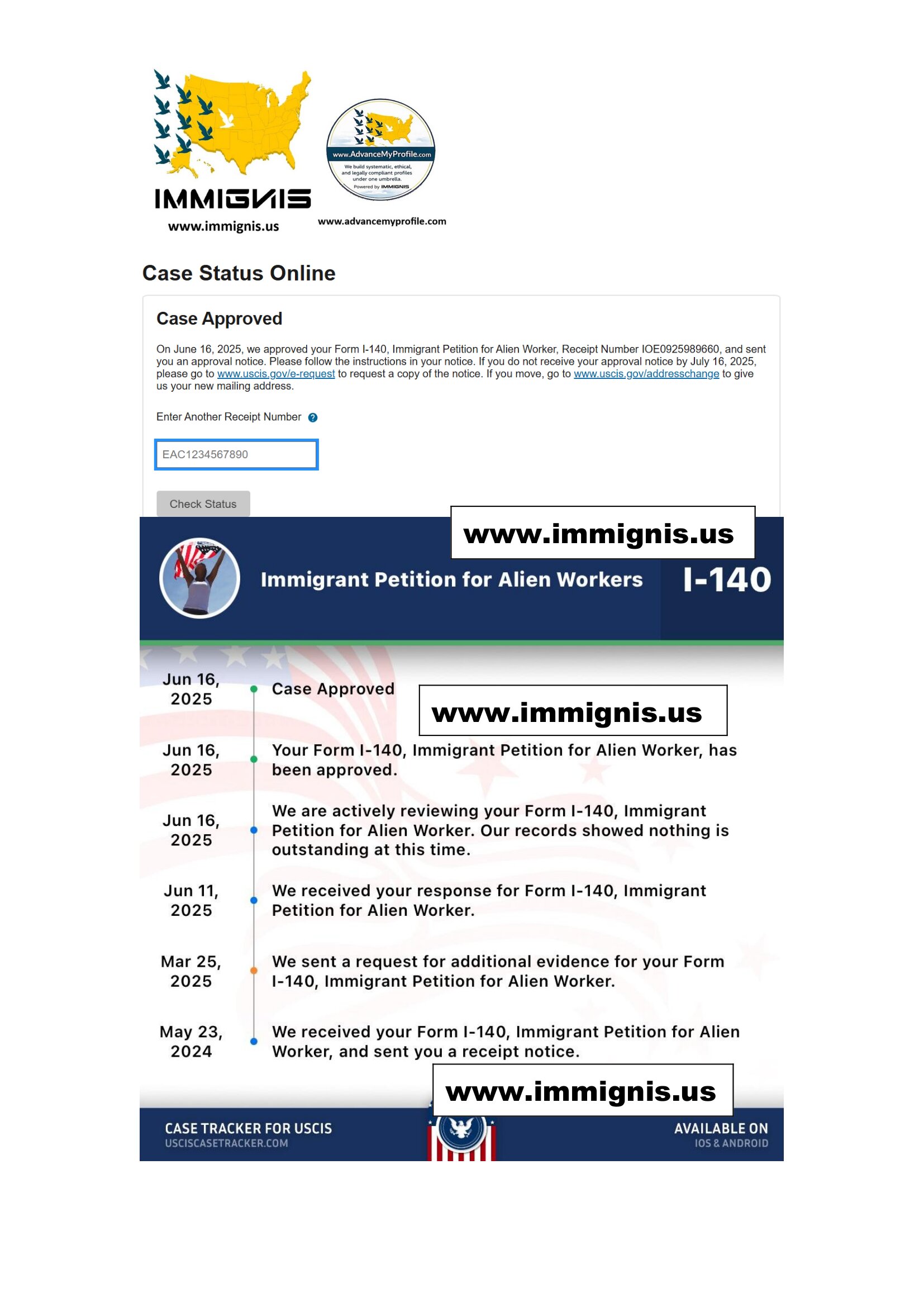
| Outcome | EB-2 NIW I-140 approved |
The Approval Result
This EB-2 NIW for Biomedical Engineers case ended with an EB-2 National Interest Waiver approval for a Pakistani biomedical engineer whose strongest record was not a traditional academic profile. His evidence came from biomedical equipment leadership, hospital infrastructure planning, clinical technology implementation, procurement intelligence, training, and multi-site deployment of patient-care systems.
The approval mattered in this EB-2 NIW for Biomedical Engineers case because the case did not reduce his work to medical-equipment sales or product management. The petition showed a broader national-interest contribution: helping underserved and rural hospitals select, deploy, sustain, and optimize advanced medical technologies in ways that support maternal-infant care, diagnostic access, operating-room efficiency, cost control, and patient safety.
The National Problem: Rural Hospitals Need Technology That Works in Real Conditions
Many rural and underserved hospitals need modern life-saving equipment, but equipment access alone is not enough in EB-2 NIW for Biomedical Engineers cases.
Hospitals also need cost-conscious selection methods, utilization planning, staff training, maintenance awareness, environmental efficiency, and long-term operational sustainability. A device that is purchased but poorly selected, poorly installed, underused, or unsupported does not solve the healthcare-access problem.
The case therefore treated biomedical technology as part of hospital capability for EB-2 NIW for Biomedical Engineers. Neonatal warmers were connected to infant survival and maternal-infant care. Low-flow anesthesia systems were connected to patient safety, cost control, reduced anesthetic waste, and lower emissions. Open MRI systems were connected to diagnostic access for claustrophobic, pediatric, geriatric, and underserved patients. Inventory and ROI tools were connected to data-driven procurement, waste reduction and sustainable facility planning.
The Proposed Endeavor
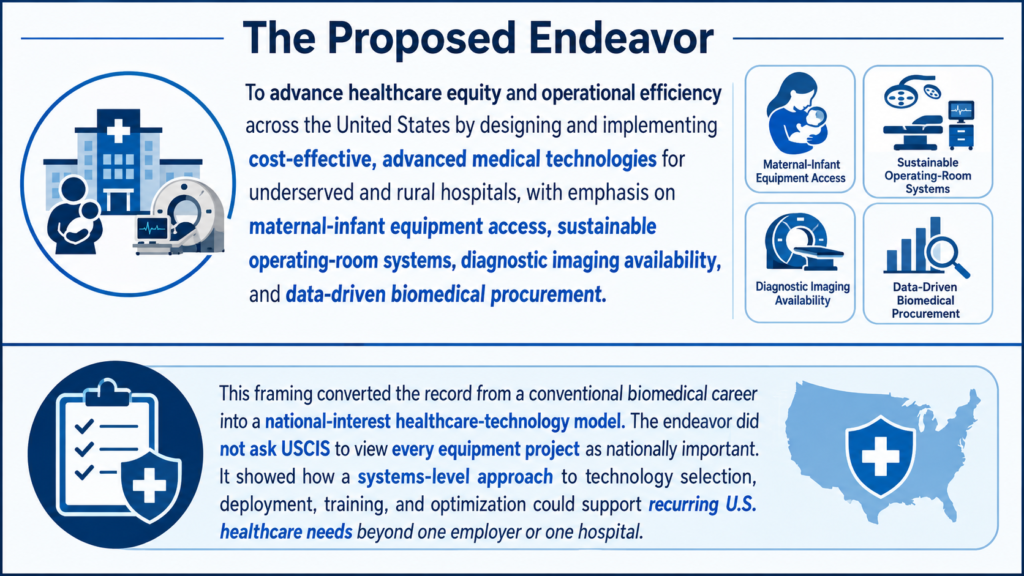
To advance healthcare equity and operational efficiency across the United States by designing and implementing cost-effective, advanced medical technologies for underserved and rural hospitals, with emphasis on maternal-infant equipment access, sustainable operating-room systems, diagnostic imaging availability, and data-driven biomedical procurement.
This framing converted the record from a conventional biomedical career into a national-interest healthcare-technology model. The endeavor did not ask USCIS to view every equipment project as nationally important. It showed how a systems-level approach to technology selection, deployment, training, and optimization could support recurring U.S. healthcare needs beyond one employer or one hospital.
What Immignis and AdvanceMyProfile Built
Maternal-infant and rural healthcare access: The record emphasized neonatal warming equipment, maternal-infant monitoring, rural hospital deployment, staff training, and underserved-community focus.
Sustainable and cost-efficient operating rooms: The petition connected low-flow anesthesia, gas-saving technology, OR utilization dashboards, emissions reduction, and resource-saving protocols to hospital efficiency and environmental responsibility.
Diagnostic access and hospital infrastructure modernization: Open MRI systems, lower-cost imaging models, site planning, AI-assisted image-enhancement concepts, and access for hard-to-scan patients were organized as part of the diagnostic-access argument.
Data-driven procurement and operational efficiency: Inventory systems, lifecycle cost tools, utilization mapping, equipment-selection protocols, international-standard adaptation, and green hospital assessment were used to show repeatable decision methods.
How the Evidence Supported Dhanasar
| Dhanasar prong | Evidence used | Strategic value |
| Substantial merit and national importance | Maternal-infant technology, rural access gaps, operating-room efficiency, open MRI access, equipment planning, and sustainability-focused deployment. | Showed the endeavor addressed patient safety, underserved healthcare access, cost control, hospital resilience, and healthcare-equipment modernization. |
| Well positioned to advance the endeavor | Biomedical engineering education, industrial management training, 17+ years of medical-technology experience, clinical equipment deployment, training, tender planning, and multi-site implementation. | Showed the petitioner had the technical and operational background to carry the proposed work forward. |
| Benefit of waiving job offer and labor certification | A proposed role as a solution architect, technical advisor, and systems integrator across hospitals, administrators, equipment manufacturers, and funding stakeholders. | Explained why the national-interest value was broader than a single employer-specific biomedical role. |
The EB-2 NIW for Biomedical Engineers Filing and Approval
In this EB-2 NIW for Biomedical Engineers case, The final petition was organized as an evidence architecture. The proposed endeavor explained the national healthcare-access and operational-efficiency problem. The project record showed medical-technology deployment in real clinical settings. The training, planning, procurement, and implementation evidence showed practical capacity. The Dhanasar analysis connected each item to the legal standard.
USCIS approved the EB-2 NIW I-140 in an EB-2 NIW for Biomedical Engineers case. The approval confirmed that a biomedical technology professional can build a strong national-interest case when the work is presented as a scalable healthcare-infrastructure contribution, not as routine sales, product distribution, or employer-specific equipment management.
What the Client Gained Beyond Approval
The approval was the immigration result, but the profile-building process also gave the client a clearer professional identity. His record could now be explained as a healthcare-technology modernization profile focused on underserved hospitals, rural access, maternal-infant systems, sustainable operating rooms, diagnostic availability, and data-driven biomedical procurement.
That clarity made his experience more useful for professional conversations with hospital administrators, medical-technology companies, rural healthcare stakeholders, funding partners, clinical engineering teams, and health-system innovation groups. The same structure that supported the petition also made the market value of his expertise easier to understand.
What Professionals Can Learn
- Large implementation experience can be strong NIW evidence when it is tied to national healthcare outcomes.
- Equipment deployment should be framed around patient safety, access, reliability, cost, and sustainability, not sales volume alone.
- Rural and underserved healthcare settings can create a strong national-importance narrative when the proposed solution is scalable.
- Technical experience, training, procurement strategy, and hospital workflow knowledge can together support a strong well-positioned argument.
- A biomedical technology professional does not have to be presented only as a researcher when the evidence shows systems-level healthcare impact.
- Ethical profile building documents real expertise. It does not manufacture a false profile or claim evidence the record cannot support.
Many biomedical engineers, healthcare technology managers, clinical engineers, and hospital-infrastructure professionals have stronger NIW potential than they realize. The challenge is often not the absence of experience. The challenge is the absence of a clear national-interest structure.
If your work involves medical equipment, hospital infrastructure, diagnostic systems, healthcare technology planning, clinical training, or biomedical procurement, the first question is whether your record can be connected to a broader U.S. healthcare need. A strong strategy begins by identifying what you already do, what can be documented, and how your proposed endeavor can serve patients, hospitals, and underserved communities beyond one employer.Start with a free, honest assessment through Immignis.us