Key facts at a glance
| Outcome | EB-1A approval for a Turkish ceramic artist modernizing Iznik techniques through contemporary ceramic works sold through design fairs and private collectors. |
| Approval date | Approved on March 10, 2026. |
| Field niche | Contemporary Iznik-inspired ceramics, with a focus on adapting Ottoman-era visual language, glazing traditions, pattern discipline, and ceramic form for modern collectors and institutions. |
| Starting problem | Sales were strong, but institutional recognition was thin. The record initially looked like a successful craft business rather than a documented artist with field-level recognition. |
| Profile-building path | Immignis and Advance My Profile built the record through museum acquisition evidence, craft-press features, juried international fair selections, workshop residencies, sales records, craft-council membership, and independent letters from curators, ceramic specialists, and design-fair professionals. |
| EB-1A evidence presented | Commercial success in the arts, display at artistic exhibitions or showcases, selective membership, published material, original artistic contributions, and independent expert evidence supporting final merits. |
| Approval hook | The petition elevated craft to documented art without losing the market evidence that made the artist’s work valuable in the first place. |
USCIS approved the Form I-140 petition on March 10, 2026.
The approval did not come from pretending that ceramics are more important when they leave the market and enter a museum. The case worked because it showed both sides of the artist’s standing: buyers valued the work, and cultural institutions and craft authorities could explain why it mattered.
The beneficiary was a Turkish ceramic artist EB-1A whose work drew from Iznik, the historic ceramic tradition associated with Ottoman visual culture, disciplined pattern, botanical forms, and luminous surfaces. Her pieces were selling through design fairs and private collectors. The problem was that sales alone did not tell USCIS whether she had risen to the top of her artistic field.
For EB-1A, commercial success can matter. But it must be documented, attributed, and explained in the context of the field. A strong sales record may show market demand. It does not, by itself, explain artistic originality, institutional recognition, or sustained acclaim.
Why a successful ceramic artist can still look ordinary on paper
Ceramic artists often live between categories. A gallery may treat the work as collectible design. A museum may discuss it as craft heritage. A buyer may purchase it for a private home. A design fair may place it beside furniture, lighting, jewelry, and textiles. None of those settings is wrong. The difficulty for EB-1A is that the record can become scattered.
This artist’s early file had strong proof that people bought the work. It had photographs, fair materials, private-collector references, invoices, and a recognizable aesthetic. What it did not yet have was a clear artistic narrative that tied the market activity to field-level recognition.
USCIS needed to understand the artist’s place in contemporary ceramics. Was she simply making decorative pieces that sold well, or was she contributing to a serious artistic conversation about Iznik technique, modern ceramic form, and the preservation and reinvention of Turkish visual heritage?
That distinction shaped the whole petition. The file had to respect the craft market while also showing that the work belonged in the language of artistic contribution, not only retail success.
The niche became contemporary Iznik-inspired ceramics
The profile was narrowed to contemporary Iznik-inspired ceramics. That niche gave the petition a stable frame. It avoided two weaker approaches: presenting the artist only as a ceramicist, which was too broad, or presenting her only as a seller of high-end craft objects, which would not fully explain artistic significance.
Iznik-inspired ceramics carry a visual and technical history. The record described the discipline of pattern, the controlled use of color, the relationship between surface and form, and the way contemporary artists may adapt historical motifs without merely copying them.
The petition did not claim that every piece reinvented Iznik. It identified the body of work in which the artist’s method was most visible: pieces that translated traditional motifs, glazing sensibility, and ceramic discipline into modern forms for design fairs, collectors, institutional audiences, and workshop settings.
This made the case easier to evaluate. USCIS did not need to decide whether one bowl, tile, or vessel was beautiful. It needed to review evidence showing whether the artist had become recognized within a defined artistic and craft-design field.
What USCIS needed to see in a ceramic-arts EB-1A case
For artists, EB-1A evidence must be built around the way the field recognizes achievement. In this case, the petition could not rely on a single type of proof. A sales record alone would not answer the institutional-recognition problem. A museum acquisition alone would not explain commercial success. A fair selection alone would not prove original contribution.
The record therefore had to work as a system. Juried fairs helped show selection by others in the field. Museum acquisitions helped show institutional recognition. Craft press features helped show public attention. Sales records helped show commercial success. Workshop residencies and craft council membership helped show professional standing. Independent letters explained why the artistic method mattered.
That combination was important because USCIS can look beyond criterion labels at final merits. Meeting several regulatory categories may still be weak if the evidence does not point to sustained acclaim and a level of expertise placing the person among the small percentage at the top of the field.
For this artist, the central question was not whether ceramics can qualify. They can. The question was whether her record showed recognized artistic standing rather than ordinary participation in a craft market.
Museum acquisitions changed the way the record was read
Museum acquisition evidence helped move the case beyond private sales. A private collector may buy a piece because it is beautiful, rare, useful, fashionable, or personally meaningful. A museum acquisition carries a different kind of value. It can show that an institution considers the work worth preserving, exhibiting, studying, or placing within a cultural or artistic collection.
The petition documented the acquisition record carefully. It identified the institution, the work acquired, the basis for the acquisition where available, and the relationship between the acquired work and the artist’s contemporary Iznik-inspired method.
This evidence was not overstated. A museum acquisition is not automatically proof of extraordinary ability. Its value depends on the institution, the context, the selection process, the role of the artist, and how the acquisition fits the broader record.
In this case, acquisition evidence gave curators and ceramic specialists a concrete basis for explaining why the work belonged in a recognized artistic conversation. It also helped USCIS see that the artist’s ceramics were not merely privately admired objects, but works with institutional value.
Juried fairs showed selection, not just participation
Design fairs and craft fairs can be difficult evidence. Some are highly selective; others are commercial marketplaces with limited screening. The petition separated juried international fair selections from ordinary booth participation.
For each fair, the record identified the selection process, the fair’s reputation, the category of work presented, and the artist’s role. Where the fair involved curators, jurors, or a competitive selection process, that evidence helped show recognition by the field rather than only rented display space.
The fair materials also helped document display. Programs, catalogues, booth records, photographs, invitations, and fair listings showed that her work was presented to relevant audiences in the ceramic, craft, and design worlds.
This mattered because artists outside traditional gallery systems often need to prove that their work was exhibited or showcased in the settings where their field actually operates. For contemporary craft, serious recognition may occur at juried fairs, design weeks, craft biennials, museum shops, institutional exhibitions, and specialized cultural programs.
Craft-press coverage explained the artistic method
Published material became important because the artist’s work needed outside interpretation. Images and sales records can show what was produced and what was purchased. They do not always explain why the work matters.
Craft press features and design publications helped fill that gap. The strongest coverage discussed her ceramics, her relationship to Iznik tradition, her technical choices, her contemporary forms, or her position within a modern craft and design conversation.
The petition did not treat every mention as published material about the artist. Short event listings, marketplace notices, and promotional blurbs were separated from substantive coverage. USCIS needed independent material that discussed the artist or her work in a meaningful way.
This distinction made the record more credible. The case did not ask the officer to accept publicity as acclaim. It selected the coverage that actually helped explain the artistic contribution.
Sales records were used as commercial success evidence
The artist had strong sales, but the petition had to present that evidence in a way USCIS could evaluate. Commercial success in the arts is not proved by simply saying that works sold. The record must show the nature of the sales, the level of demand, the market context, and where possible, how the prices or volume compare within the field.
The case used sales records carefully. It documented transactions, collector interest, fair sales, repeat buyers, and available pricing information without exposing unnecessary private details. Where confidentiality mattered, the file used disclosure-safe summaries and supporting letters.
The commercial-success argument was tied to the field. In contemporary ceramics, sales through serious design fairs, collector networks, and institutional channels can show market recognition when properly documented. But market demand had to be connected to the artist’s own work, not to a general trend in handmade ceramics or Turkish design.
This was one of the case’s strongest lessons. For artists, money is evidence only when it is organized. Sales become useful when they are attributable, verifiable, contextualized, and connected to the artist’s reputation.
Workshop residencies showed trust in her craft knowledge
Workshop residencies added another dimension to the record. They showed that institutions or programs did not only want to sell or display her work. They wanted her knowledge, method, and teaching ability in a setting where other artists, students, or craft professionals could learn from her.
The petition documented residency invitations, workshop descriptions, host institutions, participant audiences, and the technical subject matter taught. This evidence supported the view that the artist possessed specialized knowledge in contemporary Iznik-inspired ceramic practice.
The residencies were not presented as ordinary teaching. The record focused on selection, expertise, audience, and artistic method. A workshop is strongest for EB-1A when it shows that the artist was invited because of recognized skill or contribution, not merely because a class needed an instructor.
For this ceramic artist, workshop evidence helped connect her market success to field influence. She was not only producing objects. She was also transmitting technique, design judgment, and a contemporary approach to a historically rooted ceramic language.
Craft council membership helped only because the standards mattered
Membership evidence can be weak if the organization accepts anyone who pays dues. The petition therefore examined the craft-council membership carefully. It identified the admission or elevation standards, whether professional achievement was considered, and whether selection involved review by people with expertise in the field.
Where the membership showed selective professional recognition, it helped support the EB-1A record. Where an organization was primarily open enrollment, it was not treated as a major criterion.
This approach made the petition more disciplined. It avoided inflating ordinary affiliations while highlighting memberships that actually showed professional standing.
Original contribution was framed through technique, not slogans
The original-contribution argument could have become vague. It would have been easy to say that the artist “bridged tradition and modernity” and leave it there. That phrase sounds attractive, but USCIS needs evidence, not a museum wall slogan.
The petition instead explained the specific contribution: how the artist adapted Iznik-inspired motifs, glaze sensibility, pattern discipline, and ceramic forms for contemporary objects without reducing the tradition to decoration. It showed how curators, craft specialists, fair jurors, and collectors recognized that method.
Independent letters played an important role. They explained why her work was not simply derivative, why the technique had artistic discipline, and how her pieces contributed to the contemporary craft and design field.
The strongest letters avoided general praise. They identified works, methods, exhibitions, acquisitions, or market evidence and explained why those records indicated artistic standing.
How the EB-1A evidence came together
The approved petition worked because the evidence described one consistent artist rather than several disconnected activities.
• Commercial success: Sales records, fair sales, collector demand, and disclosure-safe pricing evidence showed meaningful market recognition for her ceramic work.
• Exhibitions and showcases: Juried international fair selections, institutional displays, and acquisition-related documentation showed that the work had been presented in serious craft and design settings.
• Published material: Craft-press and design-media features discussed the artist, her work, and her contemporary approach to Iznik-inspired ceramics.
• Membership: Craft-council evidence supported the case where admission or recognition standards showed professional achievement rather than open enrollment.
• Original contributions: Museum acquisition evidence, expert letters, craft-press discussion, and the artist’s documented method helped show a contribution to contemporary ceramic practice.
• Final merits: The petition connected market success, institutional recognition, public coverage, and expert analysis into a single record of sustained artistic standing.
That final synthesis was important. USCIS was not being asked to approve a craft seller. It was reviewing an artist whose commercial market, institutional record, and professional recognition all pointed in the same direction.
Why this approval matters for craft artists
This case is useful for artists whose work lives partly in the market and partly in cultural tradition. Ceramicists, textile artists, jewelry designers, calligraphers, woodworkers, glass artists, and other craft-based creators often face the same problem. Their strongest evidence may not look like a painter’s gallery record or a musician’s concert history.
That does not make the evidence weak. It means the petition must explain the field accurately. For a ceramic artist, relevant recognition may come from juried fairs, museum acquisitions, craft councils, institutional workshops, collector demand, design-media coverage, and technical peer respect.
The danger is to choose the wrong frame. If the case is framed only as craft sales, it may look commercial but not extraordinary. If it is framed only as heritage preservation, it may ignore the market evidence showing demand and contemporary relevance. The stronger approach is to show how the work functions as art, design, craft, and cultural practice at the same time.
That was the point of this petition. It elevated craft to documented art without treating the market as something to hide.
The result
USCIS approved the Form I-140 on March 10, 2026.
The final record showed a Turkish ceramic artist whose contemporary Iznik-inspired work had achieved recognition through sales, juried fair selection, museum acquisition, craft-press coverage, workshop residencies, professional membership, and independent expert analysis.
The approval turned a common arts-immigration problem into a structured record: strong market success, limited institutional recognition at first, and a field that required careful explanation. By the time the petition was filed, the evidence showed more than attractive ceramics. It showed an artist with a recognized place in contemporary ceramic practice.
Lessons for ceramic artists and craft-based creators considering EB-1A
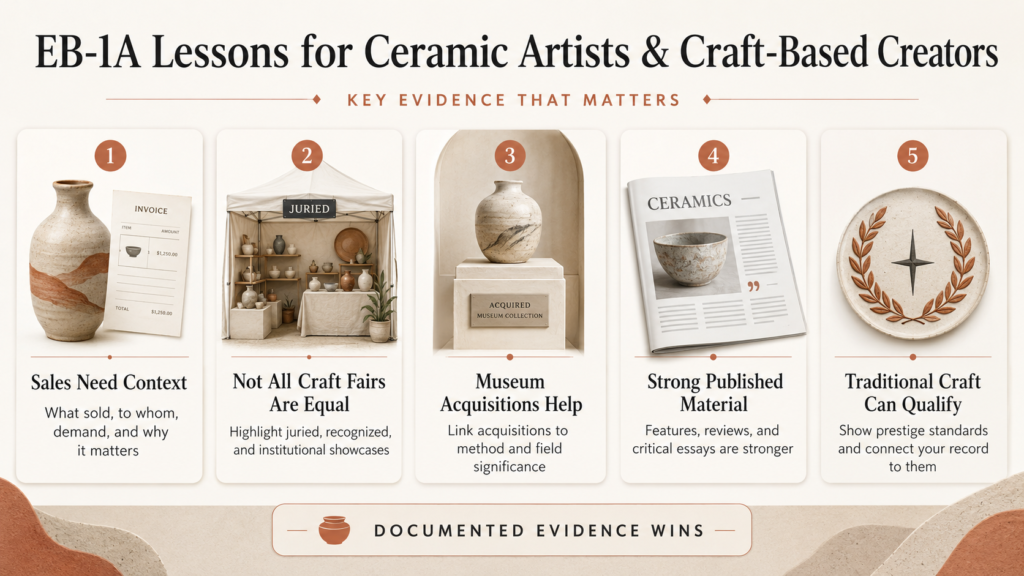
• Sales matter, but they must be documented with context. USCIS needs to understand what sold, to whom, at what level of demand, and why the sales reflect professional standing.
• Craft fairs are not all the same. Juried selections, recognized fair participation, and institutional showcases should be separated from ordinary retail events.
• Museum acquisitions can strengthen the record when they are documented and tied to the artist’s method and field significance.
• Published material should be substantive. Event listings and promotional blurbs are weaker than independent features, reviews, or critical essays about the artist or the work.
• Traditional craft can qualify for EB-1A when the petition explains the field’s standards of prestige and connects the artist’s record to those standards.
Frequently asked questions
Can ceramic artists qualify for EB-1A?
Yes. Ceramic artists may qualify when the record shows extraordinary ability in the arts through evidence such as exhibitions, commercial success, published material, awards, judging, selective memberships, original artistic contributions, or other comparable evidence where appropriate.
Are strong sales enough for an EB-1A artist case?
Strong sales can support commercial-success evidence, but they are usually not enough by themselves. The petition should document the sales, explain the market context, and connect the demand to the artist’s individual reputation and contribution.
Can craft fairs count as exhibitions or showcases?
They can help when the fair is juried, recognized, selective, or important within the field. Ordinary commercial booth participation is weaker. The evidence should explain the fair’s status, selection process, audience, and relevance to the artist’s field.
Do museum acquisitions help an EB-1A petition?
Yes, when documented properly. A museum acquisition can show institutional recognition, especially when the petition explains the museum’s relevance, the work acquired, and why the acquisition supports the artist’s standing in the field.
How can an artist prove original contribution?
Original contribution should be shown through specific works, methods, institutional recognition, expert analysis, press discussion, adoption, commissions, or market evidence. General claims that an artist is innovative are weaker unless supported by independent documentation.
Build an EB-1A record around the artistic value your craft already has
Many craft-based artists already have serious evidence, but it is scattered across sales records, fair catalogues, collector relationships, workshop invitations, museum files, and informal professional networks.
Immignis and Advance My Profile help artists identify a defensible field niche, document market and institutional recognition, organize evidence around the EB-1A criteria, and prepare a record that explains the artist’s standing without exaggeration.