Key facts at a glance
| Outcome | EB-1A approval for an Argentine bandoneon player whose reputation in tango circles was strong, but whose recognition initially lived in performances, collaborations, and oral reputation rather than formal paperwork. |
| Approval date | Approved on March 16, 2026. |
| Field niche | Bandoneon performance and tango orchestration, with a focus on the musical language, performance discipline, ensemble leadership, and interpretive authority of Argentine tango. |
| Starting problem | The beneficiary was revered in Buenos Aires circles, but the record did not yet show the kind of documented acclaim USCIS could evaluate. Festival history, recordings, collaborations, teaching lineage, and cultural recognition had to be reconstructed in writing. |
| Profile building path | Immignis and Advance My Profile built the record through festival headline documentation, reviewed recordings, letters confirming artistic collaborations, teaching lineage evidence, adjudication at tango competitions, cultural ministry recognition, and independent letters from tango scholars, organizers, and artistic directors. |
| EB-1A evidence presented | Artistic performance and showcase evidence, published material, judging, leading or critical role, original artistic contributions, and independent expert evidence tying the record together at final merits. |
| Approval hook | The petition taught USCIS what mastery means in a tradition that often preserves prestige through performance, mentorship, and community recognition rather than through conventional press packets. |
USCIS approved the Form I-140 petition on March 16, 2026.
The approval did not come from trying to make tango sound more modern than it is. It came from doing something more difficult: translating a deeply respected performance tradition into evidence that an immigration officer could review.
The beneficiary was an Argentine bandoneon player EB-1A, a musician trained in the instrument most closely associated with the sound of tango. In Buenos Aires performance circles, his name carried weight. Musicians knew his touch, dancers knew his phrasing, and younger players knew the lineage he represented. The problem was that reputation had not been organized into an EB-1A record.
That is common in traditional arts. A field may know who matters long before the paperwork does.
Why a respected tango musician can still look undocumented
In some artistic fields, recognition leaves a clean trail. A painter may have catalogues, museum exhibitions, sales records, and art criticism. A film actor may have credits, reviews, awards, and box-office data. A classical pianist may have competition records, recordings, orchestra engagements, and published reviews.
Tango can be different. Its hierarchy often lives in festivals, milongas, orchestras, recordings, teaching lineages, collaborations, and the quiet judgment of people who know the tradition. Musicians become known through who invites them, who trusts them on stage, who records with them, who asks them to teach, and who lets them interpret the music in front of serious dancers and listeners.
That kind of reputation can be real and still be difficult for USCIS to evaluate. The EB-1A petition cannot simply say that a musician is revered. It must show why the field treats the artist as important and how that recognition can be verified through documents.
For this bandoneon player, the original file had scattered proof: performance flyers, recordings, collaboration references, festival mentions, informal recommendations, and a long history of teaching and ensemble work. What it lacked was a clear explanation of the field and a disciplined record showing how those pieces fit together.
The field niche became bandoneon performance and tango orchestration
The first step was to avoid describing him only as a musician. That was too broad. It would have placed him beside every instrumentalist, teacher, arranger, accompanist, and ensemble performer, without explaining the artistic specificity of his work.
The record was narrowed to bandoneon performance and tango orchestration. That framing mattered because the bandoneon is not merely an instrument used in tango. It is one of the voices through which tango expresses tension, breath, restraint, pulse, and emotional timing.
A bandoneon player working at a high level must control phrasing, bellows pressure, articulation, rubato, ensemble balance, and the relationship between music and dance. In orchestration, the musician also shapes how the bandoneon interacts with strings, piano, bass, guitar, voice, and other instrumental lines.
The petition did not ask USCIS to become a tango expert. It gave USCIS enough context to understand why this niche has its own standards of mastery, and why recognition inside that field can be highly meaningful even when it does not look like mainstream pop-chart fame.
What USCIS needed to see in this performing arts EB-1A case
For a performing artist, EB-1A evidence must be built around the way the field actually recognizes excellence. A long list of shows is not enough. A musician can perform often without showing extraordinary ability. The question is whether the record shows recognition, selection, influence, and standing above ordinary participation.
The petition therefore focused on several evidence streams. Performance and showcase evidence documented festival headline roles, notable concert appearances, curated tango programs, and the artistic context of the stages where he performed. The point was not only that he played, but that organizers selected him for meaningful roles within recognized tango settings.
Published material required independent coverage. Routine event listings were separated from reviews, interviews, and articles that discussed the musician, the recordings, the performance style, or the significance of the artistic work. A serious review of a recording or festival performance could do what a flyer could not: it showed public critical recognition.
Judging evidence came from adjudication at tango competitions and related artistic events. This helped show that the field trusted him not only to perform, but to evaluate others.
Leading or critical role evidence was built through documented collaborations, festival roles, ensemble leadership, master classes, and letters from artistic directors. Original artistic contributions were explained through interpretation, orchestration, recordings, mentorship, and his role in sustaining and transmitting a specific tango practice.
At final merits, the evidence had to describe one coherent artist. The petition could not look like one file about a performer, another about a teacher, another about a festival guest, and another about a local cultural figure. It had to show the same bandoneon authority across all parts of the record.
Festival headline records gave performance evidence a hierarchy
One of the most important improvements was the way performance history was documented. Before profile building, performance proof was scattered across old programs, posters, social-media announcements, and memories of organizers or collaborators. That evidence showed activity, but it did not automatically show acclaim.
Immignis and Advance My Profile reorganized the record around hierarchy. Which performances were curated? Which festivals had a recognized place in the tango world? Which appearances placed him as a featured bandoneon player, headline performer, musical director, or principal collaborator? Which events involved international audiences or respected tango institutions?
This distinction mattered. A basic list of performances can make an artist look busy. A documented record of selected, curated, or headline appearances can show that the artist was chosen because of recognized ability.
The petition used programs, contracts where available, organizer confirmations, festival materials, and letters from artistic directors to show the level of the performances. It avoided inflating every event. The strongest appearances carried the argument; lesser appearances served as background.
Recordings and reviews helped turn sound into written evidence
A musician’s strongest work is often heard, not read. That creates a practical problem in EB-1A cases. USCIS can review recordings, but it still needs written evidence explaining why those recordings matter.
The record therefore connected recordings to reviews, liner notes, release documentation, collaborator letters, and expert interpretation. Where critics or music writers discussed the performance, the petition used that coverage to show independent recognition. Where recordings involved respected musicians or institutions, the record documented the collaboration and the beneficiary’s specific role.
This was especially important for the bandoneon. A listener unfamiliar with tango may not hear the difference between routine accompaniment and authoritative interpretation. Experts could explain how phrasing, attack, silence, tempo flexibility, and orchestral judgment changed the musical result.
The petition did not claim that every recording was historically significant. It selected the recordings that best showed his artistic voice and connected those recordings to outside recognition.
Collaboration letters showed authorship inside ensemble music
Tango is rarely a solitary art. The bandoneon player may perform inside an orchestra, accompany dancers, work with singers, arrange for ensembles, teach younger musicians, or lead smaller groups. That can make individual contribution difficult to see.
The petition addressed this through collaboration letters. The strongest letters did not merely say that he was excellent. They explained what he did: how he shaped arrangements, guided ensemble interpretation, influenced repertoire, stabilized performance quality, or carried a particular lineage of bandoneon technique into a project.
These letters were important because they separated participation from artistic authorship. In a group performance, USCIS may see many names on a program. The petition had to show why this person’s role mattered.
Letters from artistic directors, ensemble leaders, festival organizers, and respected musicians helped explain why his presence changed the performance. They also supported the leading or critical role argument when the record showed that a festival, recording, master class, or ensemble program depended on his artistic judgment.
Teaching lineage mattered because tango preserves knowledge through people
In many traditional arts, teaching is not secondary. It is one of the ways a field survives. A performer who transmits technique, repertoire, style, and interpretive discipline can influence the field beyond individual performances.
For this beneficiary, teaching-lineage documentation helped show the depth of his authority. The petition traced who he learned from, what tradition he represented, where he taught, who invited him to conduct master classes, and how students or younger musicians relied on him for bandoneon technique and tango orchestration.
This evidence was not presented as ordinary teaching employment. The petition focused on prestige and trust: master classes at recognized festivals, invitations from cultural institutions, mentorship of serious performers, and letters explaining why his instruction carried artistic weight.
That distinction was important. EB-1A does not reward teaching merely because a person teaches. It may recognize teaching evidence when it helps prove authority, influence, original contribution, or critical role in the field.
Judging at tango competitions showed trusted artistic judgment
The judging criterion can be powerful for performing artists when it is documented correctly. For this bandoneon player, adjudication at tango competitions and related artistic events showed that other professionals trusted him to evaluate quality in the field.
The record identified the competition or event, the judging role, the basis for selection, the type of work evaluated, and the artistic standards involved. This was not treated as a ceremonial title. The petition showed actual evaluation of competitors, performers, or submissions.
In a tradition like tango, judging can carry special meaning. It requires an understanding of rhythm, phrasing, tradition, improvisational sensitivity, ensemble relationship, and the connection between music and dance. That kind of judgment cannot be reduced to popularity.
The evidence therefore helped show that the beneficiary was not only recognized as a performer, but relied upon as an evaluator of others.
Cultural ministry recognition gave the record public institutional weight
Recognition from a cultural ministry or public cultural body can be valuable when it is documented and explained accurately. It can show that the artist’s work is not only known within a small circle, but has been recognized as part of a broader cultural heritage or artistic mission.
The petition used cultural ministry recognition carefully. It did not claim that every certificate or public acknowledgment was a major international award. Instead, it explained the purpose of the recognition, the institution involved, the connection to tango performance or preservation, and how it supported the broader record of professional standing.
This helped give USCIS a public frame for understanding why tango mastery matters. The bandoneon was not presented as an obscure personal hobby. It was presented as an art form with cultural significance, professional hierarchy, and recognized institutions.
Original contribution was explained without romantic exaggeration
The original-contribution argument was not built on generic praise. The petition did not rely on sentences such as “he is a legendary artist” or “his music touched audiences around the world” unless the evidence could support them. It explained his contribution through concrete artistic work.
That contribution included his interpretation of bandoneon repertoire, orchestration work, preservation and transmission of technique, influence on ensemble performance, and the role he played in connecting traditional tango language with contemporary stages and audiences.
Independent experts were central here. A USCIS officer may not know why a certain phrasing approach, orchestration decision, or teaching lineage matters. Experts could explain the difference between competent performance and recognized mastery within the tango field.
This made the record stronger because it avoided asking USCIS to feel the music. It gave USCIS evidence explaining how the field itself understood the musician’s contribution.
How the EB-1A evidence came together
The final petition worked because the evidence described one consistent artistic authority rather than a collection of unrelated activities.
• Performance and showcase evidence: Festival headline appearances, curated programs, concert documentation, and recognized tango settings showed that his work had been presented before meaningful audiences.
• Published material: Reviews, music features, interviews, and coverage of recordings or performances showed independent attention to the musician and his work.
• Judging: Adjudication at tango competitions and related artistic events showed that the field trusted his professional judgment.
• Leading or critical role: Festival roles, ensemble leadership, master classes, and artistic-director letters explained why programs or collaborations depended on his bandoneon expertise.
• Original artistic contributions: Expert letters and documentation connected his interpretation, orchestration, recordings, and teaching lineage to a recognized contribution in tango performance.
• Cultural recognition: Public cultural documentation helped place the work within a serious artistic tradition rather than an informal local scene.
Together, these materials answered the central question. The musician was not merely active in tango. He had achieved recognized authority within a defined artistic niche.
Why this approval matters for traditional artists
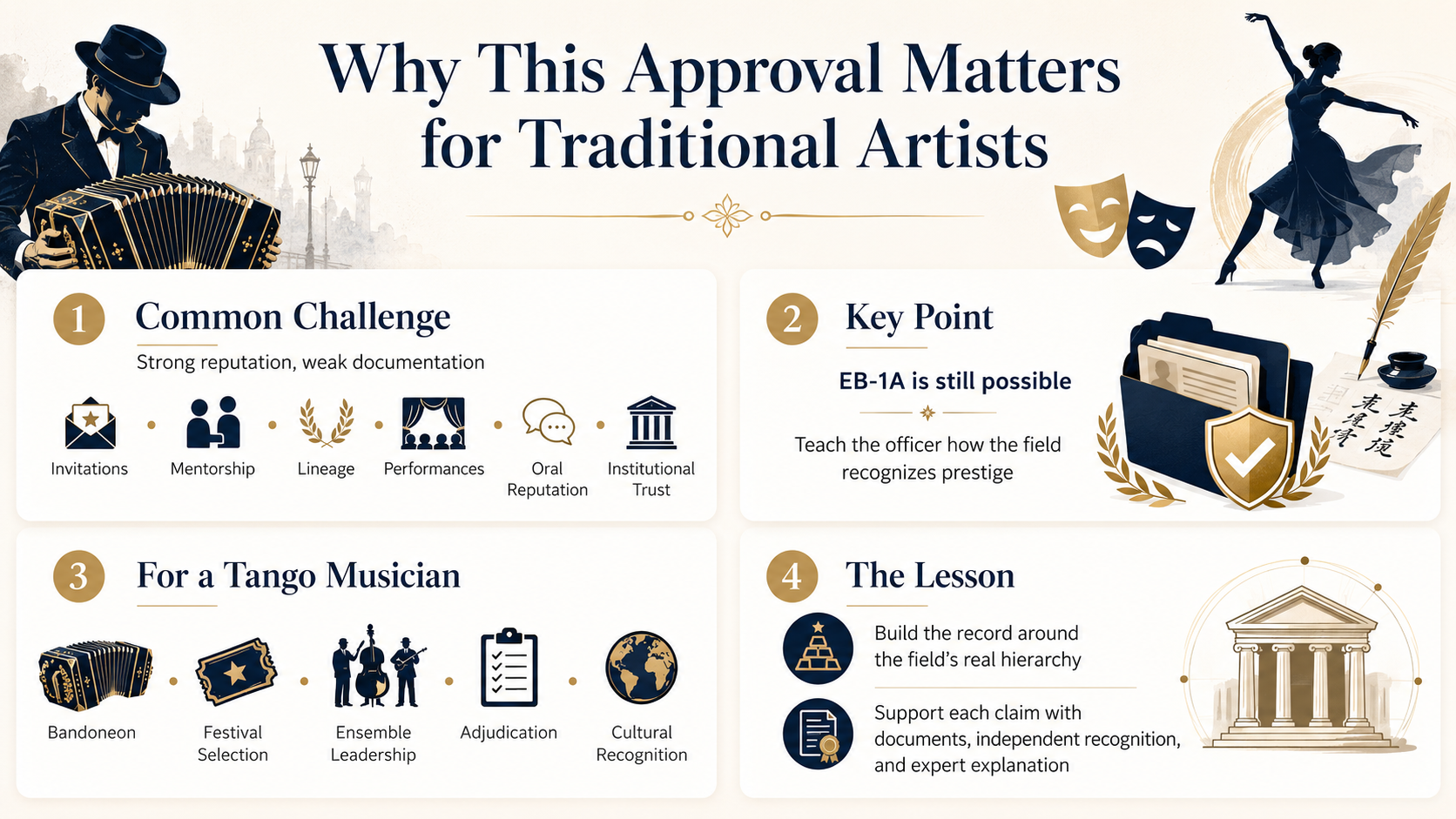
This case is useful for artists whose fields do not naturally produce neat documentation. Many traditional musicians, dancers, craft artists, calligraphers, theater practitioners, and folk-art specialists have strong reputations but weak files. Their fields may recognize excellence through invitations, mentorship, lineage, performances, oral reputation, and institutional trust rather than through searchable press databases.
That does not mean EB-1A is unavailable. It means the petition must teach the officer how the field recognizes prestige.
For a tango musician, the record had to explain the importance of the bandoneon, the meaning of festival selection, the role of ensemble leadership, the value of adjudication, and the weight of cultural recognition. It had to transform reputation into evidence without making the art artificial.
That is the lesson of the case. Traditional arts can qualify when the record is built around the field’s real hierarchy and when each claim is supported by documents, independent recognition, and expert explanation.
The result
USCIS approved the Form I-140 on March 16, 2026.
The approval reflected a record that made the artist’s standing visible in adjudicator-readable form. The petition did not try to replace tango’s oral tradition with artificial marketing language. It documented festival selection, recordings, reviews, collaboration evidence, teaching lineage, adjudication, cultural recognition, and expert analysis.
For an Argentine bandoneon player whose reputation had long existed in performance halls, rehearsal rooms, festivals, and tango circles, the central achievement was simple: the field’s knowledge finally became a record USCIS could read.
Lessons for musicians and traditional artists considering EB-1A
The strongest lesson is that talent is not the same as evidence. A respected musician may still need a disciplined profile-building process before filing EB-1A.
Artists should gather proof that answers practical questions: Who selected you? Who reviewed you? Who invited you to lead? Who asked you to judge others? Which institutions relied on your work? Which recordings or performances show your contribution? Which experts can explain your standing without using empty praise?
The more traditional the field, the more important documentation becomes. USCIS can evaluate oral tradition only after it has been converted into a written record.
This case showed that process clearly. The beneficiary did not become important because documents were created. The documents made existing artistic importance visible.
FAQs
Can a traditional musician qualify for EB-1A?
Yes, a traditional musician may qualify for EB-1A when the record shows sustained acclaim, recognized achievement, and evidence under the applicable criteria. The petition must explain how prestige works in that artistic field and provide documents that USCIS can evaluate.
Are performances enough for an EB-1A artist case?
Performances can help, but a long performance list is not automatically enough. Stronger evidence shows selection, prestige of the venue or festival, critical coverage, role in the performance, audience or institutional significance, and recognition by people who understand the field.
Can judging at music or dance competitions support EB-1A?
Yes. Judging may support EB-1A when the applicant actually evaluated the work of others in the same or an allied field. The record should document the event, judging role, selection basis, and type of artistic work reviewed.
How can an oral-tradition artist document acclaim?
An oral-tradition artist can document acclaim through festival records, institutional invitations, reviews, recordings, collaboration letters, cultural-recognition documents, teaching-lineage evidence, and independent expert letters that explain the field’s hierarchy.
Does EB-1A require mainstream fame?
No. EB-1A does not require mainstream celebrity. The record must show extraordinary ability and sustained acclaim in the relevant field. For a bandoneon player, recognition within the tango field may be more important than general public name recognition.
Build an EB-1A record around the recognition your artistic field already understands
If you are a musician, dancer, visual artist, performer, designer, or traditional culture practitioner, your strongest recognition may not look like a conventional resume. It may be found in festivals, commissions, recordings, lineages, jury invitations, cultural institutions, or the trust of respected peers.
Immignis and Advance My Profile help identify the evidence that belongs to your field, organize it into a credible EB-1A record, and prepare a petition strategy that USCIS can understand without flattening the art into generic claims.