
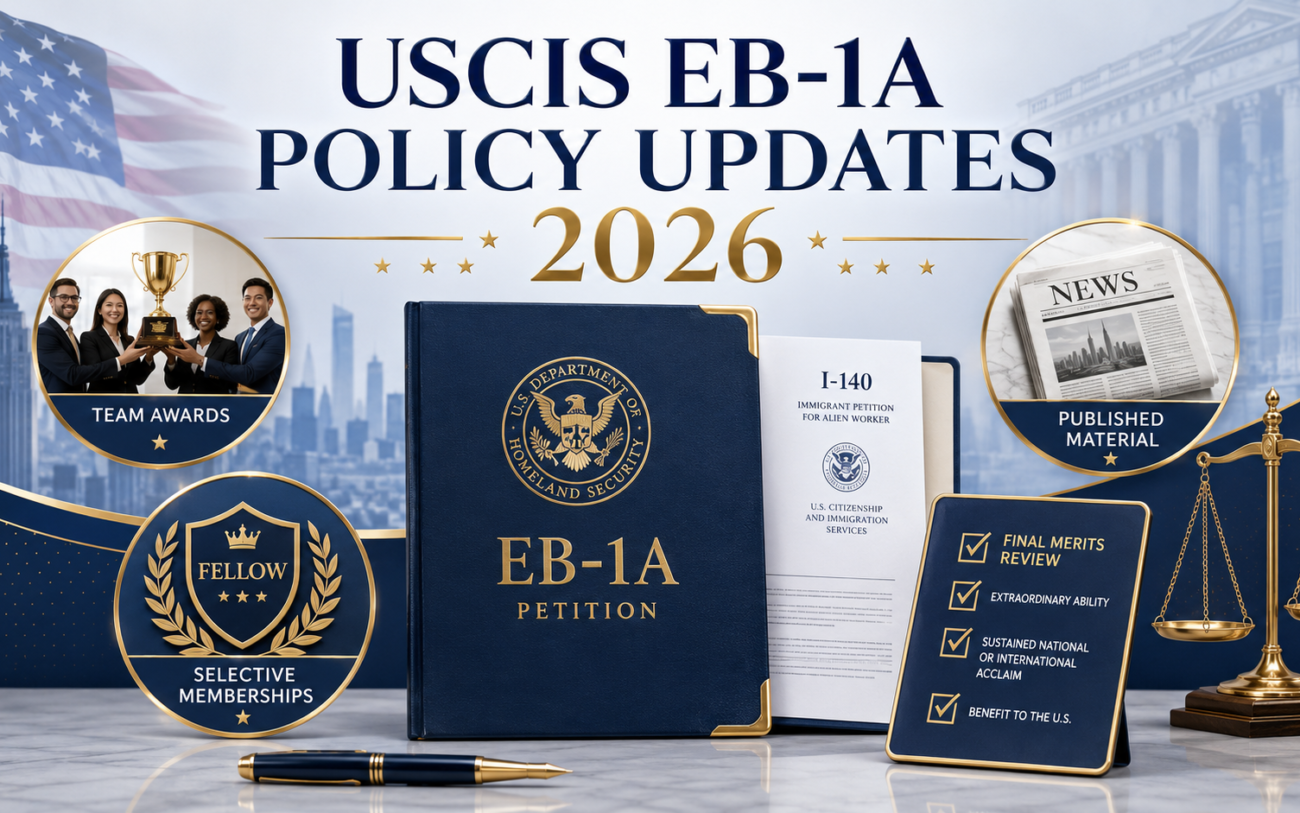
USCIS EB-1A Policy Updates in 2026: What Changed and How It Affects Extraordinary Ability Petitions
Last Updated on July 9, 2026 by Amelia
Written by Emily Carter, Immigration Law Specialist
Reviewed by Jonathan Miller, Esq., Licensed U.S. Immigration Attorney
USCIS EB-1A Policy Updates in 2026: What Changed and What Applicants Should Know
The EB-1A immigrant visa category, also known as the extraordinary ability green card category, remains one of the most powerful U.S. immigration options for high achieving professionals. It allows qualified applicants to self-petition without a U.S. employer sponsor and without PERM labor certification. However, EB-1A is still a demanding category. USCIS expects evidence of sustained national or international acclaim and proof that the applicant is among the small percentage who have risen to the very top of the field.
On October 2, 2024, USCIS issued important policy guidance clarifying how officers may evaluate certain types of EB-1A evidence. These updates remain highly relevant in 2026 because they affect how applicants should present team awards, past memberships, published material, and exhibition related evidence.
The most important point is this: the update did not create a lower EB-1A standard. It gave more clarity about how certain evidence can be considered. Applicants still need a carefully prepared petition that explains the quality, context, independence, and field level significance of their achievements.
What Changed in the EB-1A Policy Update?
| Policy area | What USCIS clarified | Practical meaning for applicants |
| Team awards | USCIS may consider a person’s receipt of team awards under the awards criterion. | A team award can help, but the petition must still prove the applicant was one of the recipients and had a meaningful role in the recognized work. |
| Past memberships | USCIS may consider present or past memberships under the membership criterion. | A former membership can still matter if admission required outstanding achievements judged by recognized experts. |
| Published material | USCIS removed language suggesting that published material must itself prove the value of the person’s work. | Media or professional coverage about the applicant and their work may satisfy the published-material criterion if it meets the rule’s requirements. |
| Exhibitions | USCIS clarified that the regulatory exhibition criterion is tied to artistic exhibitions. | Non-artistic showcases, demos, product displays, or technical exhibitions may need to be argued as comparable evidence where appropriate. |
| Final merits | USCIS still reviews the totality of evidence after the threshold criteria are addressed. | Meeting three criteria is not enough by itself; the full record must prove extraordinary ability and sustained acclaim. |
Why the 2024 USCIS EB-1A Update Still Matters in 2026
The policy update matters because modern achievement is often collaborative, interdisciplinary, and documented in ways that do not always fit old assumptions about individual awards or traditional media coverage. Scientists work in laboratories and cross institutional teams. Technology leaders build products with engineering groups. Healthcare innovators often work across clinical, data, and institutional teams. Creative professionals may contribute to award-winning productions through specialized roles.
USCIS recognized some of that reality by clarifying how certain evidence may be evaluated. However, the update should not be misunderstood as a shortcut. A petition must still prove that the applicant personally meets the EB-1A standard, even when part of the evidence comes from a team, organization, publication, or collaborative project.
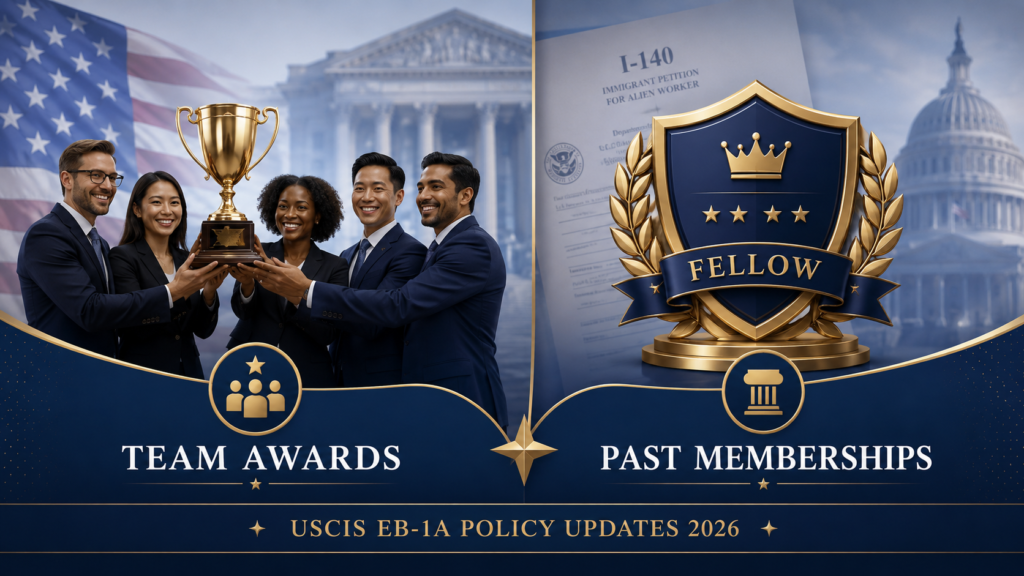
Update 1: Team Awards May Support the EB-1A Awards Criterion
A major clarification is that USCIS may consider a person’s receipt of a team award under the criterion for nationally or internationally recognized prizes or awards for excellence in the field. This is especially important for applicants in fields where major achievements are commonly produced by teams, such as artificial intelligence, biotechnology, aerospace, robotics, medicine, film, product design, advanced manufacturing, and climate technology.
This does not mean every team award will qualify. The petition should explain:
- The reputation and selectivity of the award.
- Whether the award is nationally or internationally recognized in the field.
- Whether the applicant was one of the actual recipients or an identifiable contributor.
- What role the applicant played in the recognized work.
- Why the applicant’s contribution was important to the team result.
For example, a software engineer who contributed to an award winning AI healthcare platform should not simply submit the team award certificate. The stronger approach is to include role documentation, technical contribution records, leadership confirmation, media or institutional recognition of the project, and expert explanation of why the applicant’s part was significant.
Update 2: Past Memberships May Count
USCIS also clarified that past memberships may be considered under the membership criterion. This is useful for applicants who previously held a selective membership, fellowship, academy status, or distinguished professional status but no longer hold it at the time of filing.
However, the membership must still meet the EB-1A standard. USCIS is not looking for ordinary professional memberships, paid memberships, student memberships, or memberships based only on education, years of experience, employment status, or subscription. The key question is whether the association required outstanding achievements of its members, judged by recognized national or international experts.
A strong membership claim should include:
- Membership bylaws or admission rules.
- Evidence of selectivity and acceptance rate where available.
- Proof that recognized experts judged the applicant’s achievements.
- Documents showing the specific level of membership held by the applicant.
- Evidence that the membership level was based on outstanding achievement, not payment or routine eligibility.
Update 3: Published Material About the Applicant Is Now Clearer
The published material criterion remains one of the most misunderstood EB-1A criteria. USCIS clarified that published material does not have to separately prove the value of the applicant’s work in order to satisfy this criterion. The rule focuses on published material about the applicant, relating to the applicant’s work in the field, in professional or major trade publications or other major media.
This clarification can help applicants whose media coverage describes their work, profile, projects, achievements, or professional role without using legal style language about “major significance.” However, applicants must still provide the required details, such as title, date, author, publication information, and translation where needed.
The strongest published material evidence usually shows:
- The article, interview, profile, or feature is about the applicant or substantially discusses the applicant’s work.
- The publication is professional, major trade, or major media in the relevant country or field.
- The coverage is independent and credible, not simply self-promotional or paid advertising.
- The article connects to the applicant’s field of extraordinary ability.
- The record includes publication metrics, audience, reputation, or industry relevance where available.
Update 4: Artistic Exhibitions Are Treated Differently From Non-Artistic Showcases
USCIS clarified that the exhibition criterion is tied to artistic exhibitions because the regulation expressly refers to artistic exhibitions or showcases. This matters for applicants in technology, science, engineering, business, and other non-artistic fields who previously tried to use conference demos, product launches, trade shows, pitch events, or technical showcases under the exhibition criterion.
For non-artistic applicants, these materials may still be useful, but they usually need to be presented under another criterion or as comparable evidence when properly supported. For example, a technology founder’s product showcase at a major industry event may support original contribution, leading role, commercial significance, or comparable evidence depending on the facts.
The Update Does Not Remove the Final Merits Review
A serious EB-1A petition cannot stop after claiming three criteria. USCIS still evaluates the totality of the evidence to determine whether the applicant has demonstrated extraordinary ability through sustained national or international acclaim.
This is where many weak EB-1A petitions fail. An applicant may submit evidence under awards, published material, and judging, but USCIS may still decide that the overall record does not show acclaim at the top level of the field.
In practical terms, a strong EB-1A petition should explain not only what evidence exists, but why the evidence matters. It should show the applicant’s level in the field, independent recognition, influence on others, and continuing professional direction in the United States.
The 10 EB-1A Evidence Criteria
Most EB-1A applicants do not have a one-time major internationally recognized award. Therefore, they usually attempt to meet at least three of the following ten regulatory criteria:
| No. | EB-1A criterion | 2026 evidence strategy |
| 1 | Nationally or internationally recognized prizes or awards for excellence | Explain the award’s selectivity, reputation, field relevance, and whether the applicant was an individual or team recipient. |
| 2 | Membership in associations requiring outstanding achievements | Show that admission required outstanding achievement judged by recognized experts; ordinary memberships are weak. |
| 3 | Published material about the applicant and their work | Provide independent coverage in major media, professional publications, or major trade publications with required publication details. |
| 4 | Judging the work of others | Show peer review, grant review, competition judging, editorial board service, conference review, or expert evaluation work. |
| 5 | Original contributions of major significance | Use adoption, citations, implementation, patents, standards influence, commercial use, policy use, or expert validation. |
| 6 | Authorship of scholarly articles | Provide publications, journal/conference quality, citations, field relevance, and author role where helpful. |
| 7 | Display of work at artistic exhibitions or showcases | Best for artists and creative professionals; non-artistic displays may require a comparable-evidence theory. |
| 8 | Leading or critical role for distinguished organizations | Prove both the organization’s distinction and why the applicant’s role was leading or critical. |
| 9 | High salary or high remuneration | Use reliable wage/salary comparison data and explain the applicant’s compensation level in the field and market. |
| 10 | Commercial success in the performing arts | Use sales, box office, streaming, distribution, rankings, audience metrics, or other recognized commercial measures. |
What These Updates Mean for Different Types of Applicants
Technology and AI Professionals
Team awards, product recognition, technical implementation, patents, peer review, conference roles, and media coverage can be valuable. The petition should separate the applicant’s personal contribution from the team’s general success.
Researchers and Scientists
Publications, citations, peer review, memberships, grants, awards, invited talks, and independent expert letters remain important. A team award can help if the applicant’s specific role in the research achievement is documented.
Healthcare and Biotech Professionals
Clinical innovation, research adoption, health system implementation, patents, publications, and institutional recognition can support the case. The evidence should show influence beyond ordinary employment duties.
Entrepreneurs and Business Leaders
EB-1A business cases should be carefully documented through company growth, investment, revenue, media, awards, industry adoption, leadership roles, judging, high remuneration, or original business contributions. USCIS will not treat ordinary company ownership as extraordinary ability by itself.
Creative Professionals
Artistic exhibitions, awards, media coverage, commercial success, leading roles, and critical recognition may be central. For film, design, music, visual effects, and performing arts, team awards can be useful where the applicant’s creative or technical contribution is clear.
Common Mistakes After the USCIS EB-1A Policy Update
- Assuming the policy update made EB-1A easy.
- Submitting a team award without proving the applicant’s specific contribution.
- Claiming a membership that was based only on payment, education, employment, or years of experience.
- Using paid promotional articles as if they were independent major media coverage.
- Treating non-artistic conference demos as artistic exhibitions without a proper comparable evidence argument.
- Meeting three criteria on paper but failing to build a persuasive final merits argument.
- Using generic recommendation letters that praise the applicant but do not explain field level significance.
- Ignoring Visa Bulletin realities and assuming EB-1A approval automatically means immediate green card availability.
How to Use the Policy Update in a Strong EB-1A Petition
The strongest use of the policy update is not simply mentioning it. The petition should use the clarification to organize the evidence more intelligently. A strong petition strategy may include:
- Identify which EB-1A criteria are genuinely supported by the applicant’s record.
- Separate individual achievements from team or employer achievements.
- Add objective context for awards, memberships, publications, and leadership roles.
- Use expert letters to explain the field-level importance of the applicant’s contributions.
- Connect the evidence to sustained national or international acclaim.
- Build a final merits section showing why the total record places the applicant among the top professionals in the field.
- Confirm Visa Bulletin timing before relying on EB-1A as a faster green card route.
Does the EB-1A Policy Update Help Applicants Moving From EB-2 NIW to EB-1A?
Yes, it can help some applicants, but only if their evidence supports the higher EB-1A standard. Many EB-2 NIW applicants already have strong evidence of national importance, publications, projects, patents, expert support, or leadership. Some of that evidence may be reused or reframed for EB-1A, but the legal focus changes.
EB-2 NIW asks whether the proposed endeavor has national importance and whether the applicant is well positioned to advance it. EB-1A asks whether the applicant has extraordinary ability demonstrated by sustained national or international acclaim. The policy update may create more ways to present evidence, but it does not convert an NIW approval into an EB-1A approval.
How Immignis Can Help
Immignis helps professionals, entrepreneurs, researchers, executives, and high achieving individuals assess whether their record may support EB-1A, EB-2 NIW, or a staged strategy from NIW to EB-1A.
Our work focuses on evidence mapping, profile analysis, petition strategy, recommendation letter planning, expert letter coordination, RFE response strategy, and long-term profile building. For EB-1A applicants, the goal is not to collect random documents. The goal is to build a coherent record that shows recognized achievement, field level impact, and a credible path to continued work in the United States.
Conclusion
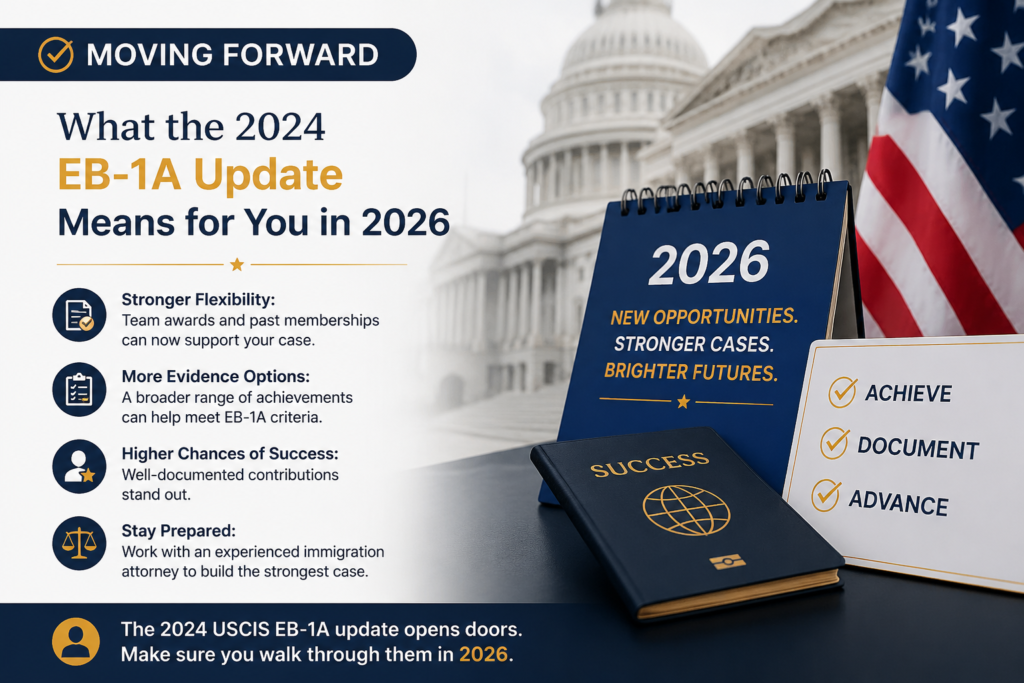
The USCIS EB-1A policy update is important because it recognizes that extraordinary ability can be documented through modern forms of achievement, including team awards, past selective memberships, and clearer published-material evidence. It also reminds applicants that evidence must be presented in context.
For 2026 applicants, the safest interpretation is this: USCIS has clarified how certain evidence may count, but the EB-1A standard remains high. A successful petition still needs a strong legal theory, credible documentation, independent recognition, and a persuasive final merits argument.
If you are considering EB-1A or evaluating whether your existing NIW profile can be developed into an extraordinary ability case, Immignis can help you review your evidence and design a strategy that fits your field, achievements, and immigration timeline.
Did USCIS make EB-1A easier?
Not exactly. USCIS clarified how certain types of evidence may be considered. The extraordinary ability standard remains high, and applicants must still prove sustained national or international acclaim.
Can a team award help an EB-1A petition?
Yes. A team award may help under the awards criterion if the applicant was one of the recipients and the petition explains the applicant’s specific contribution and the award’s recognition in the field.
Can past membership count for EB-1A?
Yes. USCIS may consider past membership, but the membership must still require outstanding achievements judged by recognized experts. Ordinary paid memberships usually do not carry much weight.
Does published material need to prove the value of my work?
The USCIS update removed language suggesting that published material must independently demonstrate the value of the applicant’s work. The publication must still be about the applicant and their work, and it should be from a qualifying professional, trade, or major media source.
Can a technology demo or conference showcase count as an exhibition?
Usually not under the artistic exhibition criterion unless the work is artistic. For non-artistic fields, a conference showcase, product demo, or trade show may be useful under another criterion or as comparable evidence.
Is meeting three EB-1A criteria enough?
No. Meeting three criteria is only the threshold step. USCIS still evaluates the totality of the evidence to determine whether the applicant has extraordinary ability and sustained acclaim.
Can EB-1A be filed without an employer?
Yes. EB-1A allows self-petitioning and does not require a job offer or PERM labor certification.
Does EB-1A approval guarantee immediate green card availability?
No. The applicant must still have an available immigrant visa number based on the Visa Bulletin and must complete adjustment of status or consular processing.


Comments
EB-1A and EB-2 NIW in 2026: Trends, Backlogs, Hope
April 2, 2026 - 11:42 am[…] practical terms, a stronger EB-1A and EB-2 NIW strategy in 2026 is built on evidence, not volume. The strongest cases are […]
EB-1A and EB-2 NIW in 2026: Why Skilled Immigrants Should Still Be Hopeful – Ags
June 24, 2026 - 9:59 am[…] practical terms, a stronger EB-1A and EB-2 NIW strategy in 2026 is built on evidence, not volume. The strongest cases are […]
EB-1A Scholarly Articles Criterion: Proven Evidence USCIS Counts
August 6, 2026 - 7:19 am[…] The EB-1A scholarly articles criterion is winnable across academic and non-academic fields when the evidence is built correctly: each publication venue documented with independent prestige evidence, citations separated by independence and contextualized with expert letters, and the comparable evidence provision invoked properly when the field operates outside the traditional journal model. Quality of venue and documented impact of the work (not volume) are what survive final merits scrutiny. […]
EB-1A High Salary Remuneration Criterion: Proven BLS Guide
August 17, 2026 - 9:26 am[…] the 90th percentile is not written into the regulation and is not an official USCIS threshold. The USCIS Policy Manual uses the language “significantly high remuneration” and evaluates whether the […]
EB-2 NIW Well Positioned Prong 2: Essential Evidence Guide
August 19, 2026 - 6:42 am[…] petitioners who succeed on Prong 2 in 2026 are not necessarily the most credentialed. They are the ones who have built a documentation package […]