How an Uzbek EB-1A agricultural scientist secured approval by turning sensor based irrigation methods, salinity management work, farm adoption, water savings and yield records, scientific publications, international irrigation roles, development agency validation, and ethical immigration specific profile building into a petition ready record of extraordinary ability.
Key facts at a glance
| Petition outcome | Form I-140 approved under EB-1A on January 28, 2025. |
| Professional profile | Uzbek agricultural scientist designing sensor based irrigation methods for water stressed cotton, wheat, and horticultural systems in arid and salt-affected farming environments. |
| Field niche | Precision irrigation and salinity management in arid agriculture. |
| Starting weakness | Farmers and regional programs used the methods, but practical adoption was easier to see than the petitioner’s individual scientific authorship, international recognition, or field level standing. |
| Profile-building focus | Farm-adoption documentation, water savings and yield records, salinity management evidence, agricultural science publications, international irrigation network roles, development agency letters, conference participation, media coverage, and careful attribution of technical responsibility. |
| Principal EB-1A evidence areas developed | Original contributions of major significance, authorship of scholarly articles, leading or critical role, qualifying published material, and achievement based professional membership where supported. |
| Central issue | Showing that methods used by farmers and regional programs were not ordinary extension work, but identifiable scientific contributions that improved how scarce water and salt-affected soils were managed. |
| Approval lesson | Applied agricultural work becomes stronger EB-1A evidence when adoption, measurable results, authorship, professional reliance, and independent recognition are connected to the scientist rather than left attached only to farms, programs, or institutions. |
The evidence was growing in the fields, not in a citation database
The petitioner’s strongest record did not begin with a famous laboratory or a large citation count. It began with irrigation decisions made under real constraints: limited water, uneven soil conditions, salinity, changing weather, and crops that could not wait for a perfect research environment. Farmers and regional programs were using the methods because the methods worked in practice.
That practical success created an unusual immigration problem. The work was visible through healthier fields, better irrigation timing, water conserved, yields protected, and salt affected land managed more intelligently. Yet the scientist’s name was not automatically attached to every farm result, training program, sensor installation, or regional recommendation.
USCIS approved the Form I-140 petition on January 28, 2025. Immignis and Advance My Profile organized the case around one central task: turn dispersed field adoption into a personal scientific record that could be evaluated under the EB-1A framework without exaggerating what belonged to the petitioner, the farming program, or the participating institutions.
Why precision irrigation creates a difficult EB-1A evidence problem
Precision irrigation combines agronomy, soil science, plant water relations, field sensing, data interpretation, irrigation engineering, and farm management. A useful method may involve soil moisture sensors, crop-stage thresholds, salinity measurements, weather information, irrigation scheduling, and adjustments for different soils or crops. Its value appears when those parts work together in a field, not merely when one component performs well in isolation.
This makes individual attribution difficult. A regional program may involve scientists, extension officers, equipment providers, local authorities, farm managers, and growers. The public result may be credited to the program as a whole. For EB-1A purposes, however, program importance does not establish that one scientist made an original contribution of major significance.
The petition therefore defined the field precisely as precision irrigation and salinity management in arid agriculture. This was narrower than general agricultural science and more accurate than describing the petitioner only as an irrigation specialist. The field definition gave the evidence a common thread: using scientific measurement and decision rules to protect production where water scarcity and salt accumulation threaten long-term farming viability.
Adoption mapping connected the method to the scientist
The first major step was to map where the petitioner’s methods had moved from research into use. The record identified the farms, demonstration sites, training programs, cooperatives, regional initiatives, or technical teams that relied on the work, while protecting confidential or identifying details where necessary.
Adoption alone was not treated as proof. Each example needed a chain of attribution: what method was used, how the petitioner developed or refined it, who implemented it, when it entered practice, and why the users considered it useful. Project records, technical protocols, training materials, correspondence, program reports, and letters from people with direct knowledge helped establish that chain.
This approach prevented a common weakness in applied science cases. The petition did not merely state that farmers benefited. It showed how specific scientific decisions attributable to the petitioner changed irrigation scheduling, monitoring, or salinity management across identifiable settings.
Water savings and yield records made practical influence measurable
Field adoption becomes more persuasive when the result can be evaluated. The case therefore organized available records on water use, irrigation frequency, soil moisture, crop performance, yield stability, input efficiency, or recovery of stressed plots. Where figures were confidential or not directly comparable, the petition used cleared summaries and explained the measurement conditions.
The evidence did not treat every improvement as proof of the petitioner’s method. Agricultural results can be affected by weather, seed, soil, management, pests, and many other variables. Strong documentation identified the baseline, the intervention, the observation period, and the basis for connecting the result to the irrigation approach.
This made the original contributions argument more credible. The significance was not based on broad statements that water is important. It came from evidence that other professionals and users relied on the petitioner’s methods to make better decisions in water stressed production systems.
Salinity management gave the case a second layer of scientific significance
In arid agriculture, irrigation is not only about delivering enough water. Poorly managed irrigation can move salts through the soil profile, concentrate them around roots, or gradually reduce productivity. A method that saves water but worsens salinity may create a new problem while solving the first one.
The petition therefore treated salinity management as a substantive scientific contribution rather than a secondary detail. It documented how sensing, irrigation timing, leaching decisions, drainage considerations, crop selection, or field monitoring were used to manage both immediate water demand and longer term soil condition.
This helped explain why the work mattered beyond one harvest. The petitioner’s contribution addressed the continued usability of agricultural land, not simply short-term irrigation efficiency. That broader technical function strengthened the argument that the work had significance within the defined field.
Publications turned field methods into a durable scholarly record
The publication record gave USCIS a public and reviewable account of the science. Articles connected to precision irrigation, sensor based scheduling, crop water response, salinity, soil monitoring, or arid land production helped show that the petitioner was not only assisting farmers but also contributing to the formal knowledge base of the field.
The case distinguished authorship from adoption. A paper supported the scholarly articles criterion because the petitioner wrote it. Farm or program use supported original contribution because others relied on the work. The two forms of evidence reinforced each other, but they were not treated as interchangeable.
Where the research involved several authors, the record explained the petitioner’s role in study design, field methodology, data interpretation, protocol development, or scientific writing. This was important because a long author list can show collaboration without revealing who shaped the contribution at issue.
Development agency and institutional letters supplied attribution
Letters from development programs, agricultural institutions, cooperatives, or technical partners helped connect regional use to the petitioner’s personal work. The strongest letters identified the writer’s basis of knowledge, the method or program involved, the petitioner’s responsibility, and the practical reason the organization relied on the expertise.
The letters did not rely on praise alone. They explained what problem existed, what the petitioner contributed, how the work was implemented, and what changed afterward. Independent experts provided field context, while witnesses involved in adoption supplied direct attribution.
This division of roles made the record more reliable. A person who worked with the petitioner could explain the facts of implementation. An independent specialist could explain why those facts mattered within precision irrigation and salinity management.
International irrigation roles and conference platforms showed recognition beyond local use
The case also documented participation in international irrigation networks, technical groups, conferences, or cross border agricultural forums. These activities mattered when they reflected selection, technical responsibility, invited expertise, or sustained contribution rather than simple attendance.
Conference presentations gave the petitioner a platform to explain methods and results to professional audiences. Committee or network roles showed that expertise developed in one region was relevant to wider discussions about water scarcity, soil degradation, crop resilience, and efficient agricultural production.
Membership evidence was handled carefully. Ordinary paid or open membership was not presented as satisfying the regulatory criterion. Where admission or appointment depended on achievement and expert evaluation, the record documented the selection requirements and the petitioner’s actual role.
Media coverage made the scientist visible without turning the story into promotion
Published material can help when it is genuinely about the petitioner and the petitioner’s work. The case used qualifying agricultural, sustainability, or regional development coverage to explain why the scientist’s methods attracted attention and how the work related to water security and productive farming.
The petition separated this coverage from articles written by the petitioner. It also avoided treating every program announcement or institutional webpage as independent media. The useful material contained substantive discussion, identifiable attribution, and enough context to show professional recognition outside the petitioner’s own publications.
The final merits argument connected practical use with scientific standing
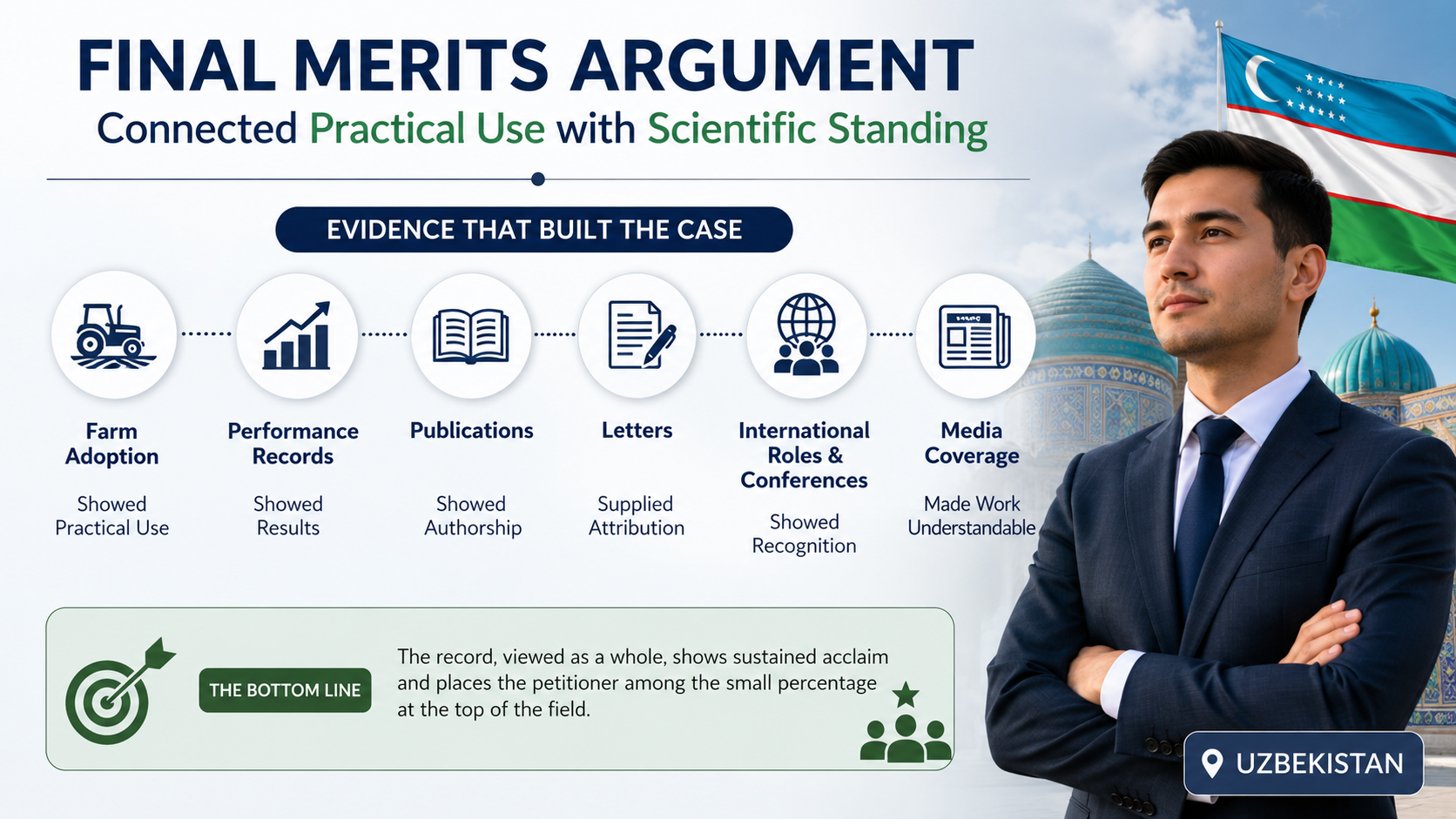
No single document carried the case. Farm adoption showed use. Performance records showed results. Publications showed authorship. Letters supplied attribution. International roles and conferences showed professional recognition. Media coverage made the work understandable to readers outside the immediate technical circle.
Together, those materials addressed the more difficult question at final merits: whether the petitioner’s record, viewed as a whole, showed sustained acclaim and placement among the small percentage at the top of the field. The case did not ask USCIS to treat regional relevance as a substitute for extraordinary ability. It showed how regional work had become scientifically attributable, adopted, measurable, and professionally recognized.
Why this case worked
The field was defined narrowly enough for the evidence to make sense. Precision irrigation and salinity management provided a clear standard for evaluating sensor methods, water records, farm adoption, publications, and professional roles.
The strongest practical results were not left as anonymous program outcomes. Adoption mapping and direct letters connected them to the petitioner while preserving the contributions of teams and institutions.
The petition used different evidence for different legal purposes. Authored research supported scholarly articles. Third party use and measurable results supported original contribution. Organizational responsibility supported leading or critical role. Coverage about the petitioner supported published material. Selective professional roles supported membership only where the admission standard was documented.
Most importantly, the record explained why agricultural impact should be measured in the forms natural to the field: methods adopted, water managed, salt-affected land protected, crops sustained, and professionals relying on the scientist’s judgment.
What agricultural scientists can learn from this approval
Applied researchers should preserve evidence while work is being implemented. Protocol versions, sensor plans, training records, adoption confirmations, baseline data, outcome summaries, and authorship documentation are much easier to use when collected contemporaneously rather than reconstructed years later.
Scientists should also separate institutional visibility from personal contribution. A successful agricultural program may be excellent evidence, but the petition must still show what the individual developed, decided, authored, reviewed, or led.
Profile building should strengthen a truthful record, not manufacture acclaim. Useful steps may include publishing legitimate research, documenting adoption, accepting genuine peer-review work, presenting at relevant conferences, and obtaining accurate letters from people who directly relied on the work.
Frequently asked questions
Can an agricultural scientist qualify for EB-1A?
Yes. EB-1A is not limited to laboratory researchers or globally famous academics. The evidence must satisfy the regulatory framework and, taken together, show sustained acclaim and that the person is among the small percentage at the top of the field.
Can farm adoption prove an original contribution of major significance?
It can help when the method is attributable to the petitioner, used beyond a private experiment, and supported by credible evidence of professional reliance or measurable effect. Adoption should be documented rather than asserted.
Are water savings or yield figures enough by themselves?
Usually not. Figures need context, a reliable source, a relevant baseline, and a defensible link to the petitioner’s method. Weather, crop variety, soil, and management conditions should not be ignored.
Can confidential farm or program records be used?
Potentially. The record can use redacted documents, cleared summaries, authorized letters, and non-confidential technical explanations. Confidentiality does not eliminate evidence, but it requires careful handling.
Do scholarly articles and published material mean the same thing?
No. Scholarly articles are works authored by the petitioner. Published material generally refers to qualifying coverage written about the petitioner and the petitioner’s work. They should be organized separately.
Does ordinary membership in an irrigation or agricultural society satisfy EB-1A?
Not automatically. The membership criterion requires evidence that admission demanded outstanding achievements judged by recognized experts. Open or fee-based membership may still provide context but usually does not satisfy that criterion alone.
Can conference presentations help?
Yes, particularly when the petitioner was invited, competitively selected, or given a substantive technical role. Attendance alone is less persuasive than evidence of presentation, panel service, or technical responsibility.
How can a scientist prove a leading or critical role in a regional program?
The record should identify the distinguished reputation of the organization or project and show which decisions, methods, work packages, approvals, or outcomes depended on the scientist’s expertise.
Does EB-1A require a permanent U.S. job offer or labor certification?
No. EB-1A does not require a permanent job offer or labor certification, and an eligible person may self-petition. The person must still intend to continue working in the area of extraordinary ability in the United States.
How does EB-1A differ from EB-2 NIW for an irrigation scientist?
EB-1A focuses on extraordinary ability and sustained acclaim. EB-2 NIW requires EB-2 qualification and a showing that waiving the job offer and labor-certification requirements is in the national interest. The better route depends on the person’s evidence and proposed U.S. work.
How can ethical profile building help an applied agricultural scientist?
It can organize existing evidence, improve attribution, document adoption, develop legitimate publications and peer-review service, preserve outcome records, and build professional visibility without inventing results or purchasing recognition.
Make the science behind the harvest visible
A strong precision irrigation record may already exist across farm files, sensor protocols, program reports, field data, publications, conference programs, network appointments, media coverage, and the testimony of professionals who relied on the work.