EB-2 NIW Approval for a telecommunications and cybersecurity leader built an approved National Interest Waiver case around secure 5G, B5G, 6G, AI-driven threat detection, and critical infrastructure protection.
| Client profile | Egyptian telecommunications and cybersecurity professional residing in the United States, with advanced degrees from NYU Tandon and the University of Bradford. |
| Professional base | 20+ years across telecommunications, cybersecurity, 5G strategy, network optimization, regional technology leadership, and executive business development. |
| Proposed endeavor | Establish and operate a National 5G Cybersecurity Center in the United States to secure 5G networks and support future B5G, 6G, and B6G technologies using AI, Big Data analytics, advanced encryption, and intrusion-detection methods. |
| Core national value | Protection of 5G networks, IoT systems, autonomous vehicles, smart cities, healthcare networks, transportation systems, and other critical digital infrastructure. |
| Profile-building focus | Telecom leadership, cybersecurity expertise, SOCAS Innovations, U.S. national cybersecurity policy alignment, and Dhanasar evidence architecture. |
| Outcome | EB-2 NIW I-140 approved. |
The EB-2 NIW Approval Result
This case ended with EB-2 NIW Approvel National Interest Waiver approval for a telecommunications and cybersecurity professional whose record became strongest when it was organized around one national problem: the United States needs secure, resilient, and future-ready telecommunications infrastructure as 5G becomes embedded in critical sectors. The approval was not built around ordinary employment or a general cybersecurity profile. It was built around a national-scale endeavor: a National 5G Cybersecurity Center designed to develop and deploy protections for 5G, B5G, 6G, IoT, autonomous systems, smart cities, and other technology-reliant sectors.
The National Problem Behind the Case
5G networks are no longer only telecommunications assets. They are becoming operating layers for healthcare, transportation, manufacturing, smart cities, autonomous vehicles, IoT ecosystems, and public services. When those networks are vulnerable, the risk extends to personal data, critical infrastructure, public safety, economic activity, and national security. The EB-2 NIW Approval case therefore led with the strategic need for specialized cybersecurity architecture around 5G and future wireless systems. It connected the EB-2 NIW Approval proposed center to U.S. policy themes including national cybersecurity resilience, CISA and NIST-aligned planning, secure 5G implementation, critical infrastructure protection, AI governance, and domestic technology resilience for EB-2 NIW Approval.
The Client’s Starting Point
The client already had strong raw material: advanced U.S. and U.K. education, executive telecommunications leadership, cybersecurity training, high-value commercial results, and experience across global network environments. What the profile needed was a clearer public and petition-facing narrative showing why those achievements were evidence of readiness to advance a nationally important U.S. endeavor. The final strategy presented him as a telecom-cybersecurity leader capable of bridging network architecture, AI-driven security, 5G monetization, threat intelligence, and practical implementation. His role as CEO and Co-Founder of SOCAS Innovations supported execution capacity, not only entrepreneurial ambition.
The Proposed Endeavor
The proposed endeavor was to establish a National 5G Cybersecurity Center in the United States to secure 5G networks and support future B5G, 6G, and B6G technologies using AI, Big Data analytics, advanced encryption, intrusion detection, Security Operations Center capabilities, and future-ready cyber-defense methods. This EB-2 NIW Approval endeavor gave the case a clear center. The client was not presented as someone offering general consulting services. He was presented as a leader proposing a structured capability to help secure the digital infrastructure that supports U.S. economic, defense, healthcare, transport, and smart-city systems under EB-2 NIW Approval.
What Immignis and AdvanceMyProfile Built
The profile-building work converted a long technical and executive record into a focused EB-2 NIW story. The first layer was a national-interest frame around secure 5G and future wireless infrastructure. The second layer was a technical evidence architecture covering AI-driven cyber analysis, advanced encryption, intrusion detection systems, Security Operations Center capabilities, Big Data analytics, federated learning, zero-trust architecture, SIEM monitoring, red-team and blue-team exercises, 5G/B5G/6G readiness, and post-quantum cybersecurity planning. The third layer was an execution narrative built from his experience at Nokia, Vodacom, Huawei, Quicktel, and SOCASAI. Together, these layers showed that the proposed center was supported by technical knowledge, leadership history, and implementation capacity.
How the Evidence Supported Dhanasar
| Dhanasar point | How the profile was built | Evidence emphasis |
| Substantial merit | The endeavor was tied to 5G cybersecurity, critical infrastructure protection, IoT security, autonomous vehicles, smart cities, and AI-enabled threat mitigation. | National Cybersecurity Strategy alignment, CISA/NIST themes, 5G vulnerability literature, and AI/Big Data cybersecurity rationale. |
| National importance | The work was shown as sector-wide and national in scope, with relevance to communications infrastructure, digital safety, data privacy, economic continuity, and U.S. technology leadership. | Secure 5G strategy, communications-sector resilience, critical and emerging technologies, cyber-threat mitigation, and global 5G competition. |
| Well positioned | The client’s telecom and cybersecurity record was organized around leadership, implementation, commercial scale, technical education, certifications, projects, awards, and publications. | NYU cybersecurity degree, Bradford MBA, Nokia/Vodacom/Huawei record, SOCASAI leadership, professional certifications, research publications, and awards. |
| Balance of benefits | The petition explained why an independent founder-led cybersecurity center could serve multiple stakeholders and should not be limited to one employer-sponsored position. | National role, scalable center model, specialized expertise, high-skill cybersecurity shortage, and cross-sector applicability. |
Profile-Building Elements Highlighted in the Story
- Public-facing positioning presented the client as a 5G cybersecurity and telecommunications infrastructure leader, not only as a senior executive.
- Technical originality was shown through AI-driven cyber analysis, predictive threat modeling, advanced encryption, IDS, SOCaaS, Big Data analytics, and 5G/B5G/6G readiness.
- U.S. relevance was tied to CISA, NIST, national cybersecurity resilience, communications-sector protection, critical infrastructure security, and emerging technology policy.
- Execution capacity was supported by leadership at Nokia, Vodacom, Huawei, Quicktel, and SOCASAI, showing real-world ability to build and scale complex technology systems.
- Evidence of recognition, awards, recruiter interest, academic achievements, cybersecurity publications, and high-value business outcomes were incorporated as credibility markers.
EB-2 NIW Approval: From Filing to Final Approval
The final petition was assembled as a structured evidence record. It did not rely only on job titles or executive status. It explained the national cybersecurity problem, defined the proposed 5G cybersecurity center, connected the client’s telecom and cyber record to that center, and organized the evidence under the Dhanasar framework. USCIS approved the EB-2 NIW I-140.
What Changed After the Profile Was Rebuilt
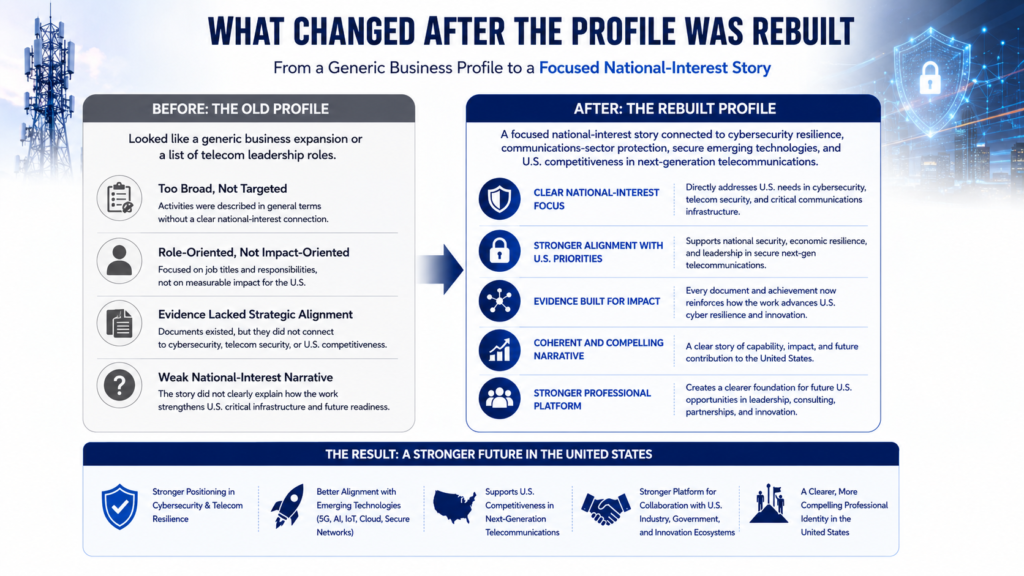
The profile no longer looked like a generic business expansion or a list of telecom leadership roles. It became a focused national-interest story connected to cybersecurity resilience, communications-sector protection, secure emerging technologies, and U.S. competitiveness in next-generation telecommunications. The same evidence that supported the petition also gave the client a clearer professional platform for future U.S. activity.
Key Lessons From This Case
A telecommunications or cybersecurity executive does not need to be framed only as an employee, manager, or vendor. When the record is built carefully, executive leadership, technical publications, advanced education, industry projects, and business-building activity can support a national-interest profile. The key is to connect the person’s work to a specific national problem and then show credible execution ability. Ethical profile building does not manufacture expertise. It identifies the expertise already present, organizes it around a national problem, and documents it in a way that an adjudicator and a public audience can understand.