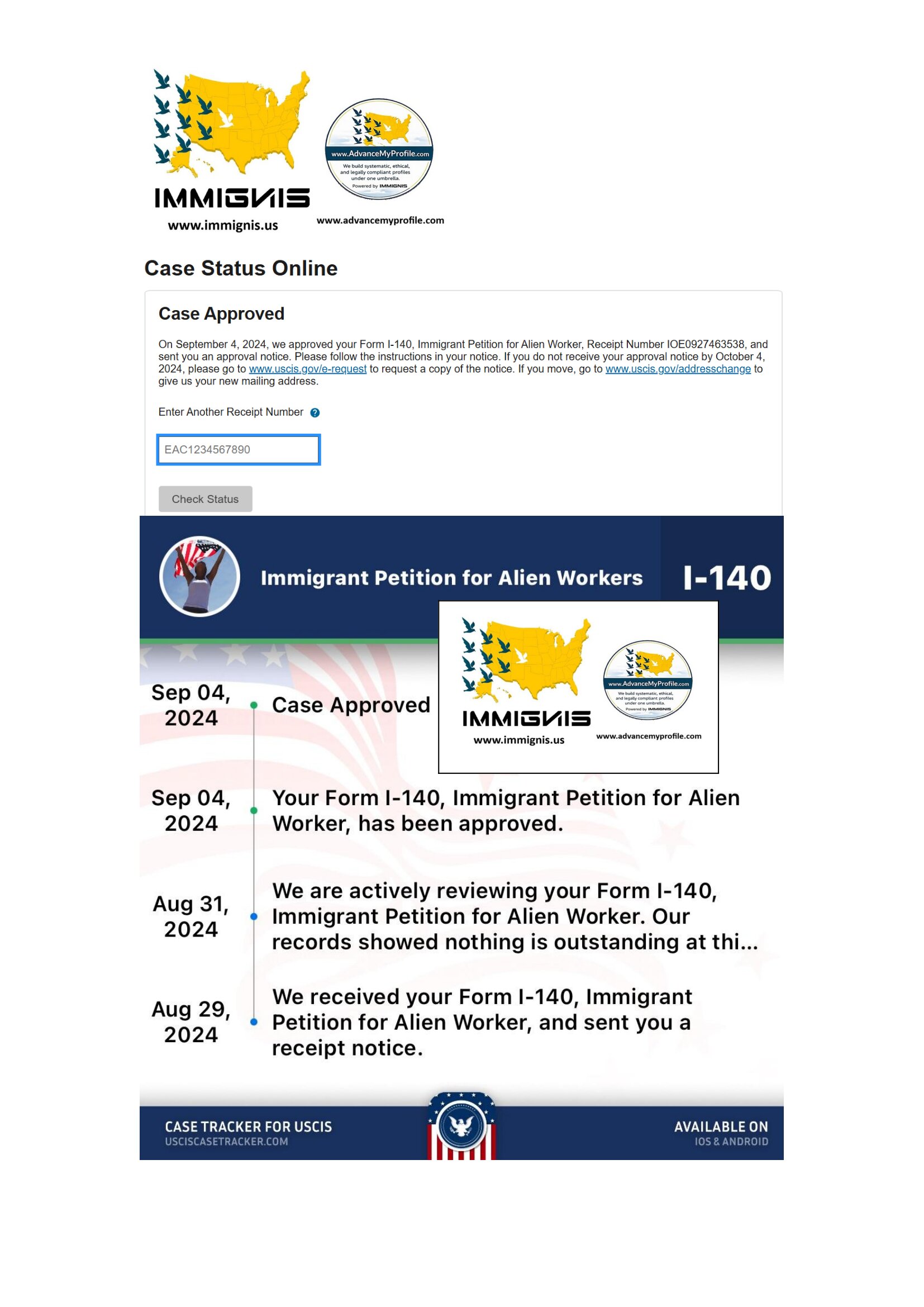
A Nigerian aviation safety professional with more than two decades of regulatory, quality, and safety-management experience was approved to advance aviation safety, certification modernization, and compliance optimization in the United States.
In Short: A Nigerian aviation professional holding a Master of Industrial and Systems Engineering from a U.S. university,
a postgraduate diploma in electrical engineering, and an aircraft maintenance engineering diploma was approved for an
EB-2 NIW as a self-petitioner. His background includes more than 20 years of aviation experience
across government oversight, helicopter maintenance quality control, commercial airline safety management, and U.S.-
based engineering study. He served for 14 years as an aviation safety inspector and air navigation safety inspector with a
national civil aviation authority, where he conducted certificate-of-airworthiness inspections, reviewed maintenance
records, and helped evaluate operators for Performance-Based Navigation approvals. His proposed endeavor is to
optimize aviation operational processes in the United States by applying predictive maintenance, digital certification
workflows, safety-management-system discipline, AI-supported compliance monitoring, and integrated operational data
practices. The petition was approved under Matter of Dhanasar.
The petitioner’s name, employer names, co-author name, and personal contact details have been withheld for privacy. The professional background, aviation credentials, proposed endeavor, and approval outcome are presented in anonymized form.
The Story: From Government Inspector to U.S. Aviation Safety Modernization
For 14 years, he worked on the regulatory side of aviation safety. He was one of the professionals responsible for reviewing whether aircraft, helicopters, operators, and maintenance records met the standards required for safe operation. That role gave him a practical understanding of how aviation safety is evaluated in real environments, not only how it is described in manuals. EB-2 NIW
His inspection work included certificate-of-airworthiness reviews for aircraft and helicopters, maintenance-record evaluations, and participation in Performance-Based Navigation approval processes. He also co-authored a national Performance-Based Navigation handbook, a technical contribution tied directly to safer, more efficient, and more precise flight operations. EB-2 NIW
That regulatory foundation was later reinforced by industry-side experience. After government service, he worked in aviation quality control, quality engineering, and airline safety management. This gave him a rare dual perspective: he understood what regulators look for during inspections, and he also understood the operational pressures faced by airlines, maintenance organizations, and aviation service providers trying to maintain compliance while keeping aircraft moving. EB-2 NIW
The Career Behind the Approval
His aviation career began with technical and maintenance-oriented work and developed into regulatory inspection, quality assurance, safety management, and operational-process improvement. The record showed a progression from technical aviation work to government oversight and then to aviation-industry safety leadership. EB-2 NIW
As a government aviation inspector, he received ICAO-endorsed Government Safety Inspector training in airworthiness and operations. He also completed FAA-related training in air operator certification procedures and aircraft type training in the United States. These credentials supported the petition’s argument that his expertise was aligned with the safety, certification, and compliance systems central to the proposed endeavor. EB-2 NIW
His industry-side work added another layer. In helicopter operations, he contributed to quality and certification-related work connected to simulation and aircraft-support systems. In commercial aviation, he served in quality and safety management, helping establish and maintain the systems that airlines need to satisfy safety, quality, and regulatory expectations. EB-2 NIW
He later earned a U.S. master’s degree in industrial and systems engineering. That degree strengthened the bridge between his aviation safety background and his proposed U.S. work, because the endeavor focuses on process optimization, systems thinking, predictive maintenance, and data-informed compliance management.
The Proposed Endeavor
The proposed endeavor focused on improving aviation operational processes, certification procedures, and regulatory compliance in the United States. It was built around three connected workstreams.
1. Predictive Maintenance and Safety Risk Reduction
The first workstream involved using aircraft operational data, maintenance records, and predictive analytics to identify mechanical or process risks before they become safety events. The petitioner’s prior inspection and maintenance-review experience made this component credible because he had already worked with the types of records, systems, and safety indicators that predictive maintenance tools must interpret.
2. Digital Certification and Compliance Workflows
The second workstream involved modernizing document-heavy certification and compliance processes through digital platforms, structured submission systems, automated status tracking, and clearer audit trails. The petition presented this as a practical aviation-process improvement, grounded in the petitioner’s experience reviewing airworthiness, operator certification, and safety-management documentation.
3. Data-Driven Safety and Quality Management
The third workstream involved applying big-data monitoring and integrated safety-management practices to identify compliance deviations earlier and support better decision-making by operators, maintenance organizations, and aviation stakeholders. His experience as both a regulator and an industry safety manager directly supported this part of the plan.
Why the Work Had National Importance
The national-importance argument was not based on a general claim that aviation is important. It was tied to the national role of the aviation system itself: public safety, transportation reliability, airport and airline operations, certification procedures, and regulatory compliance. Safety improvements in aviation do not remain local. They affect passengers, operators, supply chains, airports, and the broader transportation economy.
The petition connected the proposed endeavor to federal aviation priorities, including aviation safety, airport infrastructure modernization, safety-management systems, certification efficiency, cybersecurity and data integrity in aviation operations, and the need for more reliable compliance monitoring across an increasingly technology-intensive industry.
The argument was also strengthened by the petitioner’s practical profile. He was not proposing aviation safety in the abstract. He had worked as an inspector, reviewed aircraft records, participated in airworthiness and navigation-related approvals, and later managed safety and quality systems from the industry side. That experience made the proposed U.S. work concrete.
How the Petition Was Built
The petition was structured around a strong Second Prong. The evidence showed that the petitioner was well positioned because his background connected directly to the proposed endeavor: ICAO-endorsed inspector training, FAA-related certification training, a U.S. master’s degree, more than 20 years of aviation experience, government inspection work, industry-side safety-management experience, and a documented contribution to a national Performance-Based Navigation handbook.
The First Prong focused on aviation safety, certification modernization, operational efficiency, and regulatory compliance as matters with substantial merit and national importance. The strongest sources were government and industry materials connected to aviation safety, infrastructure, FAA modernization, safety-management systems, and regulatory oversight.
The Third Prong explained why a waiver of the job-offer and labor-certification requirement was appropriate. The proposed work was not limited to a single employer’s internal needs. It involved cross-operator safety processes, certification workflow improvement, consulting, training, compliance systems, and operational modernization that could benefit multiple aviation stakeholders.
What Made This Case Different
This case was distinct because it combined three forms of evidence that rarely appear together in one aviation NIW profile.
First, the petitioner had regulatory-side experience. He had served as an aviation safety inspector and air navigation safety inspector, giving him direct knowledge of how safety standards are applied in practice.
Second, he had industry-side experience. He later worked in quality control, quality engineering, and safety management, giving him the operational perspective of the organizations being inspected and regulated.
Third, he had a U.S. engineering degree. This helped connect his international aviation background to a U.S.-based proposed endeavor focused on process optimization, data use, and systems improvement.
Together, these facts allowed the petition to present him as more than an aviation employee with long experience. It presented him as a safety and regulatory-process professional who understands both sides of aviation compliance and can apply that knowledge to the U.S. aviation environment.
The Outcome
Approved.
USCIS approved the EB-2 National Interest Waiver petition for an aviation safety professional with more than two decades of experience, ICAO-endorsed Government Safety Inspector training, FAA-related certification exposure, a U.S. master’s degree in industrial and systems engineering, and a proposed endeavor focused on improving aviation safety, certification processes, and regulatory compliance in the United States.
The case succeeded because the petitioner’s background aligned closely with the proposed endeavor. His profile showed practical aviation safety experience, regulatory inspection authority, industry-side quality management, and systems-engineering training. The approval demonstrates how an aviation safety and compliance professional can build a strong NIW case when the proposed work is national in scope and the evidence shows direct readiness to advance it.
For Aviation Safety, Quality, and Regulatory Professionals
Aviation professionals often underestimate how valuable regulatory and safety-management experience can be in an EB-2 NIW case. The strongest cases do not simply say that the applicant has worked in aviation for many years. They show how the applicant’s work affects safety systems, certification processes, operational reliability, compliance quality, and national transportation capacity.
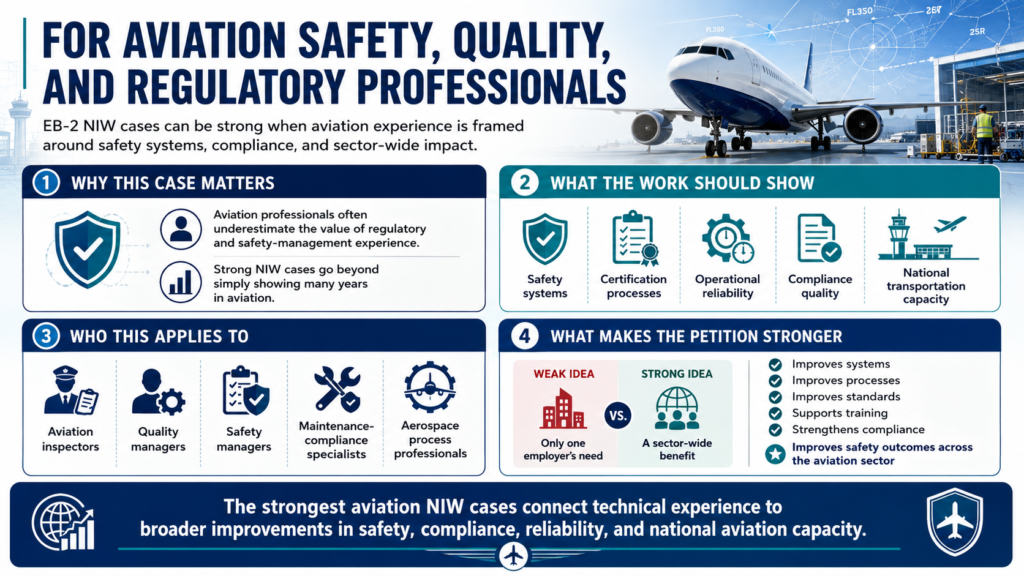
For aviation inspectors, quality managers, safety managers, maintenance-compliance specialists, and aerospace process professionals, the key question is whether the proposed endeavor can be framed beyond one employer’s need. A petition is stronger when it explains how the work can improve systems, processes, standards, training, compliance, or safety outcomes across the aviation sector.
Questions Aviation Professionals Ask Us
Can an aviation safety inspector qualify for an EB-2 NIW?
Yes, where the proposed endeavor has national importance and the evidence shows that the petitioner is well positioned to advance it. Aviation safety, certification, airworthiness, maintenance compliance, and operational risk management can all support a national-interest argument when the work is framed at the system or sector level rather than as a normal job search.
Does ICAO Government Safety Inspector training help an NIW case?
Yes. ICAO-endorsed inspector training is directly relevant when the proposed endeavor involves aviation safety, regulatory oversight, compliance, or certification procedures. It helps show that the petitioner has been trained to evaluate aviation operations through recognized international safety standards.
Is a U.S. master’s degree useful if the petitioner already has long foreign experience?
Yes. A U.S. master’s degree is not required in every NIW case, but it can strengthen the classification and well-positioned analysis. In this case, the U.S. degree in industrial and systems engineering helped connect the petitioner’s aviation experience to process optimization, predictive maintenance, and systems-based compliance improvement in the United States.
Why was the dual regulator-and-industry background important?
Because the proposed endeavor involved improving safety and compliance systems. A former regulator understands inspection standards and approval processes. An industry safety manager understands implementation challenges. Together, those perspectives supported the argument that the petitioner could design practical improvements that work in real aviation operations.
What should aviation professionals avoid in an NIW petition?
They should avoid presenting the case as a normal aviation job application. They should also avoid broad claims without evidence, unverifiable citations, incomplete fields, and language suggesting the plan is still immature. A strong aviation NIW should be specific, evidence-based, and tied to aviation safety, compliance, certification, infrastructure, or operational outcomes that extend beyond one employer.