A biomedical engineer and healthcare facility specialist who has planned, equipped, and delivered hospitals across the Gulf approved as an EB-2 NIW self-petitioner to bring that work to the U.S., where rural healthcare infrastructure is closing faster than it is being built.
In short: A biomedical engineer holding an MSc from a Swedish university and a BS in Biomedical Engineering,
with extensive experience leading healthcare facility planning for the GCC region (covering full project cycles from
conceptualization through equipment selection across all hospital departments) was approved for an EB-2 NIW as a self-petitioner. UAE-based, Pakistani national. Proposed endeavor: plan, establish, and improve
healthcare facilities in rural and underserved U.S. areas, and accelerate the transition of existing facilities toward
sustainable operations. Approved under Matter of Dhanasar with a published book on medical monitoring systems,
two founded biomedical businesses, and a track record of delivered hospital projects in the Gulf.
The petitioner’s name and employer details have been withheld for privacy. Profession, field, projects, and outcome are real.
Before the Doctor Walks In
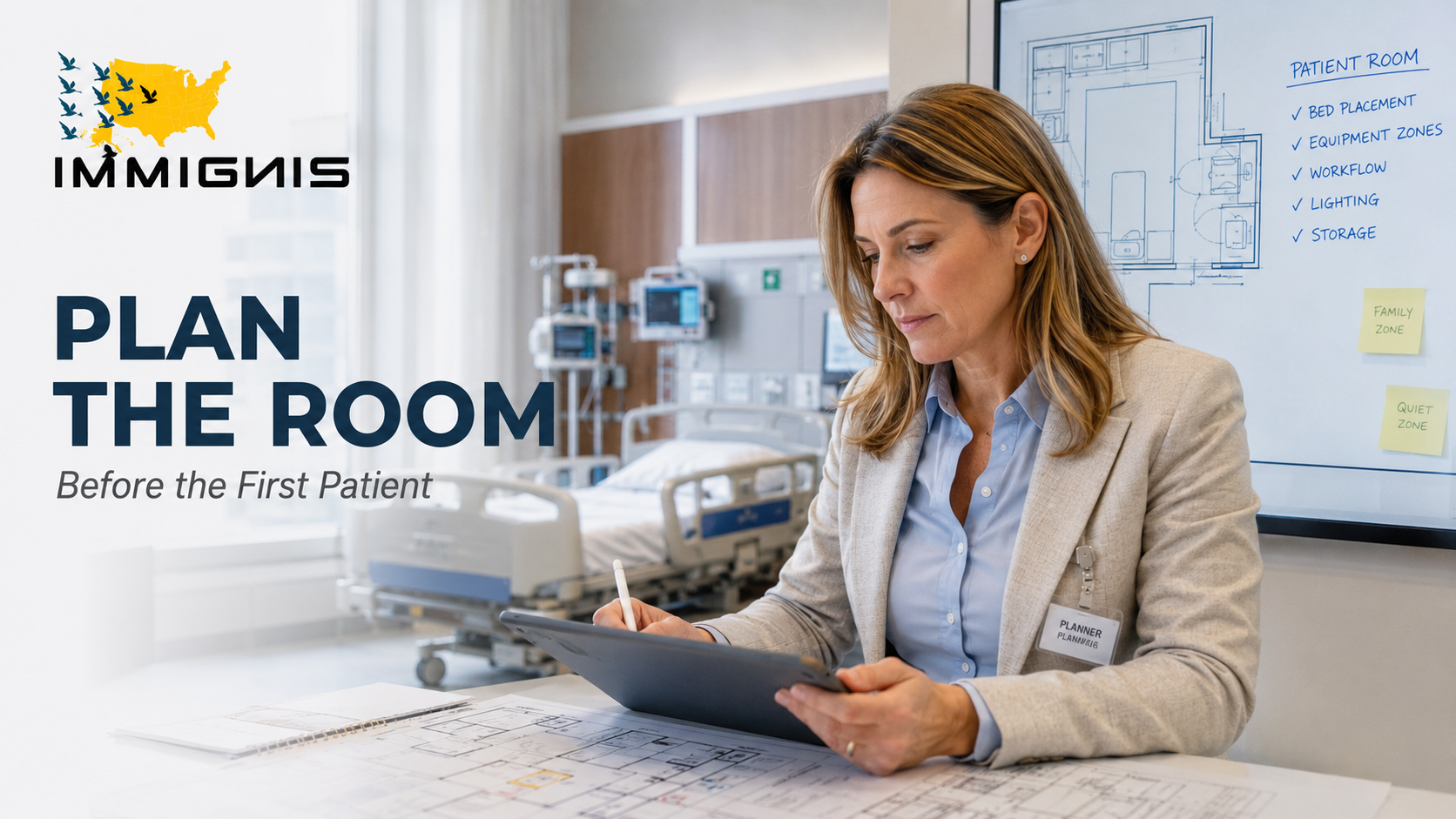
Every hospital starts as a blueprint and a set of empty rooms. Before a single patient is treated, before a single clinician arrives, someone has to answer thousands of questions. EB-2 NIW What imaging equipment goes in the radiology wing? What does the intensive care unit need to support modern monitoring? How is the laboratory laid out, and what does each bench require? What is the total equipment budget across all 150 beds, and how does procurement sequence across the project timeline?
Most people in healthcare think about the professionals who work there. EB-2 NIW Fewer think about the engineers who decide what those professionals will have to work with. This is the person who does that.
He currently leads the design team at a healthcare project management and design firm serving the Gulf Cooperation Council region. His role covers the full project lifecycle for hospital development: feasibility budgets, room equipment lists, installation and execution plans, and the coordination of biomedical equipment procurement across every department in a facility. He leads a team of biomedical engineers. His recent completed projects include a 150-bed hospital in Saudi Arabia and a major healthcare development in the UAE, both finished in 2024.
He does this work for the Gulf. EB-2 NIW His proposed endeavor is to bring it to the United States, where the infrastructure need is measurable and well-documented.
The U.S. Healthcare Infrastructure Problem
There are about 6,090 hospitals in the United States. Only 1,821 of them are in rural areas. That number has been falling, the count of rural community hospitals dropped from 1,980 in 2014 to 1,796 in 2020. Rural hospitals close when they cannot attract patients, and they cannot attract patients when their facilities and equipment are too far behind what people can access elsewhere.
Nearly 80% of rural U.S. areas are designated as medically underserved, according to a 2024 report from Harvard Medical School. The American Hospital Association has estimated that the U.S. needs to invest at least $1 trillion by 2030 simply to maintain and expand its hospital infrastructure, which is aging, outdated, and insufficient for a growing population.
Workforce shortages and low patient volumes make the economics of rural healthcare difficult. Equipment deficiencies make the clinical problem worse. When a facility cannot offer modern diagnostics or lacks properly maintained equipment, patients leave to seek care elsewhere and the hospital loses the revenue it needs to remain viable.That is a planning and infrastructure problem. And planning and infrastructure is exactly what his career has been about.
Rural hospitals are not closing because there are no patients. They are closing because the facilities can no longer
support the care patients expect. The gap between what a rural hospital has and what it should have is a biomedical
engineering problem.
A Career Built on Both Sides of Healthcare Facility Work
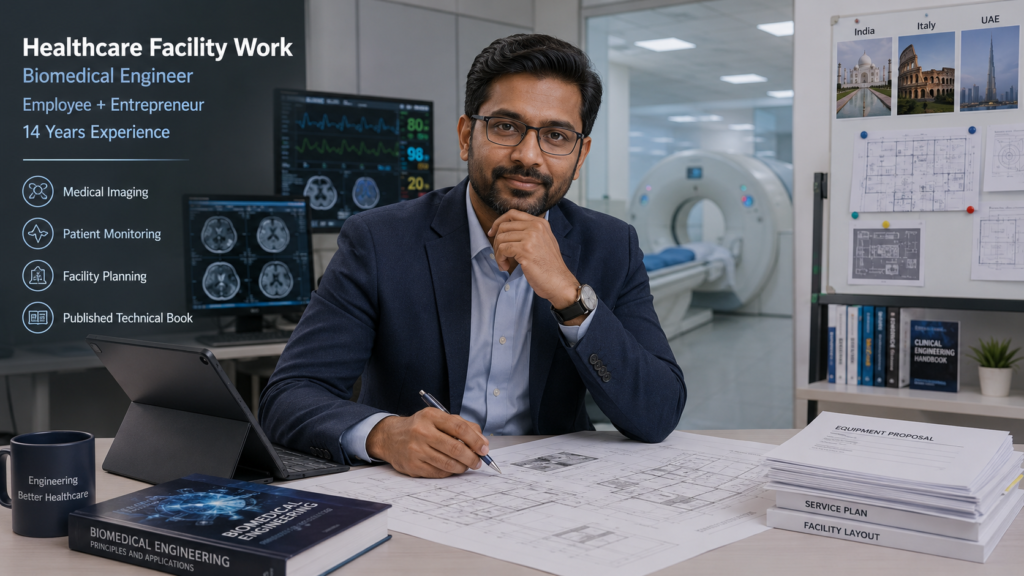
His background is broad for a biomedical engineer, EB-2 NIW. He holds an MSc in Biomedical and Electrical Engineering from a Swedish university, on top of a bachelor’s in Biomedical Engineering. He has trained on medical imaging and monitoring equipment at facilities run by major international manufacturers in India, Italy, and the UAE.
Unusually, he has been both an employee and an entrepreneur in this field, EB-2 NIW. Before his current leadership role, he founded and operated two biomedical equipment businesses in the UAE, handling sales and service for healthcare clients. Those companies gave him a different kind of knowledge, the commercial and operational side of getting equipment into facilities, keeping it working, and understanding what healthcare providers actually need when they cannot afford to have things go wrong.
In 2014, he published a book on an IP-based patient monitoring architecture a technical work on the design of networked patient monitoring systems that appeared through an academic publisher and is commercially available. For a practitioner whose daily work is facility planning rather than academic research, that publication reflects an unusual commitment to contributing to the technical literature of his field.
He holds life membership in a national engineering council and has maintained his professional standing across 14 years of progressive experience in biomedical engineering and healthcare infrastructure, EB-2 NIW.
The Two-Part Proposed Endeavor
His proposed endeavor had two distinct components, each addressing a different dimension of the U.S. healthcare facility problem.
The first: planning, establishing, and improving traditional healthcare facilities in rural and underserved U.S. areas. This draws directly on his core professional expertise. The work involves assessing what facilities have, identifying what they need, managing procurement and installation of medical equipment, and ensuring that staff are trained to use it. For new facilities, it means planning from the ground up the same work he has been doing across Saudi Arabia and the UAE.
The second: transitioning healthcare facilities toward sustainable operations, with a focus on urban facilities. The healthcare sector accounts for 4.4% of global carbon emissions and 8.5% of U.S. greenhouse gas output. The U.S. healthcare industry could save an estimated $15 billion over ten years through sustainable practices alone. His proposed approach includes energy-efficient technologies, water-saving infrastructure, sustainable materials, waste management practices, and climate-resilient design changes that require the same kind of whole-facility engineering perspective his career has developed.
The two components are not unrelated. A rural facility that operates sustainably is more financially resilient. A hospital with lower energy and waste costs can redirect resources toward the equipment and staffing that keep it viable. Sustainability and infrastructure quality work together.
How the Petition Was Built
This was a direct petition. His track record in healthcare facility planning was already there. The case was built on connecting his specific expertise to the specific, documented infrastructure gap in U.S. rural healthcare.
– National importance sourcing: American Hospital Association investment data, Harvard Medical School rural healthcare access findings, HHS strategic goals for equitable healthcare access, White House executive orders on health equity and sustainability, the Joint Commission’s Sustainable Healthcare Certification program, and HHS’s own sustainability plan.
– Well-positioned evidence: his leadership of GCC hospital projects, his team leadership experience, his founding of two biomedical businesses, his published book on patient monitoring systems, and his direct equipment training on clinical imaging and monitoring technologies.
– Proposed endeavor framed precisely: rural facility planning and equipment improvement on one side; sustainable facility transformation on the other. Both tied to documented federal priorities.
Immignis prepared the full petition: proposed endeavor, Dhanasar mapping, national importance sourcing, supporting evidence, and I-140 preparation and submission.
The Outcome
Approved.A self-petitioned EB-2 NIW for a biomedical engineer and healthcare facility planning specialist, filed from the UAE, with no U.S. employer. The case was built on the intersection of a documented national infrastructure shortage, a career spent planning and delivering exactly the kind of healthcare facilities that shortage requires, and a proposed endeavor that addressed both the access gap in rural America and the sustainability gap in urban healthcare.
The U.S. does not just need more healthcare providers. It needs better healthcare infrastructure for those providers to
work in. That infrastructure does not plan itself.
For Biomedical Engineers in Facility Planning and Equipment Management
If your career is on the engineering and planning side of healthcare (facility design, equipment procurement, hospital project management, sustainable healthcare infrastructure) rather than clinical research or patient care, the NIW can still be relevant. The Dhanasar test evaluates the national importance of your proposed endeavor and whether you are positioned to advance it, not which sector of healthcare you work in.
The U.S. has a documented and growing shortage of rural healthcare infrastructure. It has a documented and growing sustainability problem in its existing hospitals. A biomedical engineer with a track record of planning and delivering facilities across those exact two dimensions is well-positioned to argue both prongs of the test.
Questions Biomedical Engineers in Facility Planning Ask Us
Can a biomedical engineer whose work is in facility planning rather than clinical research qualify for an EB-2 NIW?
Yes. The NIW evaluates the proposed endeavor and whether the petitioner is positioned to advance it, not whether the background is clinical or academic. Healthcare facility planning, equipment procurement, and hospital project management are directly relevant to documented U.S. national priorities around rural healthcare access and healthcare sustainability. A career built on planning and delivering facilities in these domains supports both national importance and the well-positioned argument.
Does having published a book rather than academic journal articles help an NIW case?
A published book can serve as evidence of contribution to the field’s knowledge base, particularly in a technical domain. What matters is whether the contribution demonstrates expertise and a record of advancing relevant knowledge. An authored technical book on medical monitoring systems, published through a recognized academic publisher, contributes to the well-positioned argument by showing engagement beyond day-to-day project work.
Does founding and operating your own biomedical businesses help an NIW petition?
It can strengthen the case in several ways. It demonstrates independent execution ability, which is relevant when proposing to operate as an independent consultant in the U.S. It demonstrates commercial and operational knowledge of the healthcare equipment and services market, which supports the feasibility of the proposed endeavor. And it reflects a degree of professional standing and initiative that goes beyond employment alone.
Is healthcare sustainability a strong enough basis for national importance in an EB-2 NIW?
When tied to documented federal priorities, yes. The U.S. Department of Health and Human Services has a published sustainability plan. The White House has issued executive orders on federal sustainability and health sector greenhouse gas reduction. The Joint Commission has a Sustainable Healthcare Certification program. Healthcare is responsible for 8.5% of U.S. greenhouse gas emissions. These are documented, stated national priorities and a proposed endeavor specifically designed to address them, backed by engineering expertise in facility planning, supports the national importance argument under Dhanasar.
Does experience gained in GCC or international markets transfer to a U.S. NIW case?
It can. The Dhanasar well-positioned test asks whether the petitioner has the skills, knowledge, and track record to advance the proposed endeavor in the U.S. Leading hospital design and equipment planning projects for large healthcare facilities in the Gulf demonstrates project management, technical depth, and operational capability that transfers directly. The key is connecting that track record to the specific U.S. context of the proposed endeavor.
If you work in healthcare facility planning, hospital project management, or biomedical equipment infrastructure and want to understand whether your background supports an NIW, start there. Free assessment: immignis.us/contact-us