
A Doctor of Engineering, postdoctoral Alexander von Humboldt Fellow, and urban transportation researcher who built methods that influenced government policy in one country, now approved to develop those methods further for the largest transportation emissions problem in the world.
In short: An environmental engineer and urban planning researcher with a doctoral degree from a leading Japanese research university, a Master’s from a prestigious Chinese institution, and postdoctoral research fellowships at a German university and a leading U.S. research institution was approved for an EB-2 National Interest Waiver as a self-petitioner, EB-2 NIW approved. Ethiopian national, Germany-based. Proposed endeavor: develop advanced methodologies for assessing the environmental impacts of transportation systems and integrating smart city solutions using geospatial technologies. Approved under Matter of Dhanasar on the strength of peer-reviewed publications, government fellowships from three countries, policy-level research influence, and a 12-year career spanning environmental engineering, road safety, and urban sustainability.
The petitioner’s name and specific institutional affiliations have been withheld for privacy. Credentials, research record, fellowships, and outcome are real.
The Moment Research Became Policy
Think about what happens to a car as it ages. It burns more fuel. It leaks more. Its emissions rise. At some point in its lifespan, an older imported vehicle is causing measurably more environmental harm than a newer one but until someone actually quantified when that point arrives, and by how much, there was no evidence-based way to build policy around it. EB-2 NIW approved
He built that model (EB-2 NIW approved). A survival rate framework for used vehicles that tracked environmental impact across a vehicle’s lifespan and provided policymakers with a data-driven basis for decisions about vehicle import regulations, inspection costs, insurance premiums, and emissions controls. He published it. And in 2018, the Ethiopian government used that research to justify imposing tax duties on used vehicle imports.
That is what research-to-policy impact looks like. Not a study that lands in a journal and stays there, but work that travels from a researcher’s model into the regulatory decisions of a national government. His NIW case was built, in part, on that trajectory. EB-2 NIW approved
A Career Built Across Five Countries
The credential profile in this case is unusual for an NIW petition not because it is long, but because of the range of institutions that formally recognized his work along the way.
He earned his Doctor of Engineering in Environmental Engineering at a leading Japanese research university on a full scholarship from the Japanese government one of a limited number of international scholars selected annually for doctoral funding. His Master’s degree in Management came from a prestigious Chinese university, funded by a Shanghai government scholarship. His undergraduate degree in Architecture and Urban Planning is from an Ethiopian university. Three different national governments, across three continents, funded his education based on demonstrated academic merit.
After completing his doctorate, he was awarded the Alexander von Humboldt Fellowship for postdoctoral research at a German university. For readers unfamiliar with this award: the Alexander von Humboldt Foundation selects international researchers of exceptional academic distinction for independent postdoctoral positions in Germany. It is broadly regarded in the global research community as one of the most competitive and prestigious postdoctoral fellowships available, with a selectivity that places it alongside top national science foundation awards. It is not a scholarship or grant; it is a formal recognition of research achievement combined with funding for independent inquiry.
Between his doctorate and the Humboldt Fellowship, he spent 13 months as a visiting research fellow at a leading U.S. research university, where he conducted cross-city comparative research on urban transportation governance (including case studies on two U.S. cities) and published a peer-reviewed paper from that work. He also coordinated a global road safety initiative in Addis Ababa, Ethiopia, working at the intersection of data analysis, traffic engineering, and public policy.
Five peer-reviewed publications. A research record cited by subsequent scholars in transport equity and urban development. A developed model for peri-urban agricultural preservation that addresses food security and land use together. Government policy that changed because of his research. Fellowships funded by Japan, China, the European Union, the German Humboldt Foundation, the International Road Federation, and the Volvo Research and Education Foundation.
The Dhanasar test asks whether the petitioner is well-positioned to advance the proposed endeavor. A career funded
by governments and institutions across five continents, producing research that changed national policy, is a direct
answer to that question.
The U.S. Problem His Research Addresses
Transportation is the single largest source of greenhouse gas emissions in the United States, contributing 29% of total emissions according to the EPA, EB-2 NIW approved. Traffic congestion costs the U.S. economy more than $120 billion annually, with the average American losing 54 hours per year sitting in traffic. More than 135 million Americans live in areas with unhealthy air quality, and transportation emissions are a leading cause. By 2050, an estimated 89% of the U.S. population will live in urban areas, placing further strain on already strained infrastructure.
The tools currently used to assess the environmental impacts of transportation systems are not keeping pace with the complexity of the problem. Traditional environmental impact assessments rely on linear, sector-specific models that miss the interconnected dynamics between transportation networks, land use patterns, air quality, and resource consumption. The geospatial and predictive modeling capabilities needed to see the full picture and to design interventions that actually reduce emissions and improve urban resilience, are not yet deployed at scale in U.S. cities. EB-2 NIW approved
His proposed endeavor is to develop and implement exactly those capabilities: advanced, geospatially enriched methodologies for environmental impact assessment of transportation systems, integrated with smart city frameworks that allow real-time monitoring and adaptive urban planning. The same analytical approach that produced the vehicle lifecycle model. The same research discipline that drove policy change in Ethiopia. Applied now to the most complex transportation emissions problem in the world. EB-2 NIW approved
What the Proposed Endeavor Covers
His proposed work has two technical cores, each supported by his existing research and professional track record.
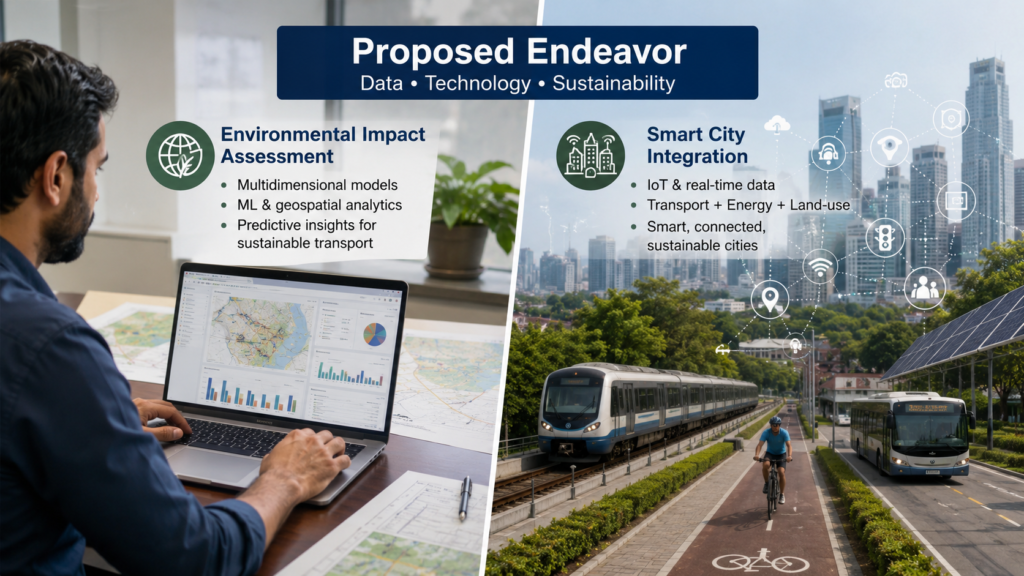
The first is advanced environmental impact assessment for transportation systems. This involves developing multidimensional models that go beyond conventional sector-specific analyses to capture cumulative, geospatially mapped impacts on air quality, resource consumption, and ecosystem health. Machine learning and geospatial analytics applied to transportation systems to enable predictive modeling of complex urban scenarios. His vehicle lifecycle research is a direct precursor: the same methodological logic building a model that makes the invisible visible, in a form that produces actionable policy guidance.
The second is smart city integration using geospatial technologies. This involves designing interoperable frameworks that combine transportation, energy, and land-use planning with IoT sensors and real-time data to allow dynamic optimization of urban systems. Peri-urban agricultural preservation integrated into growth models. Non-motorized transport infrastructure planning. His earlier work (designing the first walking and cycling path guidelines for Ethiopian cities, securing $1.5 million in grants for smart parking and bicycle sharing) reflects the applied, practical side of the same methodological framework.
How the Petition Was Built
This was a direct petition. The academic and professional record was already there. The work was in framing it precisely against the Dhanasar test and connecting it to documented U.S. national need. EB-2 NIW approved
- National importance sourcing: EPA transportation emissions data, ASCE infrastructure report, National Academies public transit research, NOAA climate disaster cost data, INRIX congestion cost analysis, American Thoracic Society mortality data, White House Critical and Emerging Technologies List, FTA environmental programs, NIST smart cities initiative, USDOT sustainability strategy, and the Infrastructure Investment and Jobs Act.
- Well-positioned evidence: five peer-reviewed publications, the Alexander von Humboldt Fellowship, visiting fellowship at a leading U.S. research university, government policy influence in Ethiopia, coordination of a global road safety program, $1.5M in secured grants, and fellowships from six different organizations across four countries. EB-2 NIW approved
- Proposed endeavor precision: geospatial-driven environmental impact assessment and smart city integration specific enough to connect to named federal programs (FTA, FHWA, NIST, FGDC) and documented national gaps.
The I-140 was filed as a self-petition without a U.S. employer or job offer. EB-2 NIW approved
The Outcome
Approved.
A postdoctoral researcher and environmental engineer, Ethiopian national, Germany-based, with a doctoral degree from a Japanese research university and a postdoc fellowship from one of the world’s most selective research foundations, approved as a self-petitioner for an EB-2 National Interest Waiver. The case rested on a career’s worth of recognized research excellence, peer-reviewed publications, policy-level influence, and a proposed endeavor that addressed the United States’ single largest contributor to greenhouse gas emissions with methods the researcher had spent 12 years developing.
Research that changes national policy in one country is the strongest possible evidence that the same research,
applied to a larger country with the same problem, will matter there too.
For Researchers and Academic Professionals in Environmental and Urban Fields
If your career is in research ‘environmental engineering, urban planning, transportation systems, geospatial science, or related fields’ and your academic record includes publications, fellowships, or demonstrated policy influence, the EB-2 NIW can be a strong path. The Dhanasar test does not require a U.S. employer. It requires a proposed endeavor of substantial merit and national importance, and evidence that you are positioned to advance it. A research career that spans multiple countries and multiple recognizing institutions, with publications and policy impact, is well-suited to making that case.
The key is connecting your specific research focus to specific, documented U.S. national need and explaining, precisely, what you intend to develop and why the United States benefits from you doing it here.
Questions Researchers and Academic Professionals Ask Us
Can a postdoctoral researcher or academic professional qualify for an EB-2 NIW approved?
Yes. The EB-2 NIW is well-suited to researchers whose work addresses documented national challenges. The doctoral degree satisfies the advanced degree requirement. The proposed endeavor developing methodologies, publishing findings, contributing to policy can be framed as nationally important when it addresses documented U.S. gaps and is tied to specific federal programs and priorities. Publications, fellowships, and policy influence all strengthen the well-positioned argument.
What is the Alexander von Humboldt Fellowship, and how does it help an NIW case?
The Alexander von Humboldt Foundation is a German institution that awards postdoctoral fellowships to international researchers based on rigorous peer review of their academic achievement. The fellowship is competitive globally and is widely recognized in the international research community as a marker of research distinction. In an NIW context, it functions as independent recognition by a prestigious organization that has formally evaluated the petitioner’s academic record and found it to meet a high standard. This is directly relevant to the well-positioned prong of the Dhanasar test.
Does research that influenced government policy in another country help a U.S. NIW case?
Yes, and it can be one of the most compelling forms of evidence in a well-positioned argument. Policy influence demonstrates that the petitioner’s work is not merely theoretical, it has been taken seriously by decision-makers and incorporated into actual governance. When the same methodology is proposed for application in the United States to address an analogous national problem, that track record directly supports the argument that the petitioner is positioned to advance the endeavor and that it will produce real benefit.
How important are peer-reviewed publications for an EB-2 NIW?
Publications are valuable but not required. For research-focused petitions, they serve multiple purposes: they demonstrate academic standing, establish that the petitioner’s work has been evaluated and accepted by peers in the field, and provide specific evidence of the petitioner’s expertise relative to the proposed endeavor. The strength of publications in an NIW context comes from what they demonstrate about the petitioner’s capability and track record, not from citation counts alone.
Does receiving fellowships and grants from multiple countries and institutions strengthen an NIW case?
Substantially. Multiple independent recognitions from different organizations especially when they span different countries and are awarded through competitive selection processes, provide strong cumulative evidence that the petitioner’s academic work has been formally evaluated and found exceptional by multiple independent bodies. Each fellowship represents a separate peer review process that reached the same conclusion. That pattern of recognition supports the well-positioned argument in a way that a single strong credential often cannot.
If your research background is in environmental engineering, urban planning, transportation, or geospatial science and you want to understand whether your academic record supports an EB-2 NIW, start with an honest assessment. Free assessment: immignis.us/contact-us