
A finance professional with CMA, CIA, CPA, SAP, and senior hospitality-finance credentials was approved for an EB-2 NIW after reframing his proposed endeavor around affordable FP&A services for U.S. small businesses and startups.
In short: A finance professional with more than 17 years of experience across banking operations, hotel-group finance,
internal audit, ERP implementation, and SME consulting was approved for an EB-2 National Interest Waiver as a self-
petitioner. His credentials included a CMA and CIA from U.S.-based professional institutions, a CPA credential, multiple
SAP certifications, and senior finance leadership experience in Saudi Arabia and Pakistan. His proposed endeavor was to
provide affordable Financial Planning and Analysis (FP&A) services to U.S. small businesses and startups through an
outsourced business-process model. The case received a Request for Evidence after USCIS accepted the substantial merit
of the work but asked for clearer evidence of national importance and stronger proof that he was well positioned. The
response rebuilt the case around the role of small businesses in U.S. job creation, the cost barrier that prevents many
SMEs from hiring in-house finance expertise, and the petitioner’s quantified record of finance restructuring, ERP
centralization, cost reduction, and business turnaround work. The petition was approved under Matter of Dhanasar.
The petitioner’s name, employer names, investor identity, receipt number, and personal details have been withheld for privacy. Credentials, RFE history, response strategy, and approval outcome are presented in anonymized form.
The RFE Became the Turning Point
This case did not begin as a simple approval story. EB-2 NIW USCIS issued a Request for Evidence after accepting that the proposed work had substantial merit. That distinction mattered. The officer did not say that FP&A services were unimportant. The concern was that the original filing had not shown why one finance consultant’s proposed work would rise to the level of national importance under Dhanasar.
That is a common problem in business-services NIW petitions. EB-2 NIW A proposed service can be useful, valuable, and commercially viable, yet still fail if the petition does not connect the work to broader U.S. economic interests. The RFE forced the case to become more precise. The response moved away from general statements about financial consulting and focused on the national economic role of small businesses, the lack of affordable finance support available to many SMEs, and the petitioner’s ability to deliver FP&A services through a scalable outsourced model.
The case was approved after the response addressed those gaps. EB-2 NIW The lesson is direct: for finance, accounting, consulting, and BPO-based endeavors, national importance must be built around scale, access, and economic consequence. It cannot rest only on the professional value of the service
A Career Built Around Financial Control, ERP Systems, and Business Turnaround
The petitioner’s professional history gave the response a strong factual base. He began in banking operations and later moved into hospitality finance, internal audit, financial control, ERP implementation, and consulting. Over time, his work shifted from routine finance functions to restructuring multi-entity operations and improving financial visibility for organizations that needed stronger planning systems.
His strongest evidence came from quantified projects. In one hotel-group finance role, he helped restructure finance operations across multiple hotels, restaurants, catering operations, and real-estate assets. He centralized ERP systems, reduced licensing costs, lowered payroll expenses by streamlining finance-team structure, improved reporting discipline, and helped bring a newly opened property to profitability through cost control and sales-aligned financial planning.
Those achievements mattered because they were not abstract credentials. They showed exactly what his proposed U.S. endeavor required: diagnosing financial inefficiency, building usable planning systems, implementing ERP-backed reporting, controlling costs, and guiding management decisions through practical financial data.
The Proposed Endeavor: Affordable FP&A for U.S. SMEs
The approved proposed endeavor focused on accessible FP&A support for small businesses and startups. Many SMEs need budgeting, cash-flow forecasting, profitability analysis, KPI dashboards, cost controls, funding-readiness materials, and ERP-supported reporting, but they cannot afford a full-time finance team. Hiring a qualified in-house financial analyst or controller can be too expensive for small firms that are still stabilizing revenue and operations. EB-2 NIW
The petitioner’s model addressed that gap through outsourced FP&A services. Instead of serving one employer, he proposed to serve multiple SMEs through a business-process-outsourcing structure, giving smaller companies access to finance expertise at a lower cost. The work would begin through independent consulting, expand into a formal consultancy structure, and later develop into a subscription-based FP&A support platform for a wider client base. EB-2 NIW
The model was important for the Third Prong. A traditional job offer would not capture the proposed national benefit because the work was not designed for one employer. It was designed to reach many small businesses that individually could not hire the type of finance expertise they needed. EB-2 NIW
How National Importance Was Rebuilt
The RFE response reframed national importance around the U.S. small-business ecosystem. Small businesses represent nearly all U.S. businesses and are central to job creation, local economic stability, entrepreneurship, and community development. EB-2 NIW When those businesses lack financial planning capacity, they are more exposed to cash-flow failures, poor pricing decisions, undercapitalization, tax and reporting problems, and preventable closures.
The response connected the proposed endeavor to that gap. It argued that affordable FP&A services could help SMEs make better financial decisions, prepare for funding, manage cash flow, control costs, and grow with more discipline. This was the correct shift. The national importance argument became less about the petitioner offering a service, and more about strengthening the financial operating capacity of the businesses that drive local employment and entrepreneurship. EB-2 NIW
The response also avoided treating every small-business benefit as automatically national. It tied the proposed model to scalability: serving multiple businesses through outsourced delivery, developing standardized FP&A systems, and using digital tools to make high-quality finance support accessible beyond large companies. EB-2 NIW
How the Well-Positioned Argument Was Strengthened
USCIS had questioned whether the original letters and evidence showed specific achievements. The response corrected that weakness by focusing on project-level results. The petitioner’s strongest evidence was not a list of job titles. It was the pattern of measurable finance outcomes across real organizations.
- ERP centralization across a multi-entity hospitality group, reducing licensing and operational duplication.
- Finance-department restructuring that lowered staffing costs while improving reporting discipline.
- Budgeting and cost-control work that supported profitability for a newly opened property.
- Financial consulting for SMEs involving planning, accounting systems, and operational financial control.
- Professional credentials in management accounting, internal auditing, public accounting, SAP systems, and financial management.
This evidence made the Second Prong stronger because it connected his past achievements directly to the proposed U.S. work. A petitioner proposing SME FP&A support must show experience not only in finance theory, but in building financial systems that managers can actually use. That is where this profile became credible.
Why the Waiver Made Sense
The Third Prong was strengthened by the structure of the endeavor. The petitioner was not seeking to become a finance employee inside one company. The proposed work required client flexibility, outreach to multiple SMEs, standardized service packages, and the ability to build a scalable consulting platform. A labor-certification process tied to one employer would have narrowed the work and reduced the proposed benefit.
The waiver argument therefore rested on the difference between employment and public-facing professional deployment. The United States would benefit more from the petitioner serving many small businesses through a scalable model than from requiring him to wait for a single employer-sponsored finance position.
The Outcome
Approved.
A self-petitioned EB-2 National Interest Waiver was approved for a finance professional with more than 17 years of experience, CMA, CIA, CPA, SAP, and senior financial-control credentials, after USCIS initially questioned national importance and well-positioned evidence. The approval followed a response that reframed the endeavor around affordable FP&A access for U.S. SMEs, documented the petitioner’s quantified finance achievements, and explained why a multi-client BPO model was better suited to the national interest than a traditional job-offer pathway.
The green card strategy succeeded because the case stopped presenting financial consulting as a general service and started presenting it as scalable financial-capacity infrastructure for small businesses.
For Finance, FP&A, and Business-Services Professionals
This case is useful for finance professionals because it shows both the risk and the solution. USCIS may accept that finance work has value and still reject national importance if the proposed endeavor appears limited to ordinary client service. The petition must show broader economic relevance, a credible delivery model, and a petitioner whose record proves execution ability.
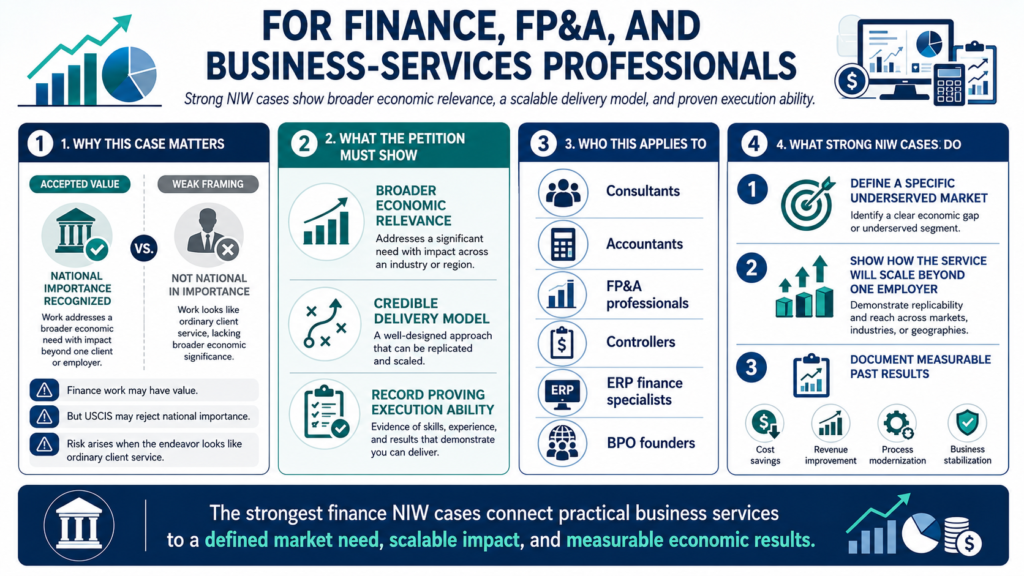
For consultants, accountants, FP&A professionals, controllers, ERP finance specialists, and BPO founders, the strongest NIW cases usually do three things: define a specific underserved market, show how the service will scale beyond one employer, and document measurable past results in cost savings, revenue improvement, process modernization, or business stabilization.
Questions Finance and FP&A Professionals Ask Us
Can a finance consultant qualify for an EB-2 NIW?
Yes, but the petition must be framed carefully. Finance consulting is useful, but usefulness alone is not enough. The case must show that the proposed work has broader implications for the United States, such as improving SME survival, financial planning capacity, access to capital, job creation, or business resilience. The petitioner must also show a record of specific achievements, not only general finance experience.
Why did USCIS question national importance in this type of case?
USCIS often distinguishes between work that benefits private clients and work that has broader national implications. An FP&A service may help a business, but the petition must explain why the model, target market, and expected impact extend beyond ordinary commercial benefit. In this case, the response tied the endeavor to U.S. SMEs, affordability of finance expertise, and scalable BPO delivery.
What made the RFE response stronger?
The response became stronger because it focused on measurable projects and economic logic. It connected the petitioner’s hotel-group restructuring, ERP centralization, cost savings, and SME consulting work to the exact services he planned to provide in the United States. It also explained why serving many SMEs through outsourced FP&A support better fit the national-interest waiver than a single-employer finance job.
Is the BPO model useful for the Third Prong?
Yes. A BPO model can help the Third Prong when the proposed endeavor depends on serving multiple clients. If the petitioner’s national benefit comes from reaching many small businesses, a single job offer may be structurally unsuitable. The petition should explain why independent consulting or a scalable service company is necessary to deliver the proposed benefit.
What evidence matters most in finance NIW cases?
The strongest evidence is specific and measurable: cost savings, revenue improvements, turnaround results, ERP or reporting-system implementation, audit or compliance improvements, client outcomes, professional certifications, and letters that describe named projects with quantified impact. General statements about being hardworking or experienced are weak. USCIS wants to see what the petitioner actually changed.
Free assessment: immignis.us/contact-us