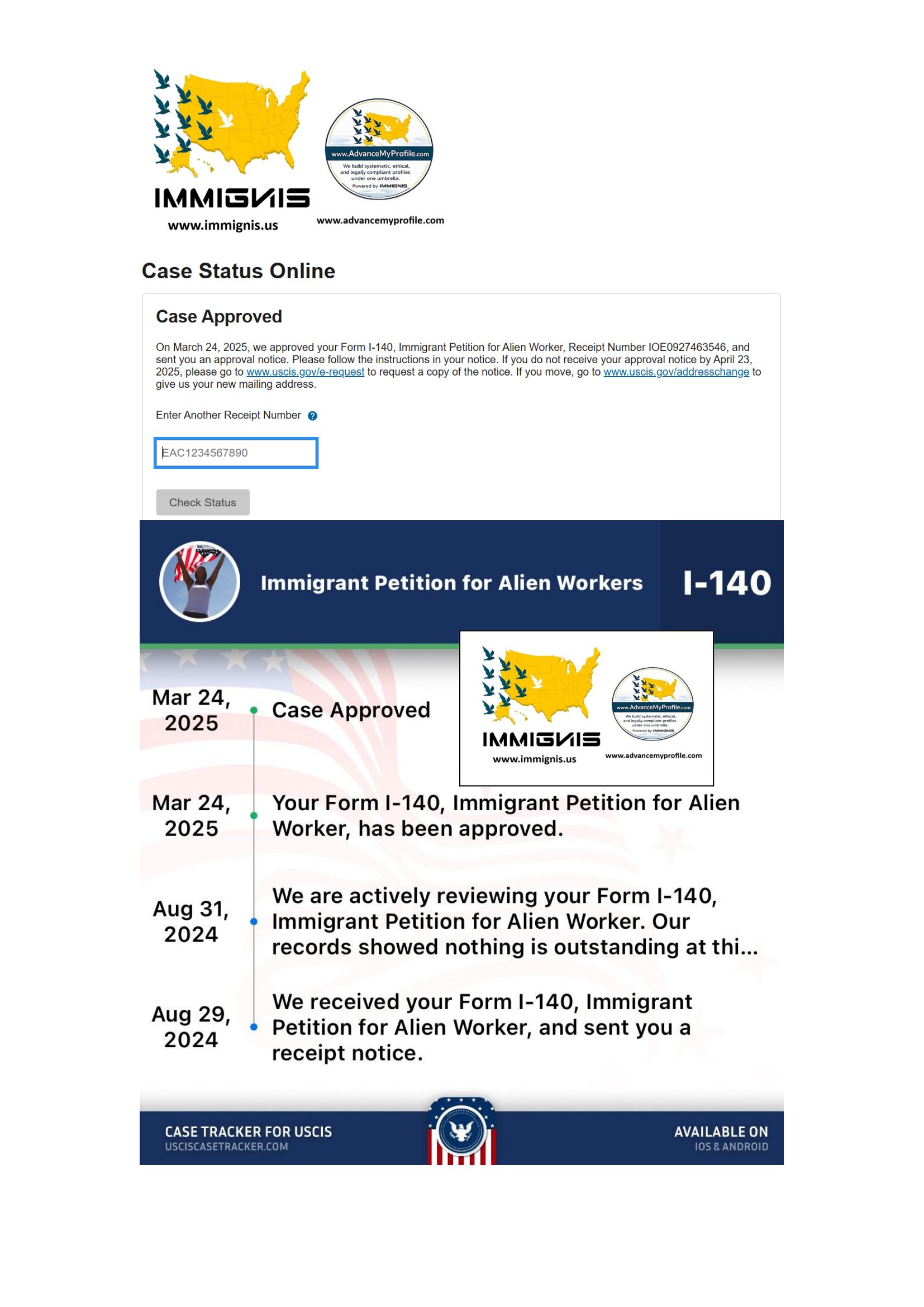
A biomedical engineer with 21 years of laboratory planning, medical equipment installation, and healthcare infrastructure experience across Pakistan and the UAE was approved for an EB-2 NIW biomedical to support modern clinical laboratory development in underserved U.S. regions, with an initial focus on West Virginia.
| Petitioner profile | Biomedical engineer with an MBA, Bachelor of Biomedical Engineering, and 21 years of progressive experience in laboratory planning, biomedical equipment selection, installation, maintenance, and healthcare infrastructure projects. |
| Professional background | Career spanning Pakistan and the UAE, including technical sales support, field service engineering, business development, biomedical maintenance leadership, and prior startup operation in biomedical equipment planning and installation. |
| Proposed endeavor | Provide independent consulting and later operate a U.S.-based startup focused on planning, designing, equipping, and modernizing clinical laboratories in underserved regions, beginning with West Virginia. |
| National importance | The petition connected laboratory infrastructure to healthcare access, diagnostic quality, rural health, biomedical workforce demand, and modern clinical testing capacity. |
| Well-positioned evidence | 21-year project record, laboratory and equipment planning experience, healthcare infrastructure assignments, prior startup execution, professional certification, and engineering membership. |
| Filing model | I-140 filed as a self-petition without a U.S. employer. |
| Outcome | Approved under Matter of Dhanasar. |
Privacy note: The petitioner’s name, employer names, client hospital names, startup name, and personal identifiers have been withheld. Career record, professional direction, and outcome are described in anonymized form.
A State-Level Laboratory Problem With National Meaning
This case was built around a simple point: modern healthcare depends on modern laboratories, but many communities still rely on facilities that were never designed for current diagnostic demands. EB-2 NIW biomedical
The petition used West Virginia as the first geographic focus EB-2 NIW biomedical because the state’s own 2022 legislative audit identified major inadequacies across state-owned laboratory facilities. The audit found that every state-owned laboratory facility reviewed had significant inadequacies and that many testing programs operated in facilities dating back to the middle of the last century, with many spaces not originally constructed for laboratory testing.
That state-level evidence gave the petition a concrete national-importance anchor. The proposed endeavor was not framed as a general business plan to sell equipment. It was framed as a healthcare-infrastructure solution for communities where diagnostic access, facility readiness, workflow design, and equipment planning directly affect patient care. EB-2 NIW biomedical
Why Laboratory Planning Matters
Laboratory planning is a technical discipline. It is not the same as selling a device or installing a machine. A laboratory planner must understand space, workflow, utilities, biosafety, sample movement, equipment compatibility, electrical and communication systems, maintenance access, future scalability, and clinical compliance needs. EB-2 NIW biomedical
In a well-designed laboratory, specimen collection, preparation, testing, reporting, quality control, and storage move through the facility logically. In a poorly designed laboratory, the same equipment can produce slower turnaround times, avoidable errors, higher staffing burden, and wasted capital. For rural or under-resourced areas, those inefficiencies can become barriers to care. EB-2 NIW biomedical
The petition emphasized that U.S. clinical laboratories perform around 14 billion laboratory tests annually, and CDC materials have long noted that a large share of medical decisions depends on laboratory testing. The proposed endeavor therefore connected laboratory design to the broader healthcare system rather than treating it as a narrow construction or procurement activity. EB-2 NIW biomedical
Twenty-One Years Across Biomedical Equipment and Healthcare Infrastructure
The petitioner started his career in Pakistan in 2002, working in biomedical equipment sales and service for distributors supplying medical systems to local healthcare providers. By 2006, he had moved to the UAE, where his career expanded across technical sales support, field service engineering, media and marketing, business development, and biomedical maintenance leadership.
His project portfolio included laboratory design work for private hospital complexes, medical city infrastructure support, consultancy to a national Ministry of Health, regional surgical equipment rollouts, and equipment installation and service programs at major healthcare institutions. This background gave him practical knowledge of how hospitals select, install, maintain, and integrate biomedical technologies into functioning care environments.
A key well-positioned point was his prior entrepreneurial experience. In 2016, he founded a biomedical equipment planning and installation business and operated it for two years. That experience directly supported the proposed U.S. model: first independent consultancy, then a specialized startup offering laboratory planning and equipment-integration services.
The Proposed Endeavor
The approved proposed endeavor was to provide independent consulting and later operate a U.S.-based startup focused on planning, designing, equipping, and modernizing clinical laboratories in underserved regions. The initial focus was West Virginia because the state provided unusually specific public evidence of aging and inadequate laboratory infrastructure.
The work covered site assessment, laboratory layout, equipment specification, installation oversight, workflow planning, quality and safety considerations, and coordination with manufacturers and healthcare clients. The petitioner did not claim to invent next-generation diagnostics. He proposed to help healthcare facilities choose, place, and integrate modern diagnostic technologies in settings where laboratory infrastructure had fallen behind clinical need.
The petition also referenced established technologies such as artificial intelligence-supported laboratory analysis, next-generation sequencing, microfluidics, and lab-on-a-chip platforms. These were framed correctly as technologies the petitioner could specify, procure, and integrate into laboratory environments, not as inventions personally created by him.
How the EB-2 NIW biomedical Petition Was Built
The First Prong focused on substantial merit and national importance. It tied the proposed work to laboratory testing volume, diagnostic access, preventable diagnostic error concerns, rural health needs, biomedical workforce demand, and the documented West Virginia laboratory-facility problem.
The Second Prong relied on the petitioner’s 21-year record, his laboratory planning and equipment installation work, his leadership of biomedical maintenance teams, his prior startup, his MBA, his biomedical engineering degree, and his professional certification and membership record. The evidence showed that he had already worked across the practical environment his proposed U.S. endeavor required.
The Third Prong argued that the United States would benefit from waiving the job-offer and labor-certification requirement because the endeavor required independent, cross-facility consulting and startup execution. A single employer role would not allow the petitioner to assess multiple underserved sites, coordinate vendors, design laboratory-specific implementation plans, and scale the model across locations.
The Outcome
Approved.
USCIS approved the EB-2 National Interest Waiver for a biomedical engineer whose career was not limited to equipment sales or maintenance, but extended into laboratory planning, healthcare infrastructure, project coordination, and prior startup execution. The approval recognized that his proposed work addressed a documented healthcare-infrastructure need and that his professional background positioned him to advance the endeavor.
The strongest feature of the case was the connection between a specific U.S. need and a specific professional background. West Virginia’s laboratory-infrastructure gap gave the national-importance argument concrete geographic weight. The petitioner’s 21-year record gave the well-positioned argument practical credibility.
For Biomedical Engineers and Laboratory Planning Professionals
This case is useful for biomedical engineers whose careers do not fit the usual research-publication profile. The petitioner did not rely on a large academic citation record or a patent portfolio. His strength came from long practical experience: planning laboratories, selecting and installing equipment, working with hospitals, managing biomedical technology projects, and understanding how clinical infrastructure functions in real settings.
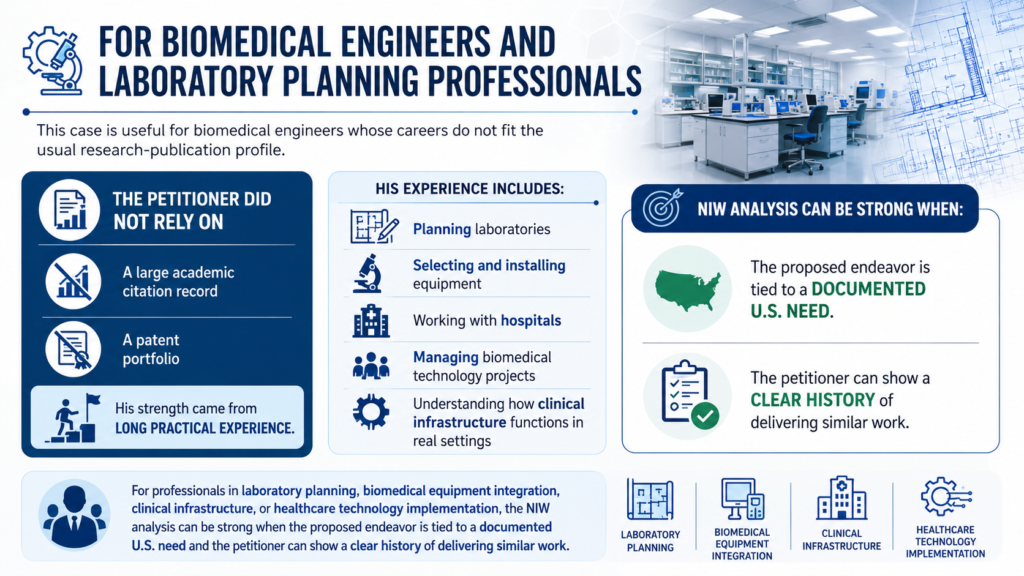
For professionals in laboratory planning, biomedical equipment integration, clinical infrastructure, or healthcare technology implementation, the NIW analysis can be strong when the proposed endeavor is tied to a documented U.S. need and the petitioner can show a clear history of delivering similar work.
Questions Biomedical Engineers Ask Us
Can a biomedical engineer focused on laboratory planning qualify for an EB-2 NIW?
Yes. Laboratory planning affects diagnostic capacity, patient access, workflow efficiency, and healthcare quality. When the proposed work is tied to a documented U.S. need and the petitioner has a substantial record of laboratory planning, equipment integration, and healthcare infrastructure work, the case can satisfy Dhanasar’s national-importance and well-positioned requirements.
Why was West Virginia used as the starting point?
West Virginia gave the petition a specific, evidence-based geographic target. The state’s 2022 legislative audit identified significant inadequacies in state-owned laboratory facilities, many of which were old or not designed for laboratory testing. That allowed the petition to move beyond a general claim about underserved healthcare and show a concrete place where the proposed work could matter.
Does a petitioner need prior U.S. work experience for this type of NIW?
No. Prior U.S. employment is not required for I-140 approval. The key question is whether the petitioner is well-positioned to advance the proposed endeavor. In this case, 21 years of biomedical equipment, laboratory planning, and healthcare infrastructure experience abroad provided relevant and transferable evidence.
How is this different from a medical equipment sales case?
The petition was not framed as sales. It was framed as laboratory infrastructure planning and equipment integration. The petitioner’s work involved assessing clinical needs, planning laboratory environments, coordinating installations, supporting biomedical maintenance, and helping healthcare facilities build functioning diagnostic capacity.
What made the case publishable as a success story?
The case became publishable when the pending-case language, internal editor notes, policy-update warnings, and years-of-experience inconsistency were removed, and the narrative was reframed around the confirmed approval, the documented U.S. need, and the petitioner’s well-positioned evidence.
Free assessment: immignis.us/contact-us