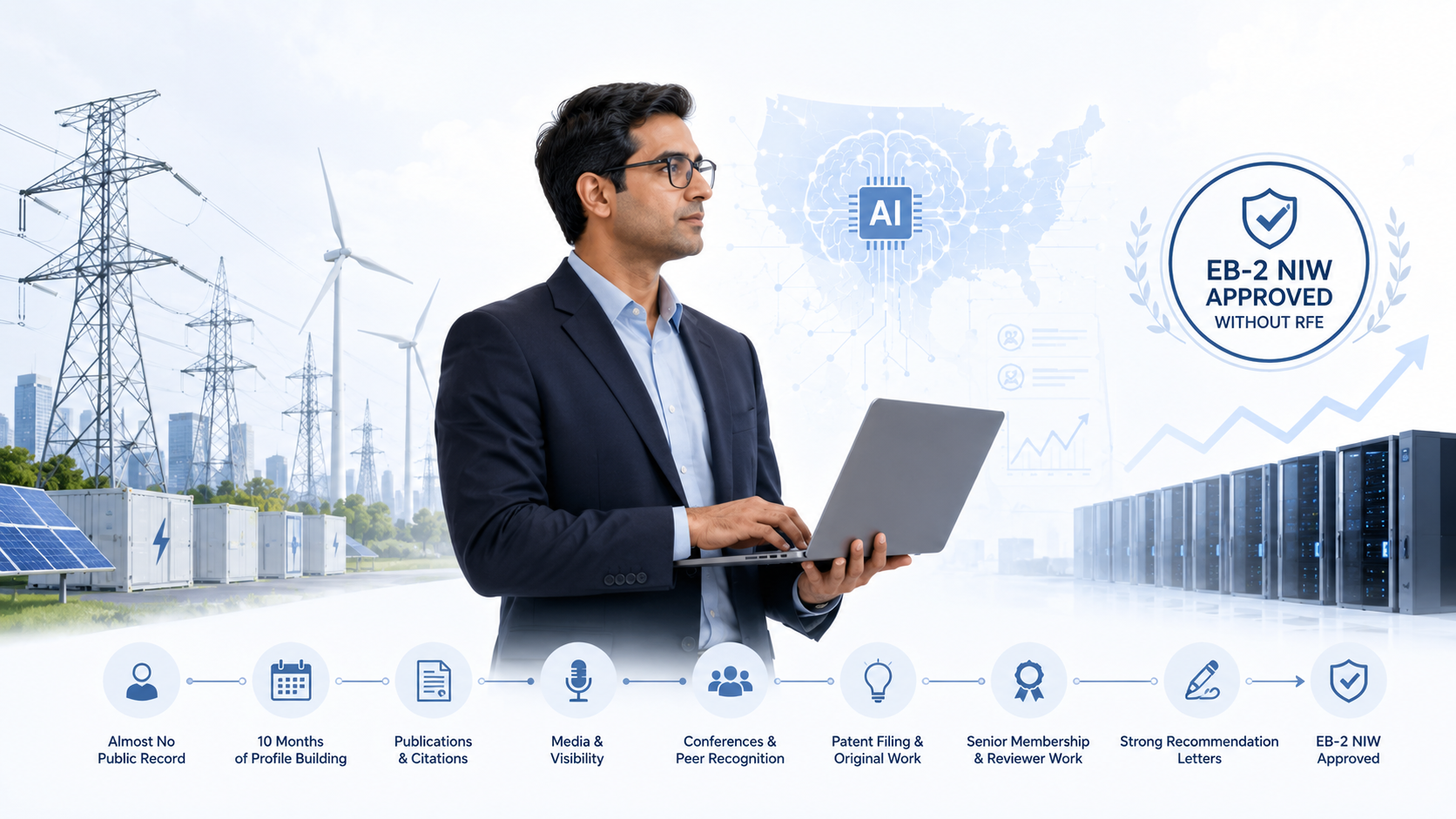
How an AI grid-reliability engineer built a petition-ready national-interest profile in 10 months through structured, ethical profile building for EB-2 NIW for AI engineers, creating a stronger EB-2 NIW for AI engineers record.
| Client profile | UAE-born Indian national; AI / machine-learning engineer focused on electric-grid reliability |
|---|---|
| Initial condition | Strong private technical experience, but almost no public-facing evidence |
| Profile-building period | Approximately 10 months |
| Proposed endeavor | To develop and deploy machine-learning systems that forecast instability and prevent cascading failures on the U.S. electric grid, enabling the grid to absorb surging demand from data centers and electrification while integrating large-scale renewable energy. |
| Evidence built | Public positioning, publications, citation growth, media visibility, conference activity, patent filing, reviewer work, senior membership, and independent recommendation letters |
| Immigration pathway | EB-2 National Interest Waiver |
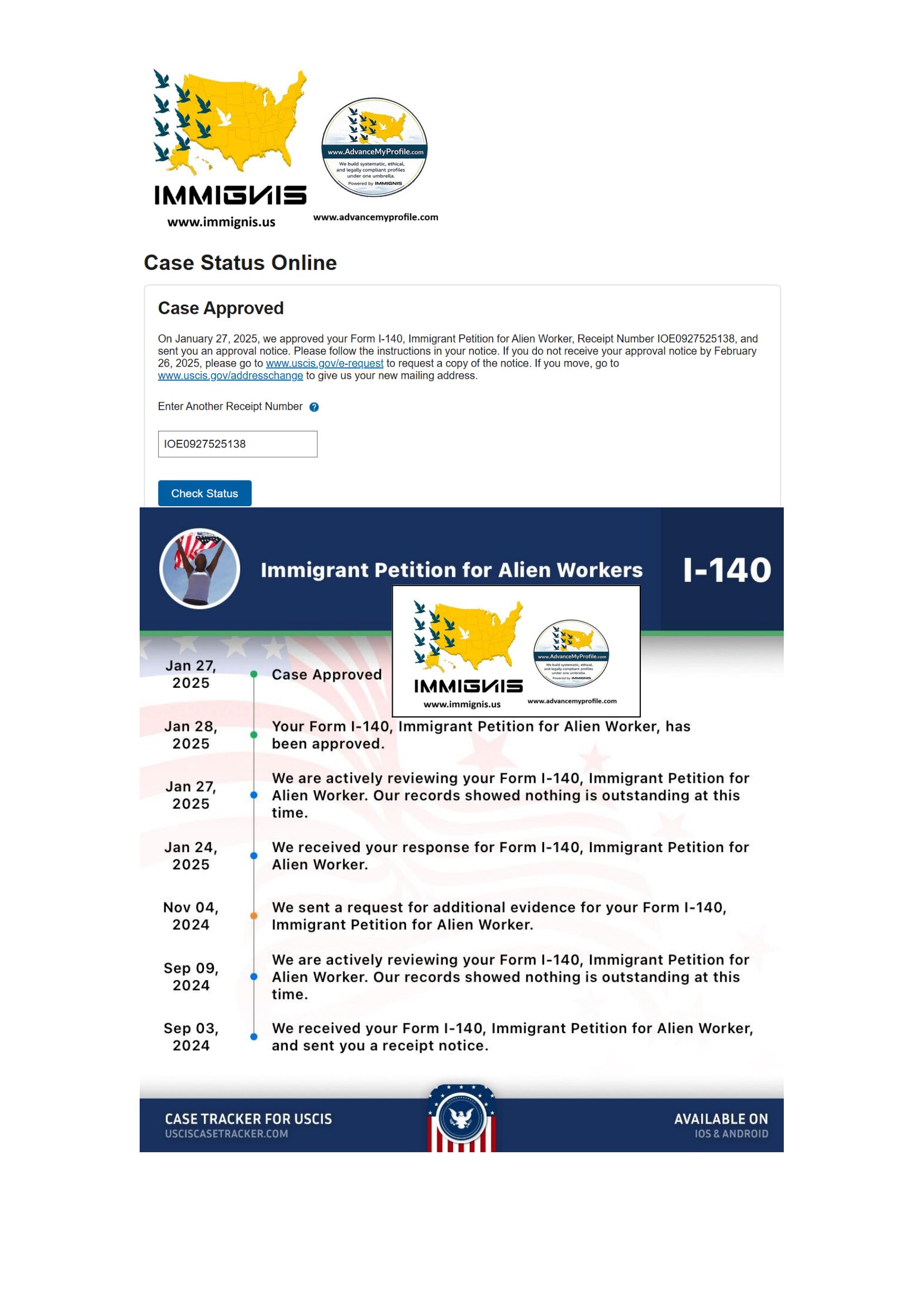
| Outcome | I-140 approved without a Request for Evidence |
The approval was the result of profile building
The approval was the result of profile building. The client was already a serious technical professional before he came to us. He had nearly nine years of experience working with machine-learning systems connected to electric-grid reliability and instability prediction. Inside his employment environment, his value was clear. The problem was that the value was almost invisible outside that environment.
For EB-2 NIW purposes, especially in EB-2 NIW for AI engineers, that distinction matters. USCIS does not approve a national-interest case because a person has a strong job title, a respected employer, or private technical knowledge that cannot be independently reviewed. USCIS reviews the written record. At the beginning, that record was thin: no public professional identity, no publication record, no independent citations, no conference visibility, no media recognition, no reviewer activity, and no clear field-facing profile connected to grid-reliability AI.
The result came after the profile was built properly for EB-2 NIW for AI engineers. In approximately 10 months, the case moved from private experience with limited public evidence to an EB-2 NIW approval without an RFE. The approval did not come from inventing a profile. It came from documenting real expertise in a way that an immigration officer could verify.
Why the proposed endeavor mattered
For EB-2 NIW for AI engineers, the proposed endeavor was not written as a generic software or AI career plan. It was built around one national problem: the reliability of the U.S. electric grid under rising pressure from data centers, electrification, industrial demand, and renewable-energy integration.
The final endeavor focused on developing and deploying machine-learning systems that forecast instability and prevent cascading failures on the U.S. electric grid. That framing was important because it connected the client’s actual work to national energy security, infrastructure resilience, data-center growth, industrial continuity, public safety, and clean-energy integration.
This was the first major strategic decision. A weak NIW endeavor says, 'I work in artificial intelligence.' A stronger endeavor for EB-2 NIW for AI engineers explains what problem the professional will solve, why the United States needs that solution, and why the applicant’s experience is directly connected to the proposed work.
The evidence gap we identified before filing

The easier path would have been to file immediately. We did not recommend that. The client had the substance for a strong case, but the public evidence was not yet strong enough to support the legal story. Employment letters and degrees could show that he was qualified. They could not, by themselves, show national importance or independent recognition.
Our assessment was direct: if the case was filed too early, the officer would have been asked to trust private experience without enough external confirmation. That is where many capable professionals lose NIW cases. They are not weak professionals; they are weakly documented professionals.
We therefore treated the first stage as profile building. The goal was to create a chain of evidence around one narrow professional identity: AI for electric-grid reliability.
What Immignis and Advance My Profile built
The first step was professional positioning for EB-2 NIW for AI engineers. We built a visible identity around a defined niche: machine learning for electric-grid reliability and instability prediction. His website, LinkedIn presence, research-facing profile, and public biography were aligned around the same direction.
The second step was publication planning. We helped structure a focused first-author publication path around predictive modeling, grid instability, AI-based forecasting, and infrastructure resilience. The point was not to create random publication volume. The point was to document his technical thinking in a form that could be reviewed, indexed, cited, and later explained in the petition.
The third step was visibility. After publication, we helped move the work into a broader field conversation through credible media, expert commentary, public-facing explanations, and energy-technology visibility. This helped move the profile from private employment evidence to independent professional recognition.
The fourth step was peer-facing engagement. Conference activity allowed the work to be presented before a professional audience. Reviewer activity showed that his judgment was being used to evaluate the work of others. These two pieces helped show a shift from participant to contributor.
The fifth step was originality and standing for EB-2 NIW for AI engineers. A patent filing documented that the client’s technical work had generated protectable intellectual-property direction. Senior-grade professional membership helped show that his standing had advanced beyond ordinary participation. Independent recommendation letters then confirmed the same story already shown by the evidence.
The turning point: independent evidence began to carry the case
For EB-2 NIW for AI engineers, the profile changed when third-party evidence began to support the same narrative from multiple directions. Publications showed technical contribution. Citations showed that other researchers were engaging with the work. Media and expert commentary showed that the work could be explained to a broader audience. Conference participation showed peer-facing visibility. Reviewer activity showed trust in his judgment. The patent filing showed original technical direction. Recommendation letters confirmed significance from outside voices.
The citation growth was especially important. The original goal was a credible citation base exceeding 100 citations. By filing time, the citation count had moved beyond 200. That momentum helped the petition move away from a future-looking claim and toward a documented record of field engagement.
The case became persuasive for EB-2 NIW for AI engineers because each piece of evidence pointed toward the same professional identity. Nothing felt random. Nothing looked artificially inflated. The evidence and the proposed endeavor were speaking the same language.
How the profile-building supported the Dhanasar framework
For Prong 1 in EB-2 NIW for AI engineers, the proposed endeavor connected the client’s work to a national infrastructure problem: grid instability during rapid growth in data-center demand, electrification, and renewable integration. The publications and public commentary helped show that the work belonged to a broader energy and technology conversation.
For Prong 2, the profile-building record showed that he was well positioned to advance the endeavor. The petition did not rely only on his employment history. It used publications, citations, conference activity, reviewer experience, patent activity, professional recognition, and independent expert letters to show readiness.
For Prong 3 in EB-2 NIW for AI engineers, the petition could explain why a job offer or labor certification would not capture the national value of the work. The endeavor was not tied to one employer’s internal project. It concerned grid-reliability methods with broader application across energy infrastructure, AI systems, and national resilience.
Filing and approval
Once the profile was ready, we assembled the petition as an evidence architecture. The proposed endeavor explained the national problem. The publications showed technical contribution. The citations showed field engagement. The media, conference, patent, reviewer, membership, and recommendation-letter evidence supported the claim that the client was positioned to advance the work.
The case was filed with a complete record and later upgraded to premium processing. USCIS approved the EB-2 National Interest Waiver I-140 without issuing a Request for Evidence.
This outcome matters because it shows the value of answering the major questions before USCIS has to ask them. The client did not become a different person during the engagement. His real expertise became visible, structured, and independently documented.
What the client gained beyond immigration approval
The approval was the central result, but it was not the only result. By the end of the process, the client had a stronger professional identity connected to a defined technical niche. His patent activity continued. His research visibility grew. His profile became more useful for career advancement, future opportunities, and possible later immigration pathways.
We later discussed a possible EB-1A pathway, including additional awards, higher membership recognition, and further authority-building. He chose not to continue at that stage because the NIW approval had achieved his immediate goal. That was a reasonable decision. A responsible strategy should serve the client’s objective, not push unnecessary activity after the main result has been achieved.
Why this success story matters
This story matters because many mid-career professionals have real expertise but lack a public evidentiary record. They solve serious problems inside companies, but their work is hidden behind internal projects, confidential systems, and employment letters. For USCIS, that is often not enough.
Ethical profile building fills that gap. It does not turn one professional into something else. It does not create a false identity. It identifies the strongest credible direction, builds public and peer-reviewed evidence around it, and organizes the record so the officer can understand why the person’s work matters.
For AI engineers, energy professionals, software architects, data scientists, biomedical specialists, entrepreneurs, and other technical professionals, the lesson is clear: file when the evidence is ready, not merely when the resume looks impressive.
Profile-building work completed before filing
| Profile-building area | What was done | Why it helped the NIW case |
|---|---|---|
| Professional positioning | Created a consistent public identity around AI for electric-grid reliability. | Made the field, niche, and proposed endeavor clear. |
| Publication strategy | Developed field-aligned publications tied to grid instability and predictive AI. | Turned private expertise into reviewable technical output. |
| Citation growth | Built a record that grew beyond 200 citations by filing time. | Showed independent field engagement. |
| Media and commentary | Placed the client in public discussions on AI, grid strain, and energy reliability. | Supported broader professional visibility. |
| Conference activity | Presented work in a recognized professional setting. | Created peer-facing evidence. |
| Patent filing | Coordinated intellectual-property direction from technical work. | Documented originality before filing. |
| Reviewer activity | Supported journal-review participation. | Showed the client had begun evaluating the work of others. |
| Recommendation letters | Built letters around specific evidence and technical significance. | Confirmed the petition story through independent voices. |
| Petition assembly | Organized the record around the Dhanasar framework. | Allowed the evidence to carry the legal argument. |
Key lessons for professionals
- A strong job title is not the same as a strong immigration record.
- The proposed endeavor must be specific, nationally important, and connected to the client’s real work.
- Profile building works best when every step creates verifiable evidence.
- Public visibility should be relevant and connected to the same professional niche.
- Publications are strongest when they are legitimate, field-aligned, and supported by later citations or expert engagement.
- Patent activity, reviewer work, speaking, membership, and recommendation letters help only when they fit the real profile.
- The best petition does not over-argue. It demonstrates the case through a clean evidentiary record.
Immignis helps serious professionals turn real technical experience into a clear, evidence-backed immigration profile. Book a free assessment to see whether your background is ready for EB-2 NIW, EB-1A, O-1, or another high-skill immigration pathway.