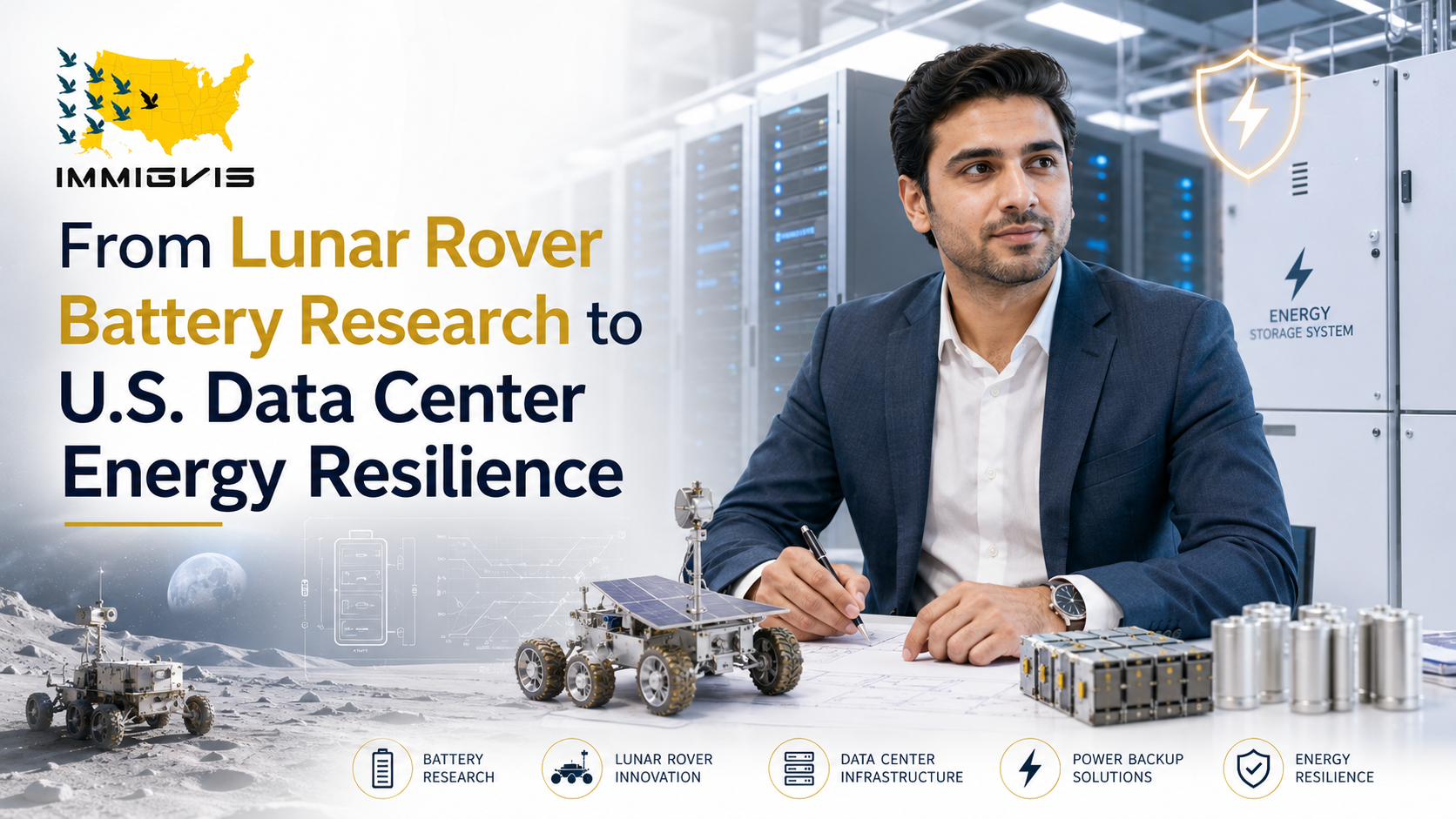
In this EB-2 NIW for Electrical Engineers case, a Pakistani electrical engineer with an MS from Khalifa University, a best-paper award for battery power-management research, and hands-on data center electrical-systems experience was approved for an EB-2 National Interest Waiver to advance cleaner, more reliable battery systems for U.S. data centers.
In short: An electrical engineer holding a Master of Science in Electrical and Computer Engineering from Khalifa
University and a Bachelor of Science in Electrical Engineering was approved for an EB-2 National Interest Waiver as a
self-petitioner. His background combined large-scale power-system exposure, instrumentation and controls, National
Instruments systems integration, a fully funded graduate scholarship, battery power-management research for a lunar
rover mission, and current work inside data center electrical systems. His proposed endeavor focused on advanced
battery systems for U.S. data centers, including battery energy storage systems, flow batteries, sodium-ion alternatives,
smarter battery management, and energy-efficiency improvements for facilities facing rising AI and cloud-computing
demand. Approved under Matter of Dhanasar.
Privacy note: The petitioner's name, employer names, university identifiers where not necessary, and personal contact details have been withheld. The profile facts, proposed endeavor, and approval result are presented in privacy-protected form.
The Infrastructure Behind Every Search, Payment, and AI Model
Data centers, a key focus in EB-2 NIW for Electrical Engineers, have become part of the physical infrastructure of the modern economy. They support cloud platforms, online payments, banking systems, healthcare data, logistics, public services, and the AI systems now being built at national scale. Their reliability depends on electricity, and their electricity demand is increasing quickly.
For years, backup power in many facilities, a major issue in EB-2 NIW for Electrical Engineers, relied on conventional battery systems and diesel generation. That model kept servers running, but it does not fully answer the next problem: how to keep data centers reliable while improving energy efficiency, integrating renewable power, reducing emissions, and handling the sharp load profile created by AI workloads.
This EB-2 NIW for Electrical Engineers case was built around that national problem. The petitioner did not present himself as a general electrical engineer looking for employment. He presented a focused endeavor: to help U.S. data centers adopt advanced battery systems and smarter power-management methods so critical digital infrastructure can scale without adding unnecessary strain to the grid.
From Power Stations to Space-Grade Battery Management: EB-2 NIW for Electrical Engineers
The petitioner's path in this EB-2 NIW for Electrical Engineers case gave the case a practical engineering foundation. He began in a national power-generation environment, gaining exposure to control rooms, instrumentation, industrial control systems, sensors, I/O cards, and PLC-based maintenance. He later moved into industrial machinery operations and then into applications engineering, where he worked with National Instruments platforms, LabVIEW, Python, electro-hydraulic testing, radio relay systems, and object-tracking systems.
The academic turning point for EB-2 NIW for Electrical Engineers came through a fully funded scholarship for graduate study in Electrical and Computer Engineering at Khalifa University in the UAE. His master's thesis addressed battery power management for a lunar rover mission in collaboration with a space-sector partner. The project required state-of-charge estimation, mission-phase energy scheduling, and battery-management logic for a system where power failure could compromise the entire mission. The work received the Best Paper Award in the Electrical and Electronic Engineering category at Khalifa University's Graduate Students Research Conference in March 2023.
That research background later connected to his field experience in data center electrical systems for EB-2 NIW for Electrical Engineers. In his current work, he troubleshoots, maintains, and updates firmware for electrical systems operating inside data center environments. This gave the petition a useful bridge: research knowledge in battery power management, practical exposure to mission-critical electrical infrastructure, and direct understanding of how data center power systems behave in real deployments.
The Proposed Endeavor: Advanced Battery Systems for Data Centers
The proposed endeavor was framed around implementation, optimization, and consulting rather than speculative invention. The petitioner proposed to help U.S. data center operators evaluate, design, and integrate advanced battery and energy-storage approaches that improve reliability and efficiency across facility power systems.
The technical scope included four connected areas:
- Battery Energy Storage Systems (BESS) for peak shaving, backup resilience, renewable integration, and smoother power delivery during high-demand periods.
- Alternative battery chemistries such as flow batteries and sodium-ion systems where longer cycle life, reduced degradation, or lower lifecycle environmental impact may fit data center use cases.
- Smarter battery management and charge-discharge scheduling, including AI-assisted monitoring, state-of-charge estimation, and predictive maintenance logic.
- Power Utilization Effectiveness (PUE) improvement through better coordination of energy storage, electrical distribution, firmware-level control, and facility load management.
The petition carefully avoided the weak claim that the petitioner would single-handedly invent a new battery chemistry. The stronger and more credible claim was that he was positioned to advance data center battery integration, energy-management strategy, and technical implementation across multiple client environments.
Why the National Importance Argument Worked
The national importance section in this EB-2 NIW for Electrical Engineers case connected the proposed endeavor to a clear U.S. infrastructure problem. Data center electricity demand has become a national planning issue because AI infrastructure, cloud services, and digital public and commercial systems all require reliable power. Federal agencies and energy researchers have warned that data center electricity use is rising sharply, and that AI growth is increasing pressure on power systems, grid planning, and clean-energy integration.
The petition tied the endeavor to three policy and market realities for EB-2 NIW for Electrical Engineers. First, the United States is expanding AI and data center infrastructure at speed. Second, the power burden of that expansion has become a grid and energy-security issue. Third, battery storage is now a central technology for grid flexibility, renewable integration, and facility resilience. This made the proposed work larger than a private consulting service; it was connected to the reliability of digital infrastructure used by businesses, consumers, public agencies, and critical sectors.
The petition also improved the national-importance framing for EB-2 NIW for Electrical Engineers by replacing broad clean-energy language with data-center-specific energy logic. The strongest argument was not simply that batteries are good for the environment. The stronger argument was that data centers need reliable, scalable, and cleaner backup and load-management systems to support the next phase of American digital and AI infrastructure.
How the Well-Positioned Argument Was Rebuilt
The original EB-2 NIW for Electrical Engineers case had a challenge: maintenance-level data center work alone would not be enough to support an independent NIW endeavor in advanced battery systems. The successful version therefore focused on the full pattern of evidence rather than a single job title.
The well-positioned argument for EB-2 NIW for Electrical Engineers relied on five connected facts. The petitioner had early exposure to large-scale power systems. He developed hands-on control, instrumentation, and systems-integration skills. He completed graduate research in battery power management at a recognized UAE research university. He won a competitive best-paper award for that work. And he then moved into practical data center electrical-systems work, giving him current exposure to the target environment of the proposed endeavor.
Together, these facts created a credible bridge for EB-2 NIW for Electrical Engineers between research and application. The case did not argue that he was already a world-famous battery scientist. It argued that his combination of battery-management research, electrical systems practice, data center experience, and implementation-oriented plan made him well-positioned to advance the proposed work in the United States.
The Critical Fix: Removing Employment-Based Framing
A major weakness for EB2 NW is suggesting that a U.S.-based company might offer him a role if the NIW were approved. That kind of statement can damage a National Interest Waiver case because it makes the petition look like a path to a job offer.
How the Petition Was Structured
The First Prong for EB-2 NIW for Electrical Engineers focused on the substantial merit and national importance of data center energy resilience. The petition used government and industry sources to show that data centers are using a growing share of U.S. electricity, that AI demand is accelerating the trend, and that battery storage is a recognized tool for grid flexibility and reliability.
The Second Prong for EB-2 NIW for Electrical Engineers was rebuilt around the petitioner's actual evidence: power-generation exposure, systems-integration work, fully funded graduate study, lunar rover battery-management research, the best-paper award, current data center electrical-systems work, and engineering registration or professional engineering evidence where available.
The Third Prong in EB-2 NIW for Electrical Engineers explained why a waiver made sense. The proposed endeavor was not a single-employer role. It required cross-client consulting, technology evaluation, systems integration, and the ability to work across data center operators, equipment vendors, and energy-storage use cases. Labor certification for one fixed job would not capture the national scope or multi-site nature of the work.
The Outcome
Approved.
A self-petitioned EB-2 National Interest Waiver was approved for an electrical engineer whose profile connected battery power-management research, a best-paper award, and data center electrical-systems experience to a U.S. endeavor focused on advanced battery systems for data center reliability and energy efficiency.
The case succeeded because the final petition corrected the weak framing. It did not rely on a possible job offer, unverifiable academic citations, or broad clean-energy claims. It connected the petitioner's real background to a specific national infrastructure problem: how the United States can power expanding data centers more reliably, efficiently, and responsibly.
For Electrical Engineers Working in Data Center Energy
This success story is useful for engineers whose work sits between research and implementation. A petitioner does not always need to be a patent-heavy inventor or senior executive. A strong NIW can be built when the proposed endeavor is specific, the national need is well documented, and the petitioner can show a credible technical pathway from past work to future U.S. contribution.
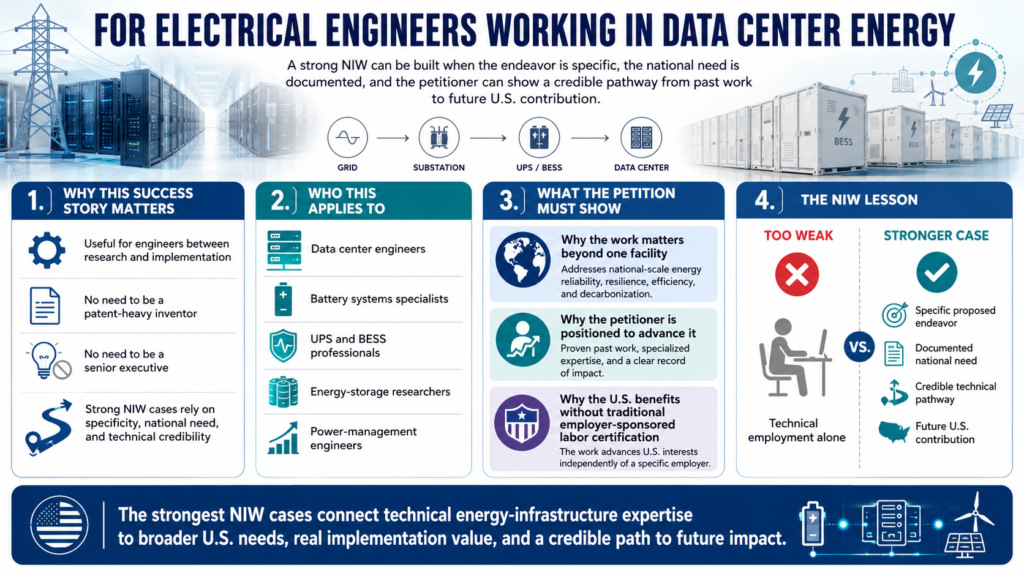
For data center engineers, battery systems specialists, UPS and BESS professionals, energy-storage researchers, and power-management engineers, the lesson is clear: the petition must show more than technical employment. It must show why the work matters beyond one facility, why the petitioner is positioned to advance it, and why the United States benefits from allowing the work to proceed without a traditional employer-sponsored labor certification.
Questions Electrical Engineers Ask Us
Can an engineer with only a few years of data center experience qualify for EB-2 NIW?
Yes, but the petition must be carefully framed. Data center work alone may look like ordinary employment. The case becomes stronger when data center experience is combined with research, awards, advanced education, systems-integration expertise, professional recognition, or a clearly defined proposed endeavor tied to national infrastructure needs.
Does a best-paper award from a university research conference help?
Yes. It is not the same as a major international award, but it is still useful evidence when connected to the proposed endeavor. In this case, the award supported the argument that the petitioner had recognized research ability in battery power management, which was directly relevant to the proposed U.S. work.
Should an NIW petition mention a possible U.S. job offer?
Usually no. A possible job offer can weaken the waiver argument if it makes the petition look employer-driven. A non-binding collaboration or pilot interest may help if it supports the proposed endeavor, but the petition should not present NIW approval as a route to employment with one company.
How is this different from a normal clean-energy petition?
This case was not presented as a broad clean-energy petition. It was built around the specific power demands of data centers, the growth of AI infrastructure, and the need for advanced battery systems to improve reliability, efficiency, and energy resilience in facilities that support critical digital services.
Pursuing an EB-2 NIW in electrical engineering, data center energy, battery systems, BESS, or clean-energy infrastructure? Start with a professional assessment of your proposed endeavor, evidence strength, and Dhanasar positioning.
For electrical engineers working in data center energy, battery systems, BESS, or clean-energy infrastructure, Immignis can help assess your profile and build a focused EB-2 NIW strategy around your real technical impact.