
EB-2 NIW for Engineers: How an energy cost-control engineer built an approved national-interest case around predictive cost forecasting, digital project controls, procurement intelligence, and resilient U.S. energy-sector execution for EB-2 NIW for Engineers.
Case Snapshot
| Client profile | Mechanical engineer and project-controls specialist with 15+ years of experience in cost engineering, planning, SAP project systems, Primavera P6, and large-scale EPC energy projects across the UAE, Qatar, Oman, and Pakistan. |
| Field | Energy project controls, EPC project delivery, cost engineering, AI-driven forecasting, digital transformation, procurement controls, and infrastructure execution. |
| Approved endeavor | Modernize project management in the U.S. energy sector through digital transformation, automation, AI-driven cost control, predictive analytics, and real-time project monitoring. |
| National-interest theme | Faster, more predictable, and more cost-disciplined delivery of energy infrastructure at a time of rising demand, input-cost volatility, workforce constraints, and grid-expansion pressure. |
| Evidence strategy | The petition connected SAP, Primavera P6, cost-control, procurement, subcontractor, planning, and EPC-delivery experience to five scalable technical components. |
| Outcome | EB-2 NIW I-140 approved. |
The EB-2 NIW for Engineers Approval Result
EB-2 NIW for Engineers: The Petitioner’s case was converted from a traditional project-controls profile into an approved EB-2 NIW success story built around U.S. energy infrastructure delivery. The approval was grounded in a clear national problem: major energy projects often suffer from cost overruns, schedule delays, procurement drift, fragmented project data, and weak early-warning systems.
The winning strategy for EB-2 NIW for Engineers did not present him as a routine cost engineer or planning employee. It positioned him as an energy project-controls professional capable, in an EB-2 NIW for Engineers case, of applying AI-driven cost forecasting, digital project visibility, procurement intelligence, and real-time risk monitoring to improve how large-scale U.S. energy projects are planned, controlled, and delivered.
The National Problem: Energy Projects Need More Predictable Delivery
U.S. energy infrastructure faces intense delivery pressure. Electricity demand is rising, transmission and generation projects face long timelines, and energy-sector owners must manage input-cost volatility, workforce constraints, procurement delays, and capital discipline. When cost, schedule, procurement, and risk data remain scattered across disconnected systems, project leaders often discover overruns only after they have already become expensive.
The petition therefore framed the endeavor as a national infrastructure delivery solution. The focus was not one employer’s internal project controls. The focus was a scalable system that could help reduce waste, improve forecasting, strengthen resource allocation, and support more reliable execution of energy projects that serve broader public and industrial needs.
The Proposed Endeavor
The approved proposed endeavor focused on modernizing project management in the U.S. energy sector through digital transformation, automation, AI-driven cost control, predictive analytics, and real-time project monitoring.
In practical terms, the endeavor would design and implement advanced project-control systems that help energy-sector owners and EPC teams forecast cost overruns earlier, identify schedule risks, optimize procurement and subcontractor performance, monitor real-time progress, and integrate sustainability-linked financial metrics into project-delivery decisions.
What Immignis and AdvanceMyProfile Built
The profile-building work converted a strong but employer-centered cost-control record into a national-interest architecture. His experience was no longer presented as a list of employers, projects, and software tools. It became a practical model for predictive forecasting, digital transparency, resource optimization, procurement intelligence, and sustainability-linked financial control.
- A focused national-interest theory tied to U.S. energy infrastructure delivery, capital efficiency, project predictability, and resilience.
- A technical framework that showed how SAP, Primavera P6, procurement data, cost reports, subcontractor information, and project dashboards could be integrated into a smarter delivery model.
- A well-positioned argument based on 15+ years of project-controls experience across large EPC energy environments in the UAE, Qatar, Oman, and Pakistan.
- A third-prong waiver argument showing that a self-directed and scalable modernization model could benefit multiple energy projects and stakeholders, not only one employer.
Five Technical Pillars Behind the Approved Strategy
| Technical pillar | How it strengthened the NIW case |
| AI-powered predictive cost and schedule engine | A machine-learning model to forecast cost overruns, schedule slippage, procurement drift, and productivity risks before they become major project failures. |
| Integrated digital twin for project controls | A project-lifecycle model that unifies SAP PS/MM/SD, Primavera P6, procurement data, resource utilization, progress reporting, and real-time dashboards. |
| Automated risk and resource optimization engine | A monitoring system that scans project data, flags contractual or supply-chain risks, and recommends resource reallocation across critical work fronts. |
| Intelligent procurement and subcontractor management | An AI-enabled system using contract intelligence, subcontractor scoring, compliance monitoring, and procurement optimization to reduce disputes and delays. |
| Sustainability-integrated financial modeling | A financial-control model that embeds carbon, energy-efficiency, waste-reduction, and lifecycle-cost metrics into project forecasting and budget decisions. |
How the Evidence Supported Dhanasar
| Dhanasar prong | How the approval strategy was built |
| Prong 1: Substantial merit and national importance | The endeavor was tied to U.S. energy infrastructure delivery, cost control, grid expansion, energy independence, AI adoption, and reduction of wasteful spending in capital-intensive projects. |
| Prong 2: Well positioned | The record showed 15+ years of progressive project-controls experience, senior cost-control responsibility at NMDC Energy, prior cost and planning roles across multiple energy markets, and hands-on use of SAP and Primavera P6 in large EPC environments. |
| Prong 3: Benefit of waiving labor certification | The petition explained why a labor-certification route would not capture the broader public-interest value of a self-directed, scalable project-management modernization framework for the U.S. energy sector. |
Why This Was More Than a Cost-Control Resume
A project-controls profile can easily look like ordinary employment if it is drafted around job duties alone. This case became stronger because the evidence was connected to a national infrastructure problem and a future-facing technical model. The petition showed how cost engineering, planning, procurement controls, subcontractor management, and digital reporting could become part of an AI-enabled system for better energy-sector execution.
The public-facing story is therefore strongest when it emphasizes measurable infrastructure value: fewer overruns, earlier risk detection, better procurement discipline, improved resource allocation, stronger project transparency, and more reliable energy-project delivery.
What the Client Gained Beyond Approval
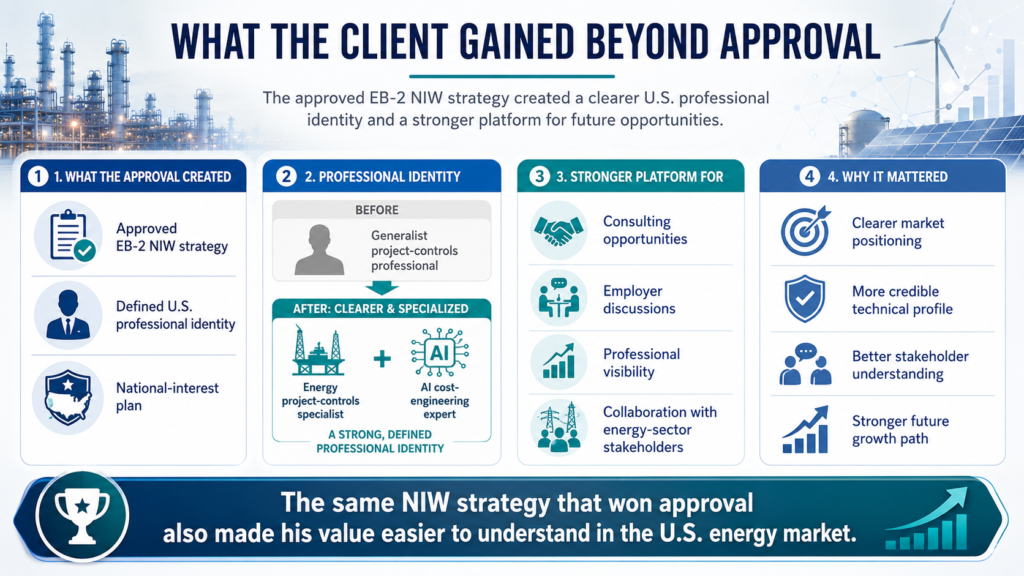
The approved EB-2 NIW strategy gave the client a defined professional identity in the United States: an energy project-controls and AI cost-engineering specialist with a national-interest plan. The profile also created a stronger platform for future consulting, employer discussions, professional visibility, and collaboration with energy-sector stakeholders.
What Professionals Can Learn From This Case
- Project-controls and cost-engineering professionals should not rely only on job titles or software experience; the petition must show the national problem their work can solve.
- Energy-sector experience becomes stronger when it is translated into a scalable method for cost forecasting, risk monitoring, procurement control, and infrastructure delivery.
- AI and digital-twin concepts should be tied to practical execution, not used as buzzwords.
- A strong NIW profile connects real work already performed to a credible U.S. implementation plan.