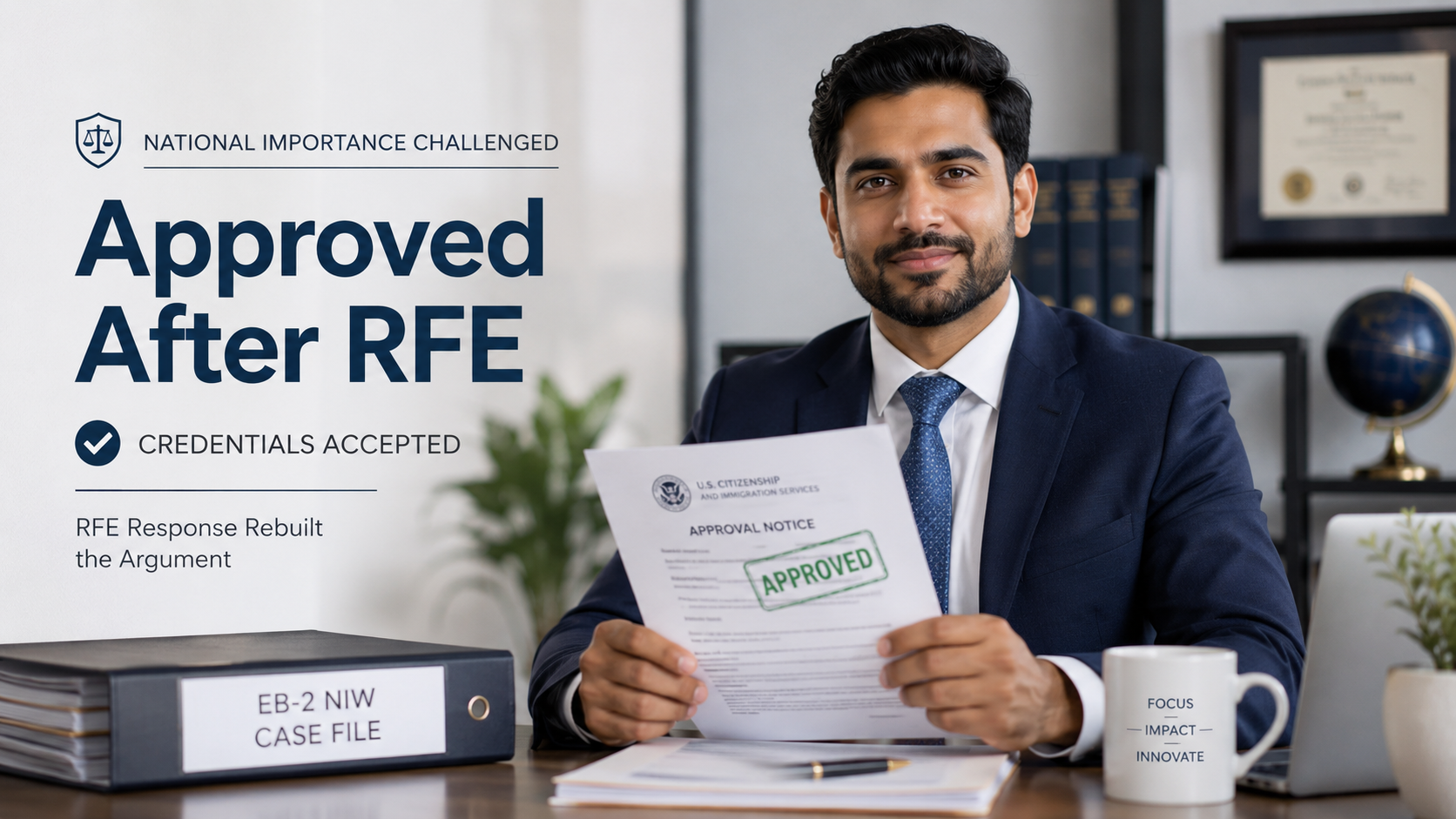
A Pakistani healthcare entrepreneur with 23 years of hospital design, medical technology, home healthcare, and E-Clinic experience secured EB-2 NIW approval in an EB-2 NIW for Healthcare Entrepreneurs case after an RFE required the petition to move beyond business ambition and show broader U.S. healthcare-system impact, making it a strong example of EB-2 NIW for Healthcare Entrepreneurs.
| Case Snapshot | Approved EB-2 NIW after RFE response |
| Professional Profile | Pakistani biomedical entrepreneur with 23 years of healthcare infrastructure, medical equipment, hospital design, home healthcare, and E-Clinic leadership experience. |
| Core Background | Former national and regional healthcare-technology leader with experience in major hospital projects, diagnostic imaging deployment, healthcare IT, home healthcare, and E-Clinic operations. |
| USCIS RFE Issue | USCIS accepted the petitioner’s credentials, accepted substantial merit, and accepted that he was well-positioned, but challenged national importance and the waiver justification. |
| RFE Strategy | The response reframed the case from a company-service model into a field-impact model based on replicable E-Clinic delivery, rural access, hospital infrastructure modernization, home healthcare, exportable healthcare technology, and scalable methods. |
| Proposed Endeavor | Improve U.S. healthcare access through hospital design, modular healthcare infrastructure, home healthcare systems, E-Clinics, telemedicine integration, and exportable healthcare delivery platforms. |
| Outcome | Approved under Matter of Dhanasar after RFE response. |
The EB-2 NIW for Healthcare Entrepreneurs RFE That Clarified the Real Problem
The case, an EB-2 NIW for Healthcare Entrepreneurs case, became stronger because the RFE clarified exactly where the initial petition had lacked. USCIS did not reject the petitioner’s professional background. It accepted his classification, accepted that the proposed work had substantial merit, and accepted that he was well-positioned to advance it.
The problem was national importance in this EB-2 NIW for Healthcare Entrepreneurs petition. USCIS asked for proof that the proposed work would extend beyond the petitioner’s companies and direct patients or clients. In other words, the petition had to show field-level impact, not only a successful healthcare business plan.
That distinction became the turning point. The RFE response reframed the case around scalable healthcare methods, replicable E-Clinic operations, rural healthcare access, hospital infrastructure improvement, home healthcare delivery, and international healthcare-service exports from a U.S. base.
The Healthcare Entrepreneur Behind the Petition
The petitioner’s career spans more than two decades across the healthcare infrastructure chain in an EB-2 NIW for Healthcare Entrepreneurs case. He began in biomedical equipment service and progressed into national sales, country management, hospital technology, healthcare engineering, and entrepreneurial leadership.
His experience included working with major diagnostic imaging systems, hospital equipment portfolios, healthcare IT platforms, and large-scale hospital projects. He later built and led healthcare companies focused on hospital planning, equipment integration, healthcare facility design, home healthcare services, and E-Clinic delivery.
Across his career, he worked on more than 40 major healthcare projects for this EB-2 NIW for Healthcare Entrepreneurs profile, including hospital design, imaging equipment deployment, healthcare IT programs, home-care services, and E-Clinic operations. This gave him unusual credibility: he had not only sold or serviced healthcare technology; he had helped build the environments where healthcare is delivered.
The Proposed Endeavor: From Healthcare Business to Healthcare Model
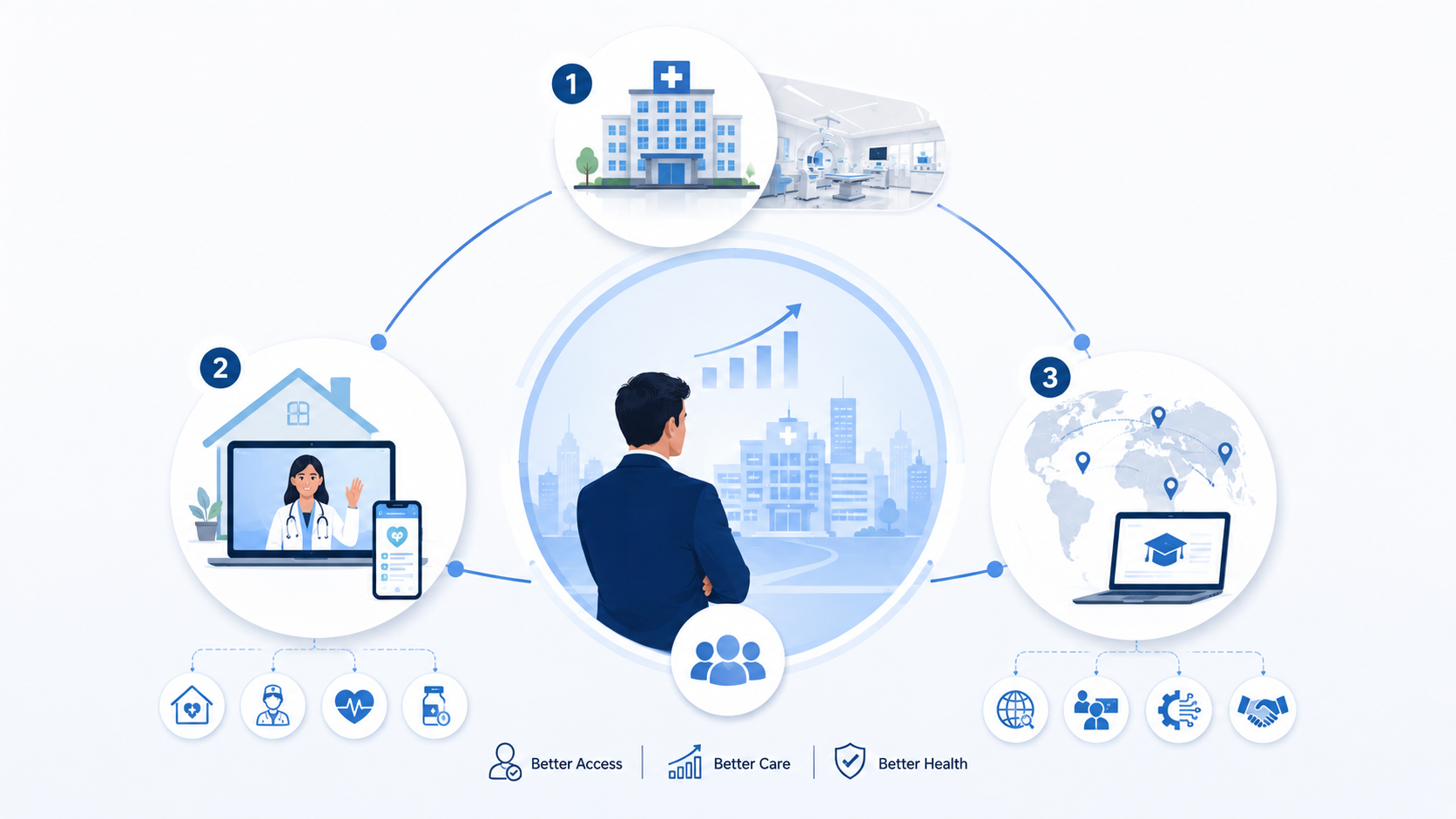
The approved proposed endeavor was framed around improving healthcare delivery through three connected tracks.
1. Modern Healthcare Facilities and Hospital Infrastructure
The first track focused on designing and improving healthcare facilities using modular planning, digital workflow systems, equipment integration, and more efficient infrastructure models. The petition explained how the petitioner’s hospital-design experience could support underserved and capacity-constrained U.S. healthcare markets.
2. Home Healthcare and E-Clinics
The second track focused on home healthcare and E-Clinics. This was the strongest part of the case because the petitioner had already implemented a working model abroad. The petition showed how remote consultations, diagnostic coordination, pharmacy support, nursing, physiotherapy, and home-based services could reduce facility pressure and expand access when properly organized.
3. U.S.-Based Healthcare Export and Training Platform
The third track positioned the U.S. operation as a base for healthcare-service exports, training, technology deployment, and cross-border healthcare delivery support. This shifted the case away from a local service business and toward a broader economic and professional contribution.
Why the RFE Response Worked
The original national-importance argument in this EB-2 NIW for Healthcare Entrepreneurs case had a common weakness: it relied heavily on the idea that serving patients and building healthcare facilities is inherently important. USCIS wanted more. It wanted evidence that the petitioner’s work would improve methods, standards, access models, or industry practice beyond his own company.
The response addressed that issue by emphasizing the petitioner’s E-Clinic model as a replicable healthcare delivery system. It explained how the model could be adapted, documented, trained, implemented, and exported. It also connected the petitioner’s prior work to problems the United States is actively trying to solve: rural access, care at home, hospital capacity, digital health integration, and cost-effective service delivery.
The strongest part of the EB-2 NIW for Healthcare Entrepreneurs response was the move from “my company will serve patients” to “this model can influence how healthcare access is organized, delivered, and scaled.” That is the difference between substantial merit and national importance in many healthcare-service NIW cases.
How the Dhanasar Prongs Were Presented After the RFE
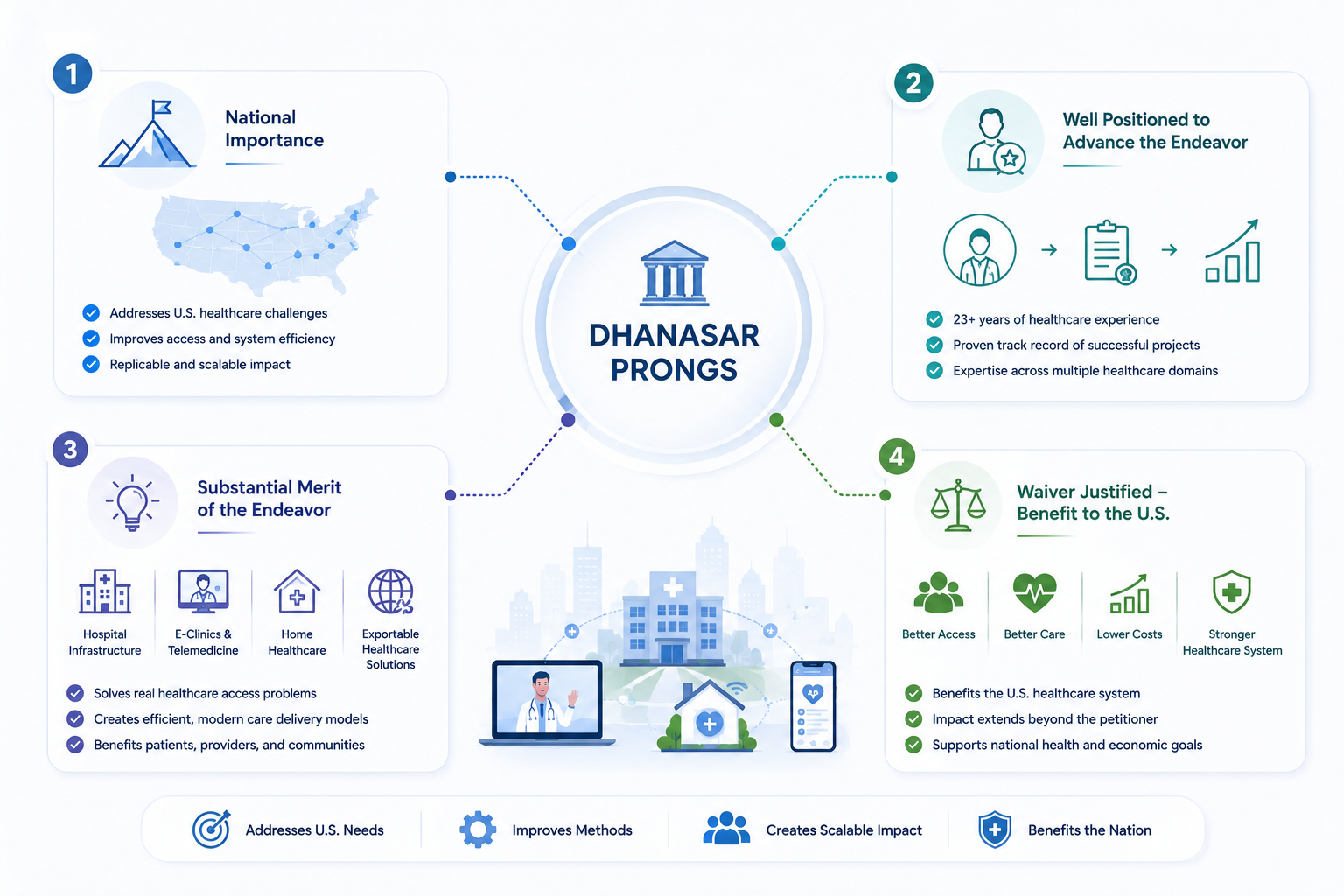
Prong One: Substantial Merit and National Importance
Substantial merit was already accepted because healthcare infrastructure, home healthcare, E-Clinics, and digital health services clearly have professional and public value. The RFE response strengthened national importance by showing that the endeavor was not limited to one clinic, one hospital project, or one patient population. It was presented as a scalable model for expanding access and improving delivery methods.
Prong Two: Well-Positioned to Advance the Endeavor
This prong was already accepted by USCIS. The petitioner’s 23-year record, healthcare leadership roles, major hospital projects, home healthcare platform, E-Clinic operations, and company-building experience showed that he had the background to advance the proposed work.
The response preserved that strength and connected it more directly to the endeavor. It showed that the petitioner was not proposing an unfamiliar field; he was expanding a model he had already helped build and operate.
Prong Three: Benefit of Waiving the Job Offer and Labor Certification Requirement
The waiver argument became stronger once the proposed endeavor was framed as a cross-institutional and exportable healthcare model. A single employer role would limit the petitioner to one organization’s priorities, while the proposed endeavor required collaboration with facilities, technology partners, providers, training teams, and international healthcare stakeholders.
The response also showed that the petitioner’s work could create business activity, professional partnerships, training opportunities, and implementation roles for U.S.-based healthcare and technology workers.
The Outcome
Approved after RFE response.
USCIS approved the EB-2 National Interest Waiver petition after the response addressed the national-importance and waiver concerns raised in the RFE. The approval turned the case from a healthcare business-services petition into a stronger healthcare-systems petition built around scalable E-Clinic delivery, home healthcare, hospital modernization, and broader field impact.
The case shows that an RFE is not the end of an NIW petition. When USCIS identifies the exact weakness, the response must answer that weakness directly. In this case, the answer was not simply more credentials. The answer was a clearer explanation of how the petitioner’s model could extend beyond his own company and affect the healthcare delivery field more broadly.
What Makes This Success Story Different
This case is different because USCIS accepted the petitioner’s qualifications and rejected the impact argument. Many NIW applicants assume that strong experience is enough. This case shows that even a very strong healthcare entrepreneur must still prove national importance through scale, field influence, replicability, and broader consequences.
It is also different because the petitioner was not a conventional researcher or employee. He was a healthcare entrepreneur whose evidence came from building systems: hospitals, E-Clinics, home healthcare operations, equipment networks, and healthcare companies. The success came from translating that entrepreneurial record into Dhanasar language.
Questions Healthcare Entrepreneurs Ask Us
Can a healthcare entrepreneur win an EB-2 NIW?
Yes. A healthcare entrepreneur can win when the proposed work is framed beyond a private business plan. The petition must show how the work addresses a national healthcare problem, creates a replicable model, improves delivery methods, supports underserved populations, or produces broader economic and professional effects.
Why was national importance challenged if the petitioner’s credentials were accepted?
Because the petitioner’s qualifications and the endeavor’s national importance are separate legal questions. USCIS may agree that a person is highly qualified but still find that the proposed work, as described, does not have sufficiently broad impact. The RFE response must address the impact of the work, not merely repeat the petitioner’s experience.
What was the strongest part of this case after the RFE?
The E-Clinic and home healthcare model was the strongest part because it could be shown as a scalable delivery method, not just a service offered by one company. A model that can be replicated, trained, exported, or adopted by other organizations is usually stronger than a model that only benefits direct customers.
Does serving underserved areas automatically prove national importance?
No. Serving underserved areas is valuable, but USCIS usually looks for evidence of scale and broader effect. The petition should show how the work can reduce access gaps through a model, method, partnership structure, technology platform, training system, or implementation framework that can extend beyond one provider.
What lesson does this case offer future RFE responses?
Answer the exact objection. If USCIS challenges national importance, do not respond only with more credentials. Explain why the proposed work affects a field, system, region, population, or national priority beyond direct clients. The RFE response must convert good work into national-interest work.
For Healthcare Entrepreneurs, Hospital Designers, and Digital Health Founders
If you work in hospital design, home healthcare, E-Clinics, or digital health, Immignis can help turn your experience into a focused EB-2 NIW strategy built around national importance and U.S. healthcare impact.