A Lead Rotating Equipment Engineer with 23 years across the world’s largest LNG and gas-processing facilities – approved for an EB-2 NIW to bring documented, quantified reliability improvements to U.S. liquefied natural gas infrastructure.
In short: A mechanical engineer holding a Bachelor of Engineering in Mechanical Engineering, with 23+ years of progressively senior leadership in turbomachinery reliability, LNG/NGL commissioning, and rotating-equipment engineering across Qatar, the UAE, Kazakhstan, Saudi Arabia, Oman, and Pakistan, was approved for an EB-2 NIW for Mechanical Engineers as a self-petitioner. Pakistani national, Qatar-based. His nine-year role at one of the Middle East’s largest gas-processing complexes produced independently verified, award-recognized results: $1M and $1.2M in annual maintenance savings, 20-30% reductions in unplanned downtime, and recovery of $250M in spare parts. Proposed endeavor for EB-2 NIW for Mechanical Engineers: advance the reliability, efficiency, and emissions performance of U.S. LNG turbomachinery through four integrated technical pillars. Approved under Matter of Dhanasar.
The petitioner’s name and employer details have been withheld for privacy. Career record, awards, specific quantified results, and outcome are real.
What Keeps LNG Flowing: EB-2 NIW for Mechanical Engineers
In October 2025, the United States exported 10.1 million metric tons of LNG – a new monthly record. The U.S. has become the world’s largest LNG exporter, and its ability to fill that role depends on a specific class of industrial equipment that most people have never heard of: main refrigerant compressors. These are the machines that compress and cool natural gas to -162°C so it can be loaded onto tankers and shipped to power grids in Europe, Asia, and beyond, making this technical record highly relevant to EB-2 NIW for Mechanical Engineers.
When one of those compressors trips, an entire liquefaction train goes offline. Production losses range from $1 million to $8 million per day depending on train size. The 2022 Freeport LNG outage demonstrated that a single site failure can shift global LNG pricing and disrupt supply commitments spanning multiple countries. And as North American LNG liquefaction capacity is projected to double by 2028-2029, the machines driving that capacity are running at increasingly demanding duty cycles, a context that strengthens the EB-2 NIW for Mechanical Engineers argument.
The engineering discipline that prevents those trips is what he has spent 23 years doing. Turbomachinery reliability, at the level of the compressors, turbines, dry-gas seals, and anti-surge systems that determine whether an LNG train runs or stops, is central to EB-2 NIW for Mechanical Engineers.
Nine Years at the Center of It
The flagship role in his career was nine years as Senior Mechanical Maintenance Engineer at one of the Middle East’s largest integrated gas-processing complexes, a $5 billion facility producing 12,000 tonnes per day of NGLs and 5,000 tonnes per day of sulphur. This experience strongly supports EB-2 NIW for Mechanical Engineers. This was not a monitoring role. He led the maintenance of the rotating and static equipment across NGL recovery units, cryogenic systems, sulphur recovery, and granulation plants – the full range of machinery that keeps a high-throughput gas-processing operation running continuously.
That role produced documented, independently verified, formally recognized results. In 2017 and 2018, his employer (a UAE government-owned energy company) awarded him consecutive Best Performance recognitions, strengthening the case for EB-2 NIW for Mechanical Engineers:
2017: 20% reduction in unplanned downtime, 15% shorter shutdowns, $1 million in annual maintenance savings.
2018: 30% reduction in unplanned downtime, $1.2 million in additional savings. These are not estimates in a report. They are the stated grounds of formal employer awards from one of the world’s most recognized national energy companies, attesting to specific results measured and verified by the organization’s own systems, which is highly relevant to EB-2 NIW for Mechanical Engineers.
Two consecutive Best Performance Awards from a major government-owned energy company, citing specific percentage improvements and specific dollar savings, is the kind of well-positioned evidence that cannot be self-reported. Someone else measured it, verified it, and put their name on it.
The $250 Million Recovery
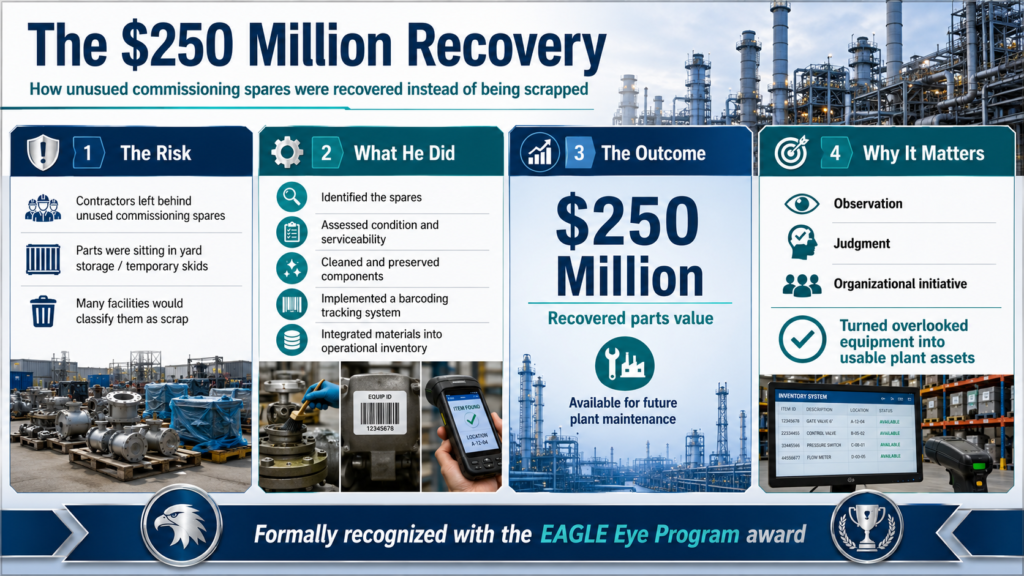
Perhaps the most striking single achievement in his career record is the outcome of the EAGLE Eye Program at the same facility, a result that strongly supports EB-2 NIW for Mechanical Engineers.
When a major commissioning phase ends, contractors leave. Sometimes they leave equipment behind – spare parts, components, materials that were procured for the project but not used, sitting in yard storage or on temporary skids with no formal inventory ownership. In many facilities, these parts are classified as scrap and disposed of. This practical engineering judgment is highly relevant to EB-2 NIW for Mechanical Engineers.
He noticed this was about to happen. He stopped it. He identified the commissioning spares, assessed each component’s condition and serviceability, cleaned and preserved them, implemented a barcoding system for tracking, and integrated the materials into the operational inventory – making them available for future plant maintenance. The recovered parts were valued at approximately $250 million.
This is not a reliability engineering story in the conventional sense. It is a story about observation, judgment, and organizational initiative. He saw $250 million in usable equipment heading toward a scrapyard, understood its value, and built a system to capture it. The employer formally recognized it with the EAGLE Eye Program award, strengthening the evidence for EB-2 NIW for Mechanical Engineers.
The Career Behind the Awards
His nine years at the gas processing complex were preceded and followed by an equally substantive career, a background that supports EB-2 NIW for Mechanical Engineers.
Earlier: six years at a leading global EPC engineering firm in the UAE, executing FEED, construction, and commissioning for major gas processing, nitrogen air separation, and industrial plant projects. Before that: two Lead Rotating Equipment Engineer roles for a major Japanese EPC contractor and a Japanese-led joint venture, covering refinery and petrochemical megaprojects in Saudi Arabia, Oman, and Pakistan. An assignment as Senior Mechanical Commissioning Engineer at one of the world’s most technically complex oil-processing developments in Kazakhstan. And a career start at a power plant in Pakistan that gave him his foundational understanding of large rotating equipment. This progression adds depth to EB-2 NIW for Mechanical Engineers.
He currently holds the Lead Rotating Equipment Engineer position at one of the world’s largest LNG producers, responsible for operations and maintenance readiness across major capital projects — ethane compressor upgrades, hydrogen compressor replacement programs, LPG bottling systems, and chiller packages.
Six countries. Seven employers. Facilities ranging from refinery projects to cryogenic NGL recovery units to one of the world’s most technically challenging oil-processing megaprojects. Throughout: always rotating equipment, always turbomachinery, always the question of how to keep the compressors running. That record makes EB-2 NIW for Mechanical Engineers a natural framework for his petition.
The Quantified Technical Track Record
Beyond the formal awards, his petition includes independently verified technical results from multiple facilities and supervisors:
– 25–35% reduction in dry-gas-seal failure events after filtration, KO-drum, and heater-duty redesigns.
– 30%+ reduction in surge-related instability on residue-gas compression systems after anti-surge recalibration.
– 15% reduction in critical-path compressor readiness time during major turnarounds.
– Extended MTBF by several hundred hours, verified in reliability reporting.
– Material reductions in vibration, nuisance alarms, and reactive interventions through systematic condition-monitoring integration.
– Safety and integrity improvements in sulphur-granulation plants, including elimination of unsafe hot-spots and reduced technician exposure to hazardous reactive work.
These results were corroborated in letters from professionals with 20–30 years of experience in LNG/NGL operations, reliability engineering, turbomachinery diagnostics, and EPC program management.
The Four-Pillar Proposed Endeavor
His proposed U.S. endeavor is built around four integrated technical pillars, each addressing a different dimension of the reliability gap in U.S. LNG and gas-processing infrastructure.
The first is integrated predictive reliability – a unified system that connects real-time vibration, lubrication, seal-gas, and surge-proximity data into a predictive decision loop linked to CMMS platforms like Maximo and SAP-PM. Most U.S. LNG facilities have the monitoring hardware. What they lack is the integrated interpretation and the connection between diagnostic signals and maintenance actions. His approach closes that loop using Bently Nevada System-1 and condition-based work order logic.
The second is mechanical integrity and emissions resilience – engineering the root mechanical causes of methane leakage out of the system. Dry-gas-seal failures, differential-pressure instability, lubrication degradation, bearing distress: these are the mechanisms behind most compressor-related fugitive emissions. His approach addresses them through seal-gas filtration redesigns, KO-pot geometry improvements, seal-gas heater optimization, and precision alignment. The result is fewer seal failures, fewer trips, and targeted 25-40% reductions in seal-related methane emissions. This directly supports EPA’s OOOOb/OOOOc methane rules and the U.S. Methane Emissions Reduction Action Plan.
The third is operational stability and energy optimization – recalibration of surge-control logic, optimization of recycle-loop configurations, and load-sharing improvements. LNG refrigerant compressors operate near their surge boundaries for maximum efficiency. Real-world conditions (ambient temperature swings, feed variability, load changes) push them into unstable regions. His framework uses field-derived operating envelopes rather than theoretical OEM maps, reducing surge events, antisurge valve hunting, and unnecessary energy consumption. Target: 5-10% energy reduction per compression train.
The fourth is a standardized RCM/RBI framework for LNG cryogenic turbomachinery – the first of its kind, specifically designed for the duty cycles and failure modes of LNG liquefaction assets. Most U.S. LNG facilities use calendar-based maintenance intervals from OEM manuals. His approach replaces those with risk-weighted, evidence-driven inspection and maintenance plans tied to actual equipment condition. Scalable, facility-to-facility, operator-to-operator.
Why Now
The national importance context for this proposed endeavor is unusually direct. North American LNG capacity is projected to double by 2028-2029. U.S. natural gas supports approximately 40% of U.S. electricity generation, and NERC identifies gas compressors and storage as critical to grid stability. EPA’s OOOOb/OOOOc methane regulations mandate rapid leak detection and mitigation at compressor facilities. The White House’s National Energy Emergency declaration and Unleashing American Energy EO establish infrastructure reliability as an explicit federal priority.
EPA data show that nearly 2,000 dry-seal centrifugal compressors are now operating in U.S. transmission and processing systems – growing to this number from far fewer in prior years, and each one a potential emissions and reliability risk when seal systems degrade. A workforce shortage means that many facilities lack the specialized expertise to implement predictive maintenance and seal-system optimization at the level his proposed endeavor delivers.
How the Petition Was Built
This was a direct petition. The 23-year career record, the formal awards, the independently verified technical outcomes, and the detailed proposed endeavor were already in place.
– National importance sourcing: White House National Energy Emergency declaration, Unleashing American Energy EO, National Energy Dominance Council EO, DOE Methane Mitigation Technologies Multi-Year Program Plan, DOE LNG Export Study, EPA methane rules OOOOb/OOOOc, INGAA Climate Report 2024, EIA LNG export data, NERC gas infrastructure reliability analysis, PHMSA integrity program, Critical and Emerging Technologies List 2024.
– Well-positioned evidence: two consecutive Best Performance Awards from a UAE government-owned energy company with specific quantified improvements ($1M and $1.2M savings, 20–30% downtime reductions), $250M spare-parts recovery recognized by the EAGLE Eye Program, Zero Backlog Award, Weak Signals Hunting recognition, independently verified technical results (25–35% DGS failure reduction, 30%+ surge instability reduction) corroborated by 20–30 year industry veterans.
– Proposed endeavor: four integrated pillars each tied to documented U.S. infrastructure gaps, all grounded in the specific work the petitioner has already delivered at scale across world-class LNG and gas-processing facilities.
I-140 filed as a self-petition without a U.S. employer. $20,000 self-funded seed capital committed.
The Outcome
Approved.A self-petitioned EB-2 NIW from Qatar, for a rotating equipment engineer with 23 years in LNG and gas processing, formal Best Performance recognitions from a UAE government-owned energy company, independently verified technical improvements across multiple facilities, and a proposed endeavor directly responsive to U.S. federal priorities in LNG reliability, methane reduction, and energy infrastructure resilience.
The U.S. is the world’s largest LNG exporter. The bottleneck in that system is not natural gas – it is the reliability of the compressors that liquefy it. That is a national infrastructure problem with a specific engineering solution, and this is the person who has spent 23 years building and validating those solutions.
For Turbomachinery and Rotating Equipment Engineers
If your career is in rotating equipment reliability, turbomachinery commissioning, LNG or NGL processing, or compressor and turbine engineering and you have formally recognized, quantified results from high-consequence facilities, the NIW is worth a serious assessment. The Dhanasar test evaluates the national importance of the proposed endeavor and whether you are positioned to advance it. A 23-year career producing documented, award-recognized improvements at world-class LNG and gas-processing facilities is a direct answer to both.
Questions Rotating Equipment and LNG Engineers Ask Us
Can a rotating equipment engineer working on LNG and NGL turbomachinery qualify for an EB-2 NIW?
Yes. LNG infrastructure is explicitly designated as critical national infrastructure by CISA, DOE, and PHMSA. The U.S. is the world’s largest LNG exporter, North American liquefaction capacity is projected to double by 2029, and EPA methane regulations specifically target compressor and seal-system failures. A proposed endeavor focused on reducing turbomachinery downtime, seal-related methane emissions, and surge instability in U.S. LNG facilities addresses documented national priorities. An engineer with 23 years of quantified results in this specific domain is well-positioned to advance it.
How do formal performance awards from a government-owned energy company help an NIW case?
They are among the strongest forms of third-party recognition available in the energy sector. A Best Performance Award from a major national oil company, citing specific percentage improvements and dollar savings, reflects the employer’s own measurement and independent verification that the petitioner’s work exceeded peer standards. This is not self-reported performance — it is an external institution formally attesting to specific, quantified results. Two consecutive awards with compound dollar savings over two years provide compelling evidence for the Dhanasar well-positioned prong.
Does experience at GCC LNG and gas-processing facilities transfer to U.S. NIW cases?
Yes, and unusually well for this specific field. LNG liquefaction facilities in Qatar and the UAE use the same API/ASME engineering standards, the same turbomachinery OEMs (GE, Nuovo Pignone, Siemens, MHI), and the same monitoring platforms (Bently Nevada System-1, Maximo, SAP-PM) as U.S. LNG export terminals. There is no operational learning curve. The dry-gas-seal failure mechanisms, surge-control challenges, and lubrication degradation pathways are identical. Improvements validated in GCC facilities apply directly to U.S. equivalents.
What makes the EAGLE Eye $250M spare-parts recovery relevant to an NIW petition?
It is evidence of professional judgment and organizational impact that extends well beyond standard engineering duties. Identifying $250M in serviceable commissioning spares about to be classified as scrap, cataloguing them, implementing a barcoding system, and integrating them into operational inventory demonstrates both technical competency (assessing each component’s fitness for service) and the kind of initiative that creates institutional value independent of any single project. The formal recognition by the employer’s EAGLE Eye Program confirms that this was an above-standard contribution, externally validated.
Mechanical engineers, turbomachinery specialists, and LNG/NGL reliability professionals with documented results may have a strong EB-2 NIW story. Immignis can help connect your technical impact to U.S. national priorities and a focused proposed endeavor.