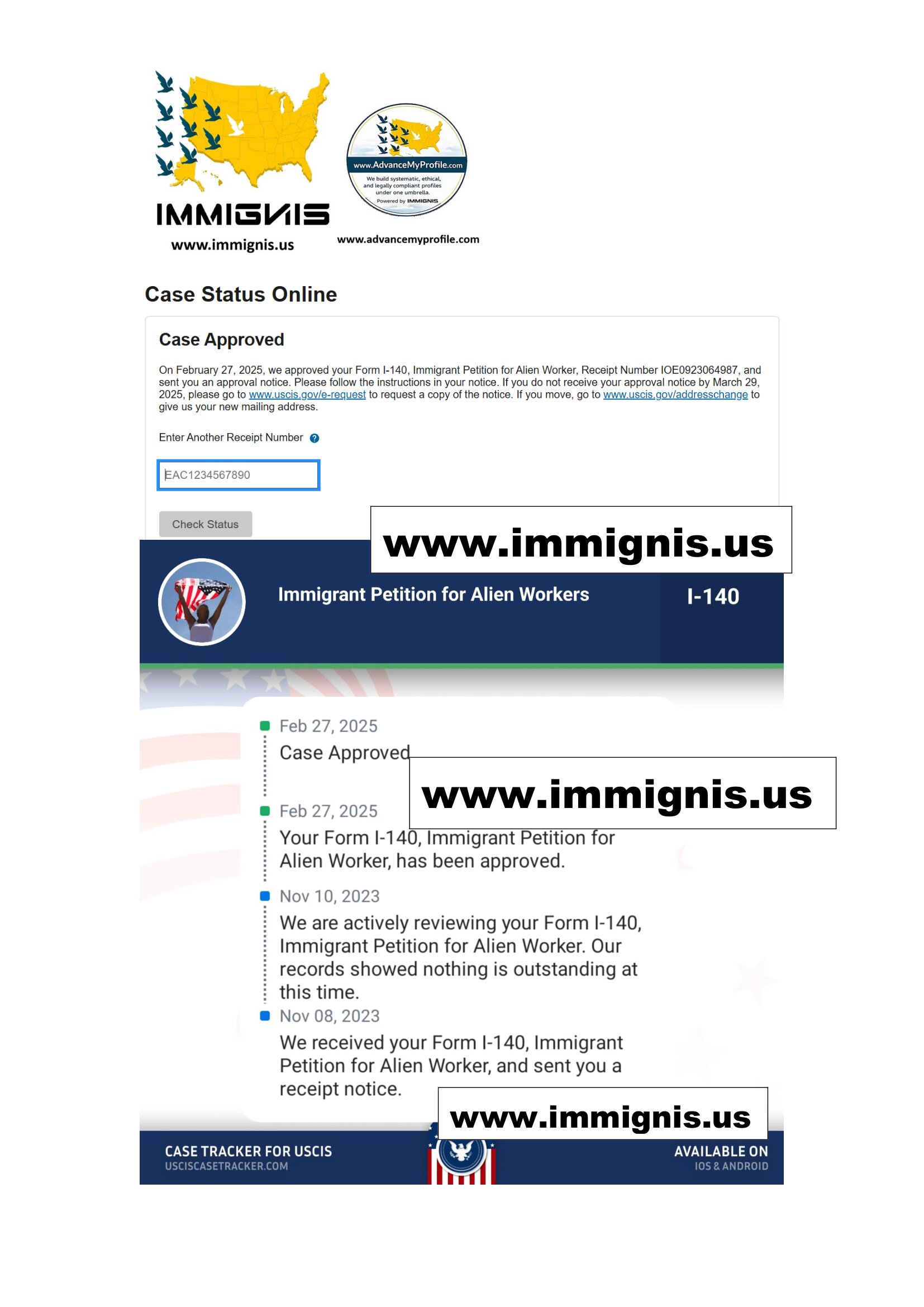
A PhD-level media scholar, university dean, and veteran journalist from Iraq’s Kurdistan Region, in an EB-2 NIW for Media Scholars case, was approved for an EB-2 National Interest Waiver to establish a U.S. center focused on media literacy, ethical journalism, and AI-assisted disinformation detection, making this EB-2 NIW for Media Scholars approval especially relevant.
| Petition Type | EB-2 National Interest Waiver, self-petition |
| Professional Field | Communications, media studies, journalism, disinformation research, and media literacy |
| Petitioner Profile | PhD-level media scholar, academic dean, author of 11 books, publisher of 30+ peer-reviewed papers, and veteran journalist from Iraq’s Kurdistan Region |
| Proposed Endeavor | Establish a U.S. National Center for Media Literacy and Ethical Journalism using public education, journalist training, and AI-driven tools to counter disinformation and deepfake threats |
| Case Outcome | Approved under Matter of Dhanasar |
The petitioner’s name, university employer, profile links, referees, and identifying details have been withheld for privacy. The career record, proposed endeavor, and approval outcome are presented in anonymized form.
In Short
A professor and academic dean from Iraq’s Kurdistan Region, holding a PhD in Media and more than 20 years of combined academic, journalism, and institutional leadership experience, was approved for an EB-2 National Interest Waiver as a self-petitioner in an EB-2 NIW for Media Scholars case. His professional record includes 11 published books, more than 30 peer-reviewed research papers, doctoral and master’s supervision, long-term membership in the International Federation of Journalists, and international conference participation, including a U.S.-based academic event in Maryland.
His proposed endeavor is to establish a U.S. National Center for Media Literacy and Ethical Journalism. The center would operate through three connected functions: public-facing media literacy campaigns, professional training for journalists and communication teams, and AI-assisted disinformation monitoring using natural language processing, machine learning, and real-time media analysis. The petition was approved because the work addressed a documented U.S. national security and democratic-resilience concern, and because the petitioner’s career showed the academic, professional, and institutional capacity to advance it, making this EB-2 NIW for Media Scholars approval highly relevant.
Six in Ten Americans Saw a Deepfake in 60 Days
The modern disinformation crisis is no longer limited to false headlines or manipulated images. It now includes synthetic audio, AI-generated video, coordinated bot networks, fake news domains, impersonation campaigns, and deepfake-driven fraud. In the 2024 election cycle, U.S. agencies repeatedly warned that foreign threat actors were using disinformation to undermine confidence in American institutions and election processes.
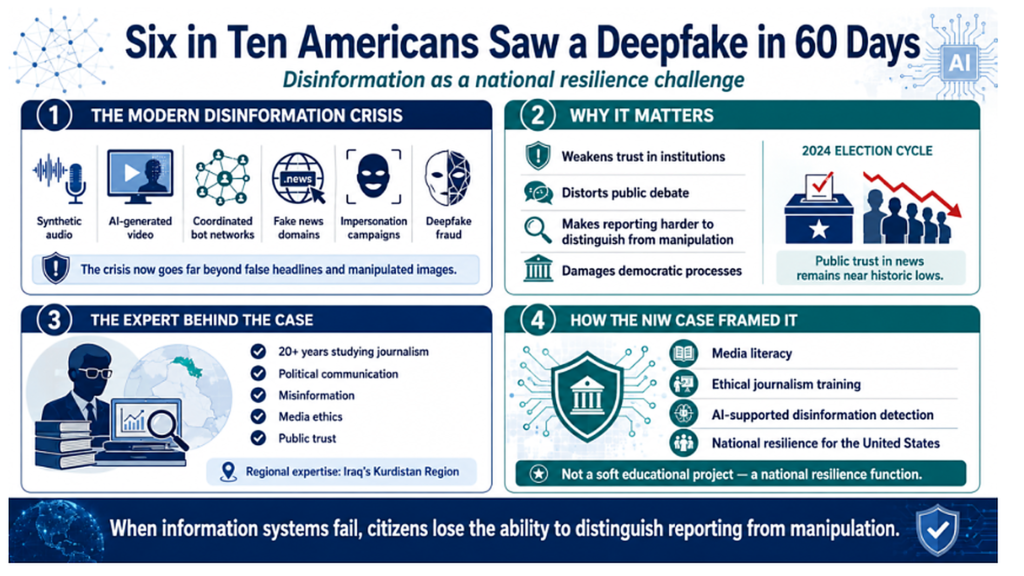
For most people, the problem appears as something scattered across social media. For a media scholar who spent two decades studying journalism, political communication, misinformation, media ethics, and public trust in Iraq’s Kurdistan Region, the pattern was familiar. Information systems can fail. When they do, citizens lose the ability to distinguish reporting from manipulation, public debate becomes easier to distort, and democratic institutions absorb the damage.
His EB-2 NIW case did not present media literacy as a soft educational project. It presented media literacy, ethical journalism training, and AI-supported disinformation detection as a national resilience function for the United States.
EB-2 NIW for Media Scholars: Building Media Scholarship Where Press Freedom Is Not Guaranteed
The petitioner built his career in a region where journalism and public communication were shaped by conflict, political pressure, institutional fragility, and contested press freedom. That environment gave his work a practical dimension that a purely classroom-based media scholar may not have experienced. He studied media systems while also living within a society where information integrity had immediate civic consequences.
He earned a PhD in Media and spent more than 20 years at the intersection of academic scholarship, journalism, and institutional leadership. He served as dean of a technical college at a leading polytechnic university in the Kurdistan Region, taught in media and public relations programs, and previously held senior university leadership responsibility in student affairs.
His academic output was substantial: 11 published books and more than 30 peer-reviewed research papers. His books and research addressed investigative journalism, public-service broadcasting, media law, freedom of expression, social media, the spread of misinformation, and the effect of digital platforms on Kurdish society. Several of these topics directly anticipated the disinformation and deepfake challenges now facing the United States.
He also supervised doctoral and master’s research, including projects on investigative journalism, corruption, political knowledge, and Kurdish digital media. This supervision record mattered in the NIW petition because the proposed U.S. endeavor required more than personal research ability. It required the ability to train others, structure programs, and develop a knowledge base that can be taught, replicated, and scaled.
The Proposed U.S. Endeavor: A Center, Not a Personal Job Search
The proposed endeavor was framed as the establishment of a National Center for Media Literacy and Ethical Journalism in the United States. This was important. The petition did not depend on a narrow job offer, a university appointment, or a single employer. It proposed an institutional platform capable of serving the public, journalists, educators, policymakers, and technology partners.
The center was designed around three practical functions:
- Public education: media literacy workshops, digital learning resources, school and university partnerships, and community-facing campaigns to help citizens identify disinformation, deepfakes, manipulated content, and coordinated influence tactics.
- Professional training: structured instruction for journalists, communication teams, and civic organizations on ethical reporting, crisis communication, source verification, synthetic-media risks, and responsible use of AI tools.
- Technology development: AI-assisted media monitoring using natural language processing, machine learning, coordinated-behavior detection, dashboards, and data-sharing tools to identify disinformation patterns in real time.
The petitioner proposed to begin with personal seed funding and then expand through grants, training revenue, institutional partnerships, and public-interest collaborations. This gave the Third Prong a clear practical foundation: his work required independent, cross-sector execution that would not fit easily within a conventional labor-certification job description.
Why the U.S. National Importance Argument Was Strong
The national importance argument was built around U.S. government recognition of disinformation as a security, election-integrity, financial-fraud, and public-trust concern. The Government Accountability Office’s 2024 report on foreign disinformation examined how U.S. agencies define and detect foreign disinformation threats and the legal authorities used to counter them. CISA’s 2024 generative-AI election-risk resources warned that malicious actors could use generative AI to target the security and integrity of elections. The FBI and CISA also issued 2024 public warnings about foreign threat actors spreading disinformation in connection with the U.S. general election cycle.
The case also addressed deepfake-enabled financial and organizational harm. Federal agencies had warned about synthetic media, impersonation, and AI-enabled influence operations. These sources made the petition’s First Prong stronger because they showed that the proposed work was not merely beneficial to one organization. It responded to a recognized national problem involving democratic resilience, institutional trust, cybersecurity-adjacent risk, and public education.
The policy framing was updated carefully. For a public 2026 success story, those references needed caution: the 2023 AI order was revoked by the January 2025 AI policy order, and the Global Engagement Center closed in December 2024. The final public version therefore presents the broader policy continuity: U.S. agencies continue to recognize foreign disinformation, synthetic media, and AI-enabled influence operations as significant risks, even as specific offices and executive orders change over time.
How the Petition Was Built
The petition was rebuilt around all three Dhanasar prongs, with the public narrative focused on the approved structure rather than the draft-stage issues that existed in earlier versions.
For the First Prong, the petition connected the proposed center to U.S. national priorities: foreign disinformation detection, election integrity, deepfake risk, AI-enabled manipulation, media literacy, and ethical journalism training. It used government reports, agency advisories, congressional activity, and real scholarly sources to show substantial merit and national importance.
For the Second Prong, the petition presented the petitioner’s long professional record: PhD-level media scholarship, 20+ years of academic and journalism leadership, 11 books, 30+ peer-reviewed papers, student supervision, international conference participation, membership in the International Federation of Journalists, and leadership at a university-level institution. Together, these showed that he was not proposing a field he had just discovered. He had spent his career studying and teaching the exact problems the U.S. endeavor addressed.
For the Third Prong, the petition argued that a labor certification requirement would not serve the national interest because the proposed work was interdisciplinary, public-facing, technology-enabled, and institution-building in nature. The endeavor required independence to work across universities, media organizations, community groups, civic institutions, and technology partners. A single employer-sponsored role would likely narrow the work and limit the national public-interest benefit.
The Outcome
Approved.
A self-petitioned EB-2 NIW was approved for a PhD-level media scholar, university dean, and veteran journalist from Iraq’s Kurdistan Region whose proposed U.S. endeavor would establish a National Center for Media Literacy and Ethical Journalism. The center is designed to counter disinformation and deepfake threats through public education, journalist training, and AI-assisted monitoring tools.
This approval is significant because the field is outside the more familiar STEM, engineering, healthcare, and finance categories commonly associated with NIW petitions. The case shows that social science, communications, and journalism profiles can support NIW approval when the proposed endeavor is tied to a documented national priority and the petitioner’s record shows the ability to advance it.
What Makes This Case Different
This was not a typical technology petition. It did involve AI tools, dashboards, and machine learning, but the core professional field was communications and media studies. The petitioner’s strongest evidence was not a patent or a product launch; it was a 20-year record of scholarship, institutional leadership, journalism experience, public communication expertise, and research on how information systems influence society.
That distinction matters. The United States does not face disinformation risk only because technology exists. It faces disinformation risk because people, institutions, platforms, and public communication systems can be manipulated. A media scholar who has studied these systems in a high-pressure regional environment brings a form of expertise that is different from software engineering but still nationally relevant.
For Media Scholars, Journalists, and Communications Researchers
If your career is in journalism, communications, media studies, public information, civic education, disinformation research, or digital media ethics, the EB-2 NIW may be worth serious assessment. The legal standard is not limited to laboratory science or engineering. The key question is whether your proposed endeavor has substantial merit and national importance, whether your record shows that you are well-positioned to advance it, and whether the United States benefits from waiving the job-offer and labor-certification requirement.
This case succeeded because the proposed work was not framed as ordinary teaching, writing, or consulting. It was framed as a national media-literacy and disinformation-response platform supported by a long record of scholarship, public communication, academic leadership, and journalism practice.
Questions Media and Communications Professionals Ask Us
Can a media scholar or journalism professor qualify for an EB-2 NIW?
Yes. The NIW standard is field-neutral. A media scholar can qualify when the proposed endeavor addresses a national priority and the petitioner is well-positioned to advance it. Disinformation, deepfakes, media literacy, public trust, election integrity, and ethical journalism training can support national importance when tied to credible government, institutional, and scholarly evidence.
Does a humanities or social-science profile face a harder NIW path than a STEM profile?
It can require more careful drafting because USCIS officers may be more familiar with STEM and healthcare cases. The petition must therefore make the national importance argument concrete. It should avoid broad statements about public benefit and instead show specific risks, specific federal concerns, specific implementation plans, and specific evidence that the petitioner can execute the proposed work.
Why did the petitioner’s background in Iraq’s Kurdistan Region matter?
Country of origin does not decide NIW eligibility. What mattered here was the professional context: the petitioner built a career in media scholarship and journalism in a region where information integrity, press freedom, and public communication carried real institutional consequences. That background strengthened the argument that he understood disinformation not only as an academic topic, but as a civic and institutional problem.
How did the petition avoid becoming only a “public education” case?
The proposed center combined public education with journalist training and AI-assisted monitoring tools. That combination gave the endeavor a stronger national architecture. Media literacy addressed the public-awareness gap; professional training strengthened ethical reporting capacity; and AI-assisted monitoring connected the work to real-time disinformation detection and institutional response.
If your career is in media studies, journalism, communications, public information, or disinformation research and you want to understand whether your background supports an EB-2 NIW, start with a free assessment.
Free assessment: immignis.us/contact-us