A clinical neurophysiotherapist and medical college principal was approved for an EB-2 National Interest Waiver to expand elder-focused neurological rehabilitation in the United States through community education, caregiver awareness, and evidence-informed non-invasive therapy development.
In short: A neurophysiotherapist with an MSc in Neurological and Musculoskeletal Rehabilitation, nine years of clinical experience, and six years of concurrent clinical and academic leadership was approved for an EB-2 National Interest Waiver, an EB-2 NIW for Physical Therapists case, as a self-petitioner. She currently serves as principal of a medical college and has built her professional work around neurological rehabilitation, clinical education, student research, and patient-centered care for stroke, Parkinson’s disease, dementia, and other neurological conditions. Her proposed U.S. endeavor for EB-2 NIW for Physical Therapists has two connected tracks: first, community-level education for elderly Americans and caregivers on early recognition, prevention, and care-navigation for neurodegenerative conditions; second, research-informed clinical development of non-invasive rehabilitation modalities, including extracorporeal shockwave therapy and transcranial magnetic stimulation, for geriatric neurological rehabilitation. Approved under Matter of Dhanasar.
The petitioner’s name, employer institutions, medical college name, country of origin, referee identities, co-author names, and personal contact details have been withheld for privacy. Career record, proposed endeavor, and approval outcome are presented in anonymized form.
The National Need: Neurological Conditions Are Becoming a Daily American Reality
Every 40 seconds, someone in the United States has a stroke. Dementia, Parkinson’s disease, and other age-related neurological conditions place sustained pressure on families, caregivers, clinics, hospitals, and long-term care systems. This is why an EB-2 NIW for Physical Therapists case can connect rehabilitation work to a national healthcare need. These conditions are not only medical diagnoses. They affect mobility, speech, balance, memory, independence, family caregiving capacity, and the ability of elderly people to remain safely in their own homes.
The challenge is not limited to treatment after diagnosis. Many elderly patients and caregivers do not recognize early warning signs, misunderstand risk factors, delay rehabilitation, or receive fragmented advice after hospital discharge. In neurological care, time matters. For EB-2 NIW for Physical Therapists, this kind of patient and caregiver education can support a broader public-health argument. A delayed stroke response, an unrecognized Parkinsonian gait change, or late engagement with dementia care can turn a manageable condition into a long-term disability crisis.
This is the gap the petitioner proposed to address. Her work connects bedside neurorehabilitation, caregiver education, and the responsible development of non-invasive therapeutic tools. For EB-2 NIW for Physical Therapists, that connection helps show how clinical rehabilitation experience can serve an aging population. The result is a proposed endeavor that speaks to one of the most urgent healthcare questions in an aging country: how can the United States help older adults preserve function, independence, and quality of life for as long as possible?
From Clinic to Campus: The Career Behind an EB-2 NIW for Physical Therapists Petition
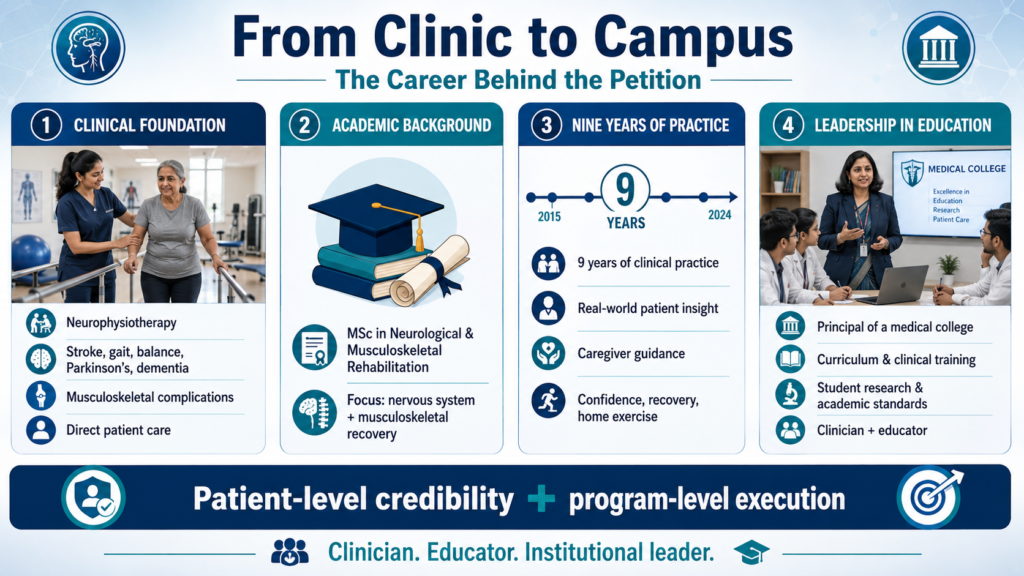
The petitioner’s professional path began in clinical neurophysiotherapy, where she worked directly with patients facing stroke-related weakness, gait problems, balance deficits, Parkinson’s-related movement limitations, dementia-related functional decline, and musculoskeletal complications that often accompany neurological disease. This clinical foundation made EB-2 NIW for Physical Therapists relevant to her record. Her MSc in Neurological and Musculoskeletal Rehabilitation gave her a focused academic foundation in how the nervous system and musculoskeletal system interact during disease, injury, and recovery.
Over nine years of clinical practice, she developed the kind of knowledge that is difficult to learn from a textbook alone: how an elderly patient responds after the first fall; how a caregiver understands a home-exercise program; how a stroke patient loses confidence in walking even after strength returns; how neurological disease changes the rhythm of an entire household. For EB-2 NIW for Physical Therapists, this bedside knowledge helped connect her record to elderly neurological care. This direct patient exposure became the foundation of her proposed U.S. work.
Her career then expanded into academic leadership. As principal of a medical college, she moved from treating patients one by one to shaping the next generation of rehabilitation professionals. She oversaw curriculum, student research, clinical training, and academic standards. Six of her nine professional years were spent in this dual role – clinician and educator at the same time. That combination mattered for the NIW petition because the proposed endeavor required both patient-level credibility and program-level execution. In an EB-2 NIW for Physical Therapists petition, that combination helped show both healthcare credibility and execution capacity.
A clinician can understand the bedside problem. An educator can translate knowledge into training, curricula, and community programs. A medical college principal can organize people, procedures, and institutional priorities. Her profile combined all three.
The Proposed Endeavor: Two Tracks Serving One Population
The proposed endeavor was designed around elderly Americans living with, or at elevated risk of, neurological disorders. It used two connected tracks rather than a single narrow service model.
Track One: Community neurological awareness and caregiver education
The first track focused on education. The petitioner proposed accessible awareness programs for elderly people, family caregivers, and community organizations. These programs would explain early warning signs of stroke, dementia, Parkinson’s disease, and related neurological conditions; practical prevention and risk-reduction habits; the importance of timely rehabilitation; and the role of caregivers in maintaining mobility, safety, and daily function. This education track made EB-2 NIW for Physical Therapists relevant to elderly neurological care.
This track was important because federal health priorities increasingly recognize that neurological care cannot depend only on hospitals and specialists. Dementia care models, Parkinson’s policy initiatives, and public-health dementia infrastructure all emphasize community awareness, caregiver education, and early engagement. For EB-2 NIW for Physical Therapists, the petitioner’s clinical background gave her authority to design programs that are medically grounded but understandable to ordinary families.
Track Two: Evidence-informed development of non-invasive rehabilitation modalities
The second track focused on clinical development. The petitioner proposed to contribute to structured research, education, and clinical translation involving extracorporeal shockwave therapy and transcranial magnetic stimulation in geriatric neurological rehabilitation. These modalities are non-invasive and have been studied in neurological and rehabilitation contexts. Her proposed role was not to make unsupported medical claims, but to help move evidence-informed approaches through careful clinical-development pathways, training protocols, and patient-centered implementation models. This clinical-development track made EB-2 NIW for Physical Therapists stronger by connecting rehabilitation expertise with emerging non-invasive care models.
This track strengthened the petition because it moved the endeavor beyond public education alone. It positioned the petitioner as a rehabilitation professional who could help evaluate, explain, and support the responsible use of emerging non-invasive tools in elderly neurological care. For EB-2 NIW for Physical Therapists, this showed how a rehabilitation professional could contribute beyond direct patient care.
Why the U.S. Government Already Treats This Area as Important
The First Prong was strong because the proposed endeavor aligned with recognized U.S. priorities in aging, dementia, Parkinson’s disease, stroke prevention, neurological research, caregiver support, and health equity.
- The National Alzheimer’s Project Act created a federal framework for addressing Alzheimer’s disease and related dementias.
- The BOLD Infrastructure for Alzheimer’s Act and its reauthorization support public-health infrastructure for dementia awareness, risk reduction, early detection, and caregiver support.
- The National Plan to End Parkinson’s Act, signed into law in 2024, established a national framework for Parkinson’s disease and related neurodegenerative conditions.
- The NINDS strategic planning framework identifies prevention of neurological disorders, health equity, and improved neurological outcomes as key research and public-health priorities.
- The CMS GUIDE Model supports comprehensive dementia care, care coordination, caregiver education, and community-based support for people living with dementia.
These sources allowed the petition to show national importance without exaggerating the petitioner’s role. The argument was direct: the United States has recognized a growing neurological-care burden, federal programs are moving toward prevention, caregiver support, and coordinated dementia care, and the petitioner’s proposed work fits that national direction.
How the Petition Was Built
The petition was restructured as a complete Matter of Dhanasar case. The final approved version connected all three prongs: substantial merit and national importance, the petitioner’s positioning, and why the United States would benefit from waiving the job-offer and labor-certification requirement.
Substantial Merit and National Importance
The First Prong focused on the scale of U.S. neurological disease burden, the aging population, the cost of delayed diagnosis and rehabilitation, the need for caregiver education, and the national policy movement toward coordinated dementia and neurodegenerative-disease care. The proposed endeavor was framed as a healthcare-access and rehabilitation-capacity contribution rather than as a private clinic plan.
Well-Positioned to Advance the Endeavor
The Second Prong was built from the petitioner’s actual record: MSc-level specialized rehabilitation education, nine years of clinical neurophysiotherapy experience, six years of simultaneous clinical and academic service, leadership as principal of a medical college, student supervision and clinical training responsibilities, and practical exposure to patients with neurological and geriatric conditions. The petition emphasized that she was not entering this field from outside; she had already been working at the exact intersection of neurological rehabilitation, patient education, and clinical training.
Balance of Interests
The Third Prong explained why the proposed endeavor was better served through the National Interest Waiver than through a conventional employer-sponsored route. The work required a flexible mix of community outreach, research collaboration, clinical education, caregiver training, and program development. A single job description would not capture the full scope. Waiving the job-offer requirement allowed the petitioner to build partnerships across rehabilitation clinics, community organizations, senior-care groups, universities, and research programs.
The Outcome
Approved.
A self-petitioned EB-2 National Interest Waiver was approved for a clinical neurophysiotherapist and medical college principal whose work centers on geriatric neurological rehabilitation, caregiver education, and the responsible development of non-invasive rehabilitation approaches for elderly patients. This EB-2 NIW for Physical Therapists case succeeded by connecting a real clinical career to a documented national need: helping older Americans and their caregivers recognize neurological conditions earlier, access rehabilitation knowledge sooner, and benefit from modern approaches to preserving function and independence. For EB-2 NIW for Physical Therapists, the approval shows how rehabilitation expertise can support aging-related neurological care in the United States.
The approval shows that healthcare professionals outside traditional physician or PhD research tracks can qualify for an NIW when the petition is built around a nationally important problem, a credible proposed endeavor, and a professional record that shows the petitioner can carry the work forward.
For Neurophysiotherapists and Rehabilitation Professionals
If your career is in neurophysiotherapy, geriatric rehabilitation, stroke recovery, Parkinson’s rehabilitation, dementia care support, or caregiver education, the EB-2 NIW may be worth serious assessment. The strongest cases are not built only on years of experience. They are built on a clear national problem, a focused proposed endeavor, and evidence that your work can create value beyond one employer or one clinic.
A rehabilitation professional who can combine direct patient care, academic leadership, training capability, and a public-health-oriented plan may have a credible path under Dhanasar, especially when the proposed work aligns with federal priorities in aging, neurological disease, caregiver support, and health equity.
Questions Neurophysiotherapists Ask Us
Can a neurophysiotherapist qualify for an EB-2 NIW?
Yes. The Dhanasar test does not limit NIW eligibility to laboratory researchers, physicians, or engineers. A neurophysiotherapist may qualify when the proposed endeavor addresses a nationally important healthcare problem and the petitioner has the education, clinical experience, leadership record, and implementation plan to advance it. In this case, the proposed work focused on elderly neurological care, caregiver education, and non-invasive rehabilitation development – all connected to recognized U.S. needs.
Is community education enough for national importance?
It can be, if it is tied to a documented public-health problem and delivered by someone with relevant clinical expertise. General awareness campaigns are usually weak. Clinician-designed education for elderly patients and caregivers, linked to dementia, Parkinson’s disease, stroke prevention, rehabilitation timing, and federal caregiver-support priorities, is much stronger because it addresses measurable gaps in care access and early intervention.
Do ESWT and TMS strengthen the case?
They strengthen the case when presented carefully. The petition should not overstate medical efficacy or promise clinical outcomes not yet established. The stronger framing is that the petitioner proposes to support responsible research, education, and clinical-development pathways for non-invasive modalities that are being studied for neurological and rehabilitation applications. That framing shows scientific caution while still supporting substantial merit.
Why did academic leadership matter?
The petitioner was not only a clinician. As principal of a medical college, she had experience organizing training, supervising academic activity, and helping shape healthcare education. That made the proposed U.S. work more credible because the endeavor included community education, caregiver programs, training materials, and possible clinical-development collaborations. The petition showed that she had already performed the type of educational and organizational work the endeavor required.
If you are a neurophysiotherapist, rehabilitation professional, healthcare educator, or clinical leader, Immignis can help you assess whether your work in stroke recovery, Parkinson’s rehabilitation, dementia care, or caregiver education may support an EB-2 NIW strategy.