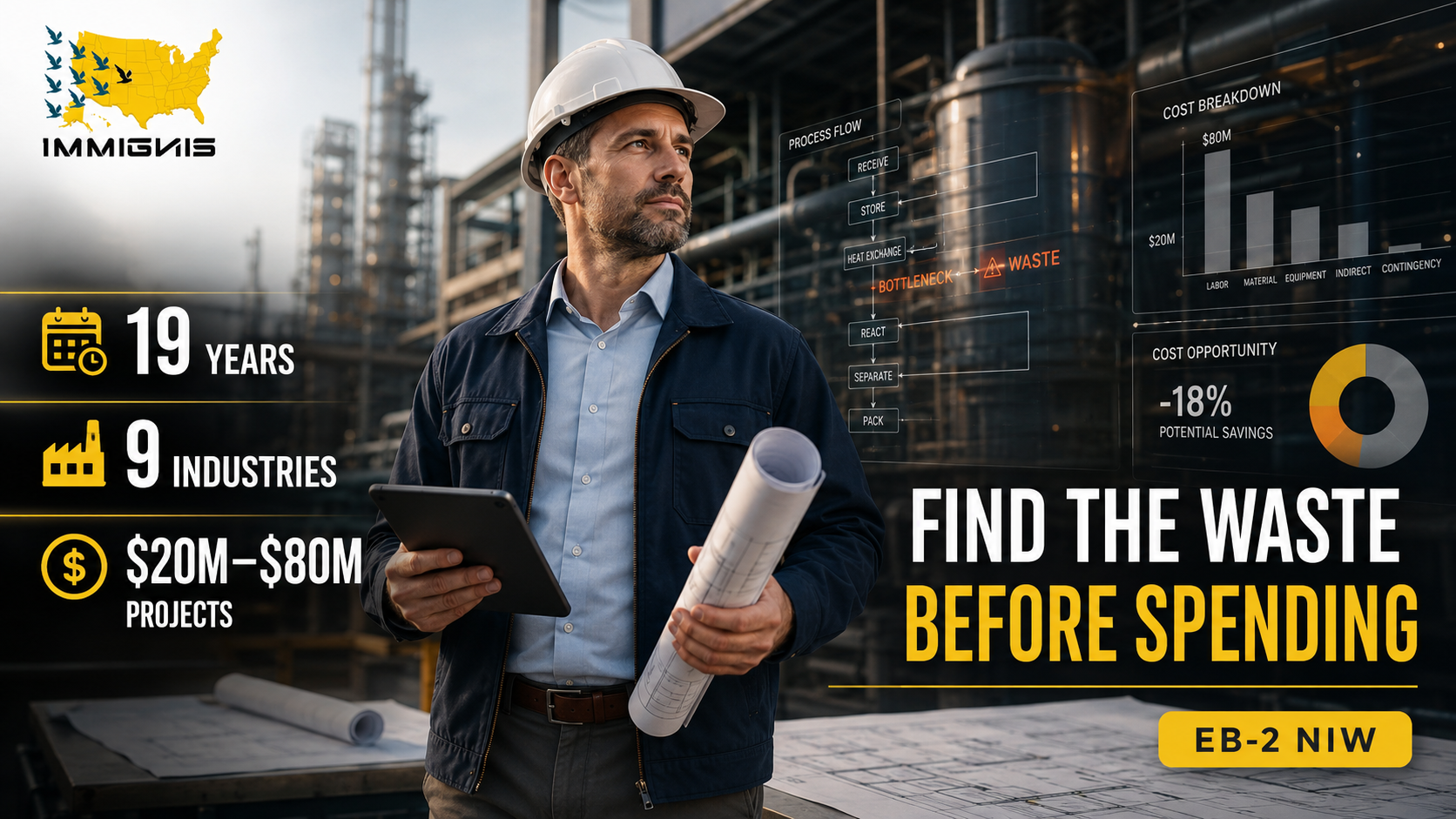
A project engineer whose 19-year career spans oil and gas, mining, recycling, automotive, and consumer goods ,most recently six and a half years managing capital expenditure projects at a major global energy company – approved for an EB-2 NIW to apply value engineering practices to U.S. oil and gas capital projects.
In short: A mechanical engineer holding an M.Sc. in Advanced Manufacturing Technology and Systems Management from a leading UK university and a B.E. in Mechanical Engineering, with 19 years of progressive project engineering and project controls experience across oil and gas, mining, subsea, recycling, automotive, and consumer goods sectors in Saudi Arabia, Norway, Australia, and Pakistan, was approved for an EB-2 National Interest Waiver as a self-petitioner, strengthening the case for EB-2 NIW for Project Engineers. Australian citizen. His longest engagement was 6.5 years as Lead Project Engineer at a major global integrated oil and gas company, managing capital expenditure projects of $20 million to $80 million including upstream pipelines, crude stabilization columns, and oil processing facility rehabilitations. He holds a Project Management Professional (PMP) certification from PMI USA. Proposed endeavor: apply value engineering methodologies to U.S. oil and gas capital projects to reduce non-value-added costs and support environmentally sustainable processes, making EB-2 NIW for Project Engineers a natural fit for this professional profile. Approved under Matter of Dhanasar.
The petitioner’s name and employer names have been withheld for privacy. Career record, projects, and outcome are real.
What Value Engineering Actually Does in EB-2 NIW for Project Engineers
When a major oil and gas company decides to build a new gas processing header, upgrade a crude stabilization column, or lay a new pipeline, the budget is set before the engineering is complete. That budget becomes the constraint around which every subsequent decision is made. If the early engineering assumptions are conservative, expensive, or not well-suited to the actual operating conditions, the cost is baked in from the beginning and nobody questions it because it was approved at the outset.
Value engineering, especially in EB-2 NIW for Project Engineers cases, is the systematic process of challenging those assumptions. Before money is committed, it asks: is this the most efficient way to achieve the required function? Are there alternative materials, designs, construction sequences, or procurement approaches that deliver the same result at lower cost or with lower environmental impact? Applied at the right moment – during project development, not during construction – it can reduce project lifecycle costs by 10-40% without compromising safety or performance.
He has been applying this methodology for 19 years, across capital projects that totaled $20 million to $80 million per project during his time at a major global integrated oil and gas company. His achievements section from that role lists them directly: reduction of project lifecycle costs through effective value engineering techniques, reduction of asset life cycle cost through value engineering, introduction of modular skid concept to minimize construction time, clubbed procurement for identical facility projects, making EB-2 NIW for Project Engineers a natural fit for this value engineering profile.
Six and a Half Years at the World’s Core
From December 2013 to June 2020, he served as Lead Project Engineer at a major global integrated oil and gas company – one of the world’s largest energy producers. His scope included upstream pipelines and capital facilities with budgets from $20 million to $80 million across different project types, strengthening the foundation for EB-2 NIW for Project Engineers.
His project portfolio from that period is specific and verifiable for EB-2 NIW for Project Engineers. He led the Gas Remote Header project (2018-2019): construction of 12 flow-lines over 5.515 kilometres, a scraper launcher and receiver, wellhead tie-in to a remote gas header, and associated piping spool fabrication. Hydro-tested at 15,000 psi. He led the Crude Stabilizer Column rehabilitation (2019-2020): restoration of crude processing columns and associated pipelines, heat exchangers, pumps, and support structures. He led the 42-inch Swing Line construction (2019-2020): laying 1.4km of 42-inch pipeline connecting crude processing areas of different grades, adding processing flexibility and eliminating the cost of additional column construction.
He also served as Lead Auditor for compliance assessments, Business Analyst for three-year operating plan preparation, and Lead Planner for the entire Well Tie-in program (2013-2018). He was recognized by the company’s Idea Management Committee for promoting innovation – a formal institutional acknowledgment that his contributions extended beyond routine project delivery.
Managing $20M-$80M capital projects at one of the world’s largest oil and gas operations for 6.5 years, delivering on schedule and within budget while applying value engineering to reduce lifecycle costs, is the most direct possible preparation for proposing to apply those same methods to U.S. oil and gas capital expenditures.
Nine Industries, Five Countries, One Methodology
The a major global integrated oil and gas company tenure is the centerpiece of the career, but the breadth before and after it reflects the transferability of the value engineering discipline across industrial contexts, strengthening the argument for EB-2 NIW for Project Engineers.
Before Saudi Arabia: Project Planner and Controls Engineer at a global EPCM consultancy for a major mining company’s field developments in Australia. Senior Planning Engineer at a global subsea EPCM for offshore rig development for a major Norwegian energy company. Process Project Engineer at an Australian manufacturer. Assistant Project Manager at a car assembly plant in Pakistan. Project Engineer at a major consumer goods manufacturer in Pakistan.
After Saudi Arabia: Principal Mechanical Engineer at an Australian engineering consultancy (FEED for bitumen storage tanks). Director of his own Pakistan-based engineering consultancy (delivered a 5.5MW Waste Heat Recovery / Combined Heat and Power project for a textile client, simultaneously reducing carbon emissions and improving plant energy economics). Project Scheduler/Controls Manager at a major Australian packaging and recycling company, managing the Victorian Government’s Container Deposit Scheme infrastructure program – 80 Reverse Vending Machines deployed to collect recyclable containers across Victoria.
The recycling current role is particularly notable for EB-2 NIW for Project Engineers: it demonstrates that value engineering and project controls disciplines transfer directly into circular economy infrastructure – a sector with its own growing role in U.S. sustainability and waste management policy.
The Credentials
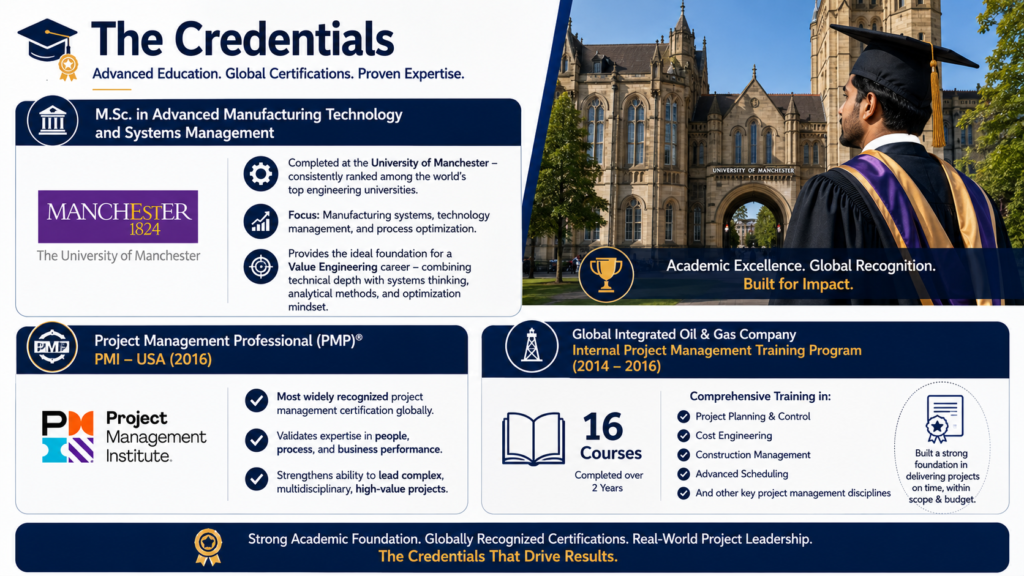
His M.Sc. in Advanced Manufacturing Technology and Systems Management was completed at the University of Manchester – consistently ranked among the world’s top engineering universities. The degree’s focus on manufacturing systems, technology management, and process optimization is precisely the academic grounding for a value engineering career in EB-2 NIW for Project Engineers: it combines technical engineering depth with the systems thinking and analytical methodology that value engineering requires.
He holds a Project Management Professional (PMP) certification from PMI USA (2016), the most widely recognized project management credential globally. He also completed the full a major global integrated oil and gas company internal project management training program – 16 courses from 2014 to 2016, spanning project planning, cost engineering, construction management, and advanced scheduling, further supporting EB-2 NIW for Project Engineers.
Why the U.S. Oil and Gas Industry
The United States declared a National Energy Emergency in January 2025 and is actively expanding domestic oil and gas production, making EB-2 NIW for Project Engineers highly relevant to this proposed endeavor. The U.S. Energy Information Administration reports that U.S. natural gas production reached record levels in 2025. Expanded production requires capital expenditure – new wells, pipelines, processing facilities, upgrade projects. Those projects must be executed efficiently if domestic production is to remain cost-competitive, reduce environmental impact, and avoid the budget overruns that characterize underplanned major capital programs.
EPA data consistently show that oil and gas capital project inefficiency is a source of methane and other emissions – through delays, rework, excessive site activity, and suboptimal process designs. Value engineering at the project development stage reduces these impacts directly for EB-2 NIW for Project Engineers: by eliminating unnecessary scope before it reaches the field, it reduces both cost and the associated environmental footprint of construction.
The White House’s April 2025 Executive Order on electric grid reliability and security, the Unleashing American Energy EO (January 2025), and the National Energy Dominance Council collectively establish a federal policy context in which energy sector capital project efficiency and environmental performance are simultaneous national priorities for EB-2 NIW for Project Engineers. His proposed endeavor addresses both.
How the Petition Was Built
This was a direct petition. The career record, certifications, project portfolio, and proposed methodology were already in place.
– National importance sourcing: EIA oil and gas production data, EPA methane regulations (OOOOb/OOOOc), EPA pollution prevention programs, National Energy Emergency declaration (January 2025), Unleashing American Energy EO, Critical and Emerging Technologies List (Advanced Manufacturing, 2022), Bipartisan Infrastructure Law recycling provisions, EPA National Recycling Strategy.
– Well-positioned evidence: Lead Project Engineer at a major global integrated oil and gas company for 6.5 years, $20M-$80M capital project portfolio, value engineering outcomes documented in project achievements, PMP from PMI USA, M.Sc. Advanced Manufacturing (University of Manchester), a major global integrated oil and gas company 16-course project management program, Idea Management Committee recognition, multi-sector breadth (O&G, mining, subsea, recycling, automotive, consumer goods), five-country career span.
I-140 filed as a self-petition without a U.S. employer.
The Outcome
Approved.
A self-petitioned EB-2 NIW for a project engineer who spent 6.5 years managing capital expenditure at one of the world’s largest oil and gas operations, consistently delivered value engineering outcomes that reduced project lifecycle costs, and now proposes to apply those same methods to the U.S. oil and gas sector at a moment of declared national energy emergency and record domestic production.
Every dollar saved in capital expenditure through value engineering is a dollar available for further production development, environmental improvement, or return to investors. At $20M-$80M per project, even a 10% reduction in lifecycle cost is a material number. Applied across the U.S. oil and gas capital expenditure cycle, the scale of that benefit is national.
For Project Engineers and Value Engineering Specialists
If your career is in capital project management, project controls, or value engineering – particularly in energy, mining, or industrial construction – and you have a track record of delivering cost and efficiency improvements on major projects, the NIW is worth a serious assessment for EB-2 NIW for Project Engineers. The U.S. has declared an energy emergency, federal programs support both production efficiency and environmental sustainability, and the documented cost of capital project overruns in the U.S. energy sector is substantial. A project engineer who has consistently delivered value engineering results at world-class facilities is well-positioned to advance the proposed endeavor, making EB-2 NIW for Project Engineers a strong pathway to assess.
Questions Project Engineers and Value Engineering Specialists Ask Us
Can a project engineer specializing in value engineering qualify for an EB-2 NIW?
Yes. The Dhanasar test evaluates whether the proposed endeavor has substantial merit and national importance and whether the petitioner is well-positioned to advance it. A proposed endeavor applying value engineering to U.S. oil and gas capital projects addresses a documented national need: the U.S. has declared a National Energy Emergency, oil and gas capital expenditure is expanding, and EPA regulations simultaneously require environmental performance improvements in how energy projects are designed and executed. A project engineer with 19 years of capital project delivery, 6.5 years at a world-class energy company managing $20M–$80M projects with documented value engineering outcomes, and a PMP from PMI USA is well-positioned to advance that endeavor.
Does a PMP from PMI USA help an NIW case filed by someone living outside the United States?
Yes, specifically for the well-positioned argument. PMI (Project Management Institute) is a U.S.-based professional body and the PMP is its U.S.-administered credential. Holding a PMP provides independent, U.S.-body-issued evidence that the petitioner’s project management expertise meets the professional standard that U.S. project management organizations recognize. It also demonstrates familiarity with U.S. project management practices, terminology, and frameworks – directly relevant to the proposed endeavor of working as a consultant to U.S. oil and gas companies.
How is value engineering different from general project management, and why does it matter for an NIW case?
General project management is about delivering a defined scope within budget and schedule. Value engineering is a pre-scope activity that challenges whether the defined scope is the most efficient way to achieve the required function. It occurs during the project development phase, before commitments are made, and can identify alternative materials, designs, construction methods, or procurement strategies that deliver the same result at lower cost or with lower environmental impact. For an NIW case, value engineering is a distinguishable, documented methodology with quantifiable outcomes (percentage cost reduction, lifecycle savings), which is more specific and more measurable than general project management – making the proposed endeavor and the well-positioned argument more concrete.
If you work in project controls, value engineering, energy, mining, recycling, or industrial construction, Immignis can help assess whether your experience supports an EB-2 NIW strategy. Start with a free assessment to see how your project impact can be framed for U.S. national interest.