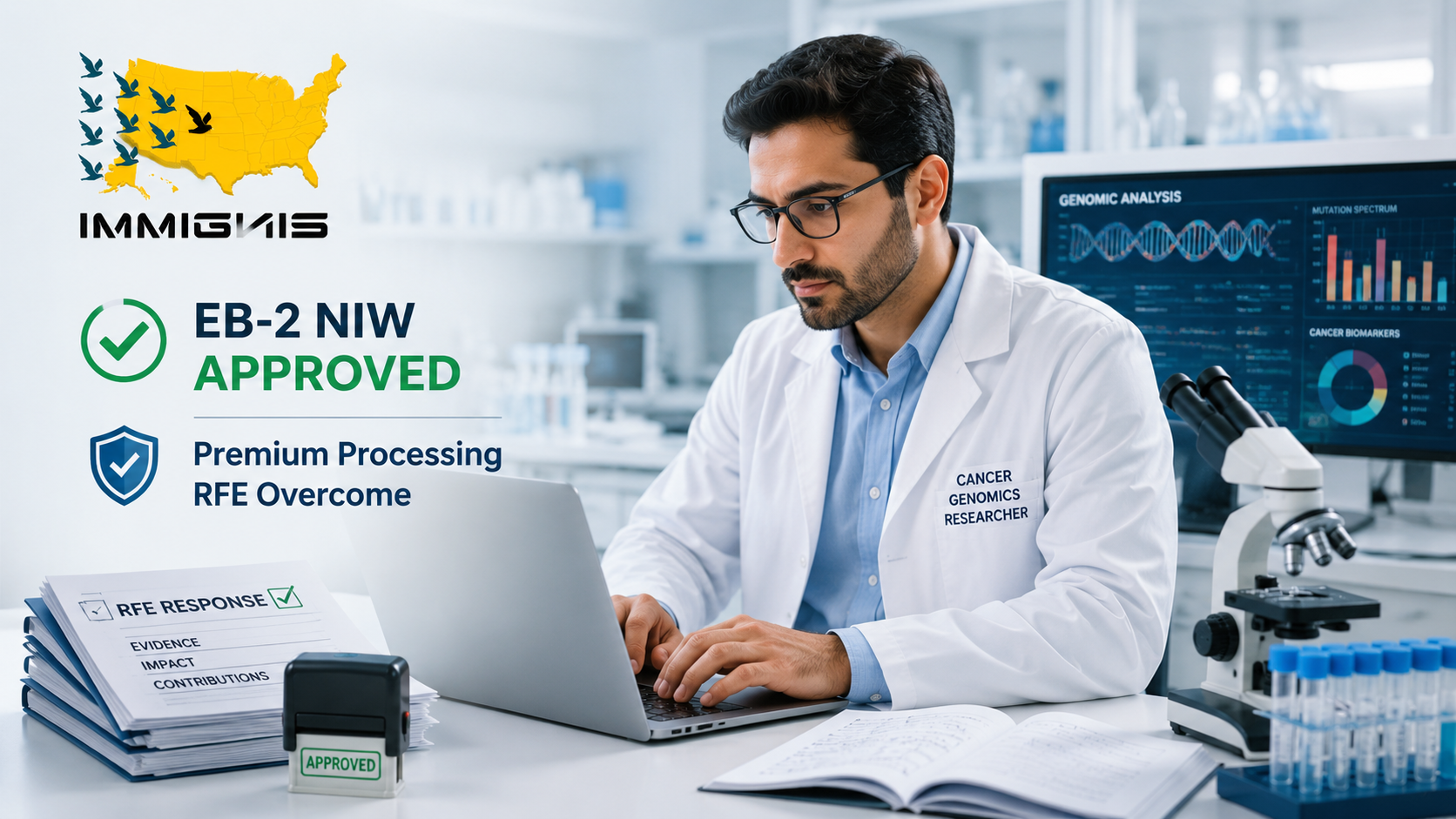
A Canada-based oncology genomics researcher faced a closing work-authorization window. Immignis and Advance My Profile built a focused liquid-biopsy NIW record, prepared for an RFE from the start, answered USCIS directly, and secured approval after premium processing resumed.
Approval snapshot: Iranian national; senior genomics researcher in Canada; proposed endeavor in liquid-biopsy and
circulating-biomarker methods for earlier cancer detection; compressed profile-building timeline; RFE on the well-
positioned prong; response filed under premium-processing strategy; EB-2 NIW I-140 approved.
| Nationality | Iranian |
| Professional field | Genomics research; liquid biopsy and circulating biomarkers for early cancer detection |
| Working location | Canada, oncology genomics research institute |
| Career stage | Approximately 9 years; senior researcher |
| Pathway | EB-2 National Interest Waiver |
| Engagement | Approximately 10 months; compressed profile-building and filing timeline |
| Outcome | RFE received and answered; premium processing used; I-140 approved |
The success result came first: approval before the window closed
This was not a slow, open-ended profile-building project. The client came to us with a real deadline. Her Canadian work authorization was approaching its limit, and the immigration strategy had to be strong enough to survive USCIS review without wasting months on evidence that looked impressive but did not answer the legal standard.
The final result was an EB-2 NIW approval after a Request for Evidence. The approval mattered because it confirmed that the record had done what a strong EB-2 NIW profile must do: connect a real scientist, a precise proposed endeavor, U.S.-relevant evidence, and a credible plan for advancing the work inside the United States.
The profile-building process was important, but it was not the headline. The headline is that a Canada-based Iranian genomics researcher, working under time pressure, won her EB-2 NIW after USCIS asked for more proof. The profile-building work explains how that result became possible.
The national problem: cancer is most treatable when detection comes early
Her work addressed a problem that is easy to understand and difficult to solve: cancer is often detected too late. Traditional imaging and late-stage clinical symptoms can miss the earliest biological signals. Liquid-biopsy and circulating-biomarker methods offer a different pathway by identifying tumor DNA and related signals through blood-based analysis.
For an NIW petition, the field mattered because it connected laboratory science to public-health value. Earlier detection can affect survival, treatment cost, patient burden, and clinical decision-making. The proposed endeavor therefore could not be described as “genomics research” in general. It had to be framed as clinical-genomics work that could support earlier, lower-cost cancer detection in the U.S. healthcare system.
Proposed endeavor: To develop and validate genomic diagnostic tools that enable earlier, lower-cost cancer detection
through liquid-biopsy and circulating-biomarker analysis, reducing cancer mortality by making detection possible at
earlier, more treatable stages and advancing the clinical genomics capacity of the U.S. healthcare system.
The starting point: strong science, but not yet a USCIS-ready record
She already had legitimate oncology and genomics publications for an EB-2 NIW case, a growing citation record, and scientific work that belonged in the early cancer-detection conversation. The weakness was not lack of substance. The weakness was organization, U.S.-specific positioning, and the absence of a clean evidence architecture.
Some of her contributions were buried inside laboratory work. Some of the professional identity was spread across related but not fully aligned research themes. Some of the U.S.-facing evidence had not yet been built for EB-2 NIW. Under a normal timeline, we might have built every possible recognition layer. Under this EB-2 NIW timeline, we had to build only what mattered most.
What Immignis and Advance My Profile built
Focused public identity: We aligned her website, LinkedIn, Google Scholar, and researcher profiles around liquid-biopsy genomics and circulating biomarkers for early cancer detection.
Publication sharpening: We supported additional first-author papers in credible oncology, genomics, and diagnostics journals, keeping the topics inside her exact research niche.
Dataset copyright: Her curated genomic reference dataset was documented through copyright registration, creating a dated record of original research contribution without forcing an unsuitable patent strategy.
Authored reference work: We supported an authored book on genomic approaches to early cancer detection, showing depth, teaching value, and command of the field.
Policy-facing white paper: We prepared and shared a white paper with cancer-research networks, clinical genomics professionals, oncology innovation forums, and healthcare-policy audiences.
Expert commentary: We placed her views on liquid biopsy, biomarker validation, early detection, and clinical translation in health and science outlets.
Selective recognition: We pursued professional recognition only where the grade required review or standing, avoiding basic memberships that would add little value.
Independent letters: We obtained U.S.-relevant expert support from oncology, clinical genomics, diagnostics, and journal-facing voices who could address national importance and well-positioned evidence.
How the evidence supported Dhanasar
Substantial merit and national importance: The endeavor addressed earlier cancer detection, clinical genomics capacity, and the practical value of liquid-biopsy tools for U.S. healthcare. The white paper and expert explanations helped translate the science into public-health relevance.
Well positioned to advance the endeavor: The publications, citations, dataset copyright, book, expert commentary, professional recognition, and U.S.-connected letters showed that she was not only studying the field; she had produced usable scientific assets and had a credible plan to continue the work in the United States.
Waiver of job offer and labor certification: The petition emphasized that her work had value beyond one employer because early cancer-detection methods, validated biomarkers, and clinical-genomics tools can support research institutions, diagnostic laboratories, and healthcare systems across the field.
The RFE: the question we expected
USCIS issued a Request for Evidence after the premium-processed filing. The question focused on the well-positioned prong. The officer wanted stronger proof that a Canada-based researcher had the U.S. connections, professional plan, and practical path needed to advance the work in the United States.
Because the case had been prepared with that risk in mind, the response did not have to rebuild the entire theory. It made the existing theory sharper. We documented citations from U.S.-based genomics laboratories, collaboration history with a U.S. oncology department, a prior U.S. cancer-research presentation, and a supplemental letter from a U.S. collaborator explaining how the work related to clinical adoption.
We also submitted a detailed U.S.-specific professional plan identifying the types of academic medical centers, clinical genomics laboratories, and cancer-research institutions where her methods could continue. The book, dataset copyright, and white paper were used to show that she had more than a list of papers; she had built research assets and communication tools that could support field advancement.
Approval and professional impact
After the RFE response was filed and premium processing resumed, USCIS approved the I-140 petition. The result gave her a current priority date and a clear path to the next immigration stage, while recognizing that later consular or adjustment steps can carry their own timing variables.
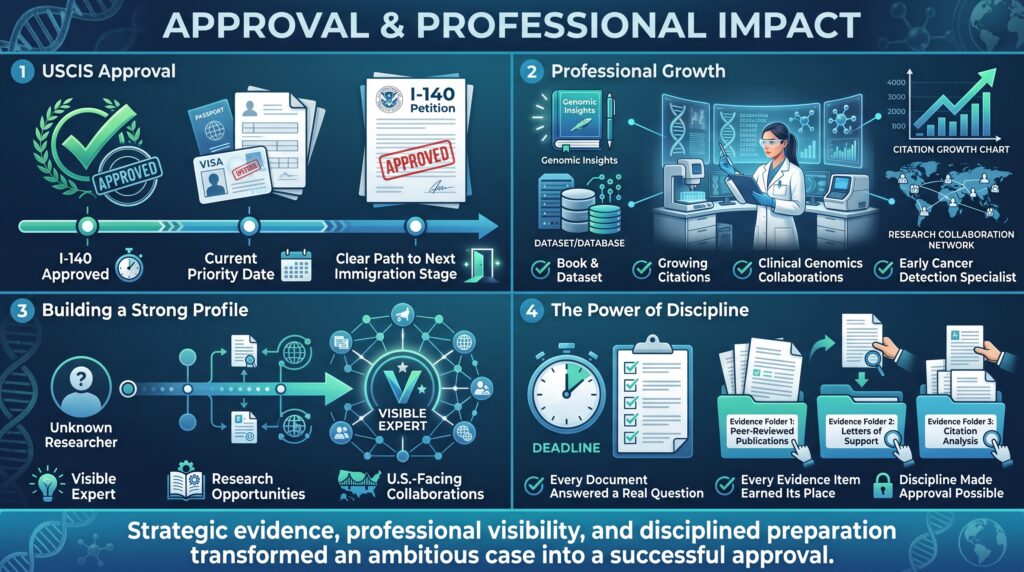
The professional impact continued after approval. Her public profile became coherent before she entered U.S.-facing conversations. Her book and dataset created stronger talking points with clinical genomics teams. Her citation record continued to grow. The profile helped her discuss collaborations and research opportunities as a visible early cancer-detection specialist, not as an unknown researcher with scattered evidence.
The deadline, which initially felt like the biggest threat, became the reason the case stayed disciplined. Every document had to answer a real question. Every evidence item had to earn its place. That discipline made the approval possible.
What this case teaches
- A deadline should sharpen the strategy, not force a weak filing. The right question is what can be built credibly in the time available.
- Premium processing gives faster USCIS action, not guaranteed approval. In time-sensitive cases, it is useful only when the team is ready to answer an RFE quickly.
- A dataset copyright can be strong contribution evidence for genomics researchers when a patent is not the natural fit.
- A serious authored book can strengthen the well-positioned prong when it reflects genuine command of a technical field.
- White papers help when they are field-appropriate and shared with relevant professional or policy-facing audiences.
- An RFE can improve the record when the response answers the officer’s exact question with targeted evidence.
For researchers facing visa deadlines
A short timeline does not mean a weak strategy. It means the evidence must be selected with discipline. The strongest case is not the one with the most documents; it is the one where each document directly supports the proposed endeavor, the Dhanasar prongs, and the officer’s likely questions.
If you are working against a visa deadline, start with a free, honest assessment. We will identify what can be built credibly, what should not be forced, and whether the timing supports a serious EB-2 NIW filing.