
A power plant performance engineer with 14 years and 3,500+ MW of combined-cycle experience – approved for an EB-2 NIW to recover efficiency and dependable capacity from the U.S. gas-fired fleet at the moment it matters most.
In short: An EB-2 NIW power plant engineer and Certified Energy Manager holding a Master of Engineering in Mechanical Engineering with an emphasis in Energy Systems and a Bachelor of Engineering in Mechanical Engineering, with over 14 years of progressive power-plant performance engineering experience across combined-cycle and gas-fired facilities in Qatar and Pakistan, was approved for an EB-2 National Interest Waiver as a self-petitioner. Pakistani national, Qatar-based. He has performed ASME PTC 46/22 thermodynamic testing, Annual Dependable Capacity testing, heat-rate diagnostics, and digital performance monitoring at facilities totaling over 3,500 MW across five employers including a major industrial technology company and a multinational energy company. Proposed endeavor: develop and implement a two-tiered reliability optimization and operational modernization system for U.S. combined-cycle and gas-fired power plants, addressing performance losses in the aging fleet at a moment of record electricity demand and critical interconnection delays. Approved under Matter of Dhanasar.
The petitioner’s name and employer names have been withheld for privacy. Career record, certifications, project outcomes, and outcome are real.
The Efficiency Gap Already in the Grid
About half of all U.S. combined-cycle gas turbine capacity was built between 2000 and 2006, making this directly relevant to an EB-2 NIW power plant engineer case. Those plants are now roughly 20 years old. The U.S. Energy Information Administration has measured the difference: combined-cycle plants built from 2010 to 2022 run about 7% more efficiently than units built in the 2000-2009 window. Seven percent more efficient means seven percent less fuel per megawatt-hour, seven percent less emissions per unit of output, and seven percent more output available from the same fuel at the same facility.
That gap is not locked in. Equipment degrades, yes. But a significant portion of degradation in a gas-fired combined-cycle plant is recoverable without replacing the turbines or rebuilding the facility. Compressor fouling, condenser back-pressure, cooling-system losses, HRSG restrictions, combustion-tuning deviations, auxiliary-load increases – these are measurable, correctable causes of performance loss. The question is whether anyone is measuring them systematically enough to act, strengthening the EB-2 NIW power plant engineer argument.
On August 2, 2024, U.S. natural gas-fired power plants generated 7.1 million megawatt-hours in a single day – a new daily record, supplying almost half of all electricity generated in the contiguous United States that day. The White House declared a National Energy Emergency in January 2025. NERC projects ERCOT summer peak demand rising from 94,650 MW in 2026 to over 154,000 MW by 2035, with 23 GW of new data-center load by 2030. Lawrence Berkeley National Laboratory reported that only 13% of capacity entering interconnection queues from 2000 to 2019 had actually reached commercial operation by 2024.
New plants are coming. They are coming slowly. In the meantime, the U.S. must run the existing fleet as well as the existing fleet can possibly run. That is what his proposed endeavor as an EB-2 NIW power plant engineer is built to do.
Fourteen Years Across the Full Combined-Cycle Stack
His career follows the arc of someone who chose one technical specialty and went deep as an EB-2 NIW power plant engineer. Power plant performance engineering. The discipline of measuring how well a gas-fired combined-cycle plant converts fuel into electricity, diagnosing where it falls short, and converting that analysis into corrective action.
He currently holds the Plant Performance & Optimization Engineer role at a major combined-cycle independent power producer in Qatar, operating a 2.0 GW gas-fired combined-cycle facility – one of Qatar’s largest independent power projects. His work includes ASME PTC 46 thermal performance testing, ASME PTC 22 simple-cycle assessments, Annual Dependable Capacity testing, outage thermodynamic analysis, continuous emissions monitoring, and digital performance analytics using OSIsoft PI, Thermoware, and GE Vernova Asset Performance Management.
Before Qatar, he spent nearly four years at a combined-cycle IPP managed by a multinational energy company in Pakistan, supporting performance engineering for combined-cycle facilities totaling nearly 1,000 MW. His work there included heat-rate diagnostics, compressor-efficiency monitoring, HRSG performance evaluation, Annual Dependable Capacity testing, and digital dashboard development using AVEVA eDNA and Power BI, strengthening the EB-2 NIW power plant engineer case.
Before that: performance analytics at a 225 MW GE-operated combined-cycle site. Before that: Assistant Manager Performance at a major Pakistani electric utility’s 248 MW combined-cycle plant, where he developed plant KPI frameworks aligned with NERC and IEEE standards, implemented a centralized performance database, and contributed to NOx optimization and commissioning support for steam turbine and HRSG systems. And before that: operations roles at a 136 MW diesel independent power plant, where he began in operations and progressed to assistant manager.
Career total: over 3,500 MW of direct combined-cycle and thermal generation experience across five employers in two countries. Three different major technology platforms. Thermodynamic testing, digital dashboards, emissions monitoring, reliability diagnostics, outage analysis, capacity validation – the full width of the discipline for an EB-2 NIW power plant engineer.
A performance engineer who has tested 2,000 MW facilities against ASME standards, built dashboards that plant
managers actually use, and recovered measurable megawatts from HRSG cleaning has a different kind of readiness
for this work than someone proposing to learn it in U.S. facilities.
The Numbers That Back the Case
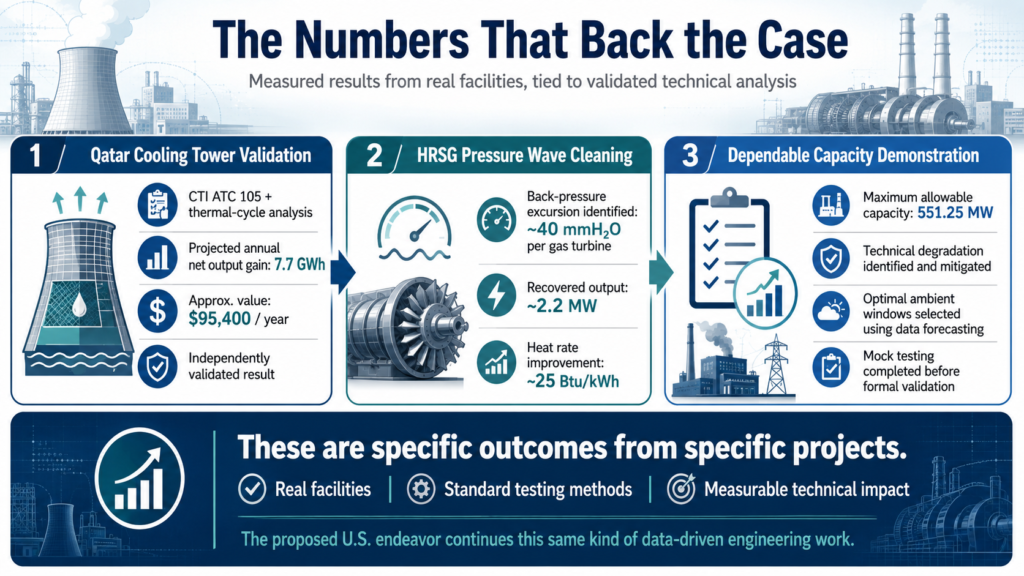
His proposed endeavor is not a framework in search of a problem for an EB-2 NIW power plant engineer. It is a continuation of specific, measurable work he has already done.
At the Qatar facility, he performed an independent performance validation of the Block 3 cooling tower using CTI ATC 105 standards and thermal-cycle analysis. The finding: a projected annual net output gain of 7.7 GWh, valued at approximately $95,400 per year. That number emerged from a test, was validated independently, and is directly tied to a correctable equipment limitation.
At the combined-cycle IPP in Pakistan, he led the technical analysis supporting an HRSG pressure wave cleaning project. He identified approximately 40 mmH₂O of back-pressure excursion on each gas turbine and supported the analysis that resulted in recovery of approximately 2.2 MW of facility output and an improvement in overall plant heat rate of approximately 25 Btu/kWh, strengthening the EB-2 NIW power plant engineer case.
At the same facility, he played a central role in demonstrating the maximum allowable capacity of 551.25 MW under the Power Purchase Agreement in the Annual Dependable Capacity test – identifying and mitigating technical degradation, using data-driven forecasting to select optimal ambient windows, and conducting mock testing before formal validation.
These are not estimates or projections. They are specific outcomes from specific projects at real facilities, each linked to standard testing methodologies, each representative of the exact kind of work his proposed U.S. endeavor will require as an EB-2 NIW power plant engineer.
The Two-Tier System
His proposed endeavor has two connected tiers for an EB-2 NIW power plant engineer, and the connection between them is what makes the approach more useful than routine plant maintenance.
Tier 1 is long-term performance optimization. Standardized thermodynamic diagnostics – using ASME PTC 46 and PTC 22 testing – to identify where each plant is losing heat rate, output, and dependable capacity. Digital decision-support dashboards, built on tools like OSIsoft PI, AVEVA eDNA, GE Vernova APM, Power BI, and Tableau, to convert those findings into ongoing operational visibility. Corrective-action prioritization, emissions-aware evaluation, and post-validation to measure whether the intervention actually improved the numbers. The target: 1-2% heat-rate reduction and 10-20 MW of recoverable dependable capacity per 1 GW of fleet, where correctable losses exist, strengthening the EB-2 NIW power plant engineer case.
Tier 2 is rapid capacity recovery during grid emergencies. The logic is preparation before the emergency: if a plant already knows which compressor fouling, condenser back-pressure, or cooling-tower limitation is limiting its output and already has ranked and validated correction protocols, it can respond in days instead of weeks when the grid needs it. Emergency readiness is not a separate program. It is the same diagnostic work, converted into a pre-ranked emergency protocol.
The two tiers share the same technical foundation. The testing that identifies Tier 1 efficiency losses is the same testing that enables Tier 2 rapid recovery. The dashboards that track long-term degradation are the same dashboards that provide visibility during a grid-stress event. One investment in plant intelligence serves both purposes for an EB-2 NIW power plant engineer.
Why the Policy Landscape Makes the Timing Clear
The federal policy context for this proposed endeavor is unusually direct.
– The White House declared a National Energy Emergency in January 2025 and issued an Executive Order strengthening the reliability and security of the U.S. electric grid in April 2025.
– The White House AI Action Plan and the Executive Order on Accelerating Federal Permitting of Data Center Infrastructure both name electricity supply as a foundational constraint on U.S. AI competitiveness.
– DOE reported that data centers consumed 4.4% of total U.S. electricity in 2023 and project 6.7-12% by 2028, a 50-175% increase driven significantly by AI infrastructure.
– ORNL reported that major power outages cost U.S. customers $121 billion in 2024, with outage frequency rising from 4,666 events in 2018 to 6,533 in 2024.
– EIA data show that the natural gas share of U.S. summer electricity generation rose from 29% in 2014 to 45% in 2024 – gas-fired plants are not a transition-era asset class, they are the backbone of peak-demand supply.
His proposed endeavor does not require new policy to matter. The policy already exists, the data already shows the need, and the assets already exist on the grid. What the endeavor adds is the systematic technical capability to close the gap between the performance those assets could deliver and the performance they currently deliver.
How the Petition Was Built
This was a direct petition. The career record, certifications, tool expertise, and measurable project outcomes were already in place.
– National importance sourcing: White House National Energy Emergency declaration, EO on electric grid reliability and security, DOE data center electricity demand report, NERC 2025 Long-Term Reliability Assessment, LBNL interconnection queue data, EIA natural gas generation and combined-cycle fleet data, ORNL power outage cost analysis, EPA power sector data, NOAA climate disaster statistics.
– Well-positioned evidence: over 3,500 MW of direct combined-cycle experience, ASME PTC 46/22 testing, Annual Dependable Capacity validation, 7.7 GWh cooling tower output recovery, 2.2 MW HRSG cleaning recovery, digital dashboards used by plant operations and management teams at multiple facilities, Certified Energy Manager designation, Vibration Analysis Level II, GE Vernova APM, AVEVA eDNA, OSIsoft PI, Power BI proficiency.
– Proposed endeavor: two-tiered framework with four integrated technical components, each tied to a documented U.S. infrastructure gap and each grounded in work the petitioner has already executed in large-scale commercial power-generation environments.
I-140 filed as a self-petition without a U.S. employer.
The Outcome
Approved.A self-petitioned EB-2 NIW, filed from Qatar, by a power plant performance engineer with 14 years of combined-cycle experience, measurable output recovery from specific projects, and a proposed endeavor that addresses one of the most concretely documented national infrastructure needs – improving the performance of a gas-fired generating fleet that runs the U.S. grid at its peak moments
There are billions of dollars committed to new power plant construction. There are almost no systematic programs to
recover the efficiency and capacity that existing plants are already losing. That gap is the proposed endeavor.
For Power Plant Performance Engineers and Energy Systems Specialists
If your career is in power plant performance engineering, energy systems optimization, heat-rate diagnostics, or related combined-cycle and gas-fired generation disciplines and your work includes thermodynamic testing, digital performance monitoring, and corrective-action implementation at scale – the NIW is worth a careful assessment. The national importance case for improving the efficiency and reliability of U.S. gas-fired generation has never been better-supported by federal policy than it is today.
Questions Power Plant Engineers Ask Us
Can a power plant performance engineer qualify for an EB-2 NIW?
Yes. The EB-2 NIW evaluates whether the proposed endeavor has substantial merit and national importance, and whether the petitioner is positioned to advance it. Combined-cycle and gas-fired power plant performance engineering addresses a directly and explicitly documented U.S. national priority – the White House has declared a National Energy Emergency, issued an EO on grid reliability, and tied AI infrastructure expansion to electricity supply. A performance engineer who can reduce heat rate, recover dependable capacity, and improve the reliability of existing generation assets is addressing the problem precisely as federal policy has named it.
Does ASME PTC 46/22 testing experience help an NIW case?
Yes. ASME PTC 46 (combined-cycle performance testing) and PTC 22 (simple-cycle gas turbine performance) are the recognized international standards for measuring how efficiently a power plant converts fuel into electricity. Having performed these tests professionally, at large-scale facilities, and produced validated results that supported commercial and regulatory conclusions, is strong evidence of the specific technical competency the proposed endeavor requires. It shows that the petitioner can quantify performance losses – not just observe them.
How does the aging U.S. combined-cycle fleet support a national importance argument?
Directly. The EIA has documented that roughly half of U.S. combined-cycle capacity was built between 2000 and 2006 and that newer plants are 7% more efficient. This creates a documented, quantifiable national efficiency gap in already-installed grid infrastructure. At a time when electricity demand is setting daily records and new generation is delayed by interconnection queues, recovering performance from existing assets is both practically and economically consequential. EIA data, NERC reliability assessments, ORNL outage cost data, and White House energy emergency declarations collectively establish the national importance of this work in unusually concrete and current terms.
Does digital performance monitoring tool expertise (OSIsoft PI, AVEVA eDNA, Power BI) help the well-positioned argument?
It strengthens the argument specifically by demonstrating that the petitioner can not only diagnose performance losses but also convert those findings into digital decision-support systems that operating teams actually use. The proposed endeavor’s Tier 1 component is not just testing; it includes building dashboards and monitoring frameworks that sustain operational discipline after the initial diagnostic work. A petitioner who has already built these tools at multiple 200-2,000 MW facilities is demonstrating that part of the proposed endeavor has already been executed, not proposed for the first time.
If your career is in power plant performance engineering and you want to understand whether your background supports an NIW, Immignis offers a free assessment. Free assessment: immignis