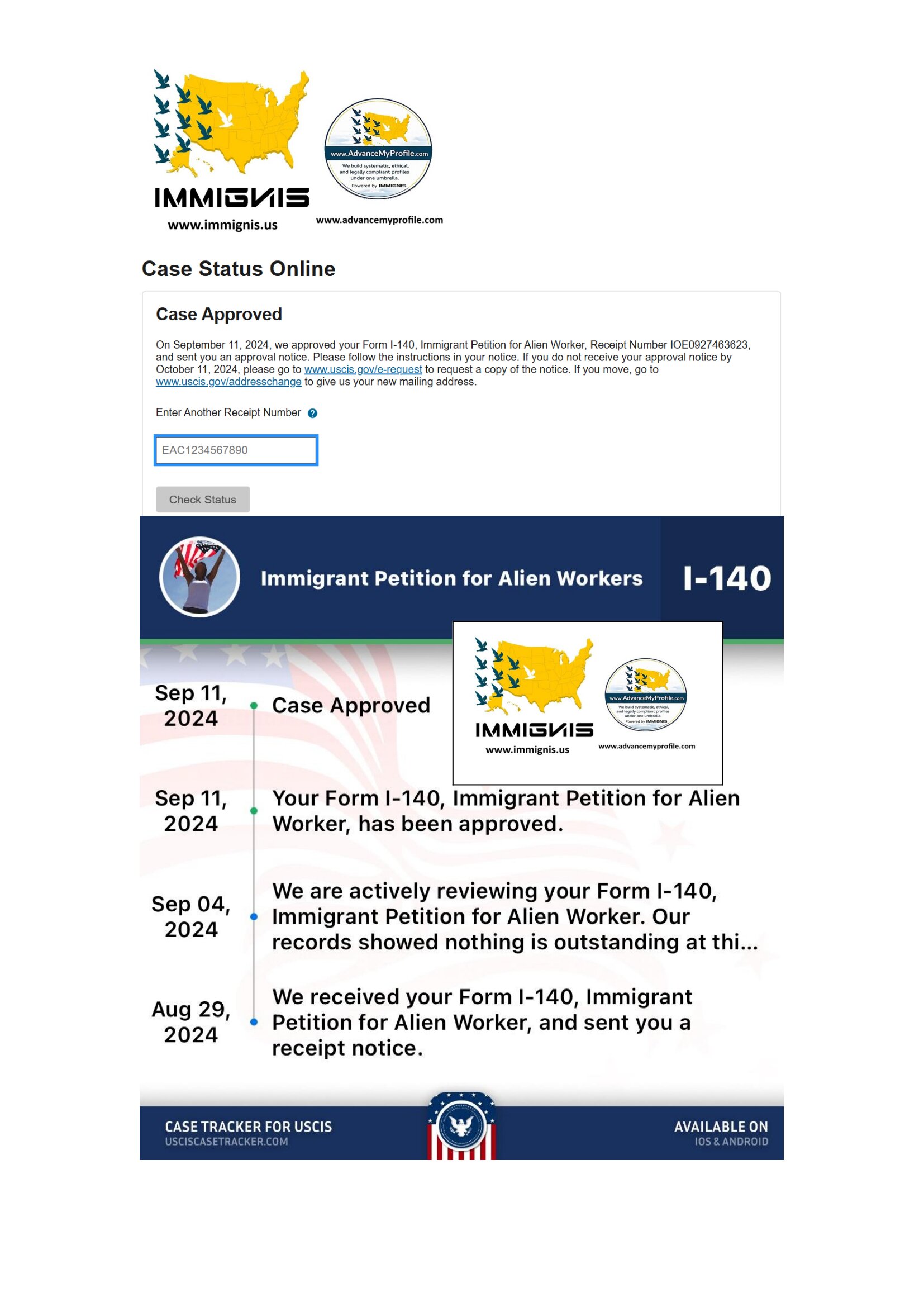
A self-filed EB-2 NIW case was denied because USCIS did not see national importance. Over approximately nine months, Immignis and AdvanceMyProfile rebuilt the evidence, reframed the endeavor, and secured approval on refile without a Request for Evidence.
| Client profile | Nigerian cybersecurity engineer working in the Dubai financial sector |
|---|---|
| Field | AI-driven cybersecurity for financial-system and critical-infrastructure defense |
| Starting point | Prior self-filed EB-2 NIW denial; USCIS found national importance was not shown |
| Engagement | Approximately 9 months of profile building and refile preparation |
| Outcome | EB-2 NIW I-140 approved on refile without an RFE |
| Core strategy | Move the case from employer-specific cybersecurity to nationally important financial-infrastructure defense |
The success result
This case ended with an EB-2 NIW approval without an RFE after an earlier denial. That is the core result. The client did not come to us with a clean first filing. He came after USCIS had already reviewed his case and found that the record did not show national importance.
The approval mattered because it showed that the problem was not the professional. The problem was the record. His original filing described a capable cybersecurity engineer working for a bank. The rebuilt filing showed a professional advancing AI-driven defense for financial-system networks and critical financial-services infrastructure.
EB-2 NIW National Problem: Financial Cyberattacks Are Not Ordinary IT Issues
Cybersecurity in the financial sector is not limited to one company’s internal network. Banks, payment processors, digital-wallet providers, and financial platforms sit inside the national economic system. A serious cyber disruption can affect consumer trust, transaction continuity, fraud exposure, and confidence in financial infrastructure.
That was the national-interest opening the first filing had missed. The original petition focused too heavily on the client’s employer. The refiled strategy moved the case to the correct level: AI-driven protection of financial-system networks against criminal and state-sponsored cyber threats.
The weak starting point
At intake, the client had real cybersecurity experience, but the public record did not prove the right points. He had worked for nearly a decade in banking cybersecurity, fraud detection, and threat-response environments. Internally, his value was known. Externally, the evidence was thin.
The denial made the gap clear. USCIS did not reject cybersecurity as unimportant. It rejected the way the case had been framed. The record showed service to one employer. It did not show a proposed endeavor with broader national importance.
What we changed before refiling

1. We rebuilt the proposed endeavor
The new proposed endeavor became the strategic center of the case:
“To develop and deploy AI-driven defenses for the integrity of U.S. financial-system networks and critical financial-services infrastructure against state-sponsored and criminal cyber threats to protect the national financial system, consumer trust, and economic stability.”
This language changed the case. It connected his real background to a U.S. national concern and gave every later evidence-building step a clear target.
2. We built a focused public identity
The client needed a visible professional identity that matched the new endeavor. We structured his professional website, LinkedIn profile, and research-facing materials around financial-system cybersecurity, fraud detection, AI-based anomaly recognition, and critical-infrastructure defense.
This did not create a false identity. It made his real expertise visible and consistent.
3. We created a practitioner-research publication record
The publication strategy stayed aligned with his actual profession. We did not try to present him as a full-time academic. We helped develop a practitioner-research profile around AI in fraud detection, anomaly recognition in payment networks, financial-sector cyber resilience, and state-aligned intrusion patterns affecting banks and financial institutions.
Several publications in indexed venues followed. Independent citations began to appear. The record moved beyond employment letters and into a field-facing evidence base.
4. We turned technical work into professional visibility
Publications alone were not enough. We helped position his work through cybersecurity and financial-technology coverage, expert commentary, and an executive-facing white paper. The goal was to make his technical knowledge understandable to the people who matter in the field: CISOs, risk leaders, cybersecurity researchers, fintech professionals, and financial-infrastructure decision-makers.
5. We added peer and industry validation
The rebuilt profile included conference participation, a working-group role focused on AI in fraud detection, senior-grade membership in a major cybersecurity professional body, a patent filing based on anomaly-detection work, and journal peer-review activity. These steps showed a transition from employee to field participant, and then from field participant to evaluator and contributor.
How the rebuilt evidence supported Dhanasar
Prong 1: substantial merit and national importance
The refile no longer asked USCIS to treat one bank’s cybersecurity needs as national importance. It explained how AI-driven defense for financial-system networks protects payment integrity, consumer trust, institutional continuity, and critical financial infrastructure.
Prong 2: well positioned to advance the endeavor
The client’s experience was now supported by more than job duties. The record included publications, citations, media visibility, a white paper, conference participation, a working-group role, senior membership, a patent filing, reviewer activity, and independent letters. Together, these showed that he had moved beyond internal employment value and had begun contributing to the broader cybersecurity field.
Prong 3: the national interest in waiving the job-offer requirement
The refile explained why the work could not be confined to a single employer. Financial-system cyber defense requires cross-institutional thinking, independent research, adaptable methods, and engagement with broader industry problems. The waiver argument became stronger because the endeavor itself was no longer employer-bound.
The refile and approval
Once the evidence architecture was complete, the petition was refiled. The cover letter addressed the prior denial directly but without sounding defensive. It showed that the national-importance weakness had been understood, corrected, and supported by new evidence.
USCIS approved the refiled EB-2 NIW petition without issuing another Request for Evidence.
What the client gained beyond approval
The approval was the immigration result. The profile-building process created additional professional value. The client now had a stronger public identity in AI-driven financial cybersecurity, a publication and citation record, peer-review experience, a senior professional membership, a patent filing, media visibility, and independent recognition.
His career also advanced after the profile became stronger. He moved from a senior individual-contributor position toward a stronger leadership path with improved compensation and greater visibility. Media outlets and industry contacts began treating him as a specialist in AI-driven financial-system defense.
Why EB-1A later became realistic
The NIW approval also changed the long-term immigration strategy. At the beginning, EB-2 NIW was the correct path because the profile first needed a strong national-interest record and a priority date. After the refile approval, the profile had grown enough to make a future EB-1A strategy more realistic.
We advised additional work only where it had a genuine purpose: stronger awards, higher-level recognition, further expert visibility, better documentation of field impact, and additional evidence of professional standing. The goal was not to continue activity for its own sake. The goal was to decide whether a stronger extraordinary-ability record could be built from the profile that now existed.
Lessons for cybersecurity professionals after an NIW denial
- A denial is often a judgment on the evidence record, not the person’s actual ability.
- A national-importance denial cannot usually be fixed by adding more employer-specific duties.
- The proposed endeavor must be reframed at the correct level of public or national impact.
- Profile building must match the profession. A cybersecurity engineer should not be forced into an artificial academic identity.
- Publications, citations, media, peer review, senior membership, patent activity, conferences, white papers, and independent letters work best when they all support one coherent professional story.
- Ethical profile building documents real expertise. It does not manufacture a false profile.
Free assessment
If your NIW was denied, the next step is not simply to argue harder. The next step is to understand why the record failed and whether your real work can be rebuilt into a stronger, evidence-based immigration profile.
Start with a free, honest assessment. If we cannot genuinely strengthen your profile, we will tell you.