
EB-2 NIW telecom regulatory expert: A telecom regulatory finance executive with nearly three decades of experience designing the cost frameworks, competition models, and incentive structures that determine whether network deployment works – approved as a self-petitioner from Kuwait.
In short: A senior finance executive and telecom regulatory economist with nearly 28 years of progressive
leadership across national regulatory authorities, major telecom operators, and global consulting firms was
approved for an EB-2 National Interest Waiver as a self-petitioner. Based in Kuwait.
Proposed endeavor:
Design a unified national telecom access, competition, and cost-optimization infrastructure for the United
States, modernizing the economic frameworks that govern rural broadband cost modeling, Universal Service
incentive design, MVNO competition, and policy-impact evaluation. Approved under Matter of Dhanasar on the
strength of a career spent building exactly these systems, at national scale, across multiple countries.
The petitioner’s name and employer details have been withheld for privacy. Profession, field, experience record, and outcome are real.
The Paradox Inside the $65 Billion Commitment
When the U.S. Infrastructure Investment and Jobs Act passed in 2021, it directed more than $65 billion toward broadband expansion, with $42.45 billion going directly to the Broadband Equity, Access, and Deployment (BEAD) Program. The ambition was significant: extend reliable connectivity to the approximately 26 million Americans, most of them in rural areas, who still lacked adequate broadband access.
The challenge is the infrastructure underneath it.
When federal oversight bodies audit rural broadband programs, the failures they document are not usually technical. They are economic. Subsidies are allocated using outdated cost formulas that no longer reflect how networks actually get built or operated. Rural deployments are funded, completed, and then quietly degrade because the long-term cost of running them was never properly modeled. Universal Service mechanisms that were designed when the industry ran on voice revenue still govern how broadband subsidies are calculated and distributed. Competition in rural markets repeatedly fails not because operators lack interest but because the economic model for sharing infrastructure or providing wholesale access has never been properly designed.
You can commit any number of billions to the problem. Without modernizing the economic foundations, the money gets less of the way there than it should.
His proposed endeavor was to fix the foundations.
What Telecom Regulatory Economics Actually Is
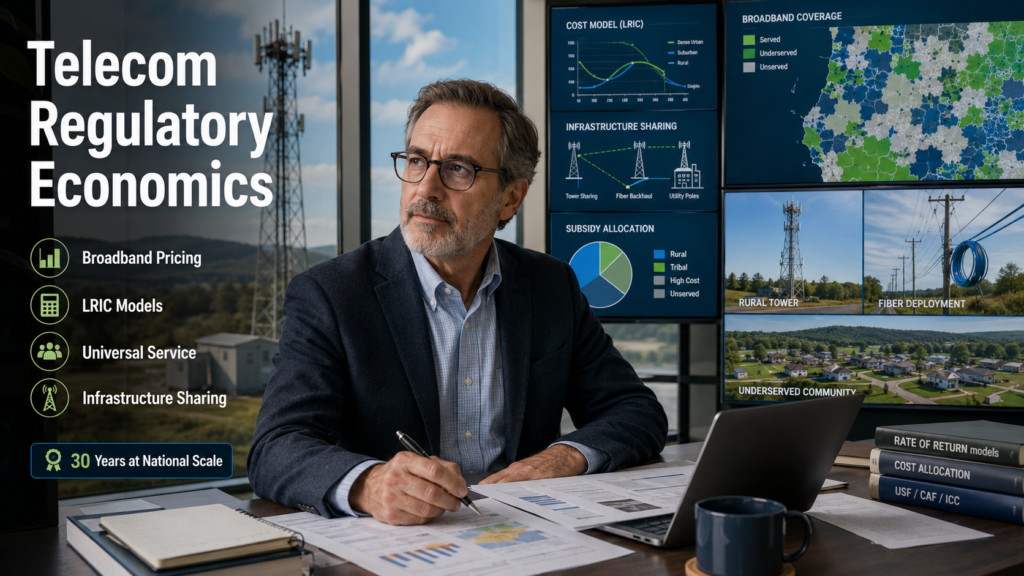
When you pay your broadband bill, you are paying a price that was shaped by decisions made in regulatory proceedings you never see: about what it costs to build a network in a rural area, about how much of that cost can be recovered from subscribers versus subsidies, about whether a second provider can share the same towers or fiber without destroying the financial model for either. These decisions determine whether service exists at all in underserved areas and whether, once deployed, it remains affordable and reliable over time.
The discipline that governs those decisions is telecom regulatory economics. It involves building Long-Run Incremental Cost (LRIC) models that quantify what it actually costs to provide a given service efficiently. It involves designing Universal Service fund frameworks that direct public money where market economics alone fall short. It involves creating competition structures (MVNO arrangements, infrastructure-sharing models, wholesale access pricing) that allow multiple providers to operate in the same area without financially destroying each other. Done well, it is invisible. Done poorly, rural broadband programs fund their way to the finish line and then quietly deteriorate.
He had been doing this work, and doing it at national scale, for nearly three decades.
Both Sides of the Table, Across Three Countries
What made the well-positioned argument unusual was not the length of the career. It was the specific trajectory through it.
He began in consulting, providing financial advisory services to organizations across banking, telecom, healthcare, and infrastructure in Pakistan. He then moved to Pakistan’s national telecom regulatory authority, where he held a Deputy Director role overseeing access promotion, the function responsible for inter-operator commercial regulation, interconnection pricing, Universal Service fund design, and competition policy. In that capacity, he built cost-based regulatory models for fixed and mobile interconnection using Long-Run Incremental Cost and Fully Allocated Cost methodologies. He designed the country’s Universal Service framework from its early stages. He introduced the first Access Promotion Contribution regime in Pakistan. These were national-level instruments that shaped how every operator in the country priced wholesale services, recovered network costs, and approached rural deployment.
He then moved to the operator side, first at a leading Pakistani telecom company where he prepared LRIC-based business cases, Universal Service Fund bids for rural expansion, and infrastructure-sharing financial models. Then to a major Middle East telecom group operating in Kuwait, where he rose over fifteen years from Senior Manager of Pricing and Costing to General Manager of Business Finance, reporting directly to the Chief Financial Officer and leading three Directors across pricing and profitability, investment analysis, and revenue assurance.
That career arc is the reason the well-positioned argument held. He had designed the regulatory rules as a government official. He had then operated under them, and shaped commercial strategy around them, as a senior executive at major telecom operators. He understood both what the rules were designed to achieve and why, in practice, they often failed to achieve it. That dual perspective is rare and directly relevant to the U.S. broadband challenge.
The gap in U.S. rural broadband is not a funding problem. It is a cost modeling and incentive design problem. The
money is available. What is missing is the economic architecture to direct it correctly and to ensure that what gets built,
stays built.
Original Contributions That Moved Beyond Their Employers
One marker USCIS weighs in Prong 2 is whether a petitioner’s contributions have extended beyond the interests of a single organization. Several of his did.
The Universal Service frameworks he helped design at Pakistan’s national telecom regulator have, since their introduction, funded more than 150 projects in underserved areas covering rural telephony, broadband, optical fiber, and next-generation connectivity. Government disbursements under those programs have reached the equivalent of more than USD 507 million. That is not a professional contribution to a single employer; it is a structural policy instrument that has shaped connectivity economics in an entire country.
At the major Middle East telecom company, he designed Kuwait’s first customer-level profitability model using Activity-Based Costing methodology, a system that was later marketed to other telecom operators outside the originating company, reflecting independent adoption of his methodology. He led the first MVNO business case and revenue-sharing framework in Kuwait, introducing a competition model the market had not previously had. He achieved an international bandwidth procurement deal that generated annual savings of approximately USD 3.2 million. He led the company’s Converged Billing System migration (a type of project notorious for operational rollbacks in the industry) without a single rollback, an outcome described internally as unprecedented in Kuwait’s telecom market.
These are not descriptions of ordinary management work. They are evidence of someone who designs systems that outlast the projects that created them.
Why the U.S. Is the Right Context for This Work
The United States faces a specific version of the problem he has been solving for decades. Approximately 22.3% of rural Americans and 27.7% of residents in Tribal lands lack access to adequate broadband. About 26 million Americans still lack fixed broadband at useful speeds. Only 68% of rural Americans maintain broadband subscriptions, compared with 80% of non-rural households which means that even where the infrastructure exists, the economics of access and affordability are not working.
The structural causes are familiar to him from prior work. Universal Service funding mechanisms rely on contribution formulas designed for voice revenue that no longer reflect data usage or network economics. Rural deployment costs are high, demand density is low, and incentive structures do not adequately encourage private participation in high-cost areas. Competition frameworks designed for infrastructure duplication have repeatedly failed in markets where duplication is economically unsustainable. Telehealth, precision agriculture, remote work, and education, all of which depend on reliable broadband, are deployed into this environment and then find themselves standing on an unstable economic foundation.
The LRIC and FAC methodologies, Universal Service redesign principles, MVNO frameworks, and Activity-Based Costing tools his proposed endeavor would introduce are well-established in international telecom regulatory practice. They are not experimental. They have been applied, adapted to country-specific conditions, and implemented at national scale. His background provides a direct, credible pathway to applying them in the U.S. context.
How the Petition Was Built
This was a direct petition. The experience was already there. What the petition required was translating a career in telecom regulatory economics into the specific language of the Dhanasar test and connecting that career precisely to documented U.S. national need.
– Proposed endeavor: a three-pillar Unified National Telecom Access, Competition, and Cost-Optimization Infrastructure, modern LRIC/FAC/ABC costing models, next-generation Universal Service incentive architecture, and MVNO and infrastructure-sharing competition frameworks. Each pillar tied to documented U.S. gaps.
– National importance sourcing: BEAD Program ($42.45B), FCC broadband progress reports, Congressional Research Service USF analysis, GAO oversight findings on broadband accountability, USDA rural broadband programs, and multiple recent FCC rulemaking proceedings.
– Well-positioned evidence: the regulatory career at Pakistan’s national telecom authority, the operator career across two major telecom companies, the original contributions that went beyond individual employers, the awards and formal recognitions, and the article published in a professionally indexed accounting journal.
– Telehealth application layer: the endeavor also integrated cost sustainability modeling for telehealth connectivity, addressing the documented 42% lower telehealth utilization in rural versus urban communities.
$250,000 in personal funds committed for development and execution, including core system development, pilot implementation, data acquisition, and initial team support.
The Outcome
Approved. A self-petitioned EB-2 NIW from Kuwait, filed by a telecom regulatory economist and senior finance executive with nearly three decades of experience designing cost models, competition frameworks, and incentive structures that have shaped connectivity economics across multiple countries. Approved on the strength of a proposed endeavor that addresses a documented, well-funded, and persistently under-solved national infrastructure problem.
Nearly three decades is not the credential. The credential is what those decades were spent doing: designing the
systems that determine whether broadband economics work. That is a specific kind of expertise, and the U.S. has a
specific documented need for it.
For Senior Finance and Policy Professionals in Telecommunications
If your career has been built at the intersection of telecom economics, regulatory finance, competition policy, or infrastructure governance, whether inside a regulator, a major operator, or a consulting firm, this case is worth reading carefully.
The EB-2 NIW does not require publications, a doctorate, or a technology product. It requires a proposed endeavor that has substantial merit and national importance, and evidence that you are positioned to advance it. A career spent designing the economic architecture behind national connectivity systems is evidence of exactly that positioning. The U.S. has committed an unprecedented level of public funding to broadband expansion. Whether that funding achieves its objectives depends, in part, on whether the underlying economic frameworks are sound. That is a national interest question, and it is one that specialized regulatory and finance expertise can meaningfully address.
Questions Finance and Policy Professionals in Telecom Ask Us
Can a senior finance or regulatory economics executive qualify for an EB-2 NIW without a technology product or PhD?
Yes. The EB-2 NIW requires an advanced degree and a proposed endeavor of substantial merit and national importance. It does not require a technology product, publications, or a doctorate. An MBA combined with professional chartered accounting qualifications (such as CIMA-CGMA) satisfies the advanced degree requirement through equivalent professional credentials. A proposed endeavor grounded in regulatory economics, cost modeling, and competition policy can satisfy national importance when tied to documented federal priorities, in this case, $65 billion in federal broadband investment with persistently documented sustainability problems.
Does experience working for foreign telecom companies or regulators count toward a U.S. national interest argument?
It can count substantially. LRIC cost modeling, Universal Service framework design, and MVNO competition structures are internationally recognized methodologies applied consistently across regulatory environments. A career spent designing and implementing these frameworks in other countries demonstrates exactly the kind of expertise that the U.S. broadband challenge requires. The national importance argument is not about where the work was done; it is about whether the work is relevant to a documented U.S. national need.
What makes a career spanning both regulatory and operator roles particularly valuable for an NIW?
The Dhanasar well-positioned test evaluates whether the petitioner can actually advance the proposed endeavor. Someone who has designed regulatory rules as a government official and then operated under them as a major operator executive understands both what the frameworks are designed to achieve and why, in practice, they sometimes fail. That dual perspective is directly relevant to a proposed endeavor that aims to redesign U.S. broadband cost and incentive frameworks because effective reform requires understanding both the regulator’s objectives and the operator’s economic constraints.
How do original national-level contributions like designing a country’s Universal Service framework strengthen an NIW case?
They directly support the well-positioned prong. USCIS looks for evidence that the petitioner has performed work of comparable nature and scale to the proposed endeavor. Designing a USF framework that has funded 150+ connectivity projects and disbursed the equivalent of half a billion dollars is evidence of the exact capability the proposed U.S. endeavor requires at a proven national implementation level.
Can a proposed endeavor focused on economic frameworks rather than technology products demonstrate national importance?
Yes. National importance does not require a technology product. The BEAD Program, FCC rulemaking, Congressional Research Service reports on Universal Service reform, and GAO oversight findings on broadband accountability all reflect documented recognition at the highest levels of the U.S. government that the economic architecture behind broadband expansion needs to be modernized. An endeavor specifically designed to address that documented gap qualifies as nationally important arguably more directly than a technology that addresses only one part of a larger systemic problem.
If you have spent years in telecom regulatory economics, infrastructure finance, or competition policy and want to understand whether your background supports an EB-2 NIW, start with an honest assessment.