EB2 NIW Visa approval was achieved by an enterprise solution architect who built a strong National Interest Waiver case around AI-powered banking modernization, fraud intelligence, telecom-integrated continuity, and quantum-resilient security for U.S. community banks and credit unions.
Approval Snapshot
| Client profile | An enterprise solution architect with MCIT, MBA, BS, and 19+ years of international banking-technology experience. |
| Field | Financial technology infrastructure, digital banking modernization, enterprise architecture, cybersecurity, fraud intelligence, and banking continuity. |
| Residence context | Kingdom of Saudi Arabia, with prior leadership across Saudi Arabia, Pakistan, the United Arab Emirates, and banking operations spanning 20+ countries. |
| Proposed endeavor | Design, develop, and implement enterprise-grade, AI-powered digital banking infrastructure for U.S. community banks, credit unions, and regional financial institutions. |
| Core national problem | Community banks face legacy systems, vendor lock-in, cybercrime, fraud, compliance burdens, FedNow readiness gaps, telecom outage risk, and cybersecurity talent shortages. |
| Outcome | EB-2 NIW I-140 approved. |
The EB2 NIW Visa Approval Result
This EB-2 NIW Visa case ended with EB-2 National Interest Waiver approval for a senior enterprise banking architect whose strongest record emerged when his international banking-technology experience was organized around one U.S. national problem: how under-resourced community banks and credit unions can modernize securely without losing resilience, compliance control, or customer trust.
The EB-2 NIW Visa approval did not depend on presenting him as a general IT professional. The successful strategy moved the record from ordinary enterprise technology language to a national financial-infrastructure narrative. His proposed work was framed around a vendor-neutral, cloud-enabled, AI-powered architecture that could help smaller U.S. financial institutions replace legacy systems, improve fraud prevention, automate compliance, and maintain service continuity during cyberattacks, disasters, and telecom disruptions.
The National Problem Behind the Case
Community banks and credit unions are essential to small businesses, farmers, households, and local economies. Yet many of these institutions face a difficult convergence of risks: legacy technical debt, dependence on concentrated core vendors, rising fraud, AML and KYC compliance pressure, Fed Now readiness gaps, commercial-real-estate exposure, telecom outage risk, and a national cybersecurity workforce shortage in the EB-2 NIW Visa context.
For the EB-2 NIW Visa case, the legal relevance was clear. This was not presented as a private bank modernization project. It was positioned as a national resilience effort aimed at strengthening the technology backbone of institutions that sustain local credit, agricultural lending, and community-level financial access.
The Proposed Endeavor
The approved proposed endeavor was to design, develop, and implement enterprise-grade, AI-powered digital banking infrastructure tailored to the needs of small and mid-sized community banks, credit unions, and regional institutions across the United States.
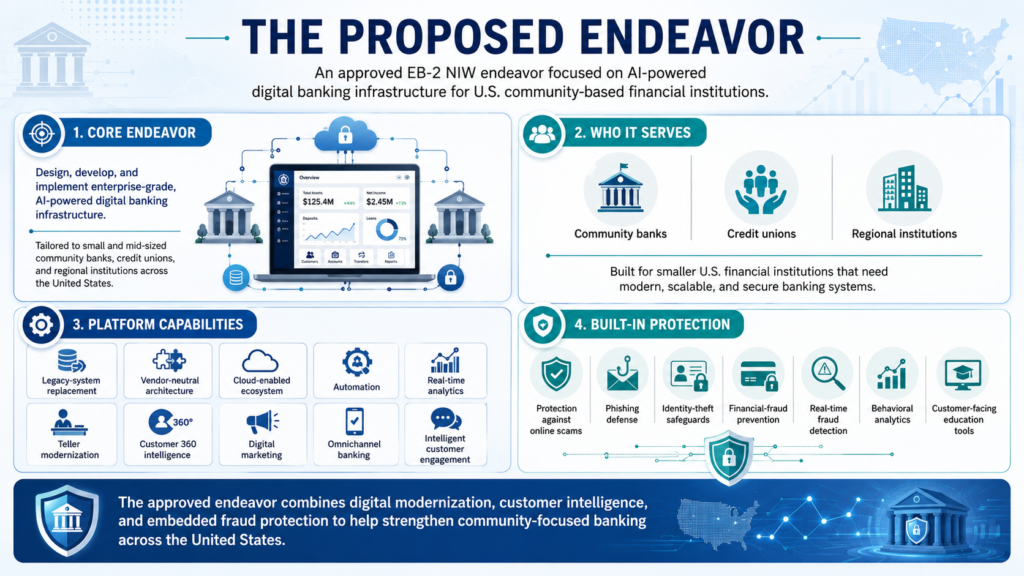
The platform would replace outdated legacy systems with agile, vendor-neutral, cloud-enabled ecosystems supporting automation, real-time analytics, teller modernization, Customer 360 intelligence, digital marketing, omnichannel banking, and intelligent customer engagement. It would also introduce embedded protection against online scams, phishing, identity theft, and financial fraud through real-time fraud detection, behavioral analytics, and customer-facing education tools.
What Immignis and AdvanceMyProfile Built
The profile-building work required turning a technically strong but broad banking-IT background into a coherent Dhanasar story. The final structure connected four technical pillars to one national-interest theme: secure, resilient, and affordable modernization for under-resourced financial institutions.
| Technical pillar | Why it helped the NIW case |
| AI-powered financial continuity and fraud intelligence | Real-time fraud detection, behavioral analytics, anomaly detection, graph-based analytics, explainable AI, and federated learning to help smaller institutions detect coordinated fraud without sharing sensitive customer data. |
| Telecom-integrated resilient infrastructure | Dual-carrier routing, SD-WAN, encrypted backup channels, satellite or 5G failover, and geo-redundant recovery hubs so banking services can continue during telecom outages, cyberattacks, or natural disasters. |
| Zero-trust security with quantum-resilient encryption | Continuous identity verification, micro-segmentation, behavioral monitoring, and post-quantum cryptography to protect financial data against current and future cyber threats. |
| Cloud-enabled, interoperable, regulatory-compliant architecture | Hybrid-cloud infrastructure, APIs, microservices, automated AML/KYC reporting, audit trails, and governance dashboards to reduce vendor lock-in and compliance burdens for smaller banks. |
How the Evidence Supported Dhanasar
Prong 1 – Substantial Merit and National Importance
The endeavor was tied to recognized problems in the U.S. financial sector: cybercrime losses, community-bank fragility, legacy system costs, FedNow capability gaps, third-party vendor risk, AML compliance pressure, and the need for secure adoption of new financial technologies. The petition also connected the technical plan to policy and regulatory concerns involving bank oversight, cybercrime reporting, check fraud, post-quantum standards, and community-bank technology modernization.
Prong 2 – Well Positioned to Advance the Endeavor
Petitioner’s record for the EB-2 NIW Visa was organized around more than 19 years of banking-technology leadership. His experience included senior roles at Riyad Bank, Habib Bank Limited, Arab Bank/Arab Gulf Tech, Meezan Bank, and earlier HBL leadership roles. The evidence for the EB-2 NIW Visa covered enterprise architecture, core banking transformation, branch-banking platform consolidation, disaster recovery, secure data exchange, data lakes, middleware, API and microservices integration, SWIFT and secure messaging, data masking, Customer 360 architecture, and enterprise risk and compliance systems.
The record also included advanced education and technical credentials for the EB-2 NIW Visa, including MCIT, MBA, BS in IT, AWS and Azure cloud credentials, cybersecurity training, SAS Enterprise GRC, DevOps, IBM WebSphere, Oracle WebLogic, SQL, and AS400 experience. Those credentials helped show that he could execute across both technical depth and banking-governance realities.
Prong 3 – Why Waiver of Labor Certification Was Beneficial
The third-prong theory was built around the independent and scalable nature of the endeavor. A standard job offer would confine the work to one employer, while the proposed architecture was designed for adoption across multiple community banks, credit unions, and regional institutions. The petition also emphasized personal seed funding of approximately 350,000 SAR, or around USD 93,000, with a component-wise deployment plan for prototypes, testbeds, telecom failover simulation, zero-trust encryption, and regulatory-compliant cloud architecture.
Strong Profile-Building Points That Carried the Case
- A clear national problem: vulnerable community banks, rising fraud, legacy systems, compliance costs, and technical debt.
- A focused technical solution: AI-powered, cloud-enabled, vendor-neutral digital banking infrastructure with fraud intelligence and continuity layers.
- A strong execution record: digital banking, enterprise architecture, data lake, middleware, disaster recovery, and security programs across large international banks.
- A credible independent plan: phased pilots, federated consortium development, growth potential across multiple institutions, and personal seed capital.
- A strong evidence bridge: recommendation letters and project confirmations supporting his role in enterprise data, risk, secure messaging, data encryption, business continuity, and cloud-interoperability initiatives.
Filing and Approval
The final petition was filed as an EB-2 NIW Visa evidence architecture rather than a career-history package. The proposed endeavor explained the national financial-infrastructure problem. The technical pillars showed how the solution would work. The professional record showed execution capacity. The Dhanasar analysis connected the EB-2 NIW Visa evidence to substantial merit, national importance, well-positioned ability, and the benefit of waiving the job-offer requirement.
USCIS approved the EB-2 NIW Visa I-140. The approval confirmed that enterprise banking-technology work can support a National Interest Waiver when it is framed as a system-level contribution to financial resilience, cybersecurity, fraud prevention, and secure modernization for U.S. financial institutions.
What the Client Gained Beyond Approval
The approval was the immigration result, but the profile-building process also produced professional value. Ammar’s background became easier to explain as a focused fintech infrastructure and digital-banking resilience profile rather than a broad banking-IT career. His expertise could now be presented to banks, technology partners, cybersecurity stakeholders, and fintech collaborators through a clear national-interest lens.
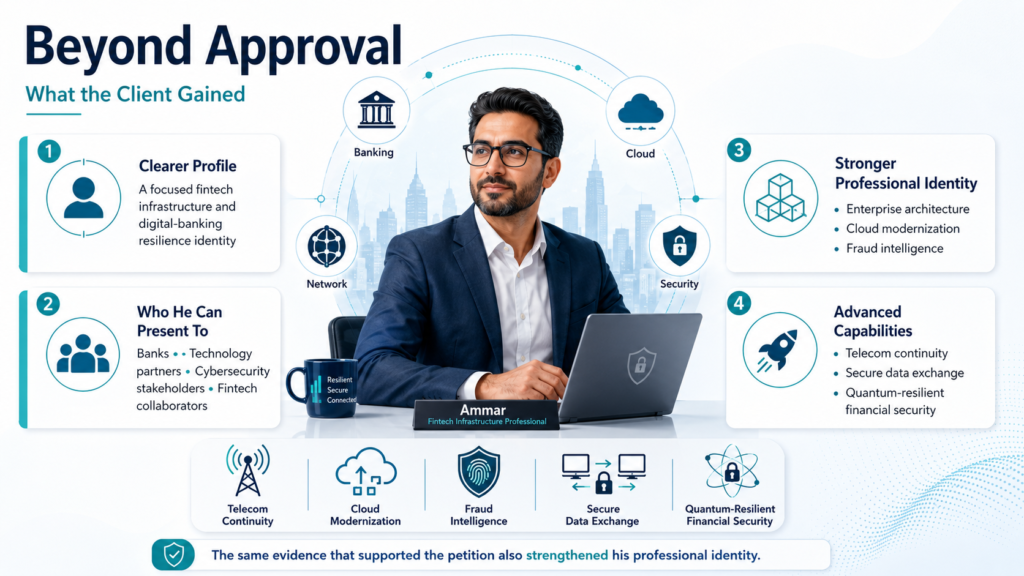
The same evidence that supported the petition also strengthened his professional identity: enterprise architecture, cloud modernization, fraud intelligence, telecom continuity, secure data exchange, and quantum-resilient financial security.
Key Lessons for Professionals
- Enterprise technology work can support an NIW petition when it is connected to a national system-level problem.
- A strong NIW profile should not rely only on job titles or employer reputation.
- The proposed endeavor must explain why the applicant’s work matters beyond one institution and why the United States needs the solution.
- For fintech and banking-technology professionals, cybersecurity, fraud intelligence, community-bank resilience, and digital-continuity planning can create a strong national-interest frame when the evidence is organized correctly.
- Ethical profile building documents real expertise. It does not manufacture a false profile or invent evidence the record cannot support.
Start with a free, honest assessment. If the record is not strong enough yet, the right strategy is to build the missing evidence before filing. immignis