Malagasy Vanilla Agronomist EB-1A, A Malagasy agronomist secured EB-1A approval after vanilla curing methods, disease management protocols, exporter network adoption, scientific authorship, trade industry validation, professional review service, and immigration-specific profile building made the scientist behind a familiar global flavor visible.
Key facts at a glance
| Petition outcome | Form I-140 approved under EB-1A on August 22, 2024. |
| Professional profile | Malagasy agronomist and post-harvest scientist whose curing and disease-management protocols helped producers and exporters protect vanilla quality, reduce losses, and supply demanding flavor markets. |
| Field niche | Vanilla agronomy and post harvest science. |
| Starting weakness | The methods were used in fields, curing houses, and exporter networks, but public credit usually went to the crop, the buyer, or the finished flavor rather than to the scientist who developed and refined the protocols. |
| Profile-building focus | Protocol-adoption documentation, agronomy publications, exporter and flavor industry letters, international spice-trade forum roles, technical review and judging records, media features, and ethical immigration specific profile building. |
| Principal EB-1A evidence areas developed | Original contributions, leading or critical role, published material about the petitioner, authorship of scholarly articles, and judging the work of others. |
| Central issue | Showing that field protocols used across a commercially important supply chain were attributable scientific contributions, not routine agricultural advice or anonymous extension work. |
| Approval lesson | Applied agricultural science can support EB-1A when the record follows a method from its author to the farms, curing operations, exporters, buyers, and quality outcomes that depend on it. |
The approval
Vanilla reaches consumers as ice cream, chocolate, perfume, bakery products, and countless other goods. The science that protects its quality is much less visible. USCIS approved this Malagasy vanilla agronomist’s Form I-140 petition on August 22, 2024 after the record identified who had developed and spread the field and curing protocols behind that quality.
The case began with a problem common to agricultural scientists. The results were easy to see, but the author was not. Producers changed how they managed disease. Curing teams adjusted timing, handling, moisture control, and quality checks. Exporters relied on more consistent beans. Yet the petitioner’s name rarely traveled with the protocol once it entered everyday practice.
Immignis and Advance My Profile did not try to turn vanilla into a novelty story. The work focused on attribution. The petition connected the scientist to specific methods, documented where those methods were used, explained the losses or quality problems they addressed, and built an independent record through publication, trade industry validation, professional review, and media coverage.
Vanilla’s public story usually leaves the agronomist out
Vanilla is often described through price swings, hand pollination, theft, weather, export demand, and the labor required to produce cured beans. Those subjects matter, but they can reduce technical work to background scenery. Disease diagnosis, plant health, harvest timing, bean preparation, controlled sweating and drying, conditioning, storage, and quality assessment all require specialized judgment.
A protocol can become widely used without remaining visibly attached to its author. It may pass from a research plot to a cooperative, from a training session to a curing house, or from an exporter to a supplier network. By the time the method improves a commercial shipment, the original scientist may appear only in an old report or internal training file.
That was the starting weakness here. The global relevance of vanilla was obvious. The petitioner’s personal role was not. A credible EB-1A case had to show more than an important crop and a respected exporter network. It had to identify the scientist’s own contribution and prove that others relied on it.
The field was defined as vanilla agronomy and post harvest science
The petition did not present the client as a general agricultural professional. The field was narrowed to vanilla agronomy and post-harvest science, where plant health and curing quality are part of one technical chain.
That definition helped explain why the evidence looked different from a conventional laboratory profile. A useful result might be lower disease loss in a growing area, a more stable curing process, fewer mold or moisture problems, improved aroma development, better grading consistency, or wider adoption of a handling protocol. These outcomes can be scientifically meaningful even when they do not begin as heavily cited journal papers.
The field definition also kept the case honest. It did not claim ownership of the global vanilla industry. It showed expertise in the agronomic and post harvest decisions that determine whether harvested beans become a stable, marketable, high-quality ingredient.
Disease management and curing protocols became attributable contributions
The core evidence was organized protocol by protocol. For each method, the petition identified the problem, the petitioner’s technical input, the form in which the guidance was communicated, the organizations or production groups that used it, and the outcome the method was designed to improve.
Disease-management evidence could include diagnostic procedures, sanitation measures, planting or field-management guidance, training records, trial results, monitoring forms, and adoption by producer groups. Post-harvest evidence could include curing schedules, moisture or temperature controls, sorting criteria, handling procedures, quality checks, and records showing how the method entered exporter operations.
This approach mattered because a protocol is not significant merely because it exists. The case needed independent evidence that the method solved a real problem and was used beyond the petitioner’s own desk. Adoption letters, training records, revised manuals, implementation summaries, quality data, and third party explanations connected authorship to practical reliance.
Adoption across exporter networks showed reach beyond one farm
A single successful trial can show technical promise. Adoption across separate producer, cooperative, or exporter networks can show something more: other professionals considered the method useful enough to incorporate into their own work.
The profile-building strategy mapped that spread. It documented where a protocol was introduced, who made the decision to use it, how staff or growers were trained, whether the method continued after the initial project, and what evidence existed of reduced loss, improved consistency, or stronger quality control.
The petition avoided vague claims such as ‘widely used throughout the industry.’ Each adoption point had to be supportable. A smaller number of clearly documented users was more persuasive than a large unsupported estimate. That made the original contribution argument measurable and protected the case from promotional overstatement.
Flavor-industry letters connected farm science to the buyer
The downstream industry helped explain why field science mattered commercially. Flavor houses, ingredient buyers, exporters, quality specialists, and supply chain professionals understand how curing consistency, moisture, aroma, defects, traceability, and storage affect the usefulness of vanilla as an ingredient.
Strong letters did more than praise the petitioner. They explained the technical problem, how the petitioner’s work affected quality or reliability, why the result mattered to buyers or processors, and whether similar methods were requested or used outside the original setting.
This evidence was especially useful because it followed the scientific contribution to the point where quality becomes economically visible. The familiar product in a consumer’s freezer was not itself the evidence. The evidence was the documented dependence of producers and buyers on methods that helped protect the ingredient before it reached that product.
Publication development gave field work a formal scientific record
The petitioner had strong field knowledge, but some of it lived in training materials, project reports, exporter procedures, and internal records. A focused publication strategy translated that knowledge into a durable scientific record.
Articles and technical papers were organized around identifiable themes such as disease control, crop management, curing variables, post-harvest losses, quality assessment, or adoption of field protocols. The goal was not to manufacture an academic identity. It was to document the science already being performed and make the petitioner’s authorship easy to verify.
Where collaborative writing was involved, the record explained the petitioner’s research, data, analysis, drafting, or corresponding-author role. This supported scholarly authorship while also strengthening the original-contribution narrative with a public technical explanation of the methods.
Trade forums and technical review showed peer trust
International spice, flavor, and agricultural forums gave the petitioner a professional platform beyond the home institution. Speaking roles, technical panels, working groups, and invited sessions were useful when the evidence showed why the person was selected and what expertise was requested.
Judging evidence required the same care. The strongest records involved completed evaluation of research abstracts, agronomy projects, quality methods, technical submissions, or the work of other professionals. Appointment notices, review instructions, scoring records, committee acknowledgments, and proof of completed service were more useful than invitations alone.
These activities showed a shift in professional position. The petitioner was no longer only providing protocols to users. Other organizations were also asking the scientist to assess ideas, methods, or quality presented by peers.
Media coverage had to move past price and scenery
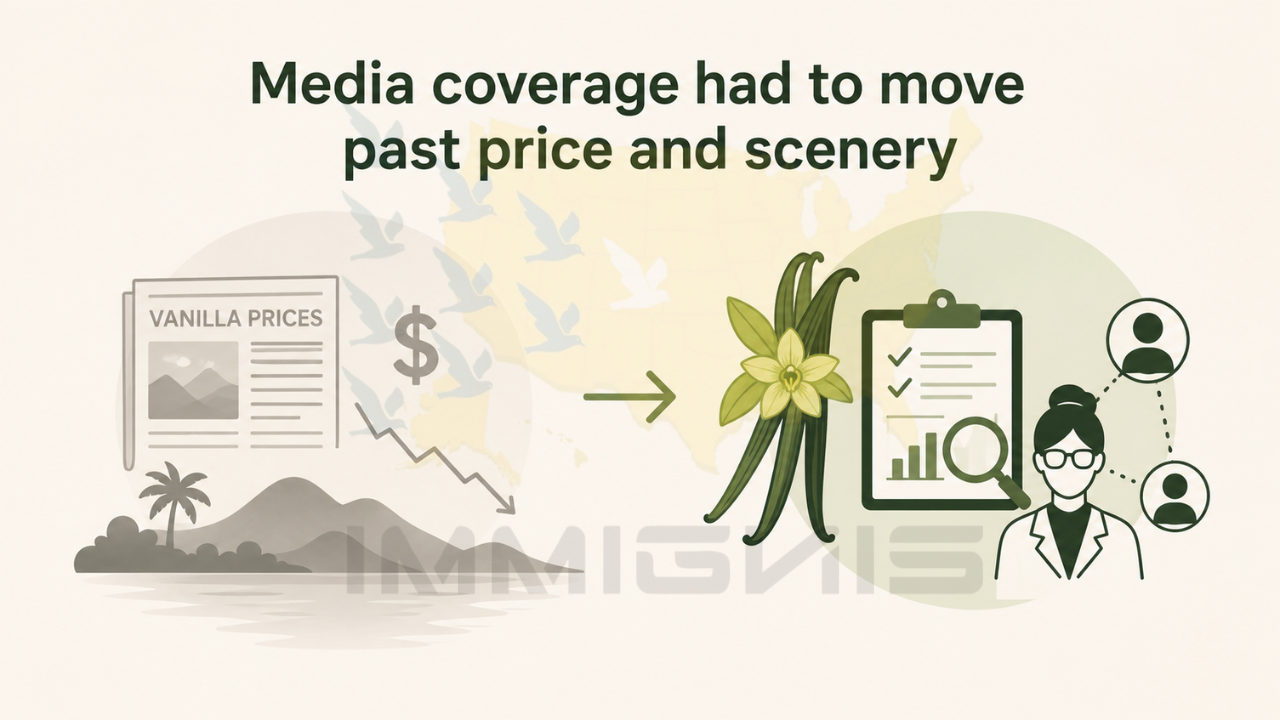
Vanilla coverage often centers on high prices, tropical landscapes, theft, luxury products, or the difficulties faced by growers. Those stories may mention a scientist without explaining the work. For published-material evidence, the profile needed coverage that identified the petitioner and discussed the person’s methods, research, or professional role.
The media strategy therefore focused on subjects the scientist could explain with authority: why curing fails, how disease affects supply, what quality control actually requires, and how producer-level science connects to the stability of a global ingredient market.
This made the public record more useful without turning it into advertising. Readers learned something specific about vanilla production, and USCIS could see that the petitioner was recognized as a source of expertise rather than simply photographed beside the crop.
How Immignis and Advance My Profile changed the case
Before profile building, the career could be summarized as ‘worked with vanilla producers and exporters.’ That description concealed the science, the authorship, and the extent of professional reliance.
Immignis and Advance My Profile rebuilt the record around the life of each protocol. Field and curing documents established authorship. Adoption evidence showed use outside the original project. Exporter and flavor-industry letters explained downstream value. Publications made the science public. Trade forums, technical review, and media coverage showed recognition beyond routine employment.
The final case did not claim that one scientist controlled the world’s vanilla supply. It showed something narrower and more credible: the petitioner created and disseminated methods that helped multiple actors protect a difficult crop and a demanding post-harvest process.
Why this case worked
Each evidence category answered a different question. Protocol records showed what the petitioner created. Adoption evidence showed who used it. Industry letters explained why the result mattered. Publications established scientific authorship. Review service demonstrated peer trust. Trade roles and media coverage made the scientist visible outside the immediate employer or project.
The approval hook was memorable but grounded: a large part of the global flavor industry depends on field and curing decisions that consumers never see. Once the petition followed those decisions back to their author, the work no longer looked like anonymous agricultural support.
What agricultural scientists can learn
Applied scientists should preserve attribution before a method becomes routine. Draft protocols, revision histories, training rosters, field-trial records, implementation emails, quality reports, adoption letters, and buyer feedback can become difficult to reconstruct years later.
They should also distinguish adoption from significance. A method may be used because it is convenient, required, or genuinely effective. The strongest record explains why others chose it and what technical or operational problem it solved.
Finally, commercial value should not replace scientific explanation. A valuable crop can provide context, but an EB-1A petition still needs the person’s own work, independent recognition, and evidence that the contribution matters within the defined field.
Conclusion
The Malagasy vanilla agronomist’s EB-1A approval came from making uncredited field science traceable. The crop was famous. The scientist became visible only after the evidence followed the methods through production, curing, export, and professional use.
Protocol authorship, exporter-network adoption, scientific publication, downstream industry validation, trade-forum participation, technical review, media coverage, and independent letters showed a record larger than one farm or one project. The world’s familiarity with vanilla provided context. The petitioner’s attributable science carried the case.
The client’s name and identifying details are omitted to protect privacy. The professional field, approval date, and evidence strategy reflect the case information provided for this success story.
Frequently asked questions
Can a vanilla agronomist qualify for EB-1A?
Yes. A vanilla agronomist may qualify when the evidence addresses the regulatory criteria and the record as a whole shows the required level of sustained professional recognition. The crop’s commercial importance alone is not enough; the petition must document the individual scientist.
Can field protocols count as original contributions?
They can when the record identifies the applicant as an author or developer and shows that the methods had significance through adoption, measurable results, professional reliance, or independent validation.
How can protocol adoption be documented?
Useful records may include revised manuals, training rosters, implementation letters, exporter procedures, cooperative records, field reports, quality data, repeat use, and detailed statements from independent users.
Do sales or export figures prove a scientist made a major contribution?
Not by themselves. Commercial figures provide context, but the petition must connect the applicant’s method to a specific technical outcome and show why others relied on that work.
Can letters from flavor houses or ingredient buyers help?
Yes, particularly when the writer has direct knowledge and explains how the applicant’s work affected quality, reliability, defects, processing, sourcing, or technical standards. Generic praise carries less weight.
Can agricultural training materials support EB-1A?
They may support attribution, leading-role, or original-contribution arguments when the applicant authored the materials and the record shows meaningful use. Training materials are stronger when paired with adoption and outcome evidence.
Can reviewing agronomy research or quality methods satisfy the judging criterion?
It may. The record should show that the applicant actually evaluated the work of other professionals and should include appointment, instructions, completed assignments, acknowledgments, or similar proof.
Does speaking at a spice or flavor conference count as an EB-1A criterion?
A speaking role can support the overall record and may connect to other criteria, but speaking alone is not a separate EB-1A criterion. The event, selection process, subject, and the applicant’s role should be documented accurately.
What counts as published material about the applicant?
Qualifying professional, trade, or major media should discuss the applicant and the person’s work. An article about vanilla prices or an exporter that merely lists the scientist’s name may not be enough.
Why is post-harvest science important in this type of case?
Because harvested vanilla does not become a stable commercial ingredient automatically. Curing, drying, conditioning, storage, grading, and defect control can determine quality, loss, and buyer acceptance.
Can work in a small agricultural institution still support EB-1A?
Yes. Institution size does not decide eligibility. The petition should document the person’s contribution, recognition, responsibility, and field impact rather than relying only on employer prestige.
How can profile building help an applied agronomist?
Profile building can recover attribution, document adoption, organize technical authorship, develop a public scientific record, secure independent validation, and identify peer-review or professional roles without inventing achievements.
Make applied agricultural science visible
Professionals working in agronomy, crop protection, post-harvest science, food ingredients, quality systems, spice production, agricultural extension, and exporter networks may already have strong EB-1A evidence hidden in protocols, training records, field trials, adoption histories, technical reports, buyer communications, and industry files.