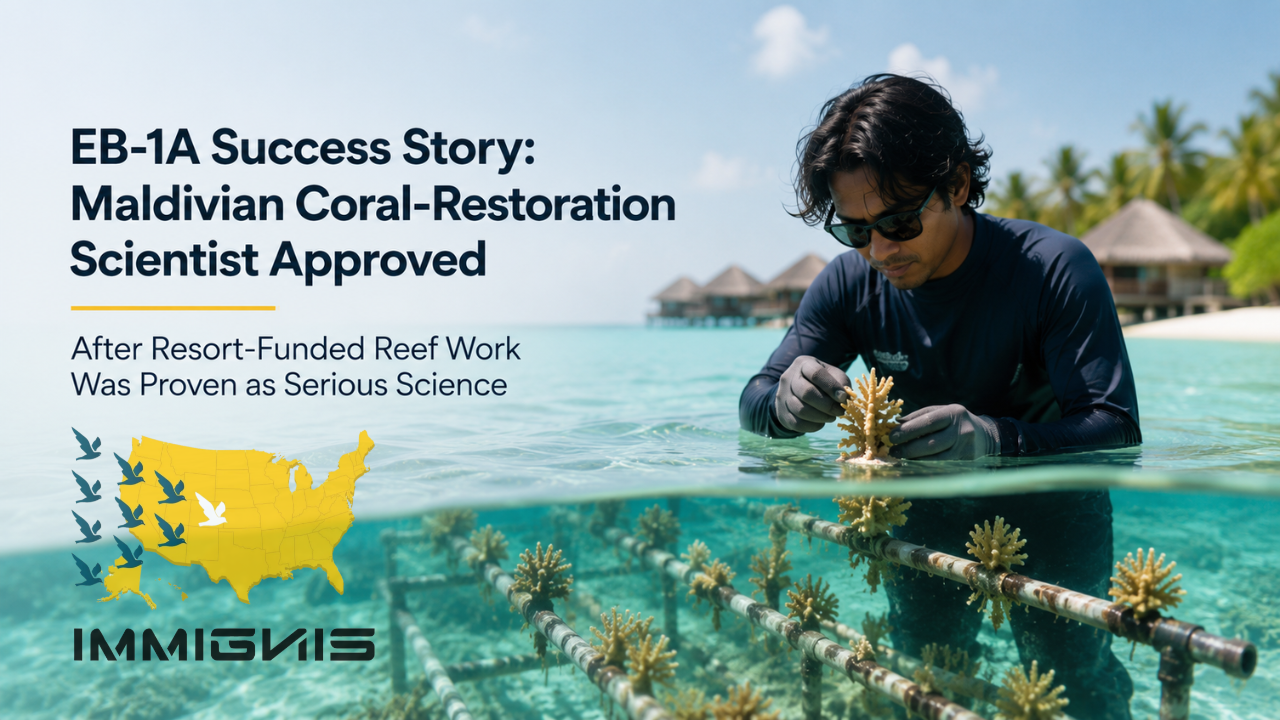
How a Maldivian marine biologist secured EB-1A approval by documenting coral restoration outcomes, scientific authorship, method adoption beyond the Maldives, international reef-initiative roles, judging activity, media coverage, and immigration specific profile building.
Key facts at a glance
| Petition outcome | Form I-140 approved under EB-1A on August 21, 2024. |
| Professional profile | Maldivian marine biologist scaling coral propagation and reef-recovery methods across atoll systems. |
| Field niche | Large-scale coral restoration for atoll nations. |
| Starting weakness | Much of the work was financed or hosted by resorts, so outsiders could mistake long-term reef science for a tourism amenity or decorative conservation project. |
| Profile-building focus | Restoration-outcome documentation, publication development, international reef-initiative roles, evidence of method adoption beyond home waters, science-media features, expert letters, and immigration-specific evidence organization. |
| Principal EB-1A evidence areas developed | Original contributions, scholarly articles, published material, leading role, and judging the work of others. |
| Central issue | Separating the scientist, methods, data, and measurable reef outcomes from the luxury resort setting in which much of the work was funded and publicly photographed. |
| Approval lesson | Private or tourism sector funding does not make restoration work less scientific when the record proves authorship, monitoring, reproducible methods, independent adoption, and professional reliance. |
The approval
On August 21, 2024, USCIS approved the Form I-140 petition of a Maldivian coral-restoration scientist whose work focused on scaling coral propagation and reef recovery across atoll environments.
The Maldivian Coral Restoration Scientist’s case began with an image problem. Much of the petitioner’s work took place near resorts, dive centers, overwater villas, and carefully photographed lagoons. To a casual observer, coral frames beside a luxury property could look like a guest activity. The scientific record told a different story: controlled propagation, survival monitoring, site selection, repeated measurements, method refinement, and restoration planning across vulnerable reef systems.
Immignis and Advance My Profile built the petition around that difference. The record had to show that the resort was a funding or operating setting, not the measure of the work. The petitioner was not arranging coral for a brochure. He was developing, testing, and extending restoration methods for an island nation whose communities, shorelines, fisheries, and economy are closely tied to reef condition.
The infinity pool backdrop was hiding the actual evidence
The petitioner did not lack real work. He lacked a public record that separated the science from its surroundings. Resort websites tended to emphasize clear water, guest participation, and environmental responsibility. They rarely explained the restoration design, the monitoring period, the reasons one site was chosen over another, or the scientist who decided how a propagation program should be run.
That difference mattered for EB-1A. A corporate sustainability page may show that a project exists, but it does not automatically establish an original contribution by one scientist. The petition needed attribution: who designed the method, who set the monitoring rules, who interpreted survival and growth, who changed the protocol after failures, and who trained other teams to repeat it.
The approval hook came from stripping away the decorative frame. Once the record focused on data ownership, method authorship, adoption, and scientific responsibility, the same resort funded projects looked very different.
Large scale coral restoration is more than attaching fragments to a frame
Coral restoration can involve nursery growth, direct transplantation, microfragmentation, larval propagation, substrate preparation, rubble stabilization, or a combination of methods. The choice depends on species, reef condition, wave exposure, water quality, heat stress, available staff, and the purpose of the project.
Scaling the work creates a second challenge. A method that keeps a small demonstration plot alive for a season may not work across several islands or under different atoll conditions. Large programs need consistent protocols, trained teams, site records, survival tracking, maintenance plans, and a way to compare results over time.
The petition defined the field as large scale coral restoration for atoll nations. That was narrower than marine biology and more accurate than tourism conservation. It gave USCIS a practical way to understand why propagation design, outcome monitoring, cross site adaptation, and external method adoption were meaningful evidence in this case.
Restoration outcomes became the proof of original contribution
The strongest section of the petition dealt with outcomes. The case did not rely on the number of coral frames installed or the number of photographs taken underwater. It examined what happened after installation.
The evidence included monitoring records, survival and growth data, site comparisons, repeated surveys, project histories, technical reports, and letters from people who had used or reviewed the petitioner’s work. Where raw data could not be disclosed fully, the record used cleared summaries that identified the method, the applicant’s responsibility, and the result without exposing private operational information.
This distinction helped support the original contributions argument. A restoration project becomes more persuasive when others can see that the method produced measurable results, was refined through evidence, and informed later work. The petitioner was connected to that chain personally rather than described as one member of a general environmental team.
Adoption beyond the Maldives showed that the method could travel
One of the most useful questions in the case was simple: did anyone outside the petitioner’s immediate projects rely on the method? Evidence of adoption beyond home waters helped answer it.
The petition documented technical exchange, training, replication, consultation, or adaptation of the petitioner’s approach by external reef programs and professionals. The value was not in claiming that every coral project used his method. It was in proving that independent practitioners considered parts of his work useful enough to test, repeat, or build into their own programs.
This moved the record past local success. It showed that lessons developed in Maldivian atoll conditions had relevance to other reef settings and that the petitioner’s work could influence practice without being tied permanently to one resort or one island.
Publication development gave the science a name and a permanent home
The original profile had a familiar imbalance. The petitioner had years of field observations and operational knowledge, but the public authorship record did not fully reflect it. Foreign collaborators and larger institutions often had easier access to journals, conferences, and editorial networks.
Publication development therefore focused on topics the petitioner could author directly: propagation outcomes, cross-site performance, monitoring design, atoll specific restoration constraints, and the practical limits of scaling. The aim was not to repackage promotional material as research. It was to turn documented field knowledge into work that other scientists could read, assess, cite, and compare.
First-author and identifiable technical authorship helped the petition separate the petitioner from project sponsors. The articles showed that he was producing knowledge, not merely implementing instructions funded by someone else.
International reef initiatives supplied recognition outside the resort relationship
International reef initiative roles were useful because they showed who trusted the petitioner when no tourism contract was involved. Working groups, technical networks, restoration forums, and cross border reef programs placed him among professionals dealing with similar scientific and operational problems.
The petition examined the substance of each role. A general mailing list or open membership would not carry the same weight as a selective appointment, technical responsibility, invited contribution, or documented reliance on the petitioner’s expertise. Where membership evidence was used, the admission or selection basis had to be explained rather than assumed.
These roles also produced independent records: invitations, agendas, committee materials, review assignments, technical correspondence, and letters from specialists outside the petitioner’s employer or funding network.
Judging evidence came from evaluating restoration work, not from a ceremonial title
In a field such as coral restoration, judging may appear through grant review, technical proposal assessment, abstract or manuscript review, competition panels, project evaluation, or selection of restoration methods and sites proposed by other professionals.
The case used activities where the petitioner genuinely evaluated the work of others. The documentation identified what he reviewed, who requested the assessment, the standards applied, and why his expertise was relevant. This avoided the common mistake of treating attendance at a workshop or participation in a committee as judging without proof of evaluation responsibility.
The evidence was valuable because it showed peer trust in direct form. Other professionals were asking the petitioner to decide whether a method, paper, proposal, or restoration plan met the required standard.
Media coverage had to discuss the scientist, not only the turquoise water
Coral projects attract visual media. That can help public understanding, but beautiful reef photographs are not automatically published material about the applicant. The petition distinguished coverage of a location or resort from coverage that identified the petitioner and explained his work.
The strongest articles and interviews discussed restoration methods, survival results, scaling questions, bleaching pressure, or the petitioner’s technical role. They made the science understandable without reducing it to a feel good travel story.
This approach also improved the credibility of the public profile. Readers could see both the appeal of the setting and the difficult scientific work behind it. The media record no longer left the impression that coral restoration was simply part of the guest experience.
A leading role can be proved in privately funded science
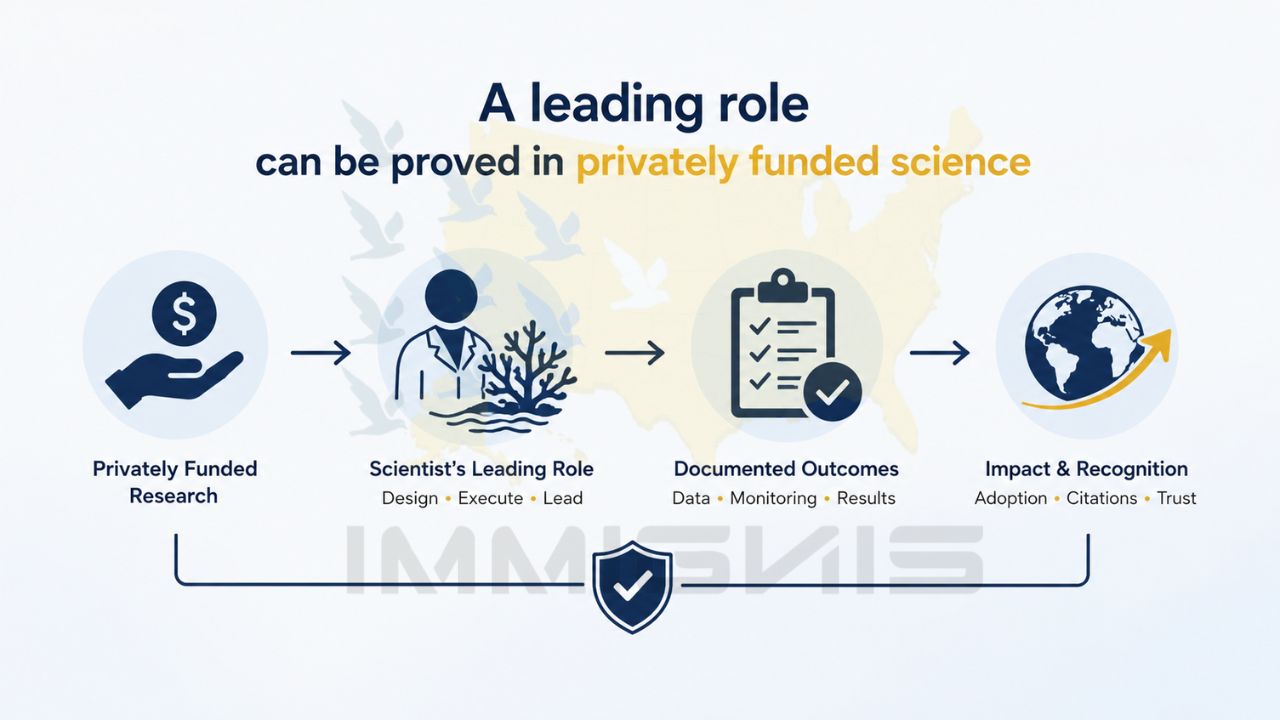
Private funding does not prevent a leading role argument. The relevant questions are whether the organization or project has a distinguished reputation and whether the applicant performed a leading or critical function within it.
The petition documented why the restoration programs mattered, how they operated across sites, and which responsibilities depended on the petitioner. His role involved scientific design, protocol control, monitoring interpretation, team training, or decisions that affected whether the program could produce reliable results.
This was more persuasive than relying on a senior sounding title. The evidence showed what would have been missing or weakened without his work and why the project sponsors relied on his judgment.
How Immignis and Advance My Profile rebuilt the story
Before profile building, the career could be misunderstood in one sentence: a marine biologist ran coral projects for resorts. That description was factually incomplete and strategically damaging.
Immignis and Advance My Profile reorganized the record around the scientific chain: method design, implementation, monitoring, outcome analysis, refinement, publication, external adoption, peer evaluation, and independent recognition. Resort support remained part of the history, but it no longer controlled the meaning of the work.
The process did not invent a separation between science and tourism. It documented one that already existed. The petitioner had been doing serious restoration work in a place where serious science happened to share the horizon with infinity pools.
Why this case held together
Every major evidence category returned to the same point. Outcome records showed that the work could be measured. Publications gave the methods identifiable authorship. External adoption showed that the ideas moved beyond one employer. Reef network roles and judging assignments showed professional trust. Media coverage made the work visible without turning it into advertising.
The field definition kept the argument disciplined. The petition did not claim extraordinary ability because coral reefs are globally important. It showed distinction within large scale coral restoration for atoll nations and explained how achievement is recognized in that specialty.
Most importantly, the record separated the person from the sponsor. The resort could fund the boat, the nursery, or the staff. The evidence showed who produced the scientific method and why other experts relied on it.
What other industry funded scientists can learn
Professionals working through resorts, foundations, private hospitals, manufacturers, energy companies, farms, or technology firms often worry that commercial funding will make their work appear less scientific. The real problem is usually not the source of funding. It is whether the record proves authorship, independence, use, and professional significance.
A useful review begins with the evidence after the press release. What was measured? Who set the method? Did the work continue long enough to produce a credible outcome? Did another organization adopt it? Was the applicant asked to publish, teach, review, or evaluate because of that work?
No single answer guarantees EB-1A eligibility, and USCIS still evaluates the complete record under the applicable legal standard. But those questions can uncover evidence that is easy to miss when the public story is controlled by a sponsor’s brand.
Conclusion
The Maldivian coral restoration scientist’s approval shows that a commercial setting does not define the quality of the science conducted within it. The case succeeded after the record moved away from promotional imagery and toward measurable outcomes, technical authorship, external adoption, peer trust, and a precise field niche.
The visual backdrop remained the same: lagoons, villas, dive boats, and coral nurseries. What changed was the evidence. USCIS could see the scientist behind the setting and the serious restoration work behind the photographs.
The client’s name and identifying details are omitted to protect privacy. The professional field, approval date, and evidence strategy reflect the underlying case record.
Frequently asked questions
Can a coral restoration scientist qualify for EB-1A?
Yes. The field itself is not a barrier. The petition must show sustained recognition through qualifying evidence and demonstrate, in the complete record, that the scientist has reached the required level of distinction in the field.
Can resort funded research support an EB-1A petition?
Yes. Private or tourism-sector funding does not disqualify the work. The evidence should separate the scientist’s contribution from marketing activity and document scientific design, outcomes, authorship, adoption, and professional recognition.
Can coral survival and growth records prove an original contribution?
They can help when the records are reliable, tied to an identifiable method, attributed to the applicant, and supported by evidence showing why the results mattered to other practitioners or programs. Project scale alone is not enough.
Does adoption of a restoration method in another country matter?
Independent adoption can be strong evidence because it shows that the work was useful beyond the applicant’s own employer or project. The petition should document what was adopted, by whom, and how the applicant’s authorship or technical role is established.
What counts as judging in coral-restoration science?
Examples may include manuscript review, grant or proposal assessment, technical project evaluation, abstract review, or formal selection of other professionals’ restoration work. The record must show that the applicant actually evaluated the work of others.
How can Immignis and Advance My Profile help marine scientists?
Immignis and Advance My Profile help define the field niche, trace scientific authorship, organize outcome and adoption evidence, develop publications and professional visibility, document judging and selective roles, and prepare an immigration-focused record without inventing achievements.
Build an immigration record around the science, not the scenery
Many marine and environmental scientists already have valuable field work, but their names remain hidden inside sponsor websites, institutional reports, collaborative projects, monitoring databases, and tourism facing publicity.