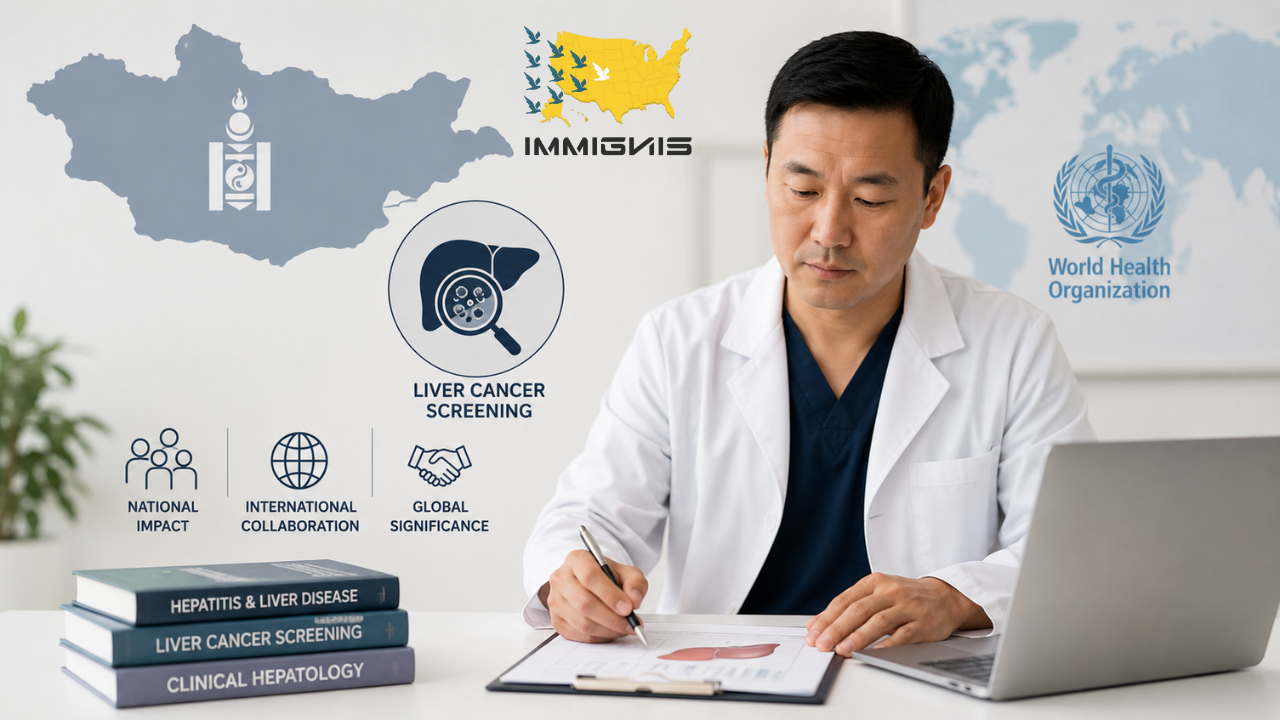
Mongolian Hepatology Clinician EB-1A: How a Mongolian physician confronting one of the world’s highest liver cancer burdens secured EB-1A approval by turning hepatitis driven screening innovation into a petition ready immigration profile built on screening program documentation, international collaboration publications, WHO regional consultation roles, conference faculty invitations, hepatology society engagement, and ethical profile building.
Key facts at a glance
| Petition outcome | Form I-140 approved under EB-1A on September 5, 2024. |
| Professional profile | Mongolian hepatology clinician confronting one of the world’s highest liver cancer burdens through screening and management innovation. |
| Field niche | Hepatitis-driven liver cancer screening and management. |
| Starting weakness | The national impact was real, but it was largely invisible in international literature and difficult for USCIS to evaluate without stronger attribution and global framing. |
| Profile-building focus | Screening program documentation, international collaboration publications, WHO regional consultation roles, conference faculty invitations, hepatology-society engagement, and independent expert letters. |
| EB-1A criteria supported | Original contributions, scholarly articles, leading role, judging, and published material. |
| Central issue | Showing that the petitioner’s liver cancer screening work was not only important inside Mongolia, but also significant to the international hepatology field because it addressed a high-burden, hepatitis-driven cancer problem with scalable clinical lessons. |
| Approval lesson | National scale health impact can support EB-1A when ethical profile building translates local program outcomes into internationally legible evidence of original contribution and field significance. |
The approval
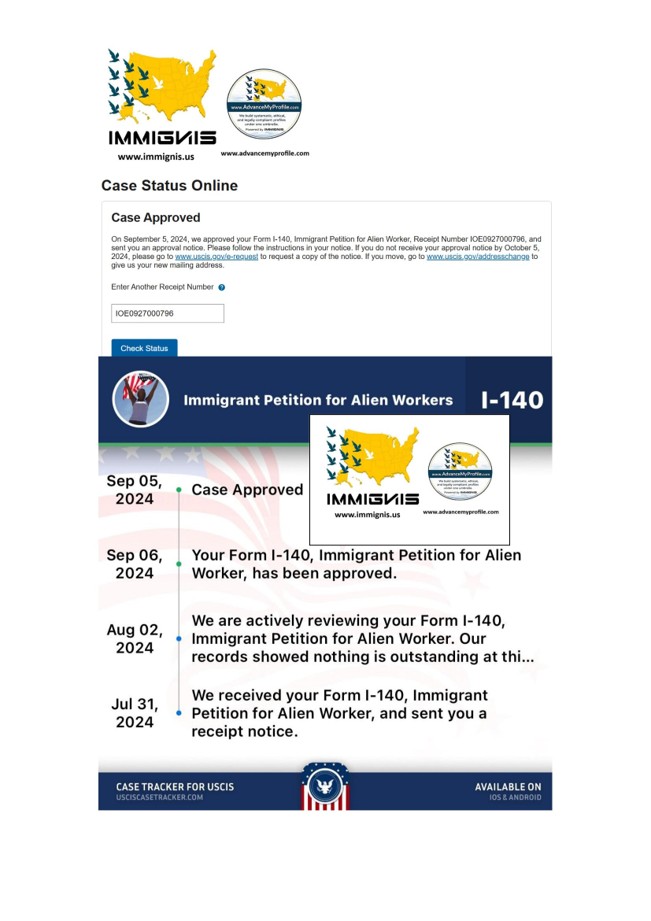
On September 5, 2024, USCIS approved the Form I-140 petition of a Mongolian hepatology clinician whose work focused on hepatitis-driven liver-cancer screening and management in a country facing one of the world’s highest liver cancer burdens.
The approval was important because the petitioner’s strongest evidence did not initially look like a typical EB-1A record. The work was clinically important and nationally relevant, but much of the impact lived inside screening programs, patient pathways, hospital systems, public health data, and regional collaborations rather than in easily visible international headlines.
That made this case a strong example of EB-1A profile building and immigration specific profile building. The petitioner already had meaningful medical expertise, but the record needed to be organized so USCIS could understand why a national screening contribution in Mongolia mattered to the broader hepatology field.
Immignis and Advance My Profile helped convert the petitioner’s clinical and public health record into a petition ready EB-1A profile. The strategy focused on screening program documentation, international collaboration publications, WHO regional consultation roles, conference faculty invitations, hepatology society engagement, expert letters, and careful profile improvement that made the contribution visible beyond national borders.
The evidence problem in hepatitis driven liver cancer cases
Hepatitis driven liver cancer presents a difficult EB-1A evidence problem because the medical impact is often measured through population health, screening access, early detection, clinical pathways, and national burden reduction rather than through individual celebrity or conventional prestige markers.
The petitioner’s starting weakness was not a lack of impact. It was the invisibility of that impact in international literature. Screening innovation that helps a high burden country can be deeply significant, but if the evidence remains inside hospital records, national reports, or local programs, USCIS may not immediately see it as extraordinary ability.
The petition therefore had to define the field precisely as hepatitis driven liver cancer screening and management. It was not framed as general internal medicine, routine gastroenterology, or ordinary clinical service. It was framed as a specialized hepatology niche focused on early detection and management in a population where viral hepatitis and liver cancer created an urgent national health challenge.
This field definition became the foundation of the profile building strategy. It allowed the evidence to be assessed through the correct lens: not how famous the petitioner was in the United States, but whether his screening work, publications, consultations, and professional roles showed recognized significance in a high burden hepatology setting.
Why national impact can be invisible internationally
Many clinicians who work in high burden countries face the same problem. Their work may change patient identification, clinical referral, screening behavior, or treatment pathways at a national level, but the international record may remain thin because the work is not always published quickly, indexed broadly, or covered by Western medical media.
In this case, the petitioner’s national influence had to be translated carefully. The petition could not simply say Mongolia had a serious liver cancer burden and the petitioner worked hard. It had to show what the petitioner personally built, how the screening work operated, where it was adopted or relied upon, and why it represented a meaningful contribution to hepatology practice.
That is where immigration specific profile building made the difference. The goal was not to inflate the record. The goal was to make the real clinical and public health contribution readable for USCIS by organizing it around authorship, adoption, expert recognition, publication, and field relevance.
The approval hook followed directly from this strategy: national scale health impact translated into international field significance. The case showed that a contribution can begin in one country and still matter internationally when the field burden, method, outcomes, and expert validation are documented properly.
Screening program documentation made the contribution measurable
Screening program documentation became one of the strongest pillars of the petition. In hepatology, screening is not administrative paperwork. It can determine whether liver cancer is detected early enough for treatment, whether high risk patients are followed, and whether hepatitis-driven cancer is managed as a predictable public health problem rather than a late-stage crisis.
The petition organized evidence showing how the petitioner contributed to screening design, implementation, or improvement. It documented program scale, patient populations, clinical pathways, and the petitioner’s role in making screening more systematic and useful in a high-burden setting.
This evidence supported original contributions because it showed practical clinical value beyond ordinary patient care. The record did not merely state that the petitioner treated liver disease patients. It showed how he helped build or improve a system for identifying and managing liver cancer risk.
As part of professional profile building for immigration, this screening evidence made the contribution concrete. It gave USCIS a measurable bridge from national health burden to the petitioner’s individual role in improving clinical response.
International collaboration publications built scholarly visibility
International collaboration publications helped address the weakness that the petitioner’s national impact was not fully visible in global literature. These publications connected the Mongolian clinical setting to the broader hepatology and liver cancer research conversation.
The petition presented the publication record as more than a list of articles. It explained how the publications helped document hepatitis driven liver cancer risk, screening needs, management challenges, and clinical lessons that could matter beyond one country.
This strengthened the scholarly articles criterion while also supporting original contribution. In a high burden setting, publications can be especially valuable because they allow local clinical experience to become field knowledge that other clinicians, researchers, and policymakers can use.
For physicians pursuing EB-1A profile building or EB-2 NIW profile building, this is a key lesson: publication evidence becomes strongest when it is tied to real clinical problems, field scarcity, international collaboration, and evidence-based methods rather than presented as isolated academic output.
WHO regional consultation roles showed relevance beyond Mongolia
WHO regional consultation roles helped show that the petitioner’s expertise was relevant outside his own hospital or national program. In public health and hepatology, consultation activity can be powerful evidence because it shows that external bodies relied on the petitioner’s knowledge of disease burden, screening methods, or clinical implementation.
The petition used these roles to demonstrate that the petitioner was not only working in a high-burden country, but was contributing expertise to regional conversations about liver disease, hepatitis, screening, and cancer management.
This evidence gave the case an international frame. It helped USCIS see that Mongolia’s liver-cancer burden was not a local footnote but part of a broader regional and global health problem, and that the petitioner’s work offered relevant expertise within that problem.
In immigration profile building, this type of consultation evidence is especially useful because it converts national experience into external validation from a recognized health-policy or global-health platform.
Conference faculty invitations demonstrated professional trust
Conference faculty invitations helped show professional recognition. When a clinician is invited to teach, present, moderate, or serve as faculty at hepatology or liver-cancer forums, the invitation signals that the field regards the person as a source of useful expertise.
The petition connected these invitations to the petitioner’s niche rather than listing them as generic speaking engagements. The record explained how the petitioner’s screening experience, hepatitis related liver-cancer work, and high-burden clinical background made his voice valuable to peers.
This evidence supported leading role and published material arguments by showing that the petitioner’s work was not locked inside local practice. It was presented, discussed, and recognized in professional settings beyond his immediate institution.
For medical profile building and USCIS evidence building, conference faculty roles are often important because they show that the petitioner’s knowledge is being transmitted to other professionals, not merely applied privately.
Hepatology society engagement and expert review supported recognition
Hepatology society engagement helped place the petitioner inside the professional structure of the field. In medicine, society participation, committee activity, review service, and professional engagement can help demonstrate that the petitioner is connected to the expert community that evaluates and advances the field.
The petition did not treat society engagement as a simple membership line. It explained the relevance of the organizations, the petitioner’s role, and how that engagement connected to liver cancer screening, hepatitis management, or hepatology practice in high-burden systems.
Judging or expert-review evidence was also important. When a physician reviews clinical work, evaluates abstracts, assesses research, or participates in professional review, it supports the judging criterion by showing that others trust the petitioner to evaluate work in the field.
Together, society engagement and expert review activity helped show that the petitioner was not just producing work. He was participating in the professional evaluation and development of hepatology knowledge.
Expert letters translated country burden into field significance
Expert letters played a major role because they explained why the petitioner’s work mattered in context. A non-specialist officer may not immediately understand why liver cancer screening in Mongolia is a field significant contribution. Experts could connect the dots between national disease burden, hepatitis prevalence, screening design, and clinical importance.
The strongest letters did not rely on adjectives. They described what the petitioner built, how the screening or management work operated, why it mattered, and how it compared with the needs of the field. They also clarified why the petitioner’s work should be understood as original contribution rather than routine clinical service.
This evidence was central to ethical profile building. It did not invent acclaim. It gave technical context so USCIS could understand evidence that already existed but was not self-explanatory.
For healthcare professionals, physicians, researchers, and public health specialists, this case shows why expert letters must do more than praise. They must map the field, define the contribution, and explain the petitioner’s individual standing with precision.
How profile building changed the case
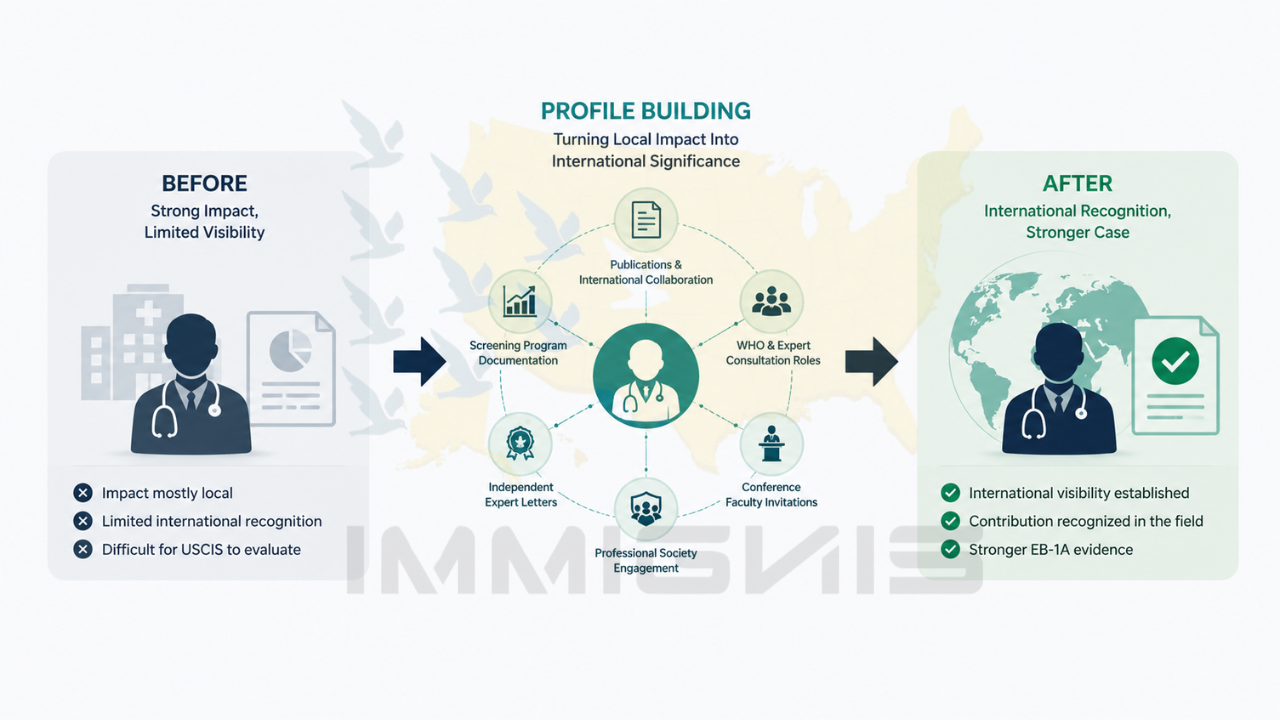
This case shows how profile building can change the way a strong medical career is understood. The petitioner already had real expertise. What was missing was a coherent immigration profile that connected clinical work, screening program documentation, publications, consultation roles, conference faculty service, society engagement, and expert validation into one narrative.
Immignis and Advance My Profile helped organize the record around the EB-1A criteria that mattered most: original contributions, scholarly articles, leading role, judging, and published material. Each evidence category supported the same central point: the petitioner’s work had significance beyond ordinary clinical service.
The profile improvement process also helped make the petitioner more visible for immigration purposes. It strengthened professional profile building, medical profile building, physician profile building, publication profile building, and USCIS evidence building without changing the truth of the underlying career.
For professionals searching for immigration specific profile building, EB-1A profile building, EB-2 NIW profile building, or profile building services for doctors and researchers, this case illustrates the core value of ethical evidence development: it makes real achievement legible.
Why this case worked
The case worked because it translated national health impact into international field significance. USCIS could see not only that Mongolia faced a serious liver-cancer burden, but that the petitioner had contributed to screening and management efforts in a way that mattered professionally.
Screening-program documentation made the work measurable. International-collaboration publications made it scholarly. WHO regional consultation roles made it externally validated. Conference faculty invitations made it visible. Hepatology-society engagement and expert review showed professional trust. Expert letters connected all of those pieces to the narrow field niche.
The petition also avoided a common mistake. It did not argue that national need alone proves extraordinary ability. Instead, it showed that the petitioner’s specific work inside that national need produced a record of original contribution, recognition, and field relevance.
That is why the case became a strong example of EB-1A profile building for clinicians working in high burden countries where the importance of the work is obvious locally but not always visible internationally.
Conclusion
The Mongolian hepatology clinician’s EB-1A approval shows that physicians working in high-burden national settings can build strong extraordinary-ability cases when their work is documented, attributed, and connected to the broader field.
The petition succeeded by turning hepatitis driven liver cancer screening and management work into a clear immigration profile supported by program documentation, publications, WHO consultation activity, conference faculty roles, hepatology society engagement, and expert letters.
Most importantly, the case proved that national scale clinical impact does not need to remain invisible. With ethical profile building and careful evidence development, local health innovation can be translated into international field significance in a credible EB-1A petition.
Frequently asked questions
Can a hepatology clinician qualify for EB-1A?
Yes. A hepatology clinician may qualify for EB-1A when the evidence shows extraordinary ability through original contributions, scholarly articles, leading roles, judging, published material, and independent recognition in a defined medical niche.
Can liver-cancer screening work support an EB-1A petition?
Yes. Screening-program work can support EB-1A when the record shows that the petitioner helped design, implement, improve, or scale a model with measurable clinical or public-health significance.
Do national health outcomes help an EB-1A case?
Yes, but national outcomes must be tied to the petitioner’s specific role. USCIS needs evidence of personal contribution, not only evidence that a country or institution faced a major health problem.
Do WHO regional consultation roles help prove extraordinary ability?
Yes. WHO regional consultation roles can be strong evidence when they show that outside health-policy or global-health bodies relied on the petitioner’s expertise.
Can international-collaboration publications strengthen a medical EB-1A profile?
Yes. International publications can help connect local clinical work to the broader field and support scholarly-articles and original-contribution arguments.
Can Immignis and Advance My Profile help physicians build EB-1A evidence?
Yes. Immignis and Advance My Profile help physicians, researchers, clinicians, and public-health professionals define a precise niche, document achievements, improve visibility, and build a petition-ready EB-1A or EB-2 NIW profile through ethical profile building and immigration-specific evidence development.
Build an EB-1A record around clinical impact, screening innovation, and international medical significance
Many physicians and public health clinicians already have meaningful impact, but the evidence is often scattered across screening programs, hospital data, publications, conference roles, professional societies, and consultation records.