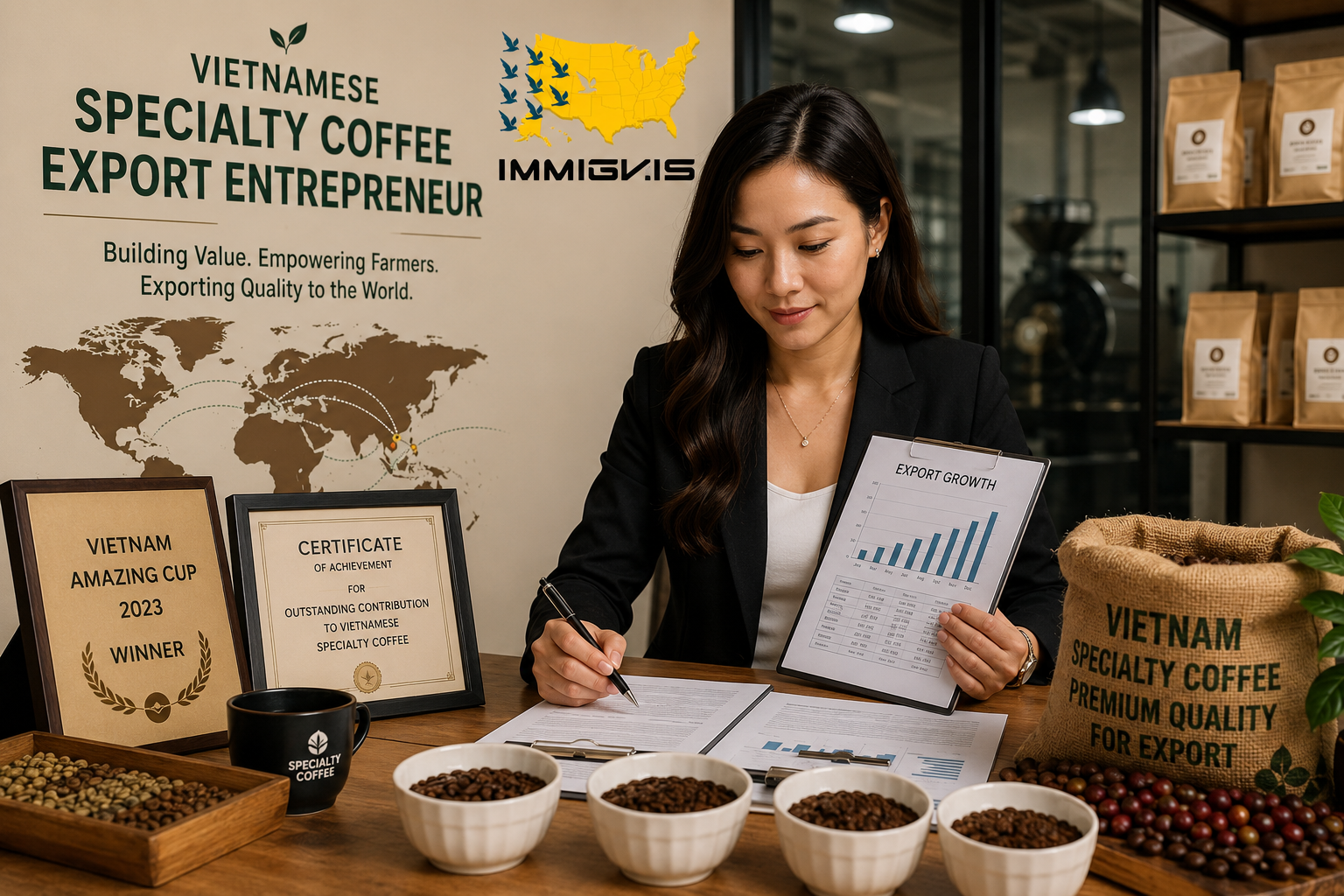
How a Vietnamese founder moved coffee exports from commodity robusta to specialty grade markets by turning export-growth records, cupping scores, trade awards, press coverage, judging roles, farmer impact documentation, and speaking invitations into a USCIS-approved EB-1A record.
Key facts at a glance
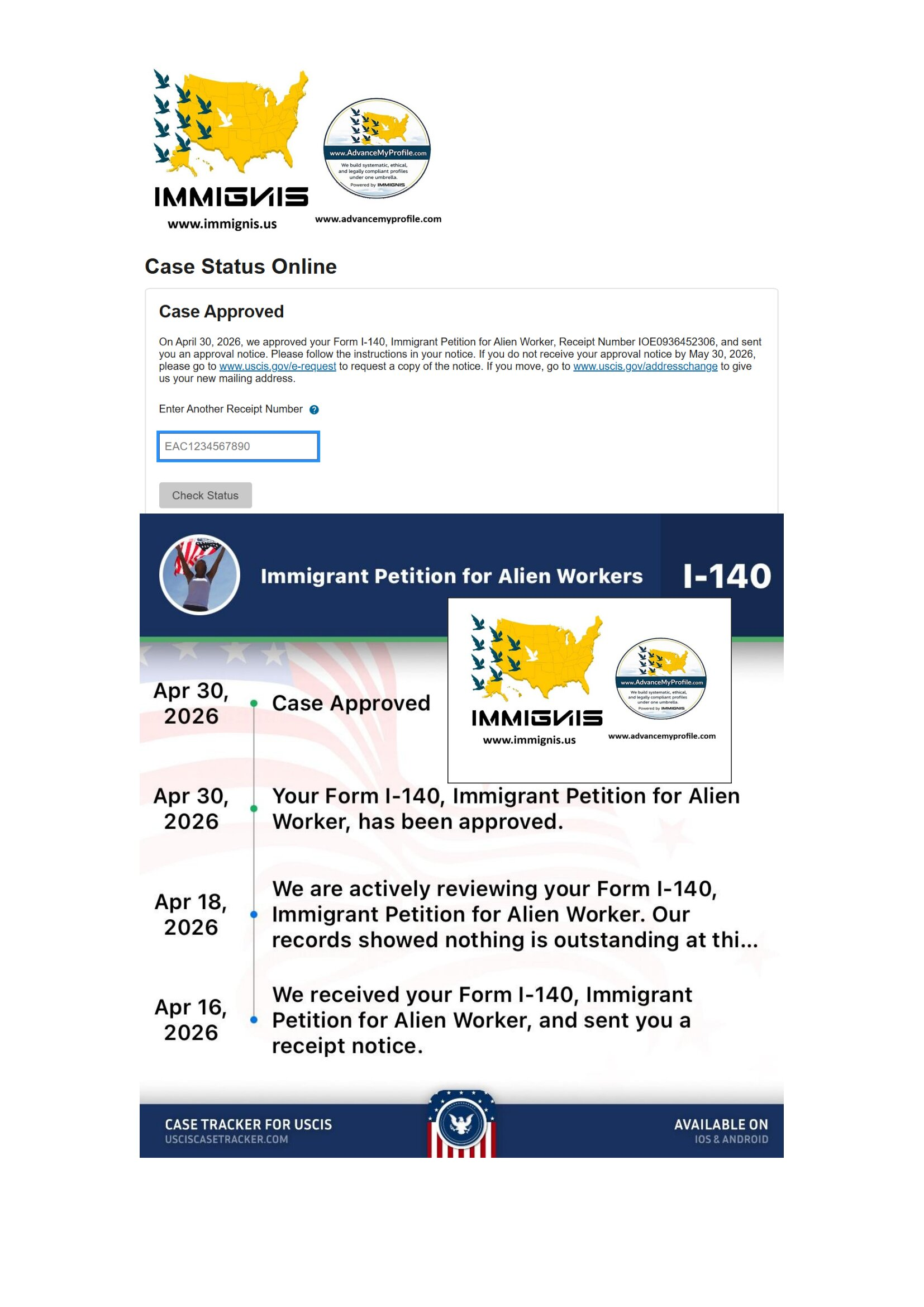
| Petition outcome | Form I-140 approved under EB-1A on April 30, 2026. |
| Professional profile | Vietnamese founder who moved coffee exports from commodity robusta toward specialty-grade markets. |
| Field niche | Specialty coffee value-chain entrepreneurship. |
| Starting weakness | The record looked like a business story, while the field’s real scoreboard lived in cupping scores, buyer trust, trade awards, and specialty-market validation. |
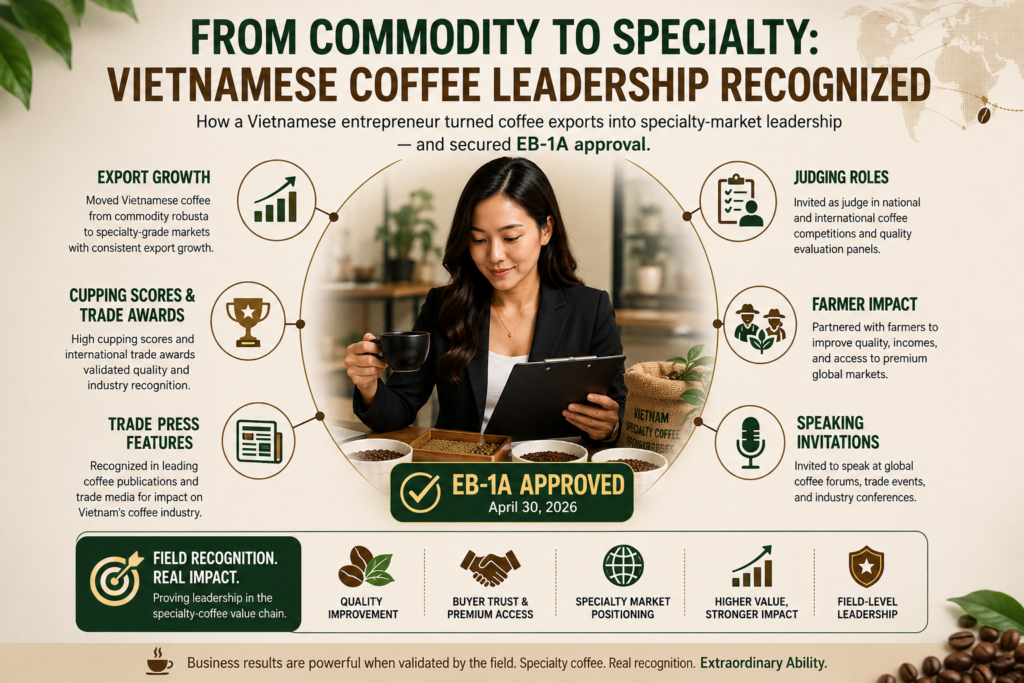
| Profile-building focus | Export growth documentation, cupping score and award records, trade press features, industry competition judging, farmer impact documentation, and speaking circuit. |
| EB-1A criteria supported | Original contributions, commercial success, published material, judging, and leading role. |
| Central issue | Proving field level specialty coffee leadership instead of relying on private sales numbers alone. |
| Approval lesson | Specialty food entrepreneur cases become stronger when business results are tied to field native proof such as quality scores, trade prizes, judging roles, and market impact. |
The approval
On April 30, 2026, USCIS approved the Form I-140 petition of a Vietnamese specialty coffee export entrepreneur whose work helped reposition Vietnamese coffee from low margin commodity trade toward specialty grade export channels.
Inside the coffee industry, the value of her work was easy to understand. Better farm practices, higher cupping scores, stronger buyer relationships, and premium export channels all showed a real change in market position. Outside the industry, however, the story could look like ordinary business growth unless the record explained the field’s own standards of recognition.
For EB-1A, the petition had to prove more than successful entrepreneurship. It had to show extraordinary ability in specialty coffee value chain entrepreneurship, with evidence that her work was recognized beyond her own company and measured by credible industry signals.
That became the center of the case: turning coffee exports, farmer outcomes, cupping records, and trade recognition into an adjudicator-readable record of field-level leadership.
The evidence problem in specialty-coffee entrepreneurship
Specialty coffee entrepreneurship can be difficult to document because much of the strongest evidence is commercial, relationship based, and technical at the same time. Buyers care about quality, origin, consistency, processing, traceability, and cup profile. USCIS, however, needs documents that clearly show recognition, contribution, and standing in the field.
The petitioner’s starting weakness was not lack of achievement. It was lack of an obvious scoreboard. She had helped move Vietnamese coffee into higher value export channels, but an immigration officer would not automatically know why that mattered or how the specialty coffee world measures excellence.
This required a focused field definition. The case was not presented as general export business, food trading, farming, or retail entrepreneurship. It was framed as specialty coffee value chain entrepreneurship: the work of improving quality, connecting producers to premium buyers, and building credible export systems around recognized specialty coffee standards.
That field definition gave the petition a realistic measuring stick. The question was not simply whether the petitioner sold coffee. The question was whether her work helped shift a commodity supply chain toward a recognized specialty market and whether the industry itself treated that shift as meaningful.
Why export growth was only the beginning
It would have been tempting to rely on export volume and sales growth alone. That would have been risky. USCIS could reasonably ask whether revenue reflected ordinary market demand, company resources, seasonal supply, or the petitioner’s specific contribution.
The record therefore treated export growth as a starting point, not the conclusion. The petition had to show how that growth was achieved, what made it unusual in the Vietnamese coffee context, and why specialty buyers, trade bodies, competitions, and industry observers recognized the work.
The strongest evidence came from disclosure-safe export growth documentation, cupping score and award records, buyer and farmer-impact materials, trade-press features, speaking engagements, and judging activity within coffee competitions and industry programs.
That distinction changed the case. Instead of asking USCIS to accept a private business success story, the petition translated the success into the coffee industry’s own language: quality improvement, specialty-grade validation, market access, traceability, and independent recognition.
Cupping score and trade-prize records became the backbone of the case
In some EB-1A fields, strong evidence appears in patents, citations, or peer-reviewed publications. In specialty coffee, some of the most native forms of acclaim appear through cupping scores, quality competitions, trade prizes, buyer recognition, and selection by respected fairs or specialty buyers.
The petition used those signals carefully. The goal was not to claim that every good score or trade mention automatically proved extraordinary ability. The goal was to show that the petitioner’s work had helped produce coffee recognized under standards the field itself takes seriously.
Good evidence did not say only that she “exported specialty coffee.” It explained what changed: quality control improved, processing became more consistent, farmer lots were positioned for premium evaluation, cupping results helped validate quality, and export channels moved beyond commodity pricing.
Those materials gave USCIS a way to understand why specialty coffee recognition matters. They also helped show that the petitioner’s work was not just private sales activity, but a documented contribution to a higher value segment of Vietnam’s coffee economy.
Leading role evidence had to show value chain authority, not business ownership alone
Founders often assume that owning a company proves a leading role. For EB-1A, ownership alone is not enough. The petition had to show that the petitioner personally directed important work in the specialty-coffee value chain and was not merely attached to a successful trading company.
The record documented her authority over export strategy, quality positioning, buyer relationships, producer coordination, trade show representation, and premium market development. It showed how she made decisions that affected both commercial outcomes and field recognition.
That evidence helped separate real value chain leadership from ordinary business operation. The case showed that her role influenced how Vietnamese specialty coffee was sourced, evaluated, presented, and sold into higher value channels.
For entrepreneurs, this distinction matters. A company profile may show revenue. An EB-1A petition must prove the individual’s role in creating the recognized result.
Original contribution in a specialty coffee value-chain case
Original contribution can be difficult in business and food-sector cases because the output is often a market pathway, supply-chain model, quality process, or buyer-development strategy rather than a patent or academic paper.
For this petitioner, the original contribution argument was built around her role in moving Vietnamese coffee upmarket. The evidence showed how she helped producers and buyers connect through quality documentation, specialty evaluation, traceability, and export positioning that improved the value of coffee lots traditionally treated as commodity product.
That mattered because USCIS looks for contributions of significance, not routine business performance. The evidence had to show that her work was recognized as meaningful by the field, not merely profitable for one company.
The petition did not claim that she invented specialty coffee or transformed an entire national industry alone. It made a narrower and more defensible point: within specialty coffee value chain entrepreneurship, her work had helped create a documented bridge between Vietnamese producers and premium international markets.
Published material and trade press visibility
The original profile had limited public visibility because food and trade press often focus on roasters, cafes, exporters, or national production trends rather than the entrepreneurs building quality pathways behind the scenes.
Trade-press features, coffee-industry commentary, event coverage, interviews, and speaking records helped make the petitioner visible to a reader outside the coffee world. They showed that her work had become part of a broader conversation about Vietnamese specialty coffee, export quality, and value chain upgrading.
The petition treated published material as supporting evidence, not decoration. The most useful public evidence connected her name to specialty-coffee exports, quality improvement, farmer impact, or market-building work rather than generic business promotion.
Commercial success and business metrics in the right context
Commercial success evidence can help entrepreneurs, but it must be presented carefully. Sales numbers, export volumes, and growth percentages do not automatically prove extraordinary ability unless they are tied to the right market and supported by reliable context.
In this case, commercial evidence was organized around relevant comparators: specialty-grade export growth, premium buyer access, repeat purchasing, recognized product quality, and movement from commodity pricing toward higher-value specialty channels.
That context helped show that the petitioner’s business results reflected more than ordinary trading activity. They reflected market recognition for a specialized value chain strategy that made Vietnamese coffee more competitive in a premium field.
Judging and industry recognition
Judging evidence can be especially useful in specialty coffee because the field has its own systems for evaluation. Competitions, cupping panels, trade awards, and selection committees can reflect serious professional trust when the role is properly documented.
The petition used industry-competition judging and related recognition to show that the field trusted the petitioner’s taste, market judgment, and technical understanding. This helped distinguish her from a founder who only sells products to a professional whose opinion is relied upon by others in the industry.
Farmer-impact documentation also strengthened the case. It showed that the petitioner’s work did not stop at buyer acquisition. It helped improve how producers prepared, positioned, and benefited from specialty grade export opportunities.
How the EB-1A criteria worked together
The petition did not depend on one perfect document. It worked because multiple forms of evidence pointed in the same direction and supported one clear theory: the petitioner had become a recognized specialty coffee value-chain entrepreneur, not just a successful exporter.
- Original contributions: Cupping records, farmer impact documentation, export quality evidence, and expert support showed that her work helped move Vietnamese coffee into higher-value specialty channels.
- Commercial success: Export-growth documentation and premium-market records showed measurable business results when placed in the context of specialty coffee value creation.
- Published material: Trade-press features, coffee-industry commentary, and speaking visibility made her work legible beyond private company records.
- Judging: Competition and evaluation roles showed that the field trusted her professional judgment within specialty coffee.
- Leading role: Company, buyer, and value-chain records showed that she personally directed the strategy behind sourcing, quality positioning, export development, and market access.
The strongest part of the record was coherence. The case did not drift into generic entrepreneurship, food trading, or broad export activity. It stayed focused on how the petitioner advanced a defined specialty-coffee niche.
The final merits argument
At the final merits stage, the petition had to show more than satisfaction of individual criteria. It had to demonstrate that, taken together, the evidence established sustained acclaim and extraordinary ability in the petitioner’s field.
The argument centered on field-native validation rather than revenue alone. The petitioner was not presented merely as a business owner who sold more coffee. She was presented as a value chain entrepreneur whose work had been validated by quality scores, trade recognition, buyer demand, industry visibility, and professional trust.
The final record showed that her expertise had been recognized through export performance, specialty-quality validation, trade-press attention, judging activity, farmer-impact evidence, and leadership in premium-market development.
That is why the case was stronger than a file built around business growth alone. It told USCIS what the specialty coffee field values, then showed where the petitioner stood inside that field.
Why the approval mattered
The approval mattered because it showed how a business case can become a strong EB-1A case when the evidence is tied to a real professional field and not left as a general success story.
For this Vietnamese entrepreneur, the petition did not try to present coffee exports as glamorous by exaggeration. It showed the concrete value of moving product from commodity markets into specialty channels where quality, traceability, cupping validation, and buyer trust determine standing.
The approval confirmed the central lesson of the case: business metrics matter most when they are translated into the field’s own recognition system. In specialty coffee, that system includes cupping results, trade awards, buyer trust, competition roles, and documented value chain impact.
Lessons for specialty food founders and export entrepreneurs
This case is useful for specialty-food founders, export entrepreneurs, agribusiness leaders, trade strategists, coffee professionals, and value-chain builders whose strongest achievements are commercial but not easily understood by a non-specialist reader.
A strong record usually begins with the following questions:
- Can your export growth be documented without exposing sensitive buyer or pricing details?
- Can quality scores, awards, certifications, or industry evaluations show that your product or process meets respected field standards?
- Do buyers, farmers, cooperatives, trade bodies, or industry experts have a basis to validate your contribution?
- Have coffee publications, trade events, conferences, or competitions recognized your work or invited your participation?
- Can your business success be connected to original value-chain work rather than ordinary buying and selling?
When those questions are answered with documents, a business story becomes much easier for USCIS to evaluate. That is the difference between private commercial success and a petition-ready EB-1A record.
Frequently asked questions
Can a specialty coffee entrepreneur qualify for EB-1A?
Yes. A specialty coffee entrepreneur may qualify for EB-1A if the evidence shows sustained acclaim and extraordinary ability in a clearly defined field, such as specialty coffee value-chain entrepreneurship, export development, or premium market positioning.
Can business metrics support an EB-1A entrepreneur case?
Yes, but they should be presented with context. Export growth, sales volume, premium pricing, buyer demand, and repeat purchasing can support the case when connected to field recognition, market impact, and the petitioner’s personal role.
Do cupping scores or coffee awards help an EB-1A petition?
They can help because they reflect the specialty-coffee field’s own evaluation system. Cupping scores, trade prizes, and recognized selections may support original-contribution, commercial-success, or acclaim arguments when properly documented.
How can farmer impact evidence help a specialty-coffee EB-1A case?
Farmer-impact evidence can show that the petitioner’s work had significance beyond private sales. It may document improved quality practices, premium access, better positioning for producers, or stronger export pathways for farming communities.
Can judging coffee competitions support EB-1A?
Yes. Judging roles in specialty-coffee competitions, cupping panels, trade awards, or industry selection programs can support the EB-1A judging criterion when the record shows that the petitioner was invited to evaluate the work or products of others in the field.
Can Immignis and Advance My Profile help specialty-food entrepreneurs build EB-1A evidence?
Immignis and Advance My Profile help specialty-food founders, export entrepreneurs, agribusiness professionals, and value-chain leaders define a clear field niche, organize business metrics, document recognition, and build a credible EB-1A evidence record.
Build an EB-1A record around specialty market leadership and field native proof
Many export entrepreneurs and specialty food founders create real market change, but their strongest proof stays inside sales records, buyer relationships, product evaluations, and trade events. Those materials can support EB-1A when they are organized around a defined field and explained through the industry’s own recognition system.