

EB-2 NIW vs PERM: Why Thousands Are Ditching Employer Sponsorship in 2026
Last Updated on August 6, 2026 by Amelia
EB-2 NIW vs PERM has become a critical decision for skilled professionals weighing how to pursue a U.S. green card. The choice between an EB-2 PERM based filing and an EB-2 National Interest Waiver has shifted meaningfully over the past two years. Pursuing an EB-2 NIW without employer sponsorship is no longer the niche path it once was it has become the default strategy for a growing segment of engineers, researchers, founders, and clinicians who want control over their own immigration timeline. The reasons are practical: PERM labor certification delays have stretched into multi year territory, employer dependency has become riskier in industries with frequent layoffs, and the NIW’s self-petition structure offers an exit from both problems.
This guide walks through how the two pathways actually differ, where the strategic tradeoffs lie, and which path makes sense for which type of applicant under current conditions.
The Two Pathways at a Glance
The EB-2 visa preference category covers professionals with advanced degrees and individuals with exceptional ability. Within this category, there are two ways to reach a green card:
- EB-2 with PERM labor certification the employer-sponsored route. The U.S. employer must conduct a test of the labor market, obtain a certified PERM from the Department of Labor, and then file an I-140 on the worker’s behalf.
- EB-2 National Interest Waiver (NIW) the self-petition route. The worker files Form I-140 directly with USCIS, asking for the PERM step to be waived because the work serves a national interest.
Both lead to the same green card. The path to get there, the level of control the applicant has, and the way credentials are evaluated differ substantially.
What PERM Labor Certification Actually Involves
PERM is not a single document; it is a structured process administered by the Department of Labor that an employer must complete before a worker can be considered for an EB-2 green card under the standard track. The process has three substantive stages.
1. Prevailing wage determination. The employer files Form ETA-9141 to establish the appropriate wage for the position, in the specific geographic area, at the relevant skill level. This stage has its own backlog.
2. Test of the labor market. The employer must run a series of recruitment steps – internal postings, newspaper ads in certain cases, electronic job postings, and additional steps depending on the role’s classification – to demonstrate that no qualified U.S. workers are available for the position.
3. PERM application (ETA-9089). Once recruitment is complete and properly documented, the employer files the PERM with DOL. If certified, the employer can then file Form I-140 with USCIS.
Historically, the PERM process took roughly six to twelve months. In current conditions, end-to-end PERM timelines have stretched well beyond that, with audits and review cycles adding further unpredictability. PERM is also tied to a specific job, employer, location, and wage level – meaning material changes to any of these can require the process to restart.
What Makes EB-2 NIW Structurally Different
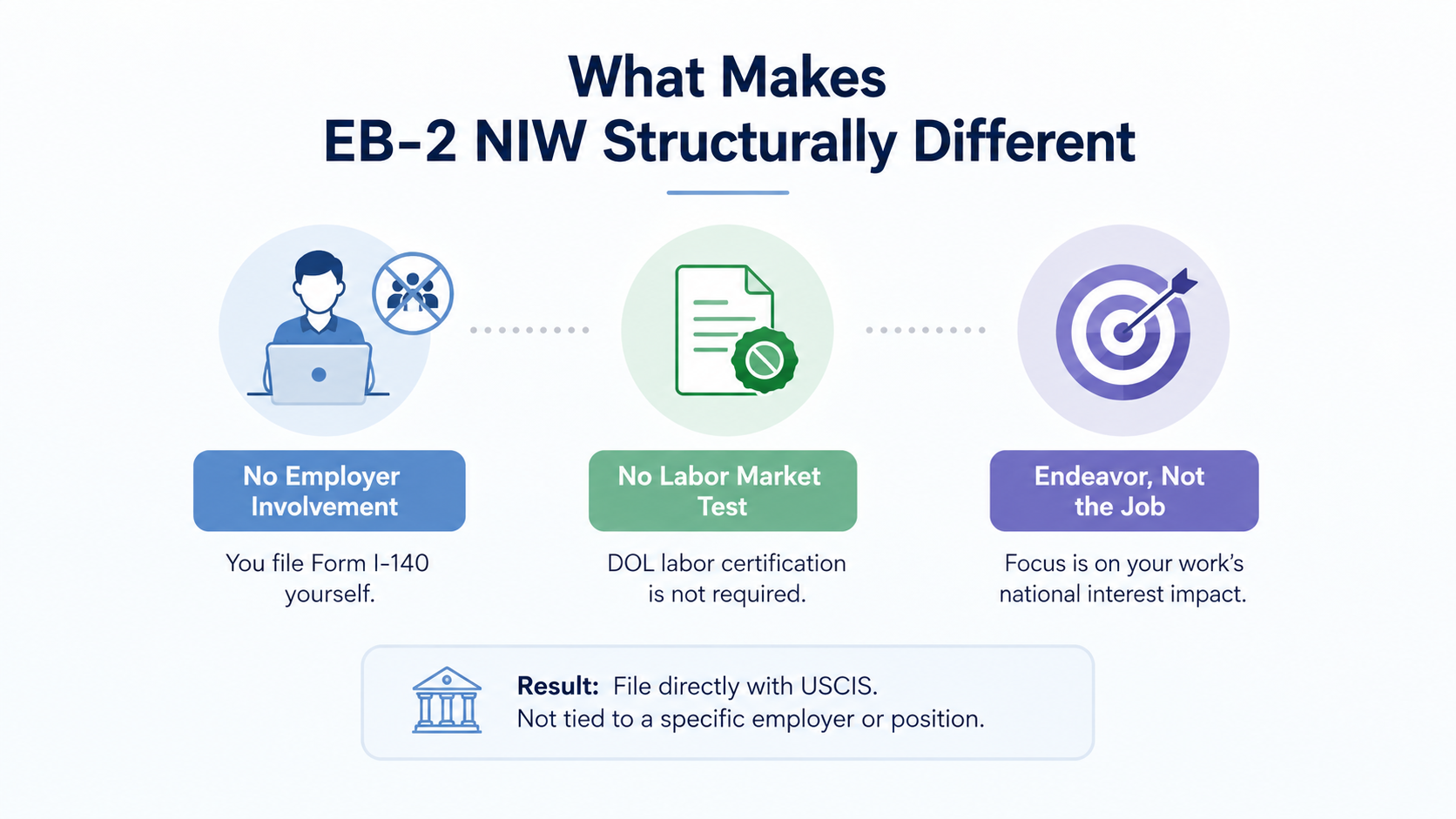
The National Interest Waiver allows USCIS to waive both the job offer requirement and the labor certification not because the law makes a categorical exception, but because the worker has demonstrated, under the three-prong test established in Matter of Dhanasar, that their proposed work serves the national interest of the United States.
Three structural differences follow from that:
- No employer involvement is required. The worker files Form I-140 themselves, signs as both petitioner and beneficiary, and controls the entire petition.
- No labor market test. The DOL recruitment process is bypassed entirely. There is no prevailing wage determination, no advertising, no audit risk on that front.
- The endeavor, not the job, is the focus. Where PERM asks whether a U.S. worker is available for a specific job, NIW asks whether the applicant’s work serves the national interest a fundamentally different evidentiary question.
The result: an NIW petition is filed directly with USCIS, evaluated on its own merits, and not bound to a particular employer or position.
NIW vs PERM: A Decision Frame Comparison
The structural picture below summarizes the practical differences before getting into timelines and risk profiles.
| Factor | EB-2 with PERM | EB-2 NIW |
| Who files | U.S. employer | The applicant directly |
| Job offer required | Yes | Waived |
| DOL labor certification | Required | Not required |
| Tied to a specific job | Yes | No |
| Tied to a specific employer | Yes | No |
| Standard of proof | Labor market unavailability | National interest endeavor (Dhanasar) |
| Time to I-140 filing | 15–20 months for PERM stage (current) | Filed immediately |
| Job-change flexibility | Limited; AC21 portability after specific milestones | High; not tied to a sponsor |
| Suitable for entrepreneurs | Difficult; requires employer | Yes; designed to accommodate |
This framing is the starting point, not the conclusion. The next sections address the timeline math, the forces driving the shift, and the situations where each pathway remains the right answer.
Where the 2026 Timeline Math Lands
Current processing times have widened the gap between the two pathways significantly.
PERM track. The Department of Labor’s PERM backlog has extended PERM stage processing to roughly 15-20 months in many cases. Layered on top of that is the I-140 adjudication stage, which adds another several months at USCIS unless the employer pays for premium processing. For applicants from oversubscribed countries, the wait then continues through visa bulletin movement before adjustment of status or consular processing.
NIW track. The applicant files Form I-140 directly. Standard processing currently runs in a comparable range to other I-140 categories, depending on service center workload. Premium processing is available at the same fee. The PERM stage is eliminated entirely.
For applicants in fields where the work readily supports a national-interest argument, removing the PERM stage can shorten the path to a filed I-140 by more than a year – a meaningful difference when capturing a priority date is part of the strategy.
Cost and Procedural Responsibility
The cost structure of the two pathways differs in ways that matter beyond headline filing fees.
PERM track. By regulation, the employer bears the costs of the PERM process – the prevailing wage determination, recruitment advertising, attorney fees for the PERM stage, and the PERM filing itself. The worker generally cannot be asked to reimburse these expenses. The employer also covers the I-140 filing fee. The applicant typically pays only for the adjustment of status stage and related costs (medical exam, biometrics, dependent filings).
This cost structure is part of why PERM sponsorship is selective – employers calculate the total investment per worker and apply internal eligibility criteria accordingly.
NIW track. The applicant pays for everything: attorney fees, the I-140 filing fee, premium processing if used, and the adjustment of status stage. There is no labor certification cost because there is no labor certification. Documentation costs – obtaining evidence, expert letters, translations – also fall on the applicant.
The dollar comparison is not necessarily what most applicants imagine. Self-petitioners take on more direct out-of-pocket expense, but they gain control over timing, evidence strategy, and filing decisions – and independence from internal employer eligibility criteria that may exclude them from PERM entirely.
Procedural ownership. A subtler difference: in PERM, the employer’s immigration counsel runs the case. The worker is the beneficiary, not the petitioner, and many strategic decisions are made by the employer’s legal team. In NIW, the worker is the petitioner. They choose their own counsel, set their own strategy, and own the case file directly. For applicants who have felt sidelined in employer-led processes, this autonomy is itself a meaningful benefit.
Why So Many Professionals Are Choosing Self-Petition
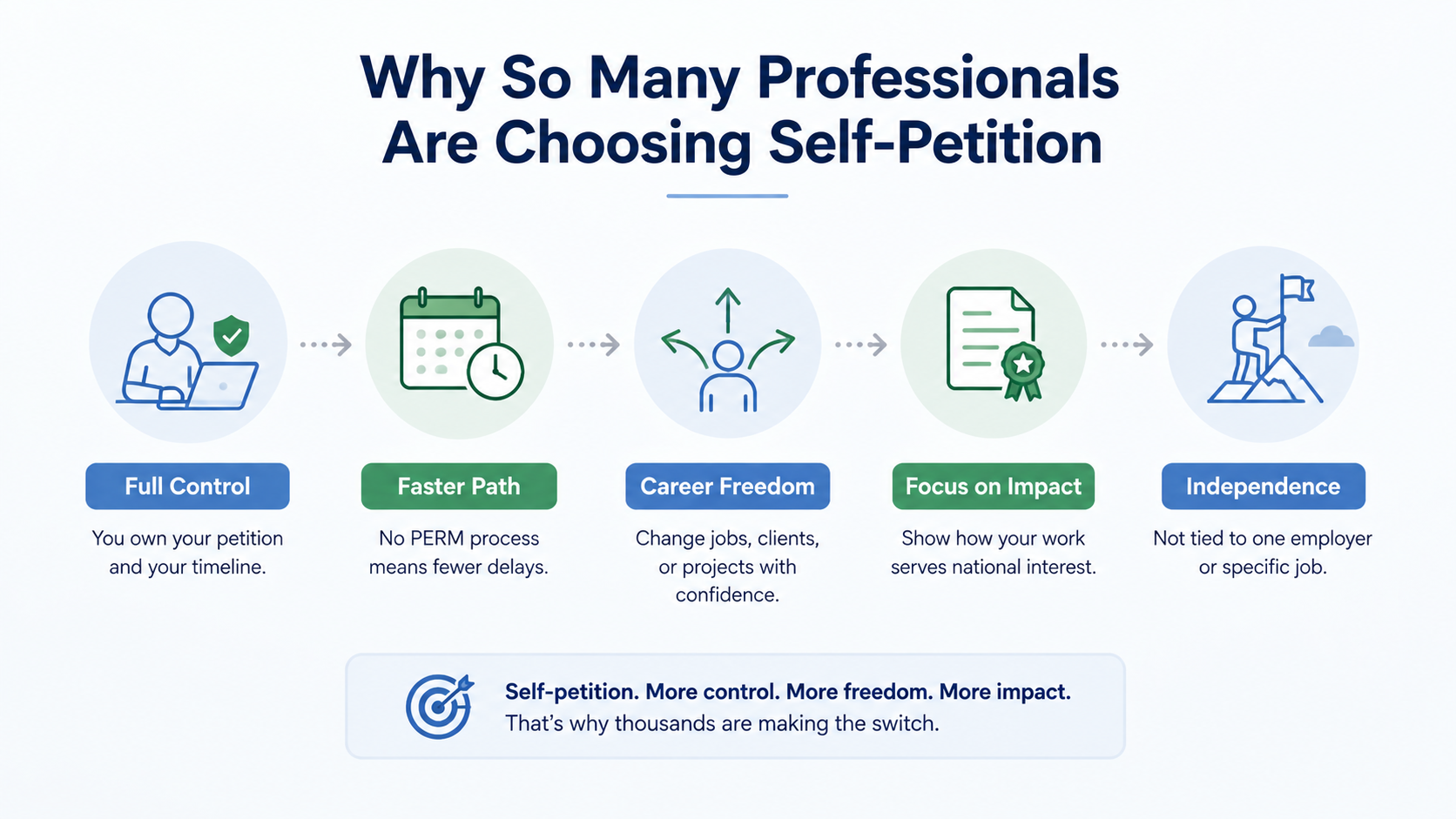
Several forces have converged to push EB-2 NIW from “alternative” to “first choice” for a large slice of qualified applicants.
Layoff exposure in tech and other sectors. Workers on employer-sponsored tracks learned in recent cycles that a layoff can effectively reset the immigration clock. PERMs filed by one employer do not transfer to another. An approved I-140, once unrevoked for the required period, can preserve a priority date, but the new employer typically has to start a fresh PERM unless specific portability conditions are met. The NIW removes this exposure because the petition belongs to the worker.
Restart of PERM at major employers with conditions. Some large employers that paused PERM filings during recent cost cutting cycles are restarting them in 2026, but with strict internal eligibility criteria. Performance ratings, role levels, and tenure requirements exclude many otherwise qualified workers. For employees who do not meet those internal thresholds, the NIW becomes the practical option.
Career optionality. Founders and consultants cannot reasonably be sponsored through PERM by their own companies, and even W-2 employees increasingly want the ability to change roles, start a venture, or move between firms without resetting their green card progress. NIW supports this in a way PERM structurally cannot.
Earlier priority date capture. For applicants from countries with backlogs, locking in a priority date is a strategic act in itself. The NIW pathway allows that priority date to be filed substantially earlier than a PERM dependent path can.
Not sure which pathway fits your case? Get a free immigration strategy assessment from Immignis and find out where your record lands before committing to either route.
When PERM Still Makes Sense
The NIW is not the right answer for every applicant. PERM remains the cleaner path in several scenarios:
- Roles that are difficult to frame under Dhanasar. Positions that are valuable to a specific employer but hard to argue as nationally significant – many corporate, operational, or commercial roles are typically better served by PERM.
- Workers whose evidence record is genuinely thin. NIW is not a low bar pathway. Applicants without publications, patents, leadership roles, deployed work, or other credible evidence of capability often find PERM more achievable.
- Employers willing to sponsor early and invest in the process. When an employer is committed and capable of filing PERM efficiently, the predictability of the standard track has value.
- Standard professional roles with strong wage and credential profiles. PERM’s evidentiary requirements are simpler meeting EB-2 educational thresholds and a qualifying job even if the timeline is longer.
Choosing PERM does not preclude an NIW filing later. Many applicants pursue both in parallel where the facts support it.
NIW for H-1B Professionals
H-1B holders face a particular structural problem: the visa is dual intent but time limited, and most workers need a permanent residency path well before their authorized stay caps out. The NIW offers several advantages specifically for this population.
The H-1B itself does not require the worker to remain in the same role indefinitely, but PERM does tie green card progress to a specific position. NIW removes that tie. An H-1B engineer who plans to move into a startup, change subfields, or take a sabbatical can still pursue an NIW based on the broader body of their work and intended endeavor.
For H-1B workers whose employer has not sponsored PERM, or has paused sponsorship, the NIW is often the only pathway that begins immediately rather than waiting for employer action. It also allows the priority date to be filed without the worker having to negotiate sponsorship a meaningful piece of leverage in current labor markets.
The transition mechanics are routine: an approved NIW does not affect H-1B status, and the worker can continue on H-1B while waiting for visa availability and adjustment of status.
NIW for Indian and Chinese Applicants
For applicants subject to per-country EB-2 caps, the calculus has additional dimensions.
The EB-2 India category remains heavily oversubscribed, with retrogression measured in years. The April 2026 visa bulletin showed an unusually large forward movement in the EB-2 India final action date driven in part by horizontal spillover under INA §202(a)(5), which redirects unused Rest of World visa numbers to oversubscribed countries when consular and PERM processing in other regions falls behind. This kind of movement is unpredictable and can reverse, but it underscores why early priority date capture matters.
For Indian and Chinese applicants, the structural value of NIW is straightforward: the petition can be filed years earlier than a PERM-dependent path would allow, locking in a priority date and creating optionality if visa numbers shift. The NIW does not shorten the visa bulletin wait, but it does shorten everything that comes before it.
The strategic principle: in a backlogged category, the earliest defensible filing is almost always the right move.
Common Pitfalls in the NIW vs PERM Decision
A few patterns appear repeatedly when applicants choose poorly between these pathways:
- Assuming NIW is “easier.” It is faster and more flexible, but the evidentiary requirements under Dhanasar are real. Applicants whose records would not meet them are better off with PERM, even if slower.
- Filing NIW with a job-centric framing. Self-petitioning with a proposed endeavor that reads like a job description undercuts the entire premise of the waiver.
- Waiting for employer sponsorship that may not come. Time spent waiting for a sponsor who has not committed is time the worker could be using to file an NIW and capture a priority date.
- Treating the decision as either/or when both are possible. Applicants with strong cases can pursue NIW while their employer pursues PERM, hedging against either timeline.
How to Self-Assess Whether NIW Is Realistic for You
Before pursuing an NIW, a candid self-assessment helps avoid wasted time and filing risk. The questions below approximate what an experienced attorney evaluates in an initial review.
On the work itself:
- Can the work be plausibly framed as addressing a documented national priority, sector-wide problem, or federal agenda?
- Does the impact extend beyond a single employer, client, or location?
- Is there a clear mechanism by which the work, if successful, would benefit the United States?
On the evidence:
- Are there publications, citations, patents, or measurable deployments tied to the work?
- Are there potential expert letter writers who can credibly speak to the field-level impact of the work?
- Is there evidence of implementation collaborators, funding, contracts, or operational use of the work?
On the petitioner’s positioning:
- Does the educational and professional track record align with the proposed endeavor?
- Is there a credible mechanism – current role, founded entity, ongoing collaborations – through which the endeavor will actually be advanced in the United States?
- Has the work received recognition outside the petitioner’s immediate organization?
A “no” or “uncertain” to most of these is not necessarily disqualifying, but it signals that the case needs further development before filing. A consistent pattern of “yes” responses across the three categories typically indicates a viable filing, subject to attorney review of the specifics.
The fastest way to find out where your case actually sits is a structured initial review with someone who evaluates these cases regularly. The result is usually clear within a single conversation.
Frequently Asked Questions
Can I get an EB-2 green card without employer sponsorship?
Yes. The EB-2 National Interest Waiver allows qualified applicants to self-petition by demonstrating, under the Dhanasar framework, that their proposed work serves the national interest of the United States. The labor certification and job offer requirements are waived in successful filings.
Is EB-2 NIW better than PERM?
It depends on the situation. NIW is faster, applicant-controlled, and not tied to a sponsor – strong advantages for many. PERM is typically simpler in evidentiary terms and works well for standard professional roles with committed employer sponsorship. The right choice depends on the applicant’s record and the nature of the work.
How long does PERM take in 2026?
Current PERM-stage processing at the Department of Labor is running roughly 15-20 months in many cases, before I-140 adjudication begins. Audits and recruitment-step delays can extend this further. The NIW skips the PERM stage entirely.
Can I switch jobs during an NIW?
Yes, with appropriate care. Because the NIW is not tied to a specific employer, a job change does not invalidate the petition provided the new work remains consistent with the proposed endeavor on which the petition was based. Material changes to the underlying endeavor warrant a strategic review.
Is self-petition safer than employer sponsorship?
It depends on which risk is being weighed. Self-petition removes employer dependency risk: layoffs, sponsorship withdrawal, role changes. It introduces a different risk – the applicant must independently meet the Dhanasar standard. For applicants who clearly meet that standard, self-petition is structurally more resilient.
Does NIW avoid labor certification?
Yes. The waiver of the labor certification requirement is the central feature of the National Interest Waiver. The Department of Labor is not involved in NIW petitions.
Can I pursue NIW and PERM at the same time?
Yes. Pursuing both in parallel is common and can be a smart hedge when the facts support both pathways. Approval of one does not affect the other; the applicant ultimately uses whichever pathway produces a usable filing first.
Will the priority date from an approved PERM transfer to an NIW?
Yes. A priority date established by an earlier I-140 can be retained and used in a later NIW filing. This is one reason early filings have value they preserve optionality even if the strategy later changes.
Do I need to leave my current employer to file an NIW?
No. Many NIW applicants file while continuing in their current position. The NIW is not an exit from employment it is independence from employer dependent immigration processing. The current job often serves as evidence supporting the proposed endeavor.
If you are weighing whether self-petition or employer sponsorship is the right structure for your case, an expert-led assessment is the most efficient way to compare both pathways against your specific record. Book a NIW vs PERM case review with Immignis to get a strategic comparison built around your evidence, timeline, and country of chargeability.



Comment
EB-2 NIW Prong 3 Waiver Benefit: The Critical Argument
August 21, 2026 - 8:29 am[…] professionals operating as their own entity, the impracticality argument is at its strongest. The PERM process requires a US employer to sponsor the petition. For someone who is that employer who holds ownership and […]