

The Dhanasar Framework Explained: Why Every EB-2 NIW Case Lives or Dies Here
Every EB-2 National Interest Waiver petition is evaluated under a single governing standard: the three-prong test established by the AAO in Matter of Dhanasar, the 2016 precedent decision that replaced the previous NYSDOT framework. Understanding the Dhanasar framework for EB-2 NIW is not optional background knowledge. It is the operative logic of every approval, denial, and RFE in this category. Petitions that fail do so because they do not satisfy one or more of the three prongs with sufficient evidence. Petitions that succeed do so because they address each prong as a distinct analytical argument, sequenced deliberately and supported throughout.
This guide explains what each prong actually requires, how the three prongs interlock, and why strong credentials alone are not sufficient to carry a petition that has not been structured around the framework.
What Is Matter of Dhanasar and Why It Matters
Before 2016, NIW petitions were evaluated under the standard established in Matter of New York State Department of Transportation (NYSDOT, 1998). That framework required petitioners to show that their field was of substantial intrinsic merit, that the benefit would be national in scope, and that the national interest would be adversely affected if labor certification were required a counterfactual standard that was difficult to apply consistently.
In 2016, the AAO replaced NYSDOT with Dhanasar. The shift had practical consequences:
-
- The new standard focuses on the prospective benefit of the proposed work forward looking rather than backward looking
-
- It removed the need to prove that national interest would be ‘adversely affected’ by requiring certification, replacing it with a more flexible balancing test
-
- It opened the pathway more explicitly to entrepreneurs, founders, and self-petitioners for whom a traditional job offer is structurally impractical
-
- It organized the analysis into three distinct prongs, making the evidentiary structure more explicit and auditable
The result is a framework that is more accessible in structure but no less demanding in evidence. The three prongs each require independent argumentation and cannot substitute for one another.
The EB-2 Threshold: What Must Be Established First
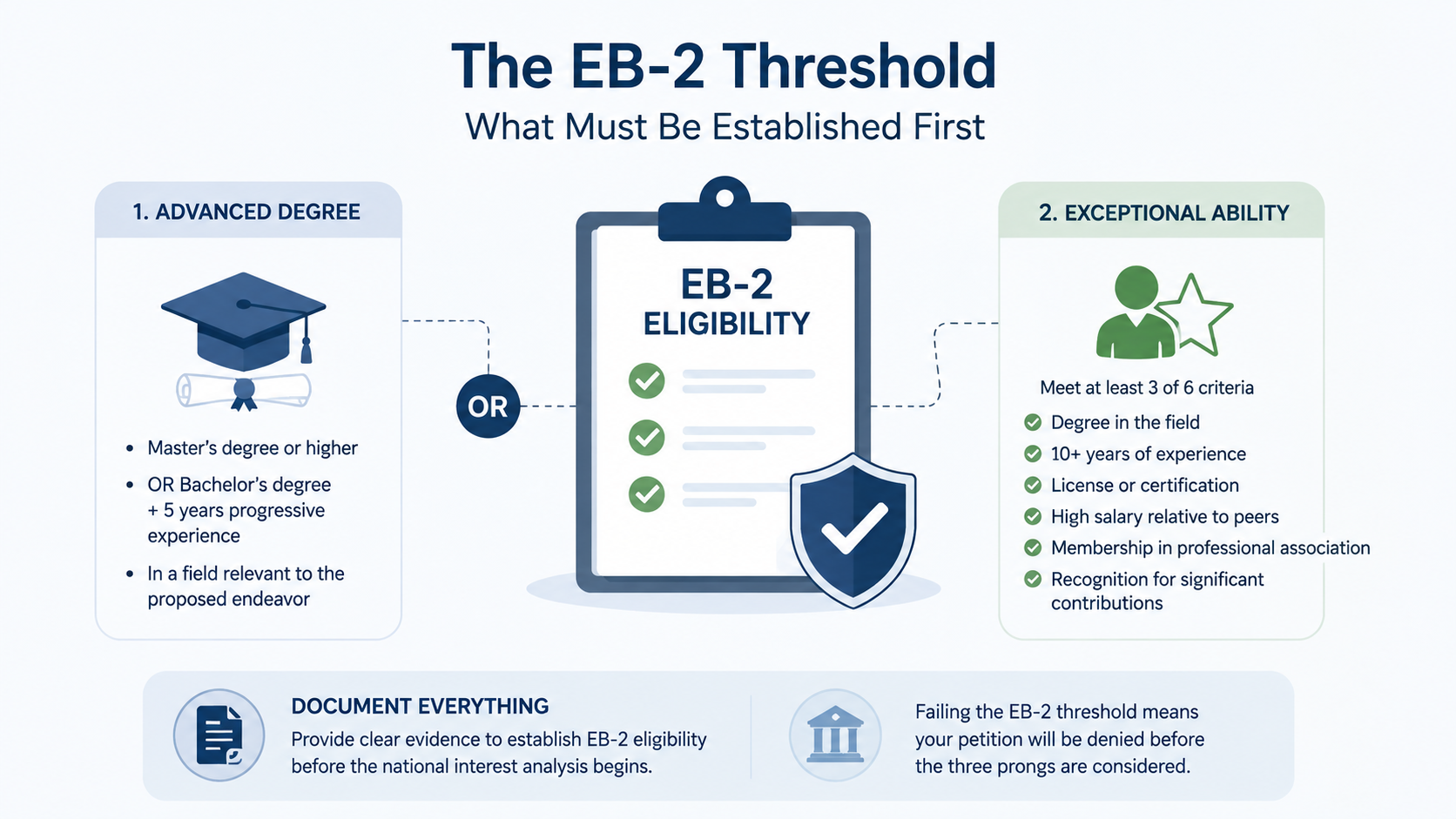
Before the three Dhanasar prongs are even evaluated, USCIS requires the petitioner to establish that they qualify for EB-2 classification. This is a threshold issue failing it means the petition is denied before the national interest analysis begins.
There are two routes to EB-2 eligibility:
-
- Advanced degree. A U.S. master’s degree or higher, a foreign equivalent, or a U.S. bachelor’s degree plus five years of progressive post baccalaureate professional experience in the specialty. The degree and experience must be in the field relevant to the proposed endeavor.
-
- Exceptional ability. For applicants without the requisite advanced degree, exceptional ability in the sciences, arts, or business can be demonstrated by meeting at least three of six defined criteria: a degree related to the area of claimed exceptional ability, letters documenting ten or more years of full-time experience, a license or certification, a high salary relative to peers, membership in a professional association, or recognition by peers or employers for significant contributions.
The threshold must be documented explicitly degree certificates, transcripts, experience letters, licenses. Officers do not infer it from the Prong 2 evidence. Petitions that treat EB-2 eligibility as self-evident without dedicated documentation risk denial on the threshold before the substantive analysis begins.
Prong 1: Substantial Merit and National Importance
The first prong evaluates the proposed endeavor itself not the petitioner’s credentials, not their past record, not their employer. The question is: does the work that this person proposes to do in the United States have genuine value, and does its potential impact reach the national level?
These are two distinct sub-requirements that must be argued separately.
Substantial Merit
Substantial merit is established by showing that the proposed work has recognized value within its own field. The standard is not extreme USCIS does not require the work to be the most significant contribution in history, only that it is meaningful and grounded in genuine expertise. Notably, the Dhanasar decision itself states that merit may exist even without immediate or directly quantifiable economic impact: research that advances human knowledge qualifies.
Evidence supporting substantial merit typically includes expert testimony that the work addresses a genuine problem in the field, technical benchmarks or performance data demonstrating quality, citations to or peer recognition of the work, demand signals (contracts, collaborators, clients), and documentation that the methodology is sound and the approach viable.
National Importance
National importance is the harder requirement and the one most petitions fail. The question is whether the work’s potential benefit extends to a national level beyond the petitioner’s current employer, beyond a single city or region, and beyond the direct beneficiaries of the immediate project.
Three elements typically establish national importance:
-
- A documented federal priority anchor. Connecting the proposed work to a specific government agency’s strategy, a legislative framework, or an identified national need transforms a private claim into an argument rooted in documented public interest. The anchor must be real and current not a generic reference to the importance of the general field.
-
- Portability of impact. The benefit must extend beyond one employer. Methods, frameworks, technologies, or policies that other organizations can adopt demonstrate that the work’s value travels beyond a single institution.
-
- Quantified or credibly projected reach. Even rough estimates, supported by third-party data, that describe who will benefit, by how much, and across what scale are more persuasive than unqualified assertions of importance.
What doesn’t work: “This work is important because AI is a national priority.” (Field importance, not specific contribution.)
What works: “To develop federated learning protocols for privacy-preserving health data analysis in federally regulated clinical systems, addressing the data-sharing barriers identified in NIH’s Accelerating Leading Edge Science in HIV initiative. The protocols are structured for open specification adoption by hospital networks beyond the petitioner’s employer.”
The geographic scope question is also worth addressing directly: Dhanasar does not require nationwide geographic impact. A locally situated project can have national importance if its outputs frameworks, technologies, policy models are replicable or if it addresses needs the federal government has identified as nationally significant.
Prong 2: Well-Positioned to Advance the Proposed Endeavor
The second prong shifts the lens from the work to the person. USCIS asks whether this specific petitioner given their education, experience, track record, and current positioning is credibly capable of executing the proposed endeavor. It is, in effect, the “execution credibility” test.
Two structural errors appear repeatedly in Prong 2 sections:
-
- Listing credentials without connecting them to the specific proposed endeavor
-
- Treating Prong 2 as a biography rather than as an argument about why this person, for this work, at this time
USCIS evaluates Prong 2 along several dimensions.
Education and Specialized Knowledge
Degrees, certifications, and training in the field of the proposed endeavor. The connection must be explicit an engineering degree supporting a proposed AI systems endeavor reads clearly. A degree in an unrelated field, without explanation of how the petitioner’s expertise transferred, raises consistency concerns.
Track Record of Success
Prior work in the same or closely related area that demonstrates the petitioner has done this type of work credibly before. For researchers, this includes publications and citations in the relevant subfield. For practitioners, it includes deployed work, documented outcomes, clients, and case studies. For entrepreneurs, it includes prior ventures, traction metrics, and investor validation.
Recognition by the Field
Independent evidence that the petitioner’s peers regard their work as significant. This includes: invitations to speak at recognized conferences, election to industry boards, membership in standard setting bodies, citations in academic literature, media coverage as a domain authority, and peer awards judged by independent professionals. The key is independence self-generated recognition or recognition from within the petitioner’s own organization is substantially weaker.
Execution Infrastructure
For entrepreneurs and self-petitioners especially, USCIS looks for evidence that the petitioner has the infrastructure to actually carry out the proposed endeavor: collaborators, funding, equipment, organizational structure, partnerships. A compelling proposed endeavor with no visible means of execution invites skepticism under Prong 2.
Recommendation Letters Under Prong 2
Expert letters serve double duty: they can contribute to both Prong 1 (by bridging the petitioner’s work to national-level significance) and Prong 2 (by independently validating the petitioner’s capability and standing). Letters that carry weight are specific, independent, and from sources with no stake in the petitioner’s outcome. Letters that offer general praise from colleagues or supervisors carry minimal evidentiary value.
The critical mismatch to avoid: a proposed endeavor framed as nationally important in a field where the petitioner’s record is entirely in a different area. USCIS will notice the gap between where the petitioner claims they will work and where their actual experience lies.
Prong 3: Why Waiving Labor Certification Benefits the United States
Prong 3 is the most consistently underdeveloped section in NIW petitions and one of the most important. It is not a formality. It is a distinct legal argument with its own required elements.
The labor certification process exists to protect U.S. workers by requiring employers to demonstrate that no qualified American is available for a position before hiring a foreign national. Waiving that process requires USCIS to conclude, on balance, that the national benefit from waiving the requirement outweighs the interest in enforcing it.
Three arguments support Prong 3, and a strong petition typically employs at least two:
Impracticality of the Standard Process
The labor certification process is designed for an employer employee relationship. For self-employed founders, independent contributors, or applicants whose work is inherently not tied to a single employer’s position, securing a job offer and sponsoring a PERM is structurally difficult or impossible. USCIS explicitly recognizes this in the Dhanasar decision. The petition must state and document why the standard PERM process is impractical for this specific petitioner’s proposed endeavor.
National Benefit Outweighs Enforcement
Even when a qualified U.S. worker could theoretically fill a similar role, the petition can argue that this specific petitioner’s contribution is sufficiently unique in its combination of expertise, established relationships, institutional knowledge, or momentum that requiring the labor market test would impose a cost on the national interest without providing meaningful protection. This argument requires specificity what exactly does this petitioner bring that cannot be readily recruited?
Urgency of the Contribution
Time-sensitive work where a multi-year PERM process would materially compromise the execution of the proposed endeavor supports Prong 3. This is particularly relevant in fast-moving fields, federally funded research on tight timelines, or ventures at a critical stage of development where delay would undermine the national interest being served.
The Prong 3 error that most petitions make: stating that the petitioner’s work is important (a Prong 1 argument) and assuming that importance makes the waiver obvious. It does not. Prong 3 requires a separate, explicit argument about why requiring the standard process would work against the national interest in this petitioner’s specific case.
The Final Merits Determination: How the Three Prongs Interlock
The Dhanasar framework is not three independent checklists. The three prongs form a sequential analytical chain that USCIS officers follow in order, and the conclusion at each stage shapes how the next stage is read.
If Prong 1 is weak if the proposed endeavor is vaguely defined or the national importance argument is thin the officer approaches Prong 2 already skeptical of the petitioner’s claimed purpose. Strong credentials in Prong 2 cannot rescue a Prong 1 argument that was never built.
If Prong 2 fails if the petitioner’s record does not credibly connect to the endeavor described in Prong 1 the Prong 3 argument about why waiving certification benefits the U.S. is stranded. The officer has no reason to believe the petitioner will actually advance the nationally important work they describe.
If Prong 3 is absent or formulaic as it frequently is the petition fails even when Prongs 1 and 2 are strong, because the legal question of why the waiver specifically benefits the United States has not been answered.
This is the logic of the “final merits determination.” After all three prongs have been evaluated, USCIS makes an overall judgment about whether, on balance, the petition supports granting the waiver. A petition that is strong across all three prongs creates a coherent case for that overall judgment. One that is uneven across the prongs creates inconsistencies the officer must resolve in the petitioner’s disfavor.
The practical implication: a petition is only as strong as its weakest prong.
The Preponderance of Evidence Standard
NIW petitions must be established by a preponderance of the evidence meaning it must be “more likely than not” that each prong is satisfied. This is a lower standard than clear and convincing evidence or beyond reasonable doubt, but it is not trivial.
What preponderance means practically:
-
- The petition does not need to prove the case with certainty, but the evidence must be credible, specific, and sufficient to tip the scales in the petitioner’s favor
-
- Generic assertions, vague claims, and unsupported characterizations do not satisfy the standard regardless of how many times they appear
-
- Independent, third-party evidence is weighted more heavily than self-generated claims
-
- Evidence that directly addresses the specific requirements of each prong is more valuable than evidence that is impressive but unconnected to the prong being argued
The preponderance standard is also why RFEs occur when they do. An RFE signals that the officer reviewed the petition and found the evidence insufficient to approve under preponderance, but also insufficient to deny. Additional specific evidence responsive to the officer’s stated concerns is required.
Evidence Mapped to Each Prong
The table below maps evidence categories to the prongs they most directly serve, with notes on what makes each category effective.
| Evidence Type | Which Prong It Serves | What Makes It Effective |
| Expert recommendation letters | Prong 1 (national importance bridging) + Prong 2 (validation) | Independent, specific contributions, field bridging to federal priorities |
| Publications and citations | Prong 2 (well-positioned) | Quality and independence of citing works; not raw count alone |
| Federal agency documents or grants | Prong 1 (national importance anchor) + Prong 3 (urgency) | Direct tie to petitioner’s specific work area; government validation |
| Adoption/replication records | Prong 1 (portability evidence) | Other organizations using petitioner’s methods beyond employer |
| Patents and deployed systems | Prong 2 (track record) + Prong 1 (merit) | Issued/deployed; shows execution, not just aspiration |
| Business plan or execution roadmap | Prong 2 (for entrepreneurs) + Prong 3 | Credible milestones, funding, partnerships; not aspirational claims |
| Industry leadership or advisory roles | Prong 2 (recognition) + Prong 1 (influence) | External organizations; not self-designated roles |
| Media or trade press coverage | Prong 1 (national significance signal) | Substantive coverage treating petitioner as authority, not press releases |
| Quantified outcome data | Prong 1 (national importance scope) | Beneficiaries, economic scale, sector reach; ties to third-party data |
Common Dhanasar Failures Mapped to Specific Prongs
The patterns below represent the most frequent causes of RFEs and denials, organized by the prong they most directly affect.
Prong 1 failures:
-
- Field level importance claim without demonstrating the petitioner’s specific contribution (“AI is a national priority”)
-
- Single-employer impact framing with no portability mechanism
-
- Proposed endeavor defined as a job description (“I will continue my research at X”)
-
- No federal priority anchor importance asserted rather than documented
Prong 2 failures:
-
- Credential listing without connecting credentials to the specific proposed endeavor
-
- Mismatch between the field of the proposed endeavor and the petitioner’s actual experience record
-
- Recommendation letters from colleagues or supervisors rather than independent experts
-
- No execution infrastructure for entrepreneur filings no funding, collaborators, or traction evidence
Prong 3 failures:
-
- Treating Prong 3 as a one-sentence formality (“Requiring PERM would be impractical and contrary to the national interest” without elaboration)
-
- Repeating the Prong 1 national importance argument verbatim instead of building the waiver-specific analysis
-
- Failing to identify what specifically makes this petitioner’s situation distinct from standard employment that PERM is designed to handle
-
- No urgency argument for time-sensitive endeavors
Want to audit your petition against all three prongs? Get a free NIW petition evaluation from Immignis with prong-by-prong case analysis.
How to Build a Petition That Satisfies All Three Prongs
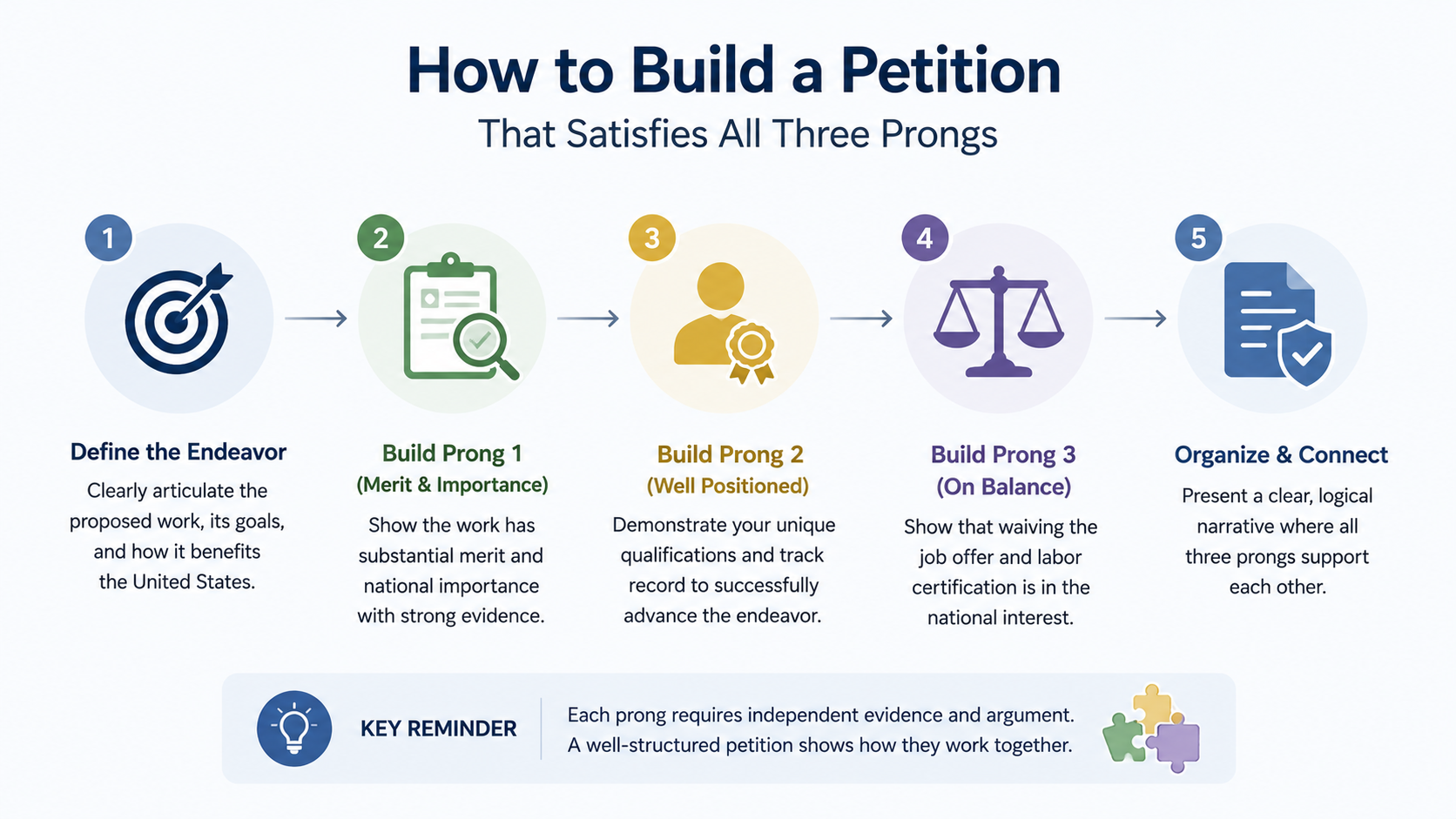
A petition built around the Dhanasar framework starts with the proposed endeavor and works outward. Everything else the evidence, the letters, the narrative structure serves the three-prong argument.
Start with a precisely defined proposed endeavor. Before assembling evidence, the endeavor must be stated with enough precision that an officer can evaluate it against each prong independently. One to three sentences: what the petitioner will do, how they will do it, what national-level benefit results.
Build Prong 1 around two anchors: merit and scale. Establish merit through expert testimony and technical documentation. Establish national importance through a documented federal priority and a portability mechanism. Keep these as distinct sub-arguments.
Build Prong 2 around the connection between the petitioner and the endeavor. Not a biography, but a targeted argument: this person, with this background, is credibly positioned to execute this specific work. Every piece of evidence in Prong 2 should explicitly connect back to the proposed endeavor.
Build Prong 3 as a stand alone legal argument. Identify the specific reasons why requiring labor certification in this petitioner’s case would work against the national interest: impracticality, unique positioning, urgency, or the nature of the endeavor. State and support the argument explicitly.
Test for internal coherence before filing. Read the proposed endeavor, the strongest paragraph of the Prong 2 section, and the most substantive recommendation letter. If they do not describe the same person doing the same work, the petition has a coherence problem that will surface in adjudication.
Frequently Asked Questions
What is the Dhanasar test for EB-2 NIW?
The Dhanasar test is the three-prong analytical framework USCIS uses to evaluate every NIW petition. The three prongs are: (1) the proposed endeavor has substantial merit and national importance, (2) the petitioner is well-positioned to advance the endeavor, and (3) on balance, it benefits the United States to waive the labor certification requirement.
What are the 3 prongs of the Dhanasar framework?
Prong 1 asks whether the proposed work has genuine value and national-level impact. Prong 2 asks whether the petitioner has the credentials, record, and infrastructure to execute the work. Prong 3 asks whether the national benefit outweighs the interest in requiring the standard labor certification process.
How does USCIS evaluate NIW petitions under Dhanasar?
Officers evaluate the three prongs sequentially as distinct analytical questions. The proposed endeavor is examined first. The petitioner’s positioning is examined second. The waiver justification is examined third. A finding against any single prong is typically sufficient to deny the petition regardless of how strong the other prongs are.
What is substantial merit in EB-2 NIW?
Substantial merit means the proposed work has genuine recognized value within its own field it addresses a real problem, uses credible methodology, and has demonstrable relevance. Research that advances human knowledge qualifies even without immediate economic impact. It is the first of the two distinct sub-requirements in Prong 1.
What does ‘well-positioned’ mean in Prong 2?
Well-positioned means the petitioner’s education, experience, track record, and current infrastructure credibly support their ability to execute the specific proposed endeavor. It is not a general excellence standard it requires connecting the petitioner’s specific background to the specific work described in the proposed endeavor.
Why do NIW petitions fail Prong 3?
Most Prong 3 failures result from treating the waiver argument as a formality one or two sentences asserting that labor certification would be impractical without explaining why. Prong 3 requires an explicit, specific argument about why this petitioner’s circumstances make the standard process contrary to U.S. interests.
Can non-STEM applicants satisfy all three Dhanasar prongs?
Yes. Dhanasar is field-neutral. Non-STEM applicants in finance, education, public policy, arts, law, and other fields can satisfy all three prongs with appropriately constructed evidence. The evidentiary path looks different from STEM cases, but the standard applied is identical.
How does Dhanasar differ from the old NYSDOT standard?
NYSDOT required petitioners to prove national interest would be ‘adversely affected’ by requiring labor certification a difficult counterfactual. Dhanasar replaced this with a forward-looking balancing test focused on whether the proposed work benefits the U.S. and whether waiving certification serves the national interest. The new standard is more structured and accessible, particularly for entrepreneurs.
What happens if a petition satisfies Prong 1 but not Prong 3?
USCIS can and does deny petitions that establish national importance but fail to separately argue why the waiver of labor certification specifically benefits the United States. Prong 1 and Prong 3 are independent requirements. A strong Prong 1 does not make Prong 3 implicit or self-evident.
What standard of proof applies to NIW petitions?
The preponderance of evidence standard: it must be ‘more likely than not’ that each prong is satisfied. This is lower than clear and convincing evidence but requires credible, specific, and independently supported documentation. Generic assertions do not satisfy preponderance regardless of how many times they appear.
Understanding the Dhanasar framework is the prerequisite. Applying it to your specific record, field, and proposed endeavor is the work that determines outcomes. Book a strategic Dhanasar case review with Immignis for a prong-by-prong analysis of your petition before you file.



Comments
EB-2 NIW Advanced Degree Requirement: The Essential PhD Truth
August 27, 2026 - 5:04 am[…] NIW analysis the Matter of Dhanasar three-prong test is where the petition is actually won or lost. Under […]
EB-2 Exceptional Ability vs Advanced Degree: Best NIW Route
August 31, 2026 - 7:16 am[…] Establishing exceptional ability satisfies the EB-2 classification threshold. After that, the petition must separately satisfy all three Dhanasar prongs to obtain the waiver of labor certification. Meeting the threshold does not affect or relax the Dhanasar requirements. […]
EB-2 NIW Final Merits Determination: Why Cases Fail
September 4, 2026 - 11:10 am[…] in the petitioner’s field as a reason for the Prong 3 waiver is a documented failure mode. Dhanasar Prong 3 is not a labor market analysis it is a benefits of waiving PERM analysis. The argument must address […]