
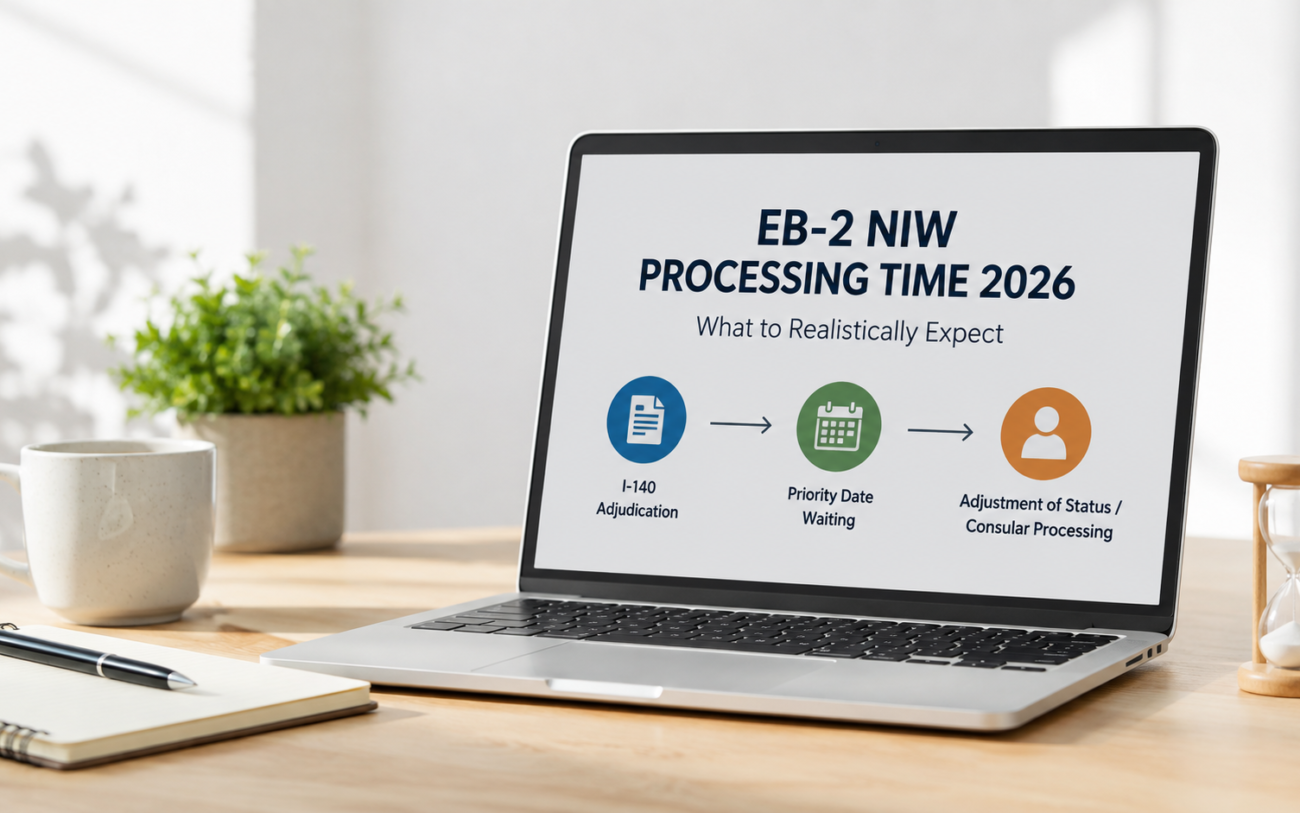
EB-2 NIW Processing Time 2026: What to Realistically Expect
Most applicants searching for EB-2 NIW processing time 2026 want one number. The honest answer is that there is no single number because “NIW processing time” conflates three distinct clocks that run in sequence, operate on entirely different mechanisms, and are affected by entirely different variables. The I-140 adjudication clock is controlled by USCIS workload and petition quality. The priority date clock is controlled by visa supply, country of birth, and monthly Visa Bulletin movement. The adjustment of status clock begins only when the first two conditions have been satisfied.
Understanding which clock matters most for your specific situation changes both what you do and how long you realistically expect to wait. This guide walks through each stage, the variables that affect it, and the strategic decisions available at each point.
The Three Clocks in an NIW Green Card Timeline
Before mapping out timelines, the framework matters.
Clock 1 I-140 adjudication. This is the stage most people mean when they ask about processing time. USCIS reviews the petition and decides whether to approve it, issue an RFE, or deny it. This stage is controlled by USCIS workload, petition quality, and whether premium processing is used.
Clock 2 Priority date waiting. After I-140 approval, the applicant waits for their priority date (the date USCIS received the I-140) to become “current” in the monthly Visa Bulletin. This clock is determined by visa supply, per-country caps, and the volume of others in the same queue. Premium processing has no effect on it.
Clock 3 Adjustment of status or consular processing. Once a priority date is current, the applicant files Form I-485 (if in the U.S.) or proceeds through consular processing abroad. This stage has its own USCIS queue, independent of the I-140.
For applicants from countries without significant EB-2 backlogs most of the world outside India and China Clock 2 is often negligible, and the total timeline is driven by Clocks 1 and 3. For applicants from India, Clock 2 dominates the entire picture, and I-140 speed becomes a secondary concern.
Current I-140 Processing Times for NIW
USCIS reports processing times for Form I-140 by category. For EB-2 NIW petitions on standard processing, current timelines at most service centers fall in a range of roughly 8 to 20 months. Service center variability is real: USCIS distributes case loads between its service centers and has periodically shifted EB-2 NIW adjudication between facilities. Checking the USCIS processing time tool for the specific service center where your case is assigned is more accurate than any published average.
Several factors push a standard processing NIW toward the longer end of that range:
- High filing volume periods when filing surges occur, particularly after visa bulletin movements, queues lengthen.
- Cases assigned to service centers with higher workloads historically, the Texas Service Center has run longer timelines than California or Nebraska for EB-2 categories, though this shifts.
- Security clearance holds some cases are flagged for additional security review, adding unpredictable time.
- Requests for Evidence an RFE pauses the adjudication clock, and the time added depends on how long the petitioner takes to respond and how long USCIS takes to review that response.
Premium Processing: What It Guarantees and What It Doesn’t
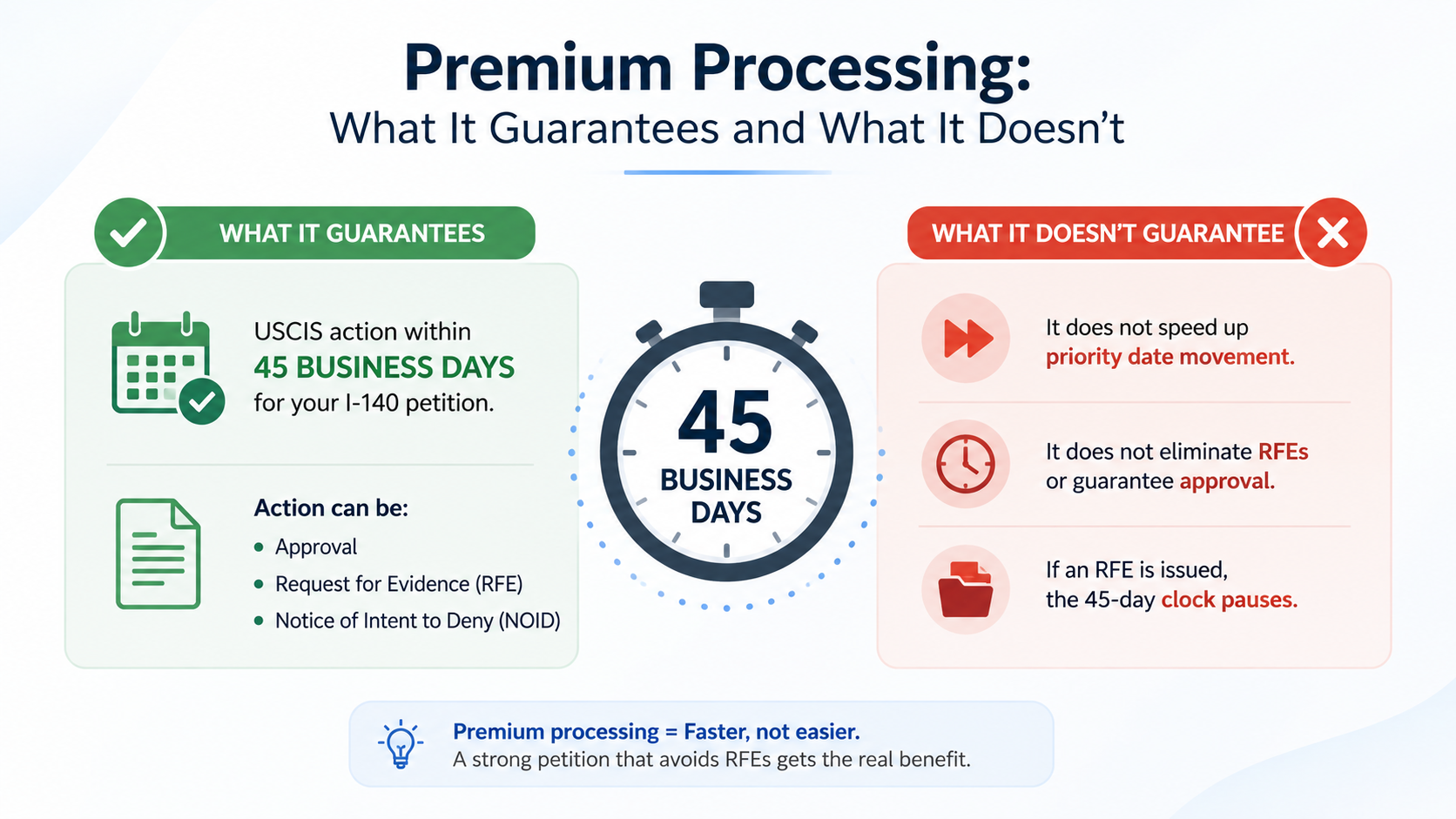
Premium processing, requested via Form I-907, is available for EB-2 NIW I-140 petitions. The guarantee for NIW cases is a USCIS action within 45 business days. In practice, many cases under premium processing see action faster than the guaranteed window decisions in the 15-30 business day range are commonly reported, though this varies.
The word “action” in that guarantee matters. USCIS can satisfy the premium processing commitment by approving the petition, issuing an RFE, or issuing a Notice of Intent to Deny. If an RFE is issued, the 45-business-day clock pauses. A new window begins only after USCIS receives the RFE response. A poorly prepared petition that draws an RFE under premium processing may end up taking nearly as long as a strong petition on standard processing.
This is why premium processing is not simply a faster path it is a faster path for petitions that do not generate RFEs. The most effective strategy is to file a petition strong enough to avoid an RFE, then use premium processing to accelerate the clean adjudication.
When premium processing makes the most sense:
- H-1B holders nearing status limits. An approved I-140 qualifies certain H-1B workers for three-year extensions beyond the standard six-year cap under AC-21. Premium processing compresses this timeline significantly.
- Applicants with current or near-current priority dates. If a priority date is already current or approaching currency, a faster I-140 approval directly accelerates the path to filing Form I-485 and accessing work authorization.
- Applicants for whom early I-485 filing unlocks EAD and Advance Parole. Concurrent filing (discussed below) becomes available sooner, enabling earlier access to employment authorization and travel flexibility.
When premium processing adds less value:
- India EB-2 applicants with 12+ year priority date waits. Faster I-140 adjudication does not move the visa bulletin. If the priority date queue is measured in years, compressing I-140 adjudication from 12 months to 2 months has minimal practical effect on the overall timeline.
- Cases with significant evidence gaps. A petition that will likely draw an RFE benefits less from premium processing, since the RFE pause eliminates most of the time advantage.
Full Timeline by Processing Path
The table below summarizes realistic timelines across the full processing sequence.
| Stage | Standard | Premium Processing | Notes |
| I-140 adjudication | 8–20 months | ~45 business days (often faster in practice) | Clock pauses if USCIS issues RFE |
| RFE response window | Adds 2–6+ months | Adds 2–6+ months | New adjudication window begins on USCIS receipt |
| Priority date wait (ROW) | Often current or <12 months | Same I-140 speed only helps | Depends on monthly Visa Bulletin movement |
| Priority date wait (India EB-2) | 12+ years from filing | Same I-140 speed only helps | Driven by per-country cap; cannot be expedited |
| Priority date wait (China EB-2) | ~4 years from filing | Same I-140 speed only helps | Subject to retrogression and spillover |
| I-485 adjudication (once current) | 8–18+ months | N/A no premium for I-485 | Includes biometrics, medical exam, interview if required |
The key insight the table makes visible: for Rest of World applicants, I-140 speed has a direct effect on overall timeline. For India EB-2 applicants, the I-140 clock is a small fraction of the total the visa bulletin wait dominates everything.
Concurrent vs Sequential Filing: A Critical Strategic Choice
Once an I-140 is approved, the path to permanent residency bifurcates based on priority date currency. Understanding this decision point changes how applicants think about their overall strategy.
Concurrent filing means submitting the I-140 and the I-485 at the same time, or submitting the I-485 immediately after I-140 approval. This is only available when the priority date is already current in the Visa Bulletin at the time of filing. It saves significant time and provides early access to Employment Authorization Documents and Advance Parole allowing the applicant to work and travel freely while the green card is pending.
Sequential filing is the only option for applicants whose priority date is not yet current. The I-140 is filed and approved, and then the applicant waits sometimes for years for the Visa Bulletin to advance enough that their priority date becomes current and the I-485 can be submitted.
| Factor | Concurrent Filing | Sequential Filing |
| When available | Priority date is current at I-140 filing | Priority date not yet current |
| Total timeline | 6–12 months faster on average | Years longer if backlogged |
| EAD/Advance Parole access | Earlier filed simultaneously | Only available once I-485 is filed |
| Who uses it | Rest of World, some China applicants | Most India applicants; long-backlog countries |
| Risk if retrogression occurs | I-485 already filed protected | May lose filing window if date recedes before I-485 filed |
| I-140 approval required first? | No can file together | Typically yes, or pending with current date |
For applicants who can file concurrently, doing so is almost always the right strategic choice. The benefits are concrete and immediate. The risk of retrogression where a priority date that was current recedes before the I-485 is filed is real but manageable: if an I-485 is already filed when retrogression occurs, the case is protected.
The Visa Bulletin and How It Controls Your Timeline
The Visa Bulletin is published monthly by the Department of State and is the single most important document in the post-I-140 phase for most applicants. It lists, by preference category and country of birth, the cutoff dates for two things: when applicants can begin filing the I-485 (the Dates for Filing chart), and when priority dates are fully current for green card issuance (the Final Action Dates chart).
Final Action Dates (FAD) represent the absolute cutoff for green card issuance. Only applicants whose priority date is earlier than the listed FAD for their category and country can receive a green card that month.
Dates for Filing (DFF) are typically more generous than FADs. When USCIS accepts them (which varies month to month), applicants with earlier priority dates than the DFF cutoff can file the I-485 even before their date is fully current. This allows earlier access to EAD and Advance Parole, which is practically valuable even though the green card itself isn’t yet issuable.
USCIS designates each month which chart governs I-485 filing eligibility. Applicants should track this monthly. A month where USCIS switches from accepting DFF to requiring FAD can eliminate a filing window that was previously open.
Retrogression when a Final Action Date moves backward is a recurring reality for oversubscribed categories. Applicants who have not yet filed the I-485 when retrogression occurs lose their window temporarily.
India and China EB-2 Backlog Reality
For applicants born in India, the EB-2 visa backlog is the dominant factor in their immigration timeline measured not in months but in years, often more than a decade from the current filing date.
The mechanics: U.S. law limits any single country to 7% of annual employment based green cards. India produces a large share of EB-2 filings, and the demand dramatically exceeds the annual supply. The result is a queue measured in years.
Several factors have affected the India EB-2 queue in 2026:
- Horizontal spillover under INA §202(a)(5). When other countries underutilize their visa allocation in a given year due to PERM backlogs, consular processing disruptions, or other factors unused numbers flow to oversubscribed countries like India. The April 2026 Visa Bulletin showed an unusually large forward movement in the India EB-2 Final Action Date, partly reflecting this dynamic.
- PERM backlogs reducing Rest of World pipeline. Because the Department of Labor’s PERM processing backlog has slowed the pipeline of new employer-sponsored green card filers from other countries, fewer cases are competing for the ROW allocation creating spillover potential.
For Indian-born EB-2 NIW applicants, the strategic implication is clear: the priority date captured at I-140 filing is the most important number in the entire immigration process. Every month of delay in filing is a month added to an already long queue. Filing with a credible petition as early as possible rather than waiting to build a theoretically stronger case is often the right calculation.
For Chinese-born EB-2 applicants, current backlog tracking shows roughly four-year queues, subject to movement in either direction.
Why NIW Cases Get Delayed Beyond Normal Processing
RFEs and Their Effect on Timeline
A Request for Evidence pauses I-140 adjudication. USCIS issues an RFE when the evidence submitted is insufficient to approve or deny the petition outright. The applicant typically has 87 days to respond. Once the response is received, USCIS begins a new adjudication window.
Under premium processing, the 45-business-day guarantee restarts upon receipt of the RFE response. Under standard processing, the case re-enters the queue from approximately where it was.
The total time added by an RFE cycle including preparation, submission, and re-adjudication commonly ranges from three to six months. Cases that receive two sequential RFEs can see a year or more added to the I-140 phase alone.
Service Center Variability
USCIS periodically redistributes EB-2 NIW cases between service centers to balance workloads. An applicant whose case is transferred mid-adjudication may see their clock reset relative to the receiving center’s current queue. Monitoring case status through the USCIS online portal and updating the address of record to ensure receipt of notices is important throughout the process.
Security and Admissibility Holds
Some NIW petitions are flagged for additional security review unrelated to the petition’s merits. These holds are not disclosed in detail by USCIS, do not indicate a problem with the petition itself, and cannot be appealed or expedited in most circumstances. Cases affected by holds may appear dormant for months before adjudication resumes.
After I-140 Approval: What Happens Next
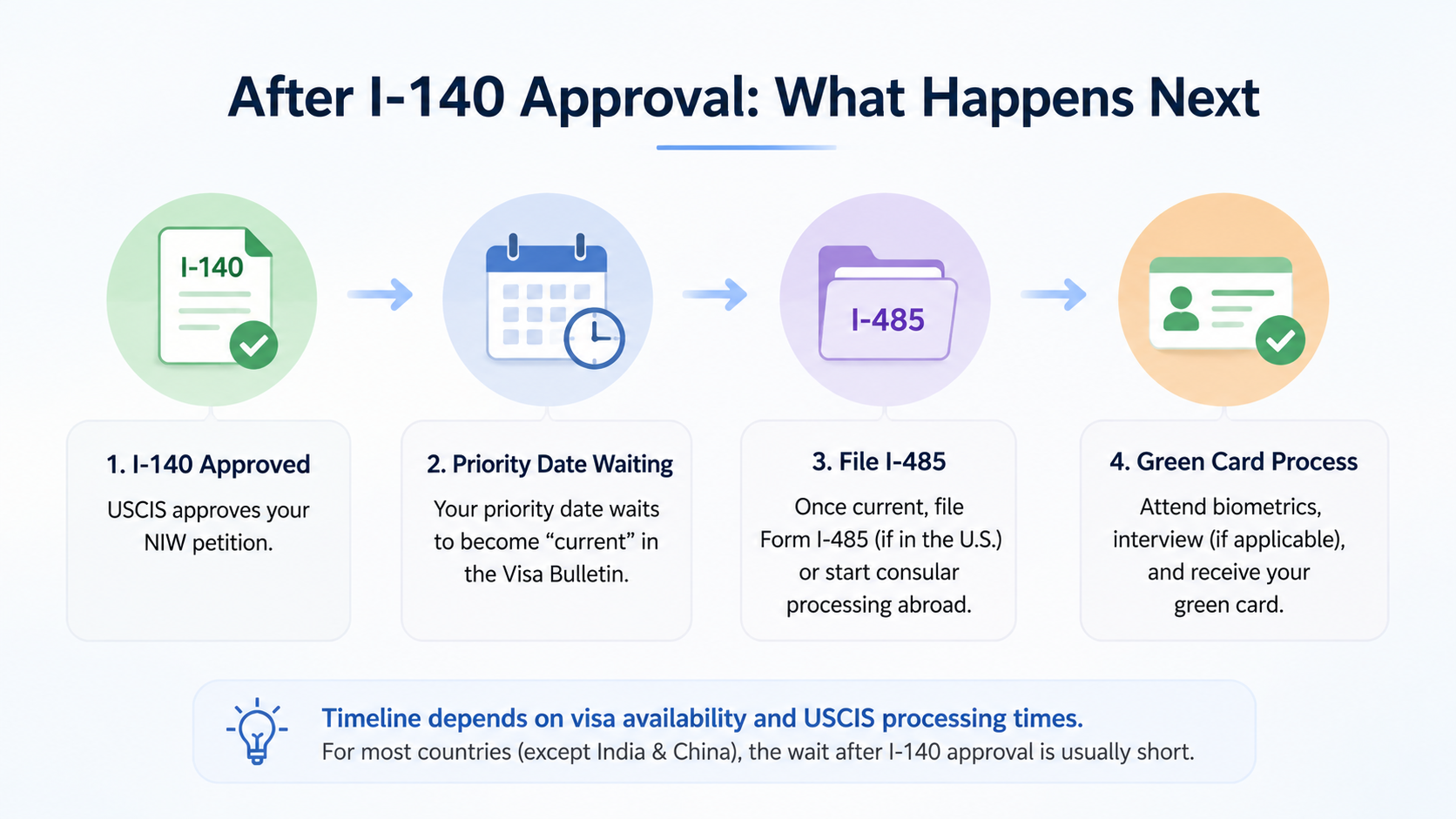
An approved I-140 does not mean a green card is imminent. The I-140 establishes the priority date and confirms that the petition has been found approvable. What happens next depends entirely on priority date currency.
If the priority date is current: The applicant can file Form I-485 (if in the U.S.) or proceed through consular processing at a U.S. embassy or consulate abroad. The I-485 adjudication stage adds additional time typically eight to eighteen months or more and includes biometrics, a medical examination, and potentially an in-person interview.
If the priority date is not current: The applicant waits. The approved I-140 is preserved indefinitely. The priority date established at I-140 filing remains valid even through job changes, employer changes, and extended waiting periods. This preservation is one of the primary reasons early filing has strategic value even for applicants facing long backlogs.
Priority date portability: Under certain circumstances, applicants with an I-485 pending for 180 days or more can change employers or job roles without jeopardizing the underlying petition a provision under AC-21. Applicants considering career changes while the I-485 is pending should review AC-21 portability requirements carefully.
Want a realistic timeline assessment for your specific situation? Get a free NIW processing strategy review from Immignis based on your country of birth, current status, and filing timeline.
How to Reduce Processing Delays
While the priority date queue cannot be compressed by any filing strategy, the I-140 adjudication stage is substantially within the applicant’s control. The strategies below address the most predictable sources of delay.
- File a complete, strong initial petition. The single most effective delay-reduction strategy is submitting a petition that satisfies all three Dhanasar prongs with sufficient evidence that no RFE is needed. RFE avoidance is more valuable than premium processing in most cases.
- Use premium processing strategically. If the priority date is current or approaching currency, premium processing compresses the timeline to a point where I-485 concurrent filing and EAD/AP access become available sooner. For applicants with long backlogs, the calculus is different.
- Respond to RFEs comprehensively. A partial or unclear RFE response invites a second RFE or a denial. Treating the RFE response as a second petition addressing every point raised by the officer with specific, documented evidence minimizes the risk of a further delay cycle.
- File early for backlogged-country applicants. For Indian and Chinese EB-2 applicants, filing with a credible petition as early as possible is almost always the right move. The priority date established at filing is the most important number in the process.
- Monitor the Visa Bulletin monthly. Priority dates move, retrogress, and occasionally advance rapidly. Applicants who monitor the bulletin can identify filing windows particularly when USCIS accepts the Dates for Filing chart that allow earlier I-485 submission and earlier access to work and travel authorization.
Frequently Asked Questions
How long does EB-2 NIW processing take in 2026?
I-140 adjudication on standard processing currently takes roughly 8 to 20 months depending on service center. Premium processing typically results in action within 45 business days, often sooner in practice. These timelines cover only the I-140 stage the full green card timeline depends on priority date currency and the adjustment of status phase.
Is EB-2 NIW premium processing worth it?
It depends on the situation. Premium processing adds the most value when the priority date is current or near-current, when H-1B status renewal depends on I-140 approval, or when concurrent I-485 filing unlocks earlier work authorization. For India EB-2 applicants with multi-year backlogs, the I-140 speed advantage has limited effect on the overall timeline.
Why is my NIW taking so long?
Delays beyond standard processing ranges typically result from RFE cycles, service center workload, security review holds, or case transfers between facilities. An RFE can add three to six months to I-140 adjudication. Cases in the visa queue after I-140 approval face delays measured by priority date movement in the Visa Bulletin.
What is a priority date and why does it matter?
The priority date is the date USCIS received the I-140 petition. It determines position in the visa queue. To file for permanent residency, the priority date must be “current” in the monthly Visa Bulletin. For India EB-2 applicants, the current backlog means priority dates filed today may not become current for more than a decade.
Can USCIS speed up NIW processing?
Premium processing compresses I-140 adjudication to approximately 45 business days. No mechanism speeds up the priority date queue for oversubscribed countries. Expedite requests for standard cases are granted only in narrow circumstances severe financial loss, urgent humanitarian need, or clear USCIS error.
What is the difference between concurrent and sequential filing?
Concurrent filing means submitting the I-140 and I-485 together when the priority date is already current, saving 6 to 12 months and unlocking earlier work authorization. Sequential filing required when the priority date is not yet current involves waiting for the Visa Bulletin to advance before the I-485 can be submitted.
Does NIW processing differ by country of birth?
The I-140 adjudication timeline is the same regardless of country of birth. What differs is the priority date wait: applicants born in India face EB-2 backlogs exceeding 12 years; Chinese-born applicants face approximately four-year waits. Applicants from other countries typically see priority dates that are current or close to current.
What delays EB-2 NIW petitions most?
RFEs are the most common controllable delay factor, typically adding 3 to 6 months per RFE cycle. Uncontrollable factors include service center workload, case transfers, and security holds. Filing a complete, well-structured petition with no evidentiary gaps is the most effective way to avoid the controllable delays.
What happens after NIW I-140 approval?
If the priority date is current, the applicant can file Form I-485 (in the U.S.) or proceed through consular processing. If not current, the applicant waits for Visa Bulletin movement. The approved I-140 preserves the priority date indefinitely. I-485 adjudication, once filed, adds additional months for biometrics, medical exams, and potential interviews.
What is the Final Action Date vs Dates for Filing?
Both appear in the monthly Visa Bulletin. The Final Action Date is the cutoff for actual green card issuance. The Dates for Filing are typically earlier and, when USCIS accepts them, allow I-485 submission before the date is fully current providing earlier access to work and travel authorization while the green card remains pending.
Understanding your timeline is the first step; optimizing your position within it is the second. Book a consultation with Immignis to map out your specific NIW timeline based on your country of birth, current immigration status, filing readiness, and priority date strategy.



Comment
Dhanasar Framework for EB-2 NIW: Proven Success Guide
August 25, 2026 - 6:07 am[…] the 2016 precedent decision that replaced the previous NYSDOT framework. Understanding the Dhanasar framework for EB-2 NIW is not optional background knowledge. It is the operative logic of every approval, denial, and RFE […]