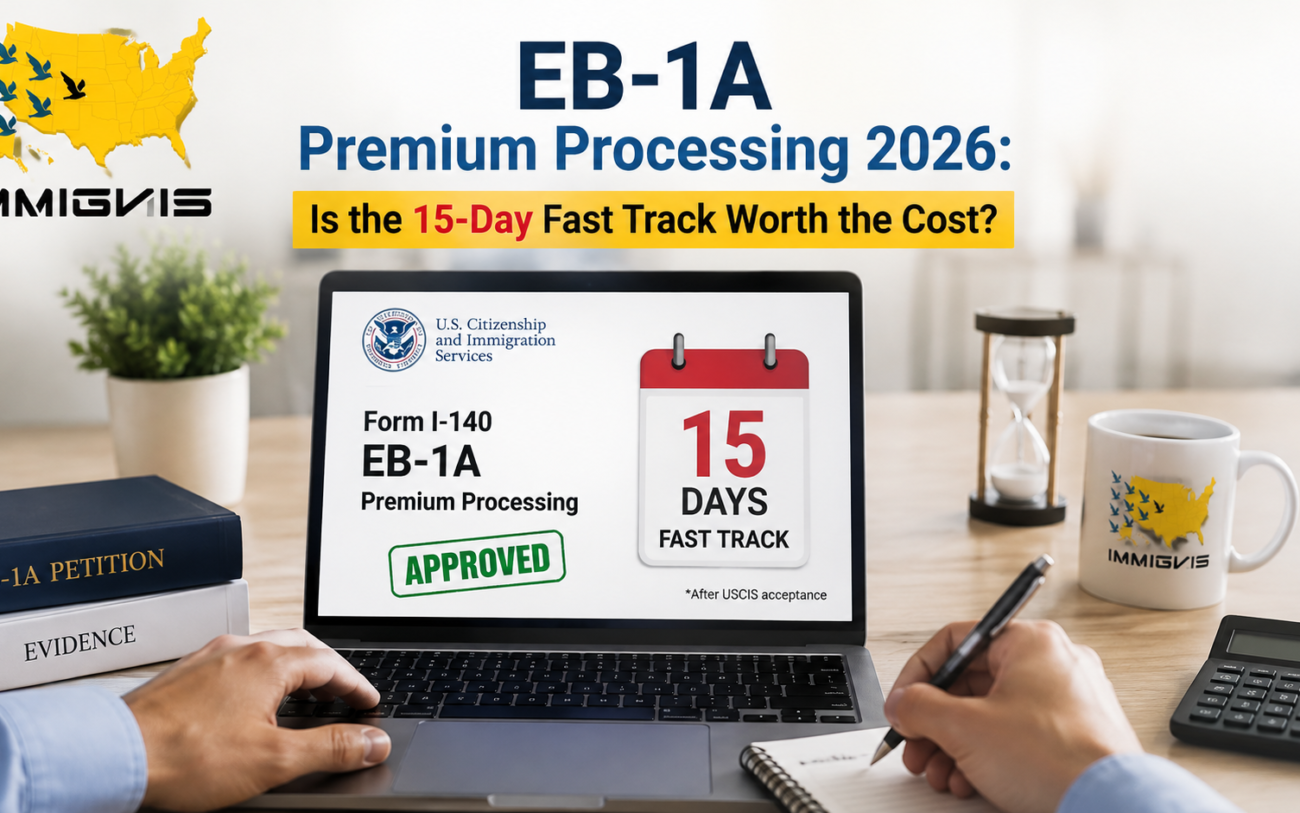
EB-1A Premium Processing 2026: Is the 15-Day Fast Track Worth the Cost?
When a professional files an EB-1A premium processing 2026 petition, one question comes almost immediately: should the filing include premium processing? The 15 business day guarantee sounds straightforward. The strategic reality is more nuanced. For well-prepared cases with specific timing pressures, premium processing genuinely accelerates outcomes. For borderline cases or applicants with more than a year of H-1B status remaining, the same service can produce worse outcomes than waiting in the standard queue.
The decision is not about whether 15 days is faster than several months. It obviously is. It is about whether speed serves your specific strategic situation or works against it.
What Premium Processing Is and What It Actually Guarantees
Premium processing is an optional USCIS service that, upon receipt of Form I-907 and the required fee, obligates USCIS to take action on a petition within a defined window. For EB-1A Form I-140 petitions, that window is 15 business days.
Critical distinction: the 15-day guarantee covers action not approval. USCIS must issue one of four responses: an approval, a Request for Evidence (RFE), a Notice of Intent to Deny (NOID), or a denial. Fast is guaranteed. Favorable is not.
Premium processing does not change the evidentiary standard the officer applies. It does not improve the odds of a favorable decision. It does not alter the legal analysis that determines whether the petition satisfies the extraordinary ability threshold. For petitioners who understand this going in, it is a timing tool. For those who treat it as a quality guarantee, it delivers exactly what it always delivers a response consistent with the strength of the evidence but faster, and sometimes with consequences that outlast the timeline.
How Premium Processing Works Mechanically
Filing Form I-907
Premium processing is requested on Form I-907, filed either concurrently with the initial I-140 or as an upgrade to a pending case.
Filed concurrently: The I-907 goes in the same package as the I-140. The clock begins when USCIS receives the complete package at the correct service center.
Upgrade to a pending case: The I-907 is filed separately, referencing the original I-140 receipt number. It must be sent to the service center currently processing the I-140 not to a lockbox or a different center. The clock begins on the date of physical receipt at the correct location, not on the mailing date.
Filing location matters more than most petitioners realize. Sending the I-907 to the wrong address does not start the clock. The correct address should be confirmed from the current I-907 instructions immediately before submission, as service center addresses for premium processing upgrades occasionally change.
The Clock Stops and Resets on RFE The Most Important Mechanical Detail
When USCIS issues an RFE or NOID during the premium processing window, the 15 business day clock stops immediately. It does not pause it resets entirely. Once the petitioner submits a response and USCIS receives it, a completely fresh 15 business day cycle begins.
What this means in practice for a premium processing case that receives an RFE:
- Day 1: USCIS receives premium processing request
- Day 9: USCIS issues RFE clock stops
- Day 9 + 87 calendar days: Petitioner submits RFE response (standard response window)
- New Day 1: USCIS receives RFE response fresh 15 business-day clock begins
- New Day 15: Deadline for USCIS action on the response
Total elapsed time: approximately 5- 6 months. Not 15 days.
Petitioners who elect premium processing to guarantee a fast outcome should account for this RFE reset in their planning. A case that receives an RFE even a routine one does not resolve in three weeks.
If USCIS Misses the Deadline
If USCIS fails to take action within the 15 business day window, the premium processing fee is refunded and the case continues to receive priority handling. The refund is automatic. Missing the deadline does not result in automatic approval.
When Premium Processing Is Strategically Worth It
Strong Cases with Specific External Deadlines
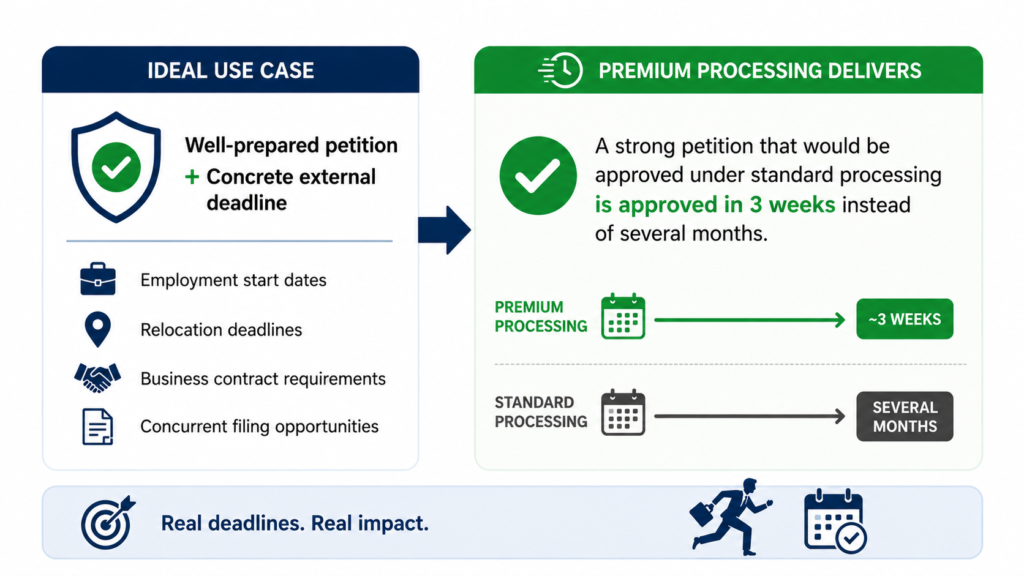
The clearest use case: a well-prepared petition with a concrete external timing requirement. Employment start dates, relocation deadlines, business contract requirements, or concurrent filing opportunities that require an approved I-140 within a defined window all create genuine urgency. For these situations, premium processing delivers exactly what it promises. A strong petition that would be approved under standard processing is approved in three weeks instead of several months.
H-1B Holders Approaching the Six-Year Cap Without an Approved I-140
Under AC21, H-1B holders with an approved I-140 qualify for three year extensions beyond the standard six-year cap. An H-1B holder in year five or early year six without an approved I-140 faces a genuine deadline. Standard processing in the 4-8 month range may not produce an approval before the cap is reached.
Premium processing resolves this timing problem directly. For these applicants, the service is not merely convenient it addresses a status vulnerability with real immigration consequences.
Concurrent I-485 Filing Opportunities
For applicants whose priority date is current or will become current within the adjudication window, the I-140 approval is the prerequisite for filing Form I-485 for adjustment of status. Premium processing makes the I-140 available within the Dates for Filing window. Given that these windows can close and retrogress with little notice, the speed advantage translates directly into a filing opportunity that might otherwise be missed entirely.
EB-1A After NIW Priority Date Porting
For Indian professionals pursuing the dual-track strategy NIW filed first for the early priority date, EB-1A built and filed later a strong EB-1A petition benefits from premium processing to confirm the I-140 approval and lock in the ported priority date position in the shorter EB-1 India queue quickly.
When Premium Processing Backfires
Borderline Cases and the Acceleration Problem
For petitions with genuine evidentiary weaknesses criteria that are thinly documented, a final merits narrative that lacks coherence, or expert letters providing general praise rather than field-level context premium processing accelerates the outcome in ways that are unfavorable.
Under standard processing, an officer who identifies weaknesses has more time to consider the full record. Under premium processing, the compressed timeline creates pressure to issue an RFE or denial rather than work through ambiguities. Officers adjudicating under a 15-business-day clock are more likely to issue RFEs on borderline cases, not because of any institutional policy but because the math of a tight deadline favors requesting clarification over resolving uncertainty.
Practitioner reporting consistently notes that RFEs in premium processing cases tend to arrive around days 8-10 of the initial window. A case that passes day 10 without an RFE is generally viewed as more likely to produce an approval or a stop-clock action. But a borderline case that triggers an RFE under premium processing is in the same position as under standard processing except that it arrived there in 10 days rather than several months, with no meaningful advantage gained.
The 365-Day H-1B Extension Rule: The Most Important Strategic Consideration
This rule is the most consequential and least understood factor in the premium processing decision for H-1B holders with borderline petitions.
Under INA §106(a), an H-1B holder whose I-140 has been pending for 365 calendar days or more becomes eligible for three-year H-1B extensions beyond the six-year cap regardless of whether the I-140 is ultimately approved or denied. The 365-day clock begins on the I-140 receipt date.
This means: a borderline EB-1A case filed under standard processing that pends for more than a year provides H-1B extension protection even if eventually denied. The petitioner can refile a stronger case while their extensions remain valid.
What premium processing destroys: A borderline case that receives a rapid denial under premium processing produces three consequences simultaneously:
- The I-140 is denied
- The 365 day pending period never accrues H-1B extension eligibility is never triggered
- The petitioner must restart the entire accrual period with a new filing while their H-1B status may be running out
For an applicant with two or more years of H-1B status remaining and a petition that is not definitively strong, the status protection available under a year-long pending I-140 outweighs any benefit from faster resolution of an unfavorable outcome.
The calculus reverses completely for strong cases. An approved I-140 under premium processing provides stronger protection than a pending one because an approval directly qualifies for three-year H-1B extensions, while a pending I-140 only qualifies for extensions if it reaches 365 days. There is no status risk to premium processing a genuinely strong petition.
The Decision Framework
| Scenario | H-1B Status | Premium? | Reason |
| Strong case, approaching 6-yr H-1B cap | < 1 year left | Yes | Approval before cap; H-1B extension unlocked immediately |
| Strong case, concurrent I-485 window open | Any | Yes | Captures DFF filing window before it closes |
| Strong case, no timing pressure | 2+ years left | Optional | Saves months; standard is also reasonable |
| Borderline case, 2+ years H-1B remaining | 2+ years left | No | Standard processing accrues 365-day H-1B protection |
| Borderline case, approaching 6-yr cap | < 1 year left | High risk | Rapid denial forfeits status with no fallback |
| Strong EB-1A after NIW priority date ported | Any | Yes, if strong | Confirms I-140 approval and EB-1 queue entry quickly |
| Case with known security review risk | Any | Caution | Security review can override the window; refund not guaranteed during review |
Premium vs Standard Processing: Timeline Comparison
| Scenario | Premium Processing | Standard Processing |
| Clean approval, strong case | ~15 business days (3 calendar weeks) | 4–8 months typically |
| RFE issued mid-review | 15 days + 87-day response window + 15 days = ~6 months total | RFE adds months to standard timeline regardless |
| Security review triggered | Potentially 6+ months (clock paused during review) | Same delay; no timing guarantee was expected |
| H-1B cap approaching, strong case | Resolves before cap; immediate extension eligibility | May not resolve in time |
| Borderline case, 2+ years H-1B | Risk of fast denial; 365-day clock never triggers | Case pends toward 365-day H-1B extension threshold |
Does Premium Processing Increase RFE Risk?
The honest answer: it may, conditionally.
For borderline cases, the compressed timeline creates pressure to issue RFEs rather than resolve ambiguous evidence in the petitioner’s favor. This is a real but conditional risk.
For genuinely strong petitions where three or more criteria are well-documented with independent evidence and the final merits narrative is coherent the same officer reaches the same conclusion under premium processing as under standard processing, just faster. The compression of the timeline does not change the outcome for cases that are clearly above the threshold.
The practical test: if the petition can withstand scrutiny under the criteria analysis and final merits determination framework without relying on an officer working through ambiguities in the petitioner’s favor, premium processing does not introduce meaningful additional risk. If the case depends on an officer giving benefit of the doubt on any substantive element, standard processing is the safer environment.
Security Reviews: When the Timeline Is Overridden
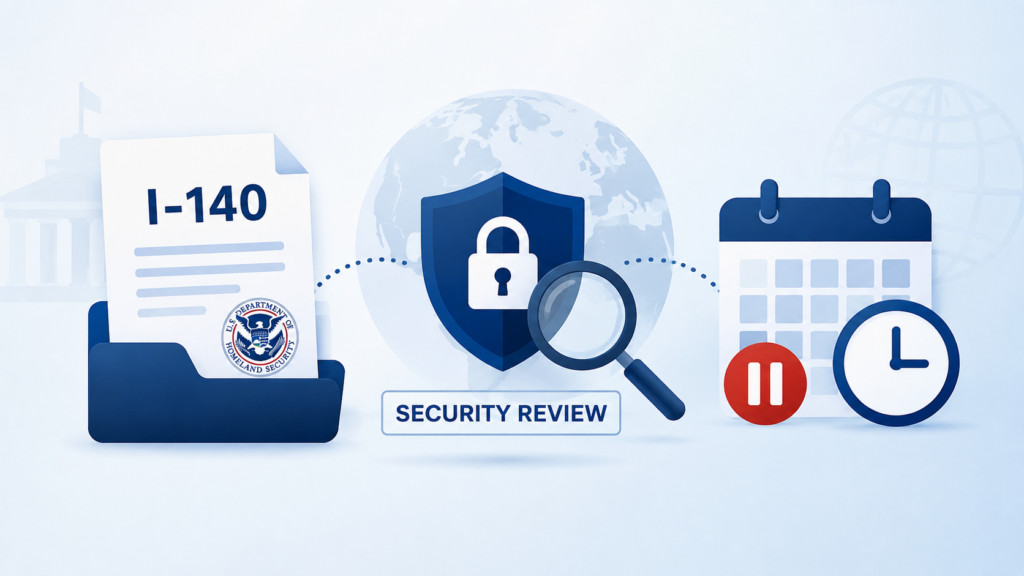
For certain applicants typically those with connections to sensitive research areas, specific nationalities, or prior immigration history flags USCIS may subject an I-140 to additional security review that can extend adjudication well beyond the premium processing window. When this occurs, USCIS stops the premium clock and notifies the petitioner.
Security review overrides are not disclosed in advance and cannot be predicted from petition contents alone. The premium processing fee is typically not refunded during the security review period. The clock resumes after the review concludes, which can take several months.
Applicants who have reason to expect additional review should discuss this with counsel before electing premium processing, since the guaranteed timeline may not be available.
How to Upgrade a Pending I-140 to Premium Processing
If circumstances change after a standard I-140 has been filed a concurrent filing window opens, an H-1B situation becomes urgent, or a business deadline emerges upgrading is straightforward.
- Complete Form I-907 and enter the original I-140 receipt number accurately
- Confirm the current fee amount on the USCIS website before submitting submitting an outdated fee amount results in rejection
- Mail the I-907 separately to the service center currently processing the I-140 confirmed from the I-907 instructions, not assumed
- Use trackable delivery with delivery confirmation the clock begins on the date of physical receipt, not the mailing date
- Monitor case status through the USCIS online portal the receipt date reflected in the system may differ by a day or two from the actual delivery date
The most common upgrade error is mailing to the wrong address. The correct destination is the service center processing the original I-140, confirmed from the current I-907 instructions.
Not sure whether your EB-1A petition is strong enough for premium processing? Get a free case assessment from Immignis to evaluate your evidence before deciding on premium or standard processing.
Frequently Asked Questions
What is EB-1A premium processing?
An optional USCIS service requested via Form I-907 that requires USCIS to issue a response on a pending EB-1A I-140 within 15 business days. The response may be an approval, denial, RFE, or NOID. Premium processing guarantees speed, not outcome, and does not change the evidentiary standard applied to the petition.
Can an EB-1A petition be approved in 15 business days?
Yes, if the petition is strong. A well-documented EB-1A petition that clearly satisfies at least three criteria with independent, specific evidence and presents a coherent final merits narrative regularly receives approvals within the 15-business-day window. Petitions with evidentiary gaps are more likely to receive RFEs or denials within that window.
What happens to the premium processing clock if I receive an RFE?
The clock stops immediately when the RFE is issued. When USCIS receives the petitioner’s response, a completely fresh 15-business-day cycle begins. A case with an RFE does not resolve in 15 total business days. Accounting for the 87-day response window, total elapsed time is approximately 5–6 months.
What is the 365-day H-1B rule and how does it relate to premium processing?
Under INA §106(a), H-1B holders whose I-140 has been pending for 365 days or more qualify for three-year H-1B extensions beyond the six-year cap, even if the I-140 is not yet approved. Standard processing allows borderline cases to pend long enough to trigger this protection. Premium processing of a borderline case that produces a rapid denial forfeits this eligibility entirely.
Is premium processing worth it for a borderline EB-1A case?
Generally not, if the petitioner has more than a year of H-1B status remaining. Standard processing allows the case to accrue toward the 365-day H-1B extension threshold. A rapid denial under premium processing forfeits that protection and forces the petitioner to restart the accrual clock with a new filing, potentially while H-1B status is running out.
Does premium processing increase RFE risk?
For borderline cases, it may. Officers under a 15-business-day deadline may issue RFEs rather than resolve ambiguous evidence in the petitioner’s favor. For strong petitions where the evidence clearly satisfies the threshold, the compressed timeline does not materially change the likelihood of an RFE.
What happens if USCIS misses the 15-business-day deadline?
The premium processing fee is refunded automatically and the case continues to receive priority handling. Missing the deadline does not result in automatic approval.
Can I upgrade a pending standard I-140 to premium processing?
Yes. File Form I-907 separately, referencing the I-140 receipt number, and mail it to the service center currently processing the original petition. Confirm the address from the current I-907 instructions before mailing. The 15-business-day clock begins on the date of receipt at the correct service center, not the mailing date.
Does premium processing affect the priority date?
No. The priority date is established when the I-140 petition is received by USCIS not when it is approved. Premium processing affects only how quickly the approval or other action is issued, not the date that determines the petitioner’s position in the visa queue.
Does premium processing apply to EB-2 NIW petitions as well?
Yes. NIW I-140 petitions are eligible for premium processing. The applicable window should be confirmed on the USCIS website, as the NIW premium processing window has historically differed from the EB-1A window and has been subject to periodic policy changes.
Premium processing for EB-1A is a tool, not a strategy. For strong petitions with genuine timing constraints, it delivers exactly what it promises. For borderline petitions or applicants with H-1B status to protect, the same service can produce a faster path to a worse outcome. Book a strategic EB-1A filing consultation with Immignis to evaluate whether your current evidence package is ready for premium processing and which filing approach serves your specific situation.