
Filing EB-2 NIW in 2026: Is This the Best Year or the Worst?
The answer depends almost entirely on how the petition is built. Filing EB-2 NIW in 2026 means navigating the strictest adjudication environment the category has seen and one with the strongest professional demand for the pathway. USCIS has applied measurably tighter standards over the past two years, RFE issuance on regular processing has become routine rather than exceptional, and the composition of the petition pool has shifted in ways that raised aggregate denial rates. None of this affects well-constructed petitions, which continue to be approved across all service centers and all professional fields. What it means is that the margin for error has narrowed and petitions that would have survived 2022 scrutiny often do not survive 2026’s.
This article explains what specifically changed, why it changed, which industries have the strongest petition momentum right now, and how to assess whether your own case is ready for the current environment.
What Has Actually Changed and What Hasn’t
Three compounding shifts explain the adjudication environment as it currently exists.
Filing volume surged past what the system was designed to absorb. Petition receipts roughly tripled between 2022 and 2025. This is not uniformly bad the growth reflects genuine expansion in the professional population for whom NIW is appropriate. But it also brought a much higher proportion of underprepared filings into the queue. Petitions with vague proposed endeavors, field-level national importance claims, and evidence that does not independently satisfy the Dhanasar standard are now a larger fraction of what officers review. The response was predictable: higher scrutiny across all filings, longer adjudication times, and more RFEs issued on cases that might previously have been approved on the original record.
USCIS shifted to “proposed endeavor first” adjudication. Policy guidance has reinforced treating the proposed endeavor’s specificity and portability as the primary evaluation object under Prong 1, rather than a supporting detail behind the petitioner’s credentials. This shift means the threshold question is now “what exactly will this person do and who benefits nationally” rather than “is this person qualified in an important field.” A strong credential record that does not connect to a specifically framed endeavor no longer carries the weight it previously did.
Prong 3 became a standalone scrutiny area. The third prong whether it is in the national interest to waive the labor certification specifically for this petitioner was historically treated as nearly automatic if Prong 1 was established. USCIS has moved away from that interpretation. RFEs increasingly ask explicitly why this petitioner’s specific circumstances warrant bypassing the standard labor market test. The most affected petitions are those where Prong 3 consists of one or two sentences asserting that the work is nationally important which restates Prong 1 without actually arguing the waiver justification.
What has not changed is the standard. The Dhanasar framework is identical to what it was in 2016. A petition that satisfies all three prongs with specific, credible, independently corroborated evidence is approvable in 2026. The filing environment has not created a new bar. It has enforced the existing one more consistently.
A Distinction That Defeats Many Prong 1 Arguments
Many petitions fail Prong 1 not because the national importance argument is entirely absent, but because the petitioner conflates two distinct sub-requirements that Prong 1 actually contains.
Substantial merit evaluates the intrinsic value of the proposed work within its field. It asks whether the endeavor matters whether it addresses a real problem, advances knowledge in a meaningful area, or produces outcomes with legitimate professional value. This component is generally easier to establish; most serious professional work has substantial merit in some form.
National importance is a separate and higher requirement. It asks whether the work’s impact extends beyond the petitioner’s immediate employer to benefit the United States at a sector, industry, or societal level. A highly meritorious piece of work that primarily benefits one company’s operations however significant to that company does not satisfy national importance.
Officers recognize the conflation pattern immediately. A Prong 1 argument that demonstrates deep expertise and valuable work, but describes its benefits primarily in terms of organizational outcomes, fails on national importance regardless of how strong the merit showing is. The national importance argument requires portability evidence documentation that the work’s benefit reaches beyond the current employer as well as a federal anchor connecting the work to documented public-sector priorities.
This distinction is why “important field + qualified person” does not equal a satisfactory Prong 1, even when both are genuinely true.
The Vagueness Trap: What It Looks Like in Practice
The dominant denial pattern in current NIW adjudications is what practitioners describe as the vagueness trap. Understanding it concretely not just as an abstract concept changes how petitions are drafted.
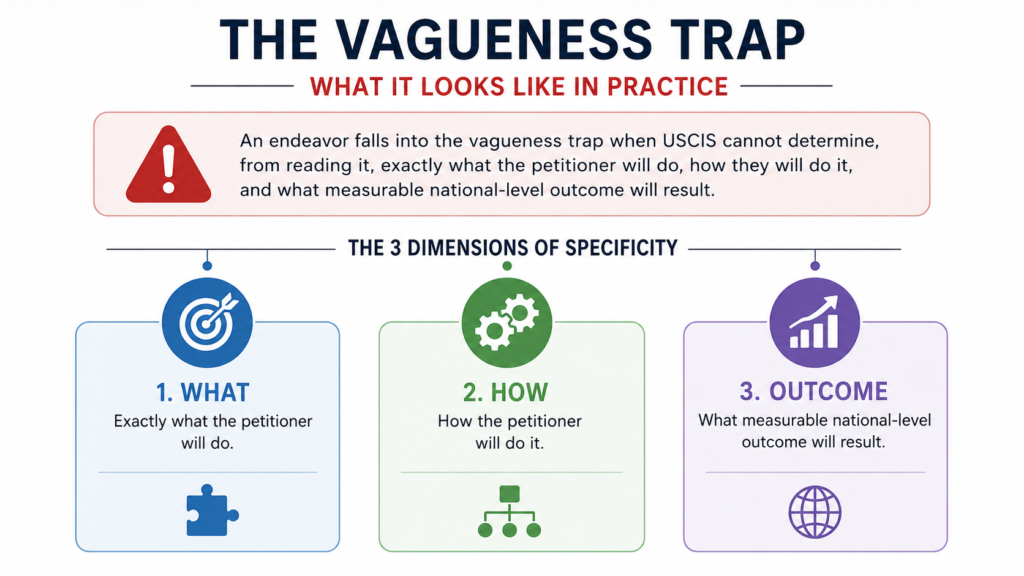
An endeavor falls into the vagueness trap when USCIS cannot determine, from reading it, exactly what the petitioner will do, how they will do it, and what measurable national-level outcome will result. The problem is not length or detail. It is the absence of specificity on three specific dimensions.
What vague looks like vs. what specific looks like:
Vague: “Dr. [Name] will continue her research in artificial intelligence, contributing to the advancement of AI technology in the United States and supporting the nation’s competitive position in this critical field.”
Specific: “Dr. [Name] will develop and validate adversarial robustness evaluation protocols for large language models deployed in federally regulated healthcare environments. Her proposed framework addresses a gap explicitly identified in the FDA’s 2023 AI/ML-Based Software as a Medical Device Action Plan, which notes the absence of standardized robustness testing methodology as a specific barrier to safe AI adoption in clinical settings. The protocols will be developed as open-access standards suitable for adoption across multiple healthcare systems, directly addressing the portability requirement under Prong 1.”
The difference is not one of length. It is that the specific version answers three questions the vague version does not: what will be done (robustness evaluation protocols), how (adversarial testing methodology, open-access standards), and why it matters nationally (FDA-identified gap, clinical AI adoption, cross-system deployment).
Every NIW proposed endeavor in 2026 needs to answer those three questions explicitly before it is ready to file.
2026 NIW Filing Environment: Decision Framework
| Factor | Challenge | Strategic Response |
| USCIS scrutiny level | Significantly tightened; vague endeavors denied outright | Invest in precision: specific endeavors, named federal anchors, portability evidence |
| RFE frequency | Standard on regular processing, not exceptional | Build petition strong enough to avoid RFE; prepare RFE response in parallel |
| Filing volume | Tripled from early-2020s levels | Quality differentiation matters more than ever; generic petitions fail |
| Prong 1 conflation | Merit and national importance conflated | Argue them separately; portability evidence is required for national importance |
| Prong 3 scrutiny | Officers requiring explicit waiver justification | Write Prong 3 as a standalone legal argument, not a one-sentence conclusion |
| India EB-2 wait time | 12+ years for new filers | File I-140 as early as possible; evaluate EB-1A simultaneously |
| H-1B instability | Layoffs expose employer-dependency | NIW self-petition removes employer-dependency; priority date survives job changes |
| Priority sector alignment | Strong federal anchors in designated sectors | Anchor to specific government documents, not field-level importance claims |
Industries With Strong NIW Momentum in 2026
The following assessments reflect the current availability of federal anchors, the pattern of recent RFE triggers, and the evidence structures that are producing approvals.
Artificial Intelligence and Applied ML
AI has the most available federal anchor documentation of any field OSTP executive orders, NSF AI research priorities, NIST AI Risk Management Framework, NIH AI strategy, CISA guidance on AI in critical infrastructure which creates both an opportunity and a dilution problem. Nearly every AI petition cites the same generic authority, which has reduced its signaling value.
What fails in 2026: Generic AI petitions that cite White House AI priorities without tying to a specific documented gap. “AI is a national priority” satisfies nothing. “NIST’s AI Risk Management Framework 1.0 identifies model evaluation for high-risk systems as a primary gap, and my proposed work addresses specifically this gap through [specific methodology]” establishes a credible anchor.
What succeeds: Specific subfield work tied to a named federal initiative AI robustness for FDA-regulated devices, privacy preserving federated learning for the VA, adversarial testing for CISA’s critical infrastructure AI deployments. The more specific the federal hook, the more credibly the portability argument follows.
Healthcare and Biomedical Research
NIH strategic plans, FDA action plans, HRSA underserved population priorities, and CDC public health emergency frameworks provide some of the most credible and diverse federal anchors available in any professional field.
What fails: Petitions that describe clinically valuable work benefiting a specific hospital system or patient population at one institution. National importance requires documentation that the intervention, methodology, or tool is designed for deployment across multiple settings.
What succeeds: Work with documented scalability open-source clinical tools, published protocols adopted at multiple institutions, methodologies designed for integration into federal health system infrastructure. The anchor is strongest when it ties to a specific NIH or HHS strategic priority with documented national level implementation intent.
Cybersecurity and Critical Infrastructure
CISA’s National Cyber Strategy, NSF cybersecurity research priorities, and DoD cybersecurity frameworks provide abundant federal documentation. The challenge is the same as in AI: generic cybersecurity importance claims are among the most overused Prong 1 patterns and among the most frequently flagged.
What fails: “Cybersecurity is a national priority and my work protects critical infrastructure.” This is true of nearly every cybersecurity professional. It is not a Prong 1 argument.
What succeeds: Petitions identifying a specific vulnerability class in a specific critical infrastructure sector water treatment SCADA systems, electrical grid ICSS, healthcare network endpoints and tying the proposed work to a CISA Sector Risk Management Agency priority document that identifies exactly that gap. The specificity of the threat vector and the specificity of the federal acknowledgment of that threat are both required.
Clean Energy and Grid Modernization
DOE’s Grid Modernization Initiative, FERC transmission planning rules, and IRA implementation frameworks have created unusually specific and well-documented federal priority maps for clean energy work.
What fails: Generic renewable energy petitions describing work that advances the clean energy transition broadly. The field is competitive and the generic framing is common.
What succeeds: Petitions tied to specific DOE program documents grid interconnection queue reform, long-duration storage deployment barriers, rural electrification technical assistance programs where the petitioner’s specific technical work addresses an identified federal bottleneck. The IRA created new federal priority documentation that has not yet been fully leveraged by petitioners in this space.
Semiconductor Manufacturing and Supply Chain
The CHIPS and Science Act created more specific and more credible legislative hooks than almost any other field. The documentation is explicit, the national importance is federally acknowledged at the statutory level, and the portability of work in this space is often naturally demonstrated through supply chain integration.
What fails: Generic semiconductor petitions that cite the CHIPS Act without identifying which specific implementation program or documented shortage the work addresses. The existence of the legislation is not itself the anchor; a specific program or identified gap within it is.
What succeeds: Work connecting to specific NATCAST programs, CHIPS Office implementation priorities, or the explicit domestic manufacturing capacity gaps documented in the Commerce Department’s semiconductor supply chain assessment. Petitions in this space should work from the specific federal document outward, not from the work outward in search of a federal hook.
Non-STEM: Finance, Education, Public Health Policy
Non-STEM petitions carry a higher evidence construction burden than STEM because the national importance connection requires more explicit argumentation the work does not self-evidently tie to national level priorities the way AI safety or semiconductor manufacturing does.
What fails: Petitions that describe professionally excellent work benefiting clients, students, or patients without documenting why the benefit extends nationally. “My financial consulting work helps businesses grow” is not a national importance argument.
What succeeds: Non-STEM petitions built on the same architecture as strong STEM filings a specific proposed endeavor, a real federal anchor from CFPB, Department of Education, CDC, or Treasury, and portability evidence showing the work or methodology extends beyond one organization. A financial regulation specialist whose work informs a documented CFPB policy gap, or an education researcher whose methodology has been adopted by multiple state systems, can build a credible Prong 1 argument. The architecture is identical; the evidence gathering requires more deliberate construction.
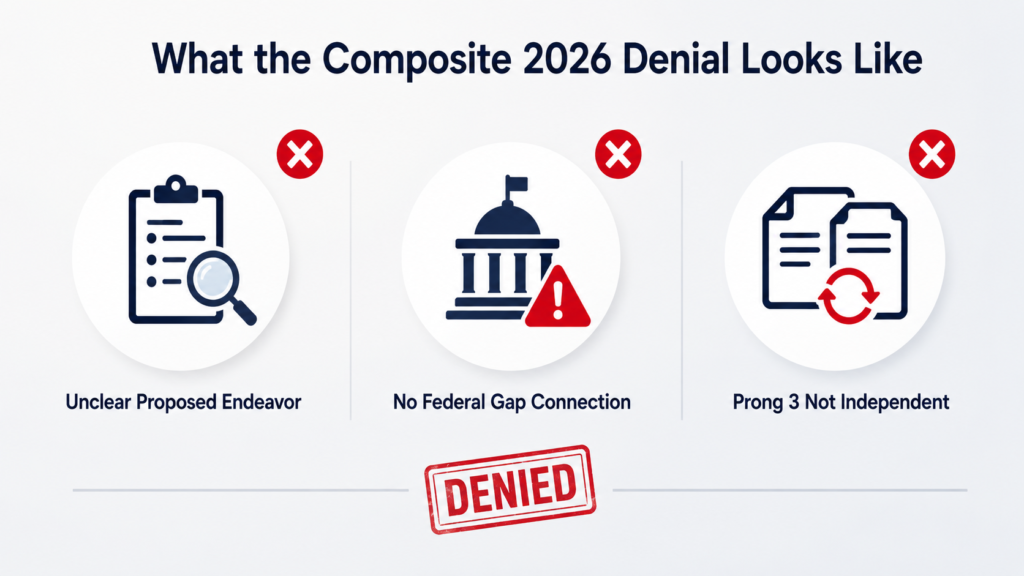
What the Composite 2026 Denial Looks Like
Understanding what USCIS is actually denying helps clarify what to avoid. The pattern that appears most consistently across 2026 denials involves three features occurring together:
A proposed endeavor that describes the petitioner’s area of expertise and the general importance of the field without specifying what the petitioner will do, how, and what measurable national-level outcome will result. A national importance argument that asserts the field’s significance without tying the petitioner’s specific contribution to a documented federal gap. And a Prong 3 section that repeats the Prong 1 argument in slightly different language rather than making an independent case for why the labor certification waiver specifically serves the national interest.
None of these three failures requires a weak petitioner. Many denials happen to professionals with strong records, real expertise, and genuine contributions. They happen because the petition letter did not make the arguments that connect that record to the Dhanasar standard explicitly and specifically.
The Four Question Readiness Diagnostic
Before deciding to file, run this specific audit. Each question maps to a specific failure mode in the current environment.
Question 1: Can you state your proposed endeavor in two to three sentences that include a specific problem, a specific methodology or output, and a named federal priority it addresses?
If the answer includes phrases like “advance the field,” “contribute to innovation,” or “support national competitiveness,” the endeavor is not ready. If it names a specific technical problem, a specific mechanism by which the work addresses it, and a specific federal document or program that identifies that problem as a national priority, it is structurally sound.
Test example: “I will develop privacy preserving federated learning infrastructure for multi-site clinical trial coordination, directly addressing the NIH’s 2023-2027 Strategic Plan priority of enabling data sharing across research sites without compromising patient privacy.” This passes. “I will continue my research in machine learning to advance the United States’ position in AI.” This fails.
Question 2: Can you name the specific federal document that anchors your national importance argument?
Not the field. A document. An NIH strategic plan section. A CISA identified gap. A CHIPS Act implementation program. A DOE grid modernization priority report. A specific FDA action plan. The anchor must be traceable to a real government publication that a USCIS officer can locate.
If the current anchor is “AI is a White House priority” or “Congress has recognized the importance of clean energy,” the argument will not hold up. If it is a specific document with a specific gap identified in specific language, it is credible.
Question 3: Do you have evidence that the work’s benefit extends beyond your current employer?
If every piece of evidence in the petition describes work done at or for the current employer, national importance under Prong 1 is vulnerable. Portability evidence takes several forms: adoption by other organizations of the petitioner’s methodology, open-source or open-access outputs designed for sector-wide use, cross-institutional deployments, industry standard contributions, or federal program involvement that by definition serves a broader constituency than one employer.
Question 4: Have you written a Prong 3 argument not a conclusion, but an argument?
The Prong 3 argument should explain, specifically, why waiving the labor certification requirement for this petitioner in this specific situation serves the U.S. national interest better than enforcing it. The relevant factors: urgency of the work relative to PERM’s 15–20 month timeline, the petitioner’s unique positioning that makes standard recruitment impractical, or the structural impossibility of PERM for self-employed or founder petitioners.
A Prong 3 section that says “the U.S. will benefit greatly from [Petitioner]’s continued work” is a conclusion, not an argument. An officer cannot credit it.
A “yes” to all four questions means the petition is in range for filing. A “no” or “unsure” to any of them identifies the specific gap to address before filing not before a theoretically better year, but before this specific petition is ready.
The File Now vs. Wait Decision
The strategic framing for this decision: file when the petition is credible, not before and not materially later.
The case for filing immediately when ready:
Priority date position is the most valuable strategic asset in the immigration process for applicants from backlogged countries. An I-140 filed today captures a priority date today. An I-140 filed in six months captures a priority date six months later. For Indian applicants, that six-month difference is six months added to a queue already measured in years. The case for urgency is real and structural, not manufactured.
Additionally, the scrutiny level is unlikely to decrease meaningfully in the near term. The petition environment in 2026 rewards quality and precision. A petition that would be strong in 2027 is strong now. There is no expected future improvement in the adjudication climate that justifies waiting once the petition is ready.
The case for a build period before filing:
A petition that would generate an RFE is not ready to file. An RFE adds four to eight months to adjudication time, requires significant preparation effort, and does not improve the underlying case. A petitioner who identifies through the four-question diagnostic that Prong 3 is underdeveloped, that the proposed endeavor is vague, or that portability evidence is thin should spend six to twelve weeks addressing those specific gaps before filing not because of the calendar year, but because a stronger initial filing is almost always faster than a filing plus RFE response.
Frequently Asked Questions
Is 2026 a good year to file EB-2 NIW?
It depends on the petition, not the calendar year. USCIS applies tightened scrutiny to vague, generic, or thin petitions but well-constructed filings continue to be approved. For qualified applicants who are genuinely ready, filing sooner captures an earlier priority date and is almost always the right call.
What is the vagueness trap in NIW petitions?
The vagueness trap refers to proposed endeavors that describe a field or area of expertise without specifying what the petitioner will do, how, and what measurable national-level outcome will result. USCIS cannot evaluate an endeavor that reads as a job description or a field summary. The officer needs to be able to answer three questions from reading the endeavor: what specifically will be done, by what methodology or through what output, and why does the result matter at a national level that extends beyond one employer.
What is the difference between Prong 1 and Prong 3?
Prong 1 establishes that the proposed work has substantial merit and national importance it concerns what the work is and who benefits from it. Prong 3 establishes that waiving the labor certification specifically serves the national interest it concerns why bypassing the standard hiring process is justified for this petitioner's particular situation. Many petitions satisfy Prong 1 and then restate it as their Prong 3 argument. Officers recognize this and flag it. Prong 3 requires an independent argument about the waiver, not a repetition of the national importance claim.
How do I find a federal anchor document for my field?
The most accessible approach by field: for AI and tech, search OSTP publications, NIST frameworks, and NSF program announcements for your specific subfield. For healthcare and biomedical work, NIH strategic plans and FDA action plans are the primary sources. For cybersecurity, CISA's national strategies and Sector Risk Management Agency publications identify specific gaps. For clean energy, DOE program documentation and FERC rulemakings are the most specific sources. For semiconductor work, the CHIPS Office publishes implementation priorities. The federal anchor must be a specific document that identifies the specific gap your work addresses not general legislative findings.
Is USCIS getting stricter on NIW petitions?
Yes, measurably so. The primary drivers are a large increase in filing volume that brought more underprepared petitions into the queue, a policy shift toward "proposed endeavor first" adjudication, and increased scrutiny on Prong 3 as a distinct argument. The standard has not changed; its enforcement has become more consistent.
Should I file NIW now or wait?
File when the petition is credible. For backlogged-country applicants, capturing an early priority date has strategic value that almost always outweighs incremental gains from additional waiting. For applicants whose record is thin or whose proposed endeavor is not yet specifically framed, a 6–12 week preparation period to address those specific gaps is more effective than filing and managing an RFE.
Can I file NIW while on OPT or STEM OPT?
Yes. OPT and STEM OPT are nonimmigrant work authorizations but do not prevent filing an immigrant petition like Form I-140. The NIW I-140 can be filed at any point during lawful status. Note that OPT status cannot be extended based on a pending I-140; the status extension rules are separate. The value of filing during OPT is capturing an early priority date and, after I-140 approval for 365 days, qualifying for H-1B extensions under AC21 when that status becomes relevant.
Why are NIW RFEs increasing in 2026?
Higher filing volume brought more underprepared petitions into the queue, increasing the proportion of cases where officers identify specific deficiencies. The most common triggers are vague proposed endeavors that do not answer the "what, how, who benefits nationally" questions, national importance arguments that describe field-level importance without establishing specific portability, and absent or formulaic Prong 3 arguments. Prong 3 RFEs have increased specifically because many petitioners historically omitted a standalone waiver justification.
What fields have the strongest federal anchor availability in 2026?
Semiconductor manufacturing (CHIPS Act implementation), clean energy and grid modernization (DOE and IRA programs), healthcare and biomedical research (NIH strategic plans, FDA action plans), cybersecurity for critical infrastructure (CISA national strategies), and applied AI in specific regulated domains (NIST, FDA, OSTP). Non-STEM fields with documented federal priority connections continue to qualify when the anchor is specific rather than generic.
Does filing NIW prevent me from filing EB-1A later?
No. An approved NIW I-140 establishes a priority date that can be carried forward to an EB-1A petition through priority date portability. Many professionals file NIW first to capture an early priority date, build toward EB-1A over 12–18 months, then file EB-1A and enter the shorter EB-1 India queue with the earlier NIW date. The two pathways are complementary, not competing.