7 Steps to See If You Qualify for EB1-A After EB2 NIW Approval
Last Updated on July 9, 2026 by Amelia
Written by Emily Carter, Immigration Law Specialist, Reviewed by Jonathan Miller, Esq., Licensed U.S. Immigration Attorney
Introduction
EB1A after EB2 NIW approval Overview
An EB-2 National Interest Waiver approval can be a major step toward U.S. permanent residence. It may show that USCIS accepted the national importance of your proposed endeavor and agreed that the job offer and labor certification requirements should be waived. However, EB-2 NIW approval does not automatically mean you qualify for EB-1A extraordinary ability.
Many professionals consider EB-1A after EB-2 NIW approval because EB-1A may offer a stronger strategic position, especially when EB-2 priority dates are delayed. In 2026, this strategy is especially relevant for applicants affected by employment based visa backlogs. Still, EB-1A is a higher and different standard. It focuses on sustained national or international acclaim, recognized achievements, and evidence that the applicant is among the small percentage at the top of the field.
This updated seven step guide explains how to evaluate whether your EB-2 NIW evidence can support a future EB-1A petition, what gaps you may need to fill, and how to build a stronger evidence record before filing.
Quick Answer: Can You Apply for EB-1A After EB-2 NIW Approval?
Yes, you may apply for EB-1A after EB-2 NIW approval if your evidence independently satisfies the EB-1A extraordinary ability standard. An EB-2 NIW approval can help show that your work is important, but EB-1A requires more than national importance. You must show sustained acclaim and recognized achievements in your field.
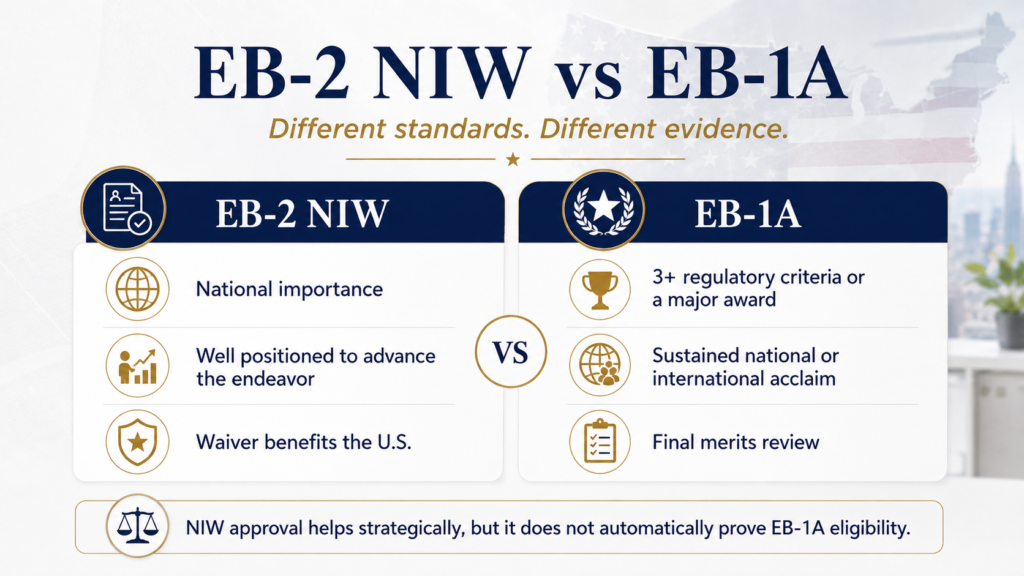
The safest way to evaluate EB-1A readiness is to review three issues:
- Whether you satisfy at least three EB-1A regulatory criteria or have a major internationally recognized award.
- Whether the totality of your evidence can pass the final merits review.
- Whether your achievements show field level recognition beyond ordinary professional success.
Step 1: Understand the EB-1A Standard Before Comparing It to NIW
The first step is to understand that EB-1A and EB-2 NIW are not different versions of the same case. They ask different legal questions.
EB-2 NIW asks whether your proposed endeavor has substantial merit and national importance, whether you are well positioned to advance it, and whether the United States benefits from waiving the job offer and labor certification requirement.
EB-1A asks whether you have extraordinary ability through sustained national or international acclaim and whether your achievements show that you are among the small percentage who have risen to the very top of the field.
For most EB-1A applicants, USCIS first checks whether the applicant meets at least three of the ten regulatory criteria. USCIS then conducts a final merits review to determine whether the full record proves extraordinary ability.
| No. | EB-1A Criterion | What USCIS Looks For |
| 1 | Awards | Nationally or internationally recognized prizes or awards for excellence in the field. |
| 2 | Memberships | Membership in associations that require outstanding achievements, as judged by recognized experts. |
| 3 | Published material about you | Articles or media coverage about you and your work in major media or professional publications. |
| 4 | Judging | Participation as a judge of the work of others in your field or a closely related field. |
| 5 | Original contributions | Original scientific, scholarly, artistic, athletic, or business-related contributions of major significance. |
| 6 | Scholarly articles | Authorship of scholarly articles in professional journals or major media. |
| 7 | Artistic display | Display of work at artistic exhibitions or showcases, where relevant. |
| 8 | Leading or critical role | Leading or critical role for organizations or establishments with distinguished reputations. |
| 9 | High remuneration | High salary or significantly high remuneration compared with others in the field. |
| 10 | Commercial success | Commercial success in the performing arts, where relevant. |
Important: meeting three criteria does not guarantee approval. A petition can satisfy three criteria and still fail if USCIS decides that the overall record does not prove sustained acclaim and top-level standing in the field.
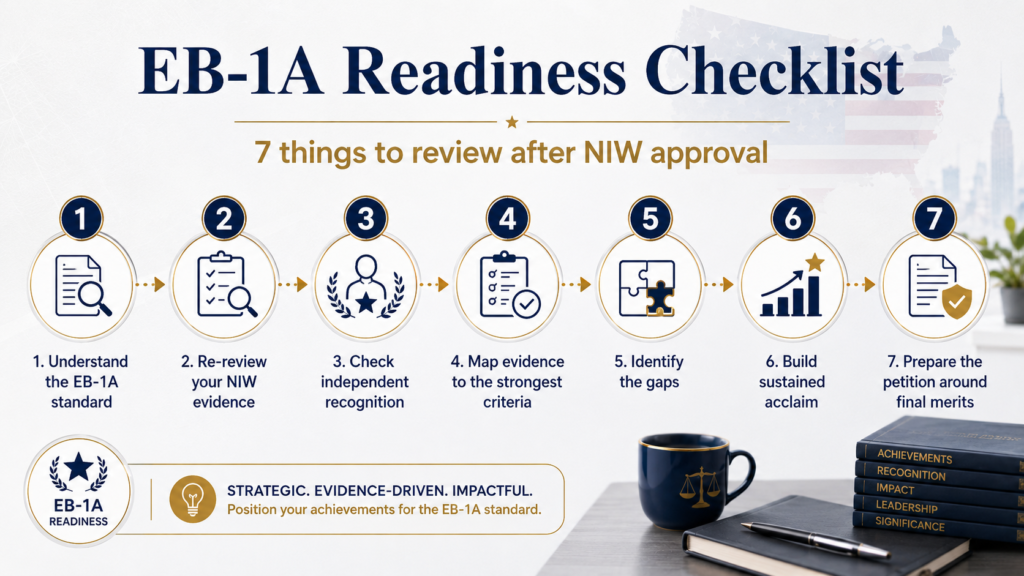
Step 2: Re-Review Your EB-2 NIW Evidence, But Do Not Copy It Blindly
After EB-2 NIW approval, many applicants assume that the same evidence can simply be reused for EB-1A. Some evidence may be useful, but it must be reviewed under the EB-1A standard.
Your NIW file may include valuable evidence such as:
- A clear proposed endeavor.
- Recommendation letters from experts, employers, clients, or collaborators.
- Publications, patents, technical reports, or project documentation.
- Evidence of implementation, adoption, funding, commercial traction, or policy relevance.
- Proof that your work addresses a national problem or priority.
- Documentation of your education, experience, and professional achievements.
For EB-1A, the same documents must answer a different question: do they show that you are recognized as one of the top people in your field?
For example, a project that helped satisfy NIW national importance may also support EB-1A original contributions, but only if you can show major significance. That may require evidence of independent adoption, citations, standards influence, patents used by others, measurable results, media recognition, expert validation, or industry reliance.
Step 3: Check Whether Your Recognition Is Independent and Field-Level
EB-1A requires evidence of sustained national or international acclaim. This does not mean every applicant must be famous to the general public. It means the applicant must show recognized distinction within the relevant field.
Ask yourself:
- Have independent experts recognized your work without being personally connected to you?
- Has your work been cited, adopted, implemented, licensed, funded, or relied on by others?
- Have you received recognized awards or honors with meaningful selectivity?
- Have major media, professional publications, or respected industry outlets written about you or your work?
- Have you judged papers, grants, competitions, awards, or professional work in your field?
- Have you held a leading or critical role for a distinguished organization?
- Can your salary, compensation, or commercial success be compared with reliable field data?
A strong EB-1A case usually includes independent proof. Letters from supervisors, colleagues, or clients can help, but they are stronger when supported by objective evidence outside your immediate professional circle.
Step 4: Map Your Evidence to the Strongest EB-1A Criteria
Do not claim every possible criterion. A focused petition with three to five strong criteria is usually better than a petition that claims many weak criteria. Weak claims can create avoidable RFE issues.
Use this practical evidence-mapping chart:
| NIW evidence | Possible EB-1A use | What may still be needed |
| Publications or technical articles | Scholarly articles; original contributions | Citation context, journal quality, readership, influence, or use by others. |
| Recommendation letters | Support for original contributions, leading role, or final merits | Independent experts, specific facts, and evidence-backed statements. |
| Patents or inventions | Original contributions of major significance | Patent approval, licensing, implementation, commercial use, or industry reference. |
| Project impact evidence | Original contributions; leading or critical role | Proof that the impact was significant beyond one employer or one client. |
| Awards or honors | Awards criterion; final merits | Award reputation, selectivity, judging process, and field relevance. |
| Media coverage | Published material about you | Coverage about the applicant, not only about the company, product, or general topic. |
| Peer review or judging | Judging criterion | Invitations, review records, conference or journal reputation, and volume/quality of judging work. |
| High salary evidence | High remuneration criterion | Reliable comparison data showing compensation above others in the field. |
Step 5: Identify the Gaps Before Filing EB-1A
A common mistake is filing EB-1A too early only because the applicant already has NIW approval. EB-1A should be filed when the record is ready, or when the evidence can be organized into a strong final merits argument.
Common EB-1A gaps after NIW approval include:
- The applicant has strong project work but limited independent recognition.
- The applicant has publications but low citation context or weak explanation of influence.
- The applicant has media coverage, but the coverage is promotional or focused on the company rather than the applicant.
- The applicant has recommendation letters but limited objective documentation.
- The applicant has a senior job title but insufficient proof that the role was critical to a distinguished organization.
- The applicant has awards, but the award criteria, reputation, and selectivity are not documented.
- The applicant has patents but no evidence of use, implementation, or field significance.
Gap filling should be ethical and evidence-based. It should document real expertise, real achievements, and real recognition. It should not manufacture a false profile.
Step 6: Build Sustained Acclaim, Not a One Time Achievement
USCIS looks for sustained national or international acclaim. This means your recognition should not appear isolated or accidental. Your evidence should show a pattern of achievement over time.
Useful ways to document sustained acclaim may include:
- A multi year record of publications, citations, patents, product adoption, or field contributions.
- Repeated invitations to judge, review, speak, advise, or contribute expertise.
- Awards, honors, memberships, or recognition from credible organizations.
- Media coverage or professional coverage showing public or industry attention.
- Letters from independent experts who can explain the importance of your work.
- Evidence that your work influenced others, changed practices, improved outcomes, or supported distinguished organizations.
For applicants moving from EB-2 NIW to EB-1A, the strongest strategy is often to continue building evidence after NIW approval. This may include publishing stronger work, obtaining independent citations, documenting adoption, securing peer-review roles, presenting at respected venues, and collecting better proof of impact.
Step 7: Prepare the EB-1A Petition Around Final Merits
Once you identify your strongest criteria and fill major gaps, the EB-1A petition should be built around a clear final merits theory. The petition should not read like a document dump. It should explain why the evidence, taken together, proves extraordinary ability.
A strong EB-1A petition after EB-2 NIW approval should include:
- A clearly defined field of expertise.
- A short explanation of why the applicant belongs in that field.
- A criteria-by-criteria evidence map.
- Independent proof for each claimed criterion.
- Context explaining the selectivity, significance, or influence of each achievement.
- A final merits section explaining sustained acclaim and top-level standing.
- Evidence that the applicant will continue working in the area of extraordinary ability.
- A concise explanation of how the applicant’s future work will substantially benefit the United States.
The final merits section is especially important. It should connect the evidence into one persuasive professional story: who you are, what you have achieved, who has recognized it, why your work matters in the field, and why your record goes beyond ordinary professional competence.
Example: From EB-2 NIW Approval to a Stronger EB-1A Profile
Consider Dr. Anika Sharma, a data scientist whose EB-2 NIW was approved based on a proposed endeavor involving AI tools for healthcare analytics. Her NIW case focused on national importance: improving healthcare decision-making, reducing inefficiencies, and supporting better patient outcomes.
After NIW approval, she did not immediately file EB-1A. Instead, she strengthened the evidence record. Over the next period, she published additional research, received independent citations, served as a peer reviewer for recognized journals, presented at a respected healthcare-AI conference, received professional media coverage about her work, and documented adoption of one of her methods by external research teams.
At that stage, her EB-1A case was no longer based only on the importance of her proposed endeavor. It was based on independent recognition, original contributions, judging activity, scholarly authorship, and a stronger final merits argument.
This is the correct way to think about EB-1A after EB-2 NIW approval. The NIW approval may be part of the immigration journey, but the EB-1A petition must stand on its own evidence.
How Current Visa Bulletin Trends Affect the EB-1A After NIW Strategy
Visa Bulletin movement is one reason many applicants consider EB-1A after EB-2 NIW approval. In some months, EB-1 may provide a better position than EB-2 for certain countries. In other months, EB-1 may also retrogress. Applicants from India and China should be especially careful because both EB-1 and EB-2 movement can change.
As of the July 2026 Visa Bulletin, EB-1 remains current for many countries, but not for India and China. The Department of State also notes that India EB-2 is unavailable for the remainder of fiscal year 2026. This makes EB-1A strategically important for some applicants, but it does not reduce the EB-1A evidentiary standard.
Before filing, applicants should review the latest Visa Bulletin, current USCIS premium processing rules, and the strength of their evidence. Faster category availability is useful only if the petition is strong enough to approve.
Common Mistakes to Avoid
Avoid these mistakes when evaluating EB-1A after EB-2 NIW approval:
- Assuming NIW approval automatically proves EB-1A eligibility.
- Copying the NIW petition without reframing the evidence for extraordinary ability.
- Claiming too many EB-1A criteria with thin documentation.
- Relying only on recommendation letters without objective proof.
- Using media coverage that is promotional or not clearly about the applicant.
- Treating job title alone as proof of a leading or critical role.
- Ignoring the final merits review.
- Filing only because EB-1 appears faster, without checking the Visa Bulletin and case strength.
How Immignis Can Help
Immignis helps professionals evaluate whether an EB-1A petition may be realistic after EB-2 NIW approval. The process begins with a profile assessment, evidence review, and gap analysis.
Immignis can assist with:
- Reviewing the existing EB-2 NIW approval record.
- Identifying which NIW evidence may support EB-1A criteria.
- Mapping achievements to the EB-1A regulatory framework.
- Creating a profile-building plan where evidence is not yet strong enough.
- Coordinating recommendation and expert letter strategy.
- Organizing evidence for final merits review.
- Preparing a petition narrative that clearly explains extraordinary ability.
The goal is not to force every NIW approved applicant into EB-1A. The goal is to identify whether the profile is ready, whether the evidence can be strengthened, and whether EB-1A is the right strategic next step.
Conclusion
EB-2 NIW approval can be an important foundation, but EB-1A requires a separate and higher level of proof. The EB-1A petition must show sustained national or international acclaim, recognized achievements, and evidence that the applicant is among the small percentage at the top of the field.
If you already have EB-2 NIW approval, the best next step is not to rush. Review your evidence, map it to the EB-1A criteria, identify gaps, build independent recognition, and prepare the petition around a strong final merits argument.
For many professionals, EB-1A after EB-2 NIW can be a powerful immigration strategy. But it should be pursued with careful evaluation, credible evidence, and a clear understanding of the current USCIS standard.
Can I apply for EB-1A after EB-2 NIW approval?
Yes. EB-2 NIW approval does not prevent you from filing EB-1A. However, the EB-1A petition must independently meet the extraordinary ability standard.
Does EB-2 NIW approval make EB-1A easier?
It can help indirectly because some evidence may overlap, but NIW approval does not automatically prove EB-1A eligibility. EB-1A requires sustained acclaim and recognized achievements.
Can I reuse my EB-2 NIW evidence for EB-1A?
Some evidence can be reused, but it must be reframed. NIW evidence usually focuses on national importance and future endeavor. EB-1A evidence must show extraordinary ability, field recognition, and top level standing.
How many EB-1A criteria do I need to meet?
Most applicants must meet at least three of the ten regulatory criteria, unless they have a major internationally recognized award. Meeting three criteria is not enough by itself; USCIS also conducts a final merits review.