

Employment-Based Immigration EB-1 in 2026: EB-1A, EB-1B, and EB-1C Explained
Last Updated on July 9, 2026 by Amelia
Written by Emily Carter, Immigration-Law Specialist
Reviewed by Jonathan Miller, Esq., Licensed U.S. Immigration Attorney
The EB-1 category is the first-preference employment based immigration EB-1 immigrant classification in the United States. It is designed for priority workers whose background, recognition, academic standing, or multinational leadership experience places them in a high-value immigration category.
For qualified applicants, employment based immigration EB-1 can be one of the strongest green card routes because it does not require PERM labor certification. However, EB-1 is not a single category and it is not automatically fast for every applicant. In 2026, applicants must understand the differences among EB-1A, EB-1B, and EB-1C, the evidence required for each, premium-processing rules, and the monthly Visa Bulletin.
This guide explains the EB-1 category in practical terms and corrects common outdated claims, including the idea that EB-1 always has no backlog or that every EB-1 case can lead to a green card within a few months.
Quick answer: Employment based immigration EB-1 is a first-preference employment-based green card category for extraordinary ability professionals, outstanding professors and researchers, and multinational executives or managers. EB-1A allows self-petitioning, while EB-1B and EB-1C require a qualifying U.S. employer petitioner. No EB-1 subcategory requires PERM labor certification, but each has a strict evidence standard and visa availability still depends on the Visa Bulletin.
What Is the EB-1 Visa Category?
EB-1 is an employment-based immigrant category under the first preference classification. It is used by individuals and employers seeking permanent residence for priority workers. EB-1 is divided into three separate subcategories:
- EB-1A: Individuals with extraordinary ability in the sciences, arts, education, business, or athletics.
- EB-1B: Outstanding professors and researchers who are internationally recognized in a specific academic field.
- EB-1C: Certain multinational executives and managers transferring to, or continuing work with, a qualifying U.S. organization.
All three EB-1 subcategories avoid PERM labor certification. That is one of the main advantages of EB-1 compared with many EB-2 and EB-3 employer-sponsored cases. However, avoiding PERM does not mean avoiding scrutiny. USCIS still reviews whether the applicant or beneficiary meets the exact legal standard for the selected EB-1 subcategory.
EB-1A vs. EB-1B vs. EB-1C: Quick Comparison
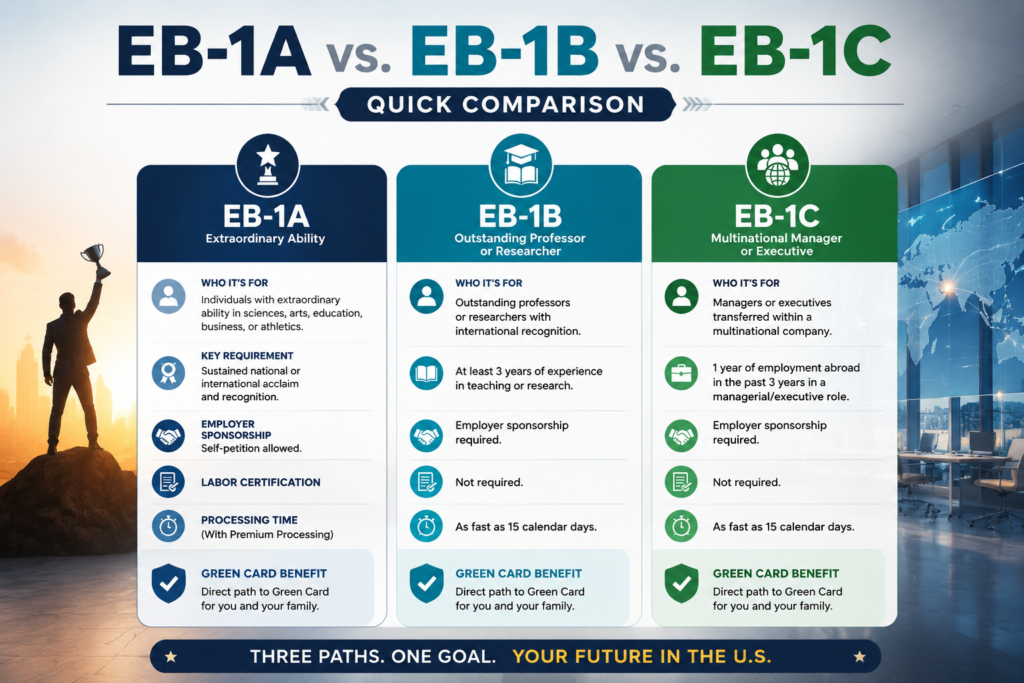
| Feature | EB-1A | EB-1B | EB-1C |
| Main applicant type | Person with extraordinary ability | Outstanding professor or researcher | Multinational executive or manager |
| Self-petition allowed? | Yes | No | No |
| Job offer required? | No | Yes | Yes |
| PERM labor certification? | Not required | Not required | Not required |
| Main proof focus | Sustained national or international acclaim and top-level standing | International recognition as outstanding in an academic field | Qualifying multinational relationship and executive or managerial role |
| Typical petitioner | Applicant may file for themselves | U.S. university, research institution, or qualifying private employer | U.S. employer with qualifying relationship to foreign entity |
| Premium processing timeframe in 2026 | 15 business days if available and properly filed | 15 business days if available and properly filed | 45 business days if available and properly filed |
| Best for | Independent top professionals, researchers, entrepreneurs, artists, athletes, executives, and experts with strong recognition | Academics and researchers with a permanent qualifying U.S. position | Executives and managers moving within multinational organizations |
EB-1A: Extraordinary Ability
EB-1A is for individuals who can show extraordinary ability in their field through sustained national or international acclaim. This is the only EB-1 subcategory that allows a complete self-petition. The applicant does not need a U.S. employer sponsor, job offer, or PERM labor certification.
The legal standard is high. The applicant must show that they are among the small percentage who have risen to the very top of the field. USCIS does not approve EB-1A simply because a person is educated, experienced, or successful. The evidence must show field-level recognition.
How EB-1A Eligibility Is Usually Proven
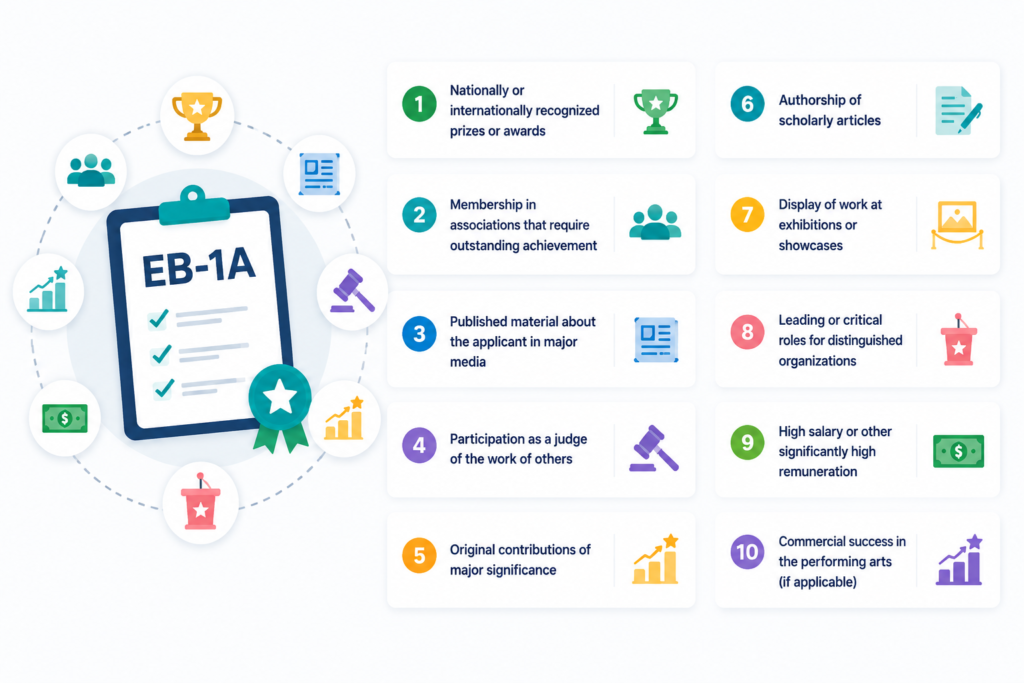
An applicant may qualify through a one-time major internationally recognized award. Most applicants do not have that type of award, so they usually submit evidence under at least three regulatory criteria, followed by a final merits analysis.
- Nationally or internationally recognized prizes or awards.
- Membership in associations that require outstanding achievement.
- Published material about the applicant in professional or major media publications.
- Participation as a judge of the work of others.
- Original contributions of major significance.
- Authorship of scholarly articles.
- Display of work at exhibitions or showcases where applicable.
- Leading or critical roles for distinguished organizations.
- High salary or other significantly high remuneration compared with others in the field.
- Commercial success in the performing arts, where applicable.
Meeting three categories is not enough by itself. USCIS also conducts a final merits review to determine whether the entire record proves extraordinary ability, sustained acclaim, recognition in the field, continued work in the area of expertise, and prospective benefit to the United States.
EB-1B: Outstanding Professors and Researchers
EB-1B is for professors and researchers who are internationally recognized as outstanding in a specific academic field. It is often used by universities, research institutions, and qualifying private employers that want to sponsor highly accomplished academic or research talent for permanent residence.
Unlike EB-1A, EB-1B is not a self-petition. A qualifying U.S. employer must file Form I-140 for the beneficiary. The applicant generally must have at least three years of teaching or research experience in the academic field and must have a qualifying offer of employment, such as a tenured, tenure-track, or comparable permanent research position.
Common EB-1B Evidence
- Major prizes or awards for outstanding achievement.
- Membership in associations requiring outstanding achievement.
- Published material in professional publications written by others about the beneficiary’s work.
- Participation as a judge of the work of others in the same or allied academic field.
- Original scientific or scholarly research contributions.
- Authorship of scholarly books or articles in journals with international circulation.
The strongest EB-1B cases explain not only that the professor or researcher has publications, citations, and recommendations, but why the person is internationally recognized as outstanding in the academic field.
EB-1C: Multinational Executives and Managers
EB-1C is for certain multinational executives and managers. It is commonly used when a foreign company has a qualifying relationship with a U.S. company, such as a parent, subsidiary, branch, or affiliate, and wants to transfer or retain an executive or manager in the United States.
EB-1C does not require PERM labor certification, but it does require a U.S. employer petitioner. The case must show a qualifying multinational relationship, qualifying employment abroad, a qualifying U.S. role, and continued business operations. The U.S. entity generally must have been doing business for at least one year before filing.
Common EB-1C Evidence
- Corporate ownership documents showing the relationship between the foreign and U.S. entities.
- Organizational charts for the foreign and U.S. companies.
- Proof of the beneficiary’s executive or managerial role abroad.
- Proof of the offered executive or managerial role in the United States.
- Business records showing that the U.S. entity is actively doing business.
- Payroll, tax, staffing, contracts, office, and operational evidence.
EB-1C is not simply a business-owner category. USCIS usually examines whether the role is truly executive or managerial, whether the company has sufficient organizational structure, and whether the U.S. position involves high-level decision-making rather than mainly day-to-day operational work.
Key Advantages of the EB-1 Category
- No PERM labor certification is required for EB-1A, EB-1B, or EB-1C.
- EB-1A allows self-petitioning without an employer sponsor.
- EB-1 is a first-preference category and may offer better Visa Bulletin movement than EB-2 or EB-3 for some applicants.
- Premium processing is available for eligible Form I-140 EB-1 filings, although timing differs by subcategory.
- Spouses and unmarried children under 21 may immigrate as derivative beneficiaries if the principal applicant completes the green card process.
- After becoming a lawful permanent resident, an EB-1 green card holder may generally become eligible to apply for U.S. citizenship after meeting the required residence and other naturalization requirements.
Important 2026 Caution: EB-1 Is Not Always Current
Older EB-1 articles often say that EB-1 has no backlog or no quota-based delay. That is no longer safe wording. EB-1 may be current for many countries, but it can still become backlogged for high-demand chargeability areas.
For example, the July 2026 Visa Bulletin shows the EB-1 final action date as current for all chargeability areas except China-mainland born and India. China-mainland born is listed at June 1, 2023, and India is listed at October 15, 2022. The same bulletin also warns about EB-1 retrogression for India. This means applicants should not assume that EB-1 approval automatically permits immediate adjustment of status or immigrant visa issuance.
EB-1 Processing Time and Premium Processing in 2026
The EB-1 process has two separate stages. First, the petitioner files Form I-140 with USCIS. Second, if the I-140 is approved and the priority date is current, the applicant completes the green card stage through adjustment of status in the United States or consular processing abroad. Premium processing can speed up USCIS action on the Form I-140 stage, but it does not guarantee approval and it does not make an unavailable priority date current. USCIS may approve the petition, deny it, issue a Request for Evidence, issue a Notice of Intent to Deny, or take another qualifying adjudicative action within the premium-processing period.
| EB-1 subcategory | Premium processing timeframe in 2026 | Practical note |
| EB-1A | 15 business days | Available for eligible extraordinary ability I-140 filings when properly requested. |
| EB-1B | 15 business days | Available for eligible outstanding professor or researcher I-140 filings when properly requested. |
| EB-1C | 45 business days | Available for eligible multinational executive or manager I-140 filings, but with a longer premium-processing timeframe. |
As of March 1, 2026, the premium-processing fee for Form I-140 requests is $2,965. This fee is separate from the Form I-140 filing fee and any applicable Asylum Program Fee or later adjustment/consular processing costs.
Who Should Consider EB-1A, EB-1B, or EB-1C?
| Profile type | Likely EB-1 route to evaluate | Why |
| Independent researcher, entrepreneur, artist, athlete, executive, or professional with major recognition | EB-1A | Self-petition may be possible if the record proves sustained acclaim and top-level standing. |
| University professor, postdoctoral researcher, principal investigator, or senior researcher with a permanent qualifying U.S. role | EB-1B | Employer sponsorship may work if the person is internationally recognized as outstanding. |
| Executive or manager transferring from a foreign company to a related U.S. entity | EB-1C | Designed for qualifying multinational executive or managerial transfers. |
| Professional with strong national-interest work but limited top-level recognition | EB-2 NIW may be better first | EB-1A may be premature if acclaim and independent recognition are still developing. |
Common EB-1 Mistakes to Avoid
- Assuming EB-1A is easy because it does not require an employer sponsor.
- Counting three EB-1A criteria without explaining the final merits argument.
- Using generic recommendation letters without independent evidence of impact.
- Claiming media coverage when the article is promotional or not mainly about the applicant.
- Submitting memberships that are open to anyone who pays a fee.
- Using awards without explaining selectivity, reputation, and field relevance.
- For EB-1B, failing to show international recognition in the academic field.
- For EB-1C, failing to prove a true executive or managerial role and a qualifying multinational relationship.
- Promising a green card timeline without checking the latest Visa Bulletin.
How Immignis Can Help
Immignis helps professionals, researchers, executives, entrepreneurs, and employers evaluate whether EB-1A, EB-1B, EB-1C, EB-2 NIW, or another immigration strategy is more suitable for the profile.
Our EB-1 strategy work may include profile assessment, evidence mapping, petition structure, recommendation-letter planning, independent expert-letter coordination, USCIS policy alignment, RFE response strategy, and long-term profile-building where the applicant is not yet ready for EB-1A filing.
A strong EB-1 case is not built by simply collecting awards, articles, letters, and job titles. It requires a clear legal theory, credible evidence, and a persuasive explanation of why the applicant or beneficiary meets the exact EB-1 standard.
Conclusion
The EB-1 category remains one of the most valuable employment-based green card pathways in 2026. It offers major advantages, including no PERM labor certification, first-preference classification, and self-petitioning for EB-1A applicants. However, EB-1 is not one simple category and it is not automatically fast for everyone.
EB-1A is strongest for individuals with extraordinary ability and sustained recognition. EB-1B is designed for internationally recognized outstanding professors and researchers with qualifying U.S. employment. EB-1C is designed for multinational executives and managers with qualifying corporate relationships and roles.
The best EB-1 strategy begins with an honest profile assessment, careful evidence review, current Visa Bulletin analysis, and a petition narrative that matches USCIS policy and the applicant’s actual record.
Frequently Asked Questions About EB-1
What are the three EB-1 categories?
The three EB-1 categories are EB-1A for extraordinary ability, EB-1B for outstanding professors and researchers, and EB-1C for multinational executives and managers.
Can I self-petition for EB-1?
You can self-petition only under EB-1A. EB-1B and EB-1C require a qualifying U.S. employer petitioner.
Does EB-1 require PERM labor certification?
No. EB-1A, EB-1B, and EB-1C do not require PERM labor certification.



Comment
Global Talent Visa 2026: US, UK, Australia & EU Comparison
March 25, 2026 - 10:30 am[…] EB-1A category is designed for individuals who demonstrate sustained national or international […]