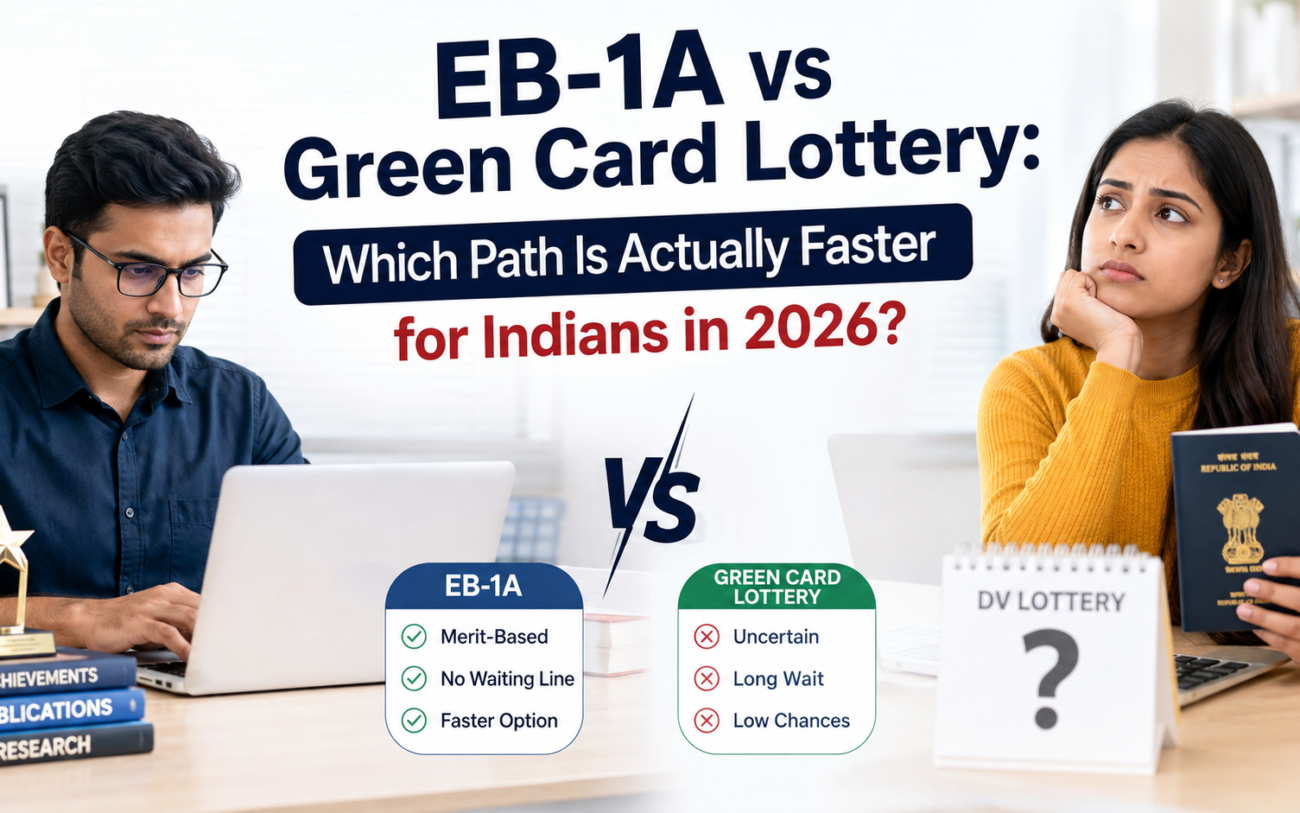
EB-1A vs Green Card Lottery: Which Path Is Actually Faster for Indians in 2026?
For Indian-born professionals facing a 12-plus year EB-2 backlog, the question of the fastest green card for Indians comes up with some regularity: what about the green card lottery? The answer is short and permanent. Indian nationals are categorically ineligible for the Diversity Visa lottery. India has exceeded the annual immigration threshold that determines country eligibility for many years running. Exclusion is determined by country of birth, not citizenship, not visa status, not how long someone has lived in the United States. The EB-1A fastest green card India comparison is not EB-1A versus lottery. It is EB-1A vs EB-2 two merit-based self-petition pathways with fundamentally different queue positions.
That comparison is where the real strategic analysis lives. And for Indian professionals with strong records, the difference in outcomes is measured in years.
The Queue Gap: Why EB-1 Changes the Timeline Math
The per-country cap structure creates separate visa queues for Indian nationals within each employment based preference category. The EB-1 India queue and the EB-2 India queue move at different speeds, driven by different demand volumes and allocation dynamics.
As of 2026, the practical gap between the two queues for Indian applicants is substantial:
| EB-2 India | EB-1 India | |
| Final Action Date (approx. 2026) | Early-to-mid 2012 range | Late 2022 range |
| Wait from a new filing today | 12+ years | ~3-4 years |
| Self-petition available? | Yes (NIW) | Yes (EB-1A) |
| Employer required? | No (NIW route) | No (EB-1A route) |
| Evidence standard | National interest of proposed work | Sustained national or international acclaim |
The gap represents roughly 8-9 years of difference in ultimate timeline. For an Indian professional filing today, qualifying for EB-1A rather than remaining in the EB-2 queue is not a marginal improvement. It is the difference between a 3-4 year path and a 12+ year path to permanent residency.
The critical qualification: EB-1A has a higher evidence standard than NIW. It requires demonstrated extraordinary ability sustained recognition at a national or international level rather than a showing that the proposed work serves the U.S. national interest. For professionals who meet that standard, or can build toward it, the queue differential makes EB-1A the most impactful strategic move in the Indian immigration toolkit.
Priority Date Portability: The Mechanism That Makes the Dual-Track Work
The most powerful feature of the EB-1A strategy for Indian applicants who currently qualify for NIW is priority date portability. Understanding how this works mechanically not just conceptually changes the filing calculus.
What portability means: A priority date established by an approved Form I-140 in one preference category can, under USCIS policy, be carried forward to a new I-140 filing in a different category. The petitioner requests this explicitly at the time of the new filing.
The procedural mechanics: When filing the EB-1A I-140, the petition letter should explicitly state that the petitioner has a previously approved I-140 under EB-2 NIW with an earlier priority date, and request that USCIS recognize that date for the EB-1A petition. A copy of the EB-2 NIW approval notice is included as a supporting exhibit. USCIS then adjudicates the EB-1A petition and, upon approval, assigns the earlier priority date from the EB-2 NIW to the EB-1A I-140.
What this produces: An approved EB-1A I-140 with the priority date from the earlier NIW filing. The petitioner then enters the EB-1 India queue which is currently several years ahead of EB-2 India with a priority date that is 12-18 months (or more) earlier than the current EB-1 India filing date.
A concrete example to illustrate the compounding effect:
- An Indian professional files an NIW I-140 in January 2024. Priority date: January 2024.
- Over the following 18 months, they build toward EB-1A through judging, expert publications, and salary documentation.
- In July 2025, they file an EB-1A I-140 requesting the January 2024 priority date.
- USCIS approves the EB-1A. Assigned priority date: January 2024.
- The EB-1 India Final Action Date in 2026 is in late 2022. The petitioner’s January 2024 date is currently in queue expected to become current in approximately 2027-2028.
- Compare: if this same professional had filed only EB-2 NIW in January 2024, they would be in the EB-2 India queue with a 12+ year wait.
The priority date portability mechanism converts the NIW’s strategic advantage (early priority date capture) into the EB-1A’s strategic advantage (shorter queue) without sacrificing either.
Important limitations: Portability is a discretionary policy, not a statutory right. USCIS has historically honored it consistently, but it is not guaranteed. The earlier I-140 must be approved (not just pending) at the time the new petition is filed. If the earlier I-140 has been withdrawn or revoked, portability is unavailable. These are generally manageable conditions for applicants pursuing the dual-track deliberately.
EB-1B: The Often Overlooked Option for Researchers
Indian professionals in research and academic settings often focus exclusively on EB-1A when evaluating the EB-1 category. There is a second EB-1 pathway that is sometimes more accessible for researchers and is consistently overlooked: EB-1B, Outstanding Researcher or Professor.
EB-1B shares the EB-1 India queue with EB-1A meaning the same shorter wait time applies. The differences:
| EB-1A | EB-1B | |
| Evidence standard | Extraordinary ability (top of field broadly) | Outstanding researcher in a specific field |
| Self-petition? | Yes | No requires employer sponsorship |
| Job offer required? | No | Yes academic or research position |
| Criteria required | 3 of 10 | 2 of 6 specific criteria |
| Who it best serves | Broad professional backgrounds | Research scientists, faculty, postdocs with employer support |
The EB-1B standard “outstanding” rather than “extraordinary” is somewhat lower than EB-1A for researchers with strong publication and citation records. The tradeoff is employer dependency: an EB-1B petition requires a qualifying employer (university, research institution, or private employer with a qualifying research function) to petition on the researcher’s behalf.
For Indian researchers at universities, government labs, or research intensive companies whose employers are willing to sponsor:
- EB-1B may be achievable with a stronger existing record than EB-1A requires
- The same EB-1 India queue position applies
- If the employer has initiated PERM elsewhere, EB-1B can be pursued in parallel without interfering
- Priority date portability from an earlier NIW I-140 applies to EB-1B as well as EB-1A
EB-1B criteria (2 of 6 required):
- Documentation of receipt of major prizes or awards for outstanding achievement in the field
- Membership in associations requiring outstanding achievement for admission
- Published material in professional publications about the petitioner’s work
- Evidence of participation as a judge of others’ work in the field
- Evidence of original scientific or scholarly research contributions
- Evidence of authorship of scholarly books or articles in journals with international circulation
For a researcher with publications, citations, and peer review history, Criteria 4 (judging), 5 (original contributions), and 6 (scholarly articles) may already be documentable requiring only two to file.
The EB-1B option deserves evaluation by any Indian researcher whose employer is willing to file it, before defaulting to EB-1A alone.
The Timeline Math: Dual-Track vs Single-Track
The full value of the dual-track strategy is clearest when the numbers are made explicit. Three scenarios for an Indian professional filing in 2024:
Scenario A EB-2 NIW only:
- File NIW in January 2024. Priority date: January 2024.
- EB-2 India Final Action Date advances approximately 3-5 months per year in normal years.
- January 2024 priority date becomes current: estimated 12+ years, approximately 2036–2037.
- Total path to permanent residency from filing: 12+ years.
Scenario B EB-1A only (filing when record is ready, 18 months from now):
- File EB-1A in July 2025. Priority date: July 2025.
- EB-1 India Final Action Date advances more quickly than EB-2; current date is late 2022.
- July 2025 priority date becomes current: estimated 5-6 years from the EB-1A filing date, approximately 2030-2031.
- Total path from today: approximately 7–8 years (includes the 18-month build period).
Scenario C Dual track (NIW now, EB-1A in 18 months, port the date):
- File NIW in January 2024. Priority date: January 2024.
- File EB-1A in July 2025. Request priority date porting to January 2024.
- EB-1 India queue with January 2024 priority date: estimated current approximately 2027-2028.
- Total path from today: approximately 3-4 years.
The difference between Scenario B (single EB-1A without porting) and Scenario C (dual-track with porting) is roughly 3-4 years generated entirely by the 18 month head start on the priority date. The difference between Scenario A (EB-2 only) and Scenario C is roughly 8-10 years.
These are estimates based on current Visa Bulletin movement rates and historical patterns. Retrogression can extend timelines; spillover can accelerate them. The directional advantage of the dual-track approach is structural and robust to these variations.
Risks of the Dual-Track Strategy

A complete analysis requires acknowledging where the dual-track approach carries risk.
EB-1A denial: If the EB-1A petition is denied, the NIW I-140 remains valid, the NIW priority date is preserved, and the petitioner remains in the EB-2 India queue. The dual-track failure mode is not losing everything it is reverting to the single NIW strategy. This makes the downside of attempting EB-1A very limited for any petitioner who files a credible petition.
EB-1A RFE extending the timeline: A request for evidence on the EB-1A can add several months to adjudication. This does not affect the NIW priority date; it only delays when the EB-1A is approved and when the ported date is formally assigned.
USCIS declining portability: In rare cases, USCIS has questioned priority date portability requests. Having a written record of the earlier I-140 approval and explicitly addressing portability in the petition letter with the supporting approval notice minimizes this risk. An immigration attorney experienced with priority date portability should review the filing.
Retrogression between EB-1A approval and I-485 eligibility: If the EB-1 India Final Action Date retracts before the petitioner’s ported priority date becomes current, the I-485 filing window closes temporarily. This is a risk inherent to any India-specific strategy; it is not unique to the dual-track. Filing the I-485 at the first available window, rather than waiting for a “better” time, is the standard risk mitigation.
Qualifying employer leaves for EB-1B: For researchers pursuing EB-1B, employer changes can affect the petition. This is the specific risk of employer-sponsored pathways a consideration that self-petitioned EB-1A does not carry.
Family Unit Considerations
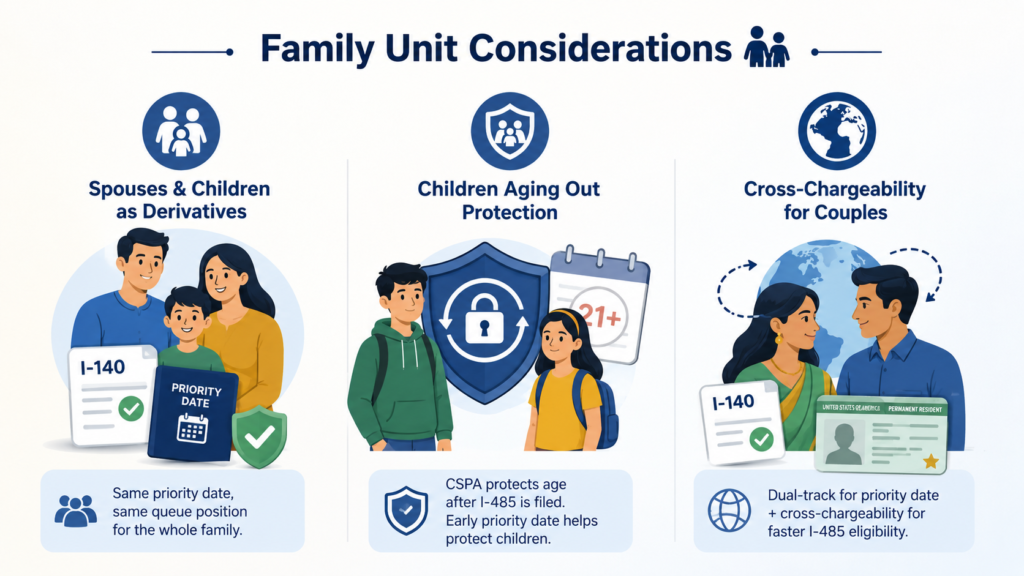
For Indian applicants with families, the timeline implications extend beyond the petitioner.
Spouses and children as derivatives: Derivative spouses and children receive the same priority date as the principal petitioner and benefit from the same queue position. The dual-track strategy improves the timeline for the entire family unit, not just the petitioner.
Children aging out: U.S. immigration law generally protects minor children from aging out of derivative status while an I-485 has been filed and is pending. However, children who have not yet reached the I-485 filing stage when they turn 21 may age out before the priority date becomes current. For parents whose children are approaching their mid-teens, this is a meaningful planning consideration that makes capturing the earliest possible priority date through NIW as the first step especially important.
The Child Status Protection Act provides some relief by allowing children’s ages to be “frozen” in certain circumstances once an I-485 is filed. But the protection requires the I-485 to be filed, which requires a current priority date. Parents who are still in the EB-2 queue when a child approaches 21 may be unable to protect them through this mechanism. Accelerating the priority date through the dual-track strategy directly mitigates this risk.
Cross-chargeability for couples: If the petitioner’s spouse was born in a non-backlogged country, cross-chargeability may provide an even faster I-485 filing path than either EB-1 queue advancement. This option is most effectively combined with the dual-track rather than replacing it: the dual-track provides the EB-1A I-140 and priority date structure; cross-chargeability provides the I-485 filing eligibility. Both are worth evaluating simultaneously with professional guidance.
The Indian Professional’s Strategic Decision Framework
Given everything above, the strategic question for any individual Indian professional is not “EB-1A or NIW?” but “what sequence, given my current record and timeline constraints, produces the best outcome for my family?”
The framework:
If you currently qualify for NIW: File the NIW I-140 immediately. Do not wait. Every month of delay is a month of priority date position lost in a queue measured in years. Begin evaluating EB-1A simultaneously.
If you may qualify for EB-1A within 12–18 months: Run the dual-track. File NIW now for the priority date. Build toward EB-1A. File EB-1A when credible. Port the priority date.
If you are a researcher with an employer willing to sponsor: Evaluate EB-1B in parallel with EB-1A. The lower evidence bar and same EB-1 queue position may make EB-1B achievable earlier.
If your spouse was born outside India, China, Mexico, or the Philippines: Cross-chargeability evaluation is urgent. This may be the fastest available path to I-485 filing eligibility and should be assessed before making any other strategic decision.
If children are approaching their mid-teens: Priority date capture is even more time-sensitive. NIW filing should be treated as urgent regardless of where the EB-1A record stands.
If EB-1A is genuinely 3+ years away: Focus exclusively on NIW for now, capture the best priority date possible, and return to EB-1A evaluation when the professional record has developed.