How a Nigerian battery recycling electrochemist secured EB-1A approval by turning hydrometallurgical recovery methods for lithium-ion batteries, cleared pilot performance records, patents, technical publications, battery conference presentations, standards activity, industrial validation, remuneration evidence, and ethical immigration specific profile building into a petition-ready record of extraordinary ability.
Key facts at a glance
| Petition outcome | Form I-140 approved under EB-1A on March 27, 2025. |
| Professional profile | Nigerian electrochemist developing recovery methods for lithium, nickel, cobalt, graphite, and other valuable materials from spent electric-vehicle and energy-storage batteries. |
| Field niche | Hydrometallurgical recycling of lithium-ion battery materials. |
| Starting weakness | The recovered material yields were commercially valuable, but the strongest evidence remained inside pilot plants, industrial partnerships, protected process records, and confidential testing reports. |
| Profile-building focus | Cleared recovery performance documentation, patent and invention records, electrochemistry publications, battery conference presentations, standards working-group roles, industrial validation letters, project attribution, and remuneration benchmarking. |
| Principal EB-1A evidence areas developed | Original contributions of major significance, authorship of scholarly articles, leading or critical role, qualifying published material, and high salary or other significantly high remuneration where supported. |
| Central issue | Showing that the petitioner did not merely operate a recycling process, but helped develop technically significant recovery methods capable of converting end-of-life batteries into reusable sources of critical materials. |
| Approval lesson | Confidential industrial chemistry can support EB-1A when recovery performance, inventorship, adoption, technical authorship, professional recognition, and compensation are documented in a disclosure-safe and personally attributable record. |
The strongest evidence was inside the pilot plant
The petitioner’s achievements were not difficult to understand because they lacked value. They were difficult to document because the most persuasive proof was commercially sensitive. Recovery yields, reagent conditions, impurity profiles, process sequences, pilot scale results, and production economics were recorded inside industrial systems rather than public articles.
This created a familiar problem in applied electrochemistry. A method may recover valuable battery materials more efficiently, reduce waste, or improve material purity, yet the scientist responsible may remain invisible behind a company, pilot program, patent portfolio, or confidential technical team. The process is visible through what it produces. The person is not.
USCIS approved the Form I-140 petition on March 27, 2025. Immignis and Advance My Profile organized the case around a practical question: how could the petition show the significance of the petitioner’s recovery science without exposing protected process details or claiming credit that belonged to a larger industrial team?
Why battery recycling creates an unusually technical EB-1A evidence problem
Lithium-ion battery recycling sits between electrochemistry, extractive metallurgy, materials science, chemical engineering, waste management, and manufacturing quality. A hydrometallurgical process may involve pretreatment, leaching, solution purification, selective precipitation, solvent extraction, metal recovery, graphite treatment, and management of residual streams.
The technical contribution is rarely captured by a single public metric. Recovery percentage alone may say little if the resulting material has poor purity, excessive reagent use, difficult waste streams, or no path back into battery production. Pilot scale performance may matter more than laboratory promise, but pilot data is also more likely to be restricted.
The petition therefore defined the field precisely as hydrometallurgical recycling of lithium-ion battery materials. This was narrower and more useful than describing the petitioner as a general chemist or recycling engineer. It gave USCIS a coherent framework for evaluating patents, recovery records, publications, industrial letters, conference roles, and remuneration evidence.
Cleared recovery performance documentation made confidential results reviewable
The central evidentiary task was to convert protected pilot results into material USCIS could evaluate. The petition used disclosure cleared summaries, redacted records, authorized technical descriptions, performance ranges, process diagrams without proprietary settings, and letters from people with direct knowledge of the work.
Each item had to answer several questions. What battery material or waste stream was being processed? What technical barrier existed? What part of the method did the petitioner develop, refine, or validate? What result was observed? Why did the organization consider that result important?
The record avoided unsupported precision. Where exact yields, reagent concentrations, costs, or impurity levels could not be disclosed, the evidence explained the improvement in a form that remained meaningful without revealing protected information. Confidentiality narrowed the description; it did not erase the achievement.
Inventorship separated original chemistry from routine operation
Patent and invention records helped distinguish the petitioner from professionals who only implemented an established process. The petition mapped the petitioner’s role in identifying a technical problem, designing an experimental approach, selecting or modifying process chemistry, interpreting results, and contributing to a protectable solution.
A patent was not treated as self proving evidence of major significance. Inventorship established a public link between the petitioner and an original technical concept. Additional evidence was still needed to show whether the invention addressed an important problem, advanced beyond routine work, attracted industrial interest, or influenced subsequent development.
Where several inventors were listed, the record explained the petitioner’s contribution without overstating exclusive ownership. This was especially important in a field where electrochemists, process engineers, materials scientists, and plant teams may contribute different parts of the same recovery system.
Pilot scale validation showed that the work moved beyond laboratory possibility
A laboratory result can demonstrate scientific promise. Pilot performance begins to show whether the method can survive larger volumes, variable feedstock, contamination, repeated cycles, equipment limitations, safety requirements, and quality control demands. The petition treated that transition as an important part of the petitioner’s professional influence.
Industrial validation letters explained which aspects of the work were tested, why the petitioner’s judgment was relied upon, and how the method affected recovery, purity, process stability, waste handling, or commercial evaluation. The strongest letters identified direct knowledge rather than offering general praise.
This evidence helped show that the petitioner’s contributions were not isolated experiments. They had become part of a serious technical effort to recover materials that could re-enter manufacturing or reduce dependence on newly extracted resources.
Publications translated proprietary chemistry into a scholarly record
The publication record gave USCIS a public route into the science. Articles on leaching chemistry, selective separation, impurity control, material recovery, graphite treatment, process optimization, or life-cycle performance helped demonstrate authorship and technical depth.
The papers did not need to disclose the petitioner’s employer-specific process. Strong scientific writing could explain underlying mechanisms, comparative methods, analytical findings, or non-confidential lessons from battery recycling. This allowed the petitioner to build a legitimate scholarly identity while respecting contractual and intellectual property limits.
The petition kept authored articles separate from published material written about the petitioner. Publications supported the scholarly articles criterion because the petitioner wrote them. Independent reporting, profiles, or trade coverage could support published material when it genuinely discussed the petitioner and the petitioner’s work.
Conference presentations created professional visibility outside one company
Battery and electrochemistry conferences helped move the record beyond confidential internal work. Presentations, invited talks, technical panels, and specialist sessions gave the petitioner an opportunity to explain non-proprietary findings to professional audiences and demonstrated that the expertise was relevant beyond one pilot program.
The petition documented the nature of each role rather than listing event attendance. An invited technical presentation, competitively selected paper, panel assignment, or conference faculty role carried more weight than registration alone. Programs, invitation records, abstracts, recordings, and organizer letters helped establish the petitioner’s actual participation.
These platforms also strengthened final merits by showing a developing pattern: the field relied on the petitioner not only to perform technical work, but also to communicate, explain, and evaluate battery recycling science.
Standards and working group roles showed trust in technical judgment
Battery recycling is shaped by questions of material characterization, safety, quality, transport, reuse, traceability, environmental performance, and compatibility with manufacturing requirements. Technical committees and working groups can therefore be meaningful when participation depends on relevant expertise and involves substantive review or development work.
The petition documented what the group did, how the petitioner was selected, which technical responsibilities were assigned, and whether the role involved reviewing methods, data, proposed practices, or other professionals’ work. The evidence did not assume that every professional association or committee membership met an EB-1A criterion.
Where the role reflected peer evaluation or achievement-based selection, it supported the argument that other specialists trusted the petitioner’s technical judgment. Where it did not meet a regulatory criterion, it still provided useful context for the petitioner’s standing and continued activity in the field.
High remuneration required a field-specific comparison
Compensation evidence can be persuasive only when the comparison is meaningful. The petition did not rely on a large number in isolation. It compared the petitioner’s salary or total remuneration with appropriate professionals in a similar occupation, geography, career stage, and industrial setting, while explaining bonuses, allowances, equity, or other compensation where relevant.
This was particularly important in a specialized field spanning research, pilot operations, manufacturing, and intellectual property. A general salary average for chemists would not necessarily reflect the market for an electrochemist trusted with high value battery recovery development.
Remuneration therefore functioned as supporting evidence of market recognition. It did not replace proof of original contribution, authorship, or critical responsibility, but it helped show that the petitioner’s expertise commanded unusual professional value.
Critical-minerals framing explained why recovered material mattered
The case did not present recycling as a generic environmental activity. It explained the technical and industrial significance of recovering lithium, nickel, cobalt, graphite, and other battery materials in forms suitable for further refining or reuse. Spent batteries were framed as concentrated material resources rather than only as waste requiring disposal.
That framing made the petitioner’s niche understandable to a non-specialist adjudicator. The value of the work was not limited to reducing discarded material. Effective recovery methods can preserve valuable inputs, support more resilient supply chains, and improve the practical sustainability of battery-dependent industries.
The petition still connected that broad relevance to personal evidence. The importance of critical minerals did not automatically establish extraordinary ability. The record had to show what the petitioner personally developed, authored, validated, presented, or led.
The final merits case was built from several different forms of recognition
No single document established the entire case. Cleared pilot records showed measurable technical work. Patents linked the petitioner to original inventions. Publications showed scholarly authorship. Industrial letters established reliance and attribution. Conferences and working groups demonstrated recognition outside the immediate employer. Compensation evidence showed market value.
Together, those materials addressed the larger final-merits question: whether the petitioner’s record, viewed as a whole, showed sustained acclaim and placement among the small percentage at the top of the field. The argument was strongest because each category did a different job and the evidence converged on the same narrow professional identity.
Why this case worked
The field was defined precisely. Hydrometallurgical recycling of lithium-ion battery materials connected the chemistry, process data, patents, pilot work, publications, industry recognition, and remuneration evidence into one professional record.
Confidentiality was addressed instead of ignored. The petition used cleared summaries, redactions, authorized letters, and non-proprietary explanations rather than making unsupported claims about inaccessible results.
The record distinguished invention from implementation, laboratory promise from pilot validation, authored papers from coverage about the petitioner, ordinary membership from selective professional recognition, and compensation from the technical accomplishments that gave it meaning.
Most importantly, the petition converted a hidden industrial contribution into a personally attributable story: spent batteries contained valuable materials, the recovery problem was technically difficult, and other professionals relied on this electrochemist’s methods and judgment to move the work forward.
What battery and materials scientists can learn from this approval
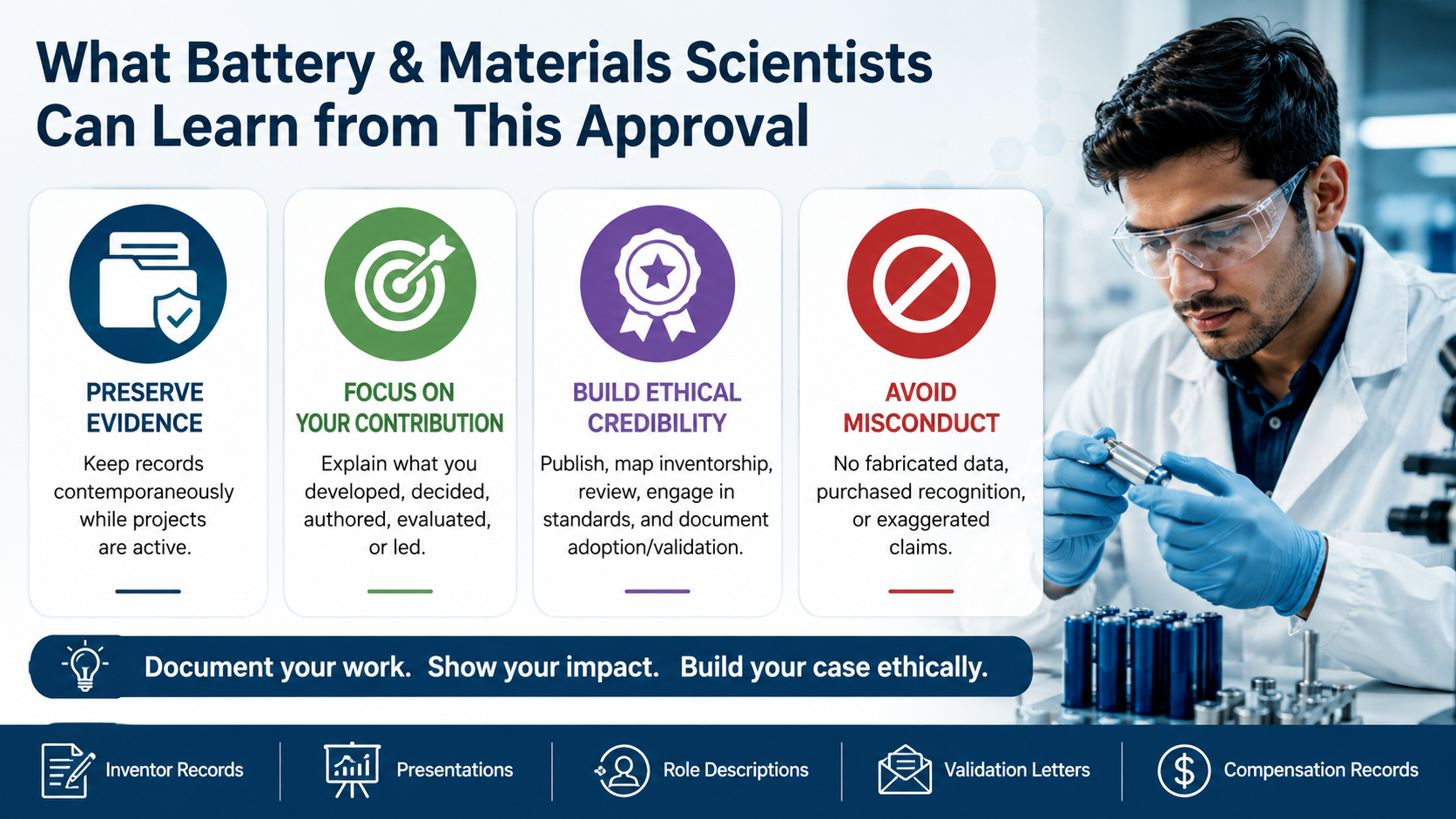
Professionals in confidential industries should preserve evidence while projects are active. Inventor records, approved technical summaries, protocol histories, presentation materials, role descriptions, validation letters, and compensation records are much easier to use when they are created contemporaneously.
Scientists should also separate product or company success from personal contribution. A valuable pilot program or patented process is not automatically evidence of extraordinary ability. The petition must explain what the individual developed, decided, authored, evaluated, or led.
Ethical profile building should make real work visible. It may include legitimate technical publication, accurate inventorship mapping, conference participation, peer review, standards activity, and careful documentation of adoption or validation. It should never depend on fabricated data, purchased recognition, or exaggerated claims of sole responsibility.
Frequently asked questions
Can a battery recycling electrochemist qualify for EB-1A?
Yes. EB-1A is available across the sciences and engineering. The evidence must satisfy the regulatory framework and, viewed as a whole, show sustained acclaim and that the person is among the small percentage at the top of the defined field.
Can confidential pilot plant data be used in an EB-1A petition?
Potentially. Redacted records, disclosure cleared summaries, authorized technical descriptions, and letters from knowledgeable professionals may be used when they remain specific enough to show the petitioner’s role and the significance of the work.
Does a patent automatically prove an original contribution of major significance?
No. A patent can establish inventorship and originality, but additional evidence is usually needed to show significance, such as adoption, validation, licensing, industrial reliance, technical impact, or independent expert explanation.
Can pilot-scale results be stronger than laboratory results?
They can be highly persuasive because pilot testing addresses scale, variability, equipment constraints, safety, repeatability, and product quality. The result still needs reliable documentation and a clear link to the petitioner.
How can an electrochemist prove a leading or critical role?
The record should identify the distinguished organization or project, the technical responsibilities assigned to the petitioner, the decisions that depended on the petitioner’s expertise, and the consequences of that work for the program.
Do conference presentations help an EB-1A case?
Yes, especially when the petitioner was invited, competitively selected, given a substantive technical role, or asked to speak because of recognized expertise. Attendance alone is less persuasive.
Can standards or working group participation support EB-1A?
It can help when the role reflects achievement-based selection, technical review, peer evaluation, or significant responsibility. Ordinary participation or open membership should not be overstated.
How is high remuneration evaluated?
USCIS generally needs a relevant comparison. The evidence should account for occupation, location, experience, industry, and total compensation rather than relying on a salary figure without context.
What is the difference between scholarly articles and published material?
Scholarly articles are works authored by the petitioner. Published material generally refers to qualifying coverage written about the petitioner and the petitioner’s work. They should be documented separately.
Can industrial validation letters prove major significance?
They can be important when the writers have direct knowledge and explain the technical problem, the petitioner’s contribution, the validation performed, and why the result mattered. General praise is less useful.
Does EB-1A require a permanent U.S. job offer or labor certification?
No. EB-1A does not require a permanent job offer or labor certification, and an eligible person may self-petition. The person must still intend to continue working in the area of extraordinary ability in the United States.
How can ethical profile building help a scientist whose strongest work is confidential?
It can organize existing evidence, improve attribution, develop lawful public-facing publications, preserve inventorship and role records, document validation, and build legitimate professional visibility without revealing protected information or manufacturing acclaim.
Make the chemistry behind recovered materials visible
A strong battery recycling record may already exist across pilot reports, invention disclosures, patents, laboratory notebooks, cleared process summaries, conference programs, publications, committee records, compensation documents, and the testimony of professionals who relied on the work.