
Can a Mid-Career Professional Win an EB-1A Without Being World Famous?
The psychological barrier to EB-1A is almost always the label. “Extraordinary ability” creates an immediate mental reference point Nobel laureates, Olympic athletes, the kind of professionals whose names appear in the first paragraph of their Wikipedia articles. That reference point is wrong, and it causes qualified professionals to self-select out of a category they could credibly pursue.
This article is not a guide to EB-1A criteria or evidence documentation those are covered in detail elsewhere. This is a guide to a specific question: can a mid-career EB-1A applicant with a strong but non-famous record actually win an EB-1A? The honest answer is yes, regularly, and understanding why requires dismantling several specific myths that keep qualified people from evaluating the pathway seriously.
What “Extraordinary Ability” Actually Means in Adjudication
The regulatory language is precise: extraordinary ability means a level of expertise indicating that the person is one of that small percentage who have risen to the very top of their field. Every word in that phrase matters.
“Small percentage” does not mean one in a million. It does not mean nationally recognized. It does not mean someone who appears on conference keynote stages or gets quoted in the New York Times. In practice, USCIS officers apply this standard relative to the population of practitioners in the relevant field and “top of the field” in most professional fields means roughly the top 5–15% of active practitioners, as documented through evidence of recognition, compensation, influence, and standing.
“Their field” is narrowly interpreted. This is one of the most important and least discussed features of the standard. USCIS does not evaluate whether the petitioner is among the top engineers in the world. It evaluates whether the petitioner is among the top practitioners in their specific area of work. A senior engineer specializing in cryptographic protocol design for satellite communications does not need to be the top aerospace engineer in the country they need to be demonstrably above most practitioners in cryptographic protocol design for satellite communications. This field segmentation can make EB-1A accessible to professionals who would dismiss the category immediately if they thought it required industry-wide fame.
“Who have risen to” implies current documented standing, not career peak. An officer evaluating a petition in 2026 is asking whether this professional currently occupies extraordinary standing, not whether they once did or might someday. This distinction matters in both directions: a senior professional whose recognition has faded carries weaker evidence than their reputation might suggest, and a mid-career professional at the current peak of their field relevance may carry stronger evidence than their career length would imply.
The Mid-Career Advantage: Why This Stage Is Often Optimal

Most professionals assume the EB-1A pathway becomes more accessible as careers lengthen. This is not consistently true. Three structural features of EB-1A adjudication favor mid-career professionals specifically.
Recognition currency. The evidence that matters for EB-1A is current, active recognition not a record of past achievements that the field has moved on from. A mid-career professional who is actively publishing, actively being invited to evaluate others’ work, and actively sought for expert commentary is presenting evidence with strong currency. A more senior professional who completed their most significant work fifteen years ago and whose current professional activity is reduced may have an impressive CV and a weaker EB-1A case.
Field relative positioning at a credible threshold. In most technical fields, reaching the top 10% of a subfield is achievable within 10-15 years for professionals who have pursued a focused area of specialization. A professional who has spent a decade building genuine expertise in a specific problem domain and who has been recognized for it by peers outside their organization often occupies the kind of field relative standing that EB-1A measures, even if their name is not widely known outside that domain.
The documentation inflection point. Many professionals first become documentable as above average practitioners around the mid-career stage: this is when senior editorial boards start trusting them as peer reviewers, when compensation reaches upper distribution levels, when their organizations start making decisions that depend on their specific judgment. The evidence architecture of EB-1A maps well onto what the mid-career stage naturally produces.
The Myths That Keep Mid-Career Professionals Out
Several specific misconceptions cause qualified mid-career professionals to dismiss EB-1A before evaluating it honestly.
Myth: You need major awards to qualify.
Reality: Criterion 1 (prizes and awards) is one of ten criteria and is not required. Many successful EB-1A petitions are built entirely on combinations of judging history, critical role evidence, salary documentation, original contributions, and published material. A professional without a single named award can have a stronger EB-1A case than one with multiple industry recognitions, if the award holder’s other evidence is thin.
Myth: Your employer needs to be a prestigious company.
Reality: Criterion 8 requires the organization to be “distinguished” but distinguished in its field, not necessarily famous outside it. A specialized engineering firm that holds a significant position in its industry niche, a healthcare technology company with documented market standing, or a research institution recognized within its domain all satisfy the organizational distinction requirement. USCIS does not require Silicon Valley employer names.
Myth: You need to be widely recognized across your whole industry.
Reality: See above on field segmentation. “Top of field” is evaluated within the specific area of the petitioner’s work. A professional who is among the most recognized practitioners in a specific technical niche even a narrow one satisfies the standard. The evidence must show above average standing within that niche, not industry-wide fame.
Myth: EB-1A is only realistic for academics and researchers.
Reality: The regulatory criteria include salary, critical role, media coverage, and judging none of which require academic credentials or research publication records. Senior practitioners in industry, technology, finance, medicine, and other professional fields regularly qualify. The evidence looks different from an academic profile, but the standard applies equally.
Myth: Without publications and citations, there’s no path.
Reality: Citations and publications serve Criteria 5 and 6 and can contribute to final merits, but they are not the only path to meeting the threshold or building a coherent merits case. Many strong EB-1A petitions from industry professionals are built entirely on non-publication evidence: salary, organizational role, judging, media authority, original contributions with deployment evidence.
The Field Segmentation Principle in Practice
The way USCIS defines “field” in final merits review is more specific than most applicants realize, and understanding it changes who should be evaluating EB-1A.
A petitioner does not need to be extraordinary in “engineering” or “medicine” or “finance.” They need to be extraordinary in their specific area of focus within that field the specific problem domain, methodology, or subspecialty where their expertise is concentrated.
This matters practically for three reasons:
The comparison group shrinks. Being in the top 10% of all engineers in the United States is an extraordinarily high bar. Being in the top 10% of engineers specializing in real time systems for autonomous vehicle perception is a different and potentially achievable standard. The smaller the comparison group, the more concentrated expertise can be, and the more visible above average standing becomes.
Evidence of recognition is more legible. An invitation to serve on a program committee for a conference focused specifically on the petitioner’s subspecialty, a journal in that exact subfield, or a grant panel for research in that exact problem domain is more credible evidence of recognized standing than generic participation in a large professional society.
The narrative is more coherent. A petition that builds its final merits argument around a specific, well-defined area of expertise creates a more legible picture of above average standing than one that ranges across multiple domains. Officers are looking for clarity about who this person is in their field; a narrowly defined but deeply documented area of expertise provides it.
The practical implication: mid-career professionals who have spent years developing genuine depth in a specific area rather than breadth across many areas are often better positioned for EB-1A than their immediate self-assessment suggests.
Distinguishing “Competent Professional” from “Extraordinary Standing”
This is the question at the center of every mid-career EB-1A self-assessment: am I genuinely in the range for this, or am I a strong professional who doesn’t quite meet the standard?
The honest answer is that the distinction is not always obvious from inside a career. Most professionals have limited visibility into how their standing compares to peers outside their immediate professional circle. The following indicators tend to differentiate “competent senior professional” from “documentable extraordinary standing.”
Indicators that suggest extraordinary standing may be documentable:
- Being sought out for peer review, expert commentary, or advisory roles by parties who independently found the petitioner’s work rather than being recruited through professional networks
- Compensation consistently in the upper quartile of the documented range for the occupation and geographic market
- Contributions methodologies, tools, systems, frameworks that others have adopted and that those adopters can document specifically
- Leadership in a function or project where, if asked, the organization’s leadership could articulate specifically what would have been different without this person
- Recognition in publications or media that the petitioner did not initiate or arrange
Indicators that suggest waiting and building makes more sense:
- Recognition comes primarily from within the petitioner’s own organization
- Compensation is slightly above average but not consistently in upper distribution territory
- Judging activities are minimal or undocumented
- The petitioner cannot name a specific contribution that others have adopted or that the field has engaged with
- The petitioner’s professional reputation does not extend meaningfully outside their current employer and immediate professional network
Neither list is definitive. A professional who recognizes themselves in the second list is not disqualified they are describing a build gap that can be addressed over 12-18 months with deliberate effort. A professional who recognizes themselves in the first list has evidence that is worth formally evaluating.
Career Stage Scenarios: When the Transition Happens
The following scenarios illustrate how the transition from “strong but not ready” to “credibly extraordinary” typically looks across professional backgrounds. These are composite illustrations, not specific cases.
Scenario 1: The Senior Engineer at Year 10
At year seven, a software engineer specializing in distributed systems security has a solid record: strong performance reviews, above-average compensation, a few conference presentations. They are good. Nothing in their record yet establishes above-average standing outside their employer.
At year ten, the picture has changed. Two years of systematic peer review for two indexed security journals initiated by contacting the editorial boards has produced 22 completed reviews and an editorial board position at one journal. Their compensation, documented against BLS percentile data and Levels. fyi survey data, sits at the 88th percentile. A technical architecture they designed has been implemented by three named financial institutions, documented in letters from those institutions confirming the adoption. A trade publication covered their approach in a feature piece after an independent editor reached out.
Year seven: strong professional. Year ten: documentable extraordinary standing in distributed systems security, supported by independent recognition across multiple dimensions.
Scenario 2: The Healthcare Executive at Year 12
At year nine, a clinical informatics director has an impressive job history and is widely respected within their organization. Their professional reputation beyond their employer is limited. Nothing ties their work to above-average standing in the broader field.
By year twelve, deliberate professional positioning has changed the evidence. They pursued and received fellowship designation in a clinical informatics society that requires peer-nominated election. Their compensation, compared against specialty compensation data for the health IT field, sits above the 85th percentile. A profile piece in a respected health IT publication grew from an interview the publication requested after covering their organization’s digital transformation. Two advisory board positions at peer healthcare organizations create external organizational evidence. The combination tells a coherent story about a professional whose standing has extended beyond their employer.
The pattern in both scenarios: The transition is not about becoming more accomplished in an absolute sense. It is about building documented recognition from independent external sources that, read together, create a legible picture of above-average standing. The underlying expertise in both scenarios existed before the build period. What changed was the documentation of that expertise’s recognition outside the immediate employer.
How to Build the Narrative Thread
The final merits argument in an EB-1A petition is not the sum of its criteria. It is a single argument about a specific professional and their specific standing in a specific area of work, supported by criteria that mutually reinforce that argument.
Building the narrative thread means answering one question explicitly and specifically: why is this professional among the small percentage at the top of their area of work, and what credible independent sources recognize that?
The answer should be expressible in two to three sentences:
“[Petitioner] is among the leading practitioners in [specific area] in the United States, as evidenced by independent invitations to evaluate the work of others in the field [Criterion 4], compensation consistently above the 90th percentile for this occupation [Criterion 9], and organizational reliance on their specific judgment documented by leadership at [organization] [Criterion 8]. This standing is not self-assessed it is reflected in the recognition of external parties who had no obligation to recognize them.”
That argument, once articulated, should govern:
- Which criteria are claimed
- How each piece of evidence is selected and framed
- What the petition letter argues
- What each expert letter is asked to address
A petition built around a clear through line reads differently from one where the criteria evidence is presented independently. Officers reading the former experience a coherent case for extraordinary standing. Officers reading the latter experience a collection of credentials that they are being asked to assemble into an argument themselves which is not their job.
When to Evaluate, When to Build, When to File
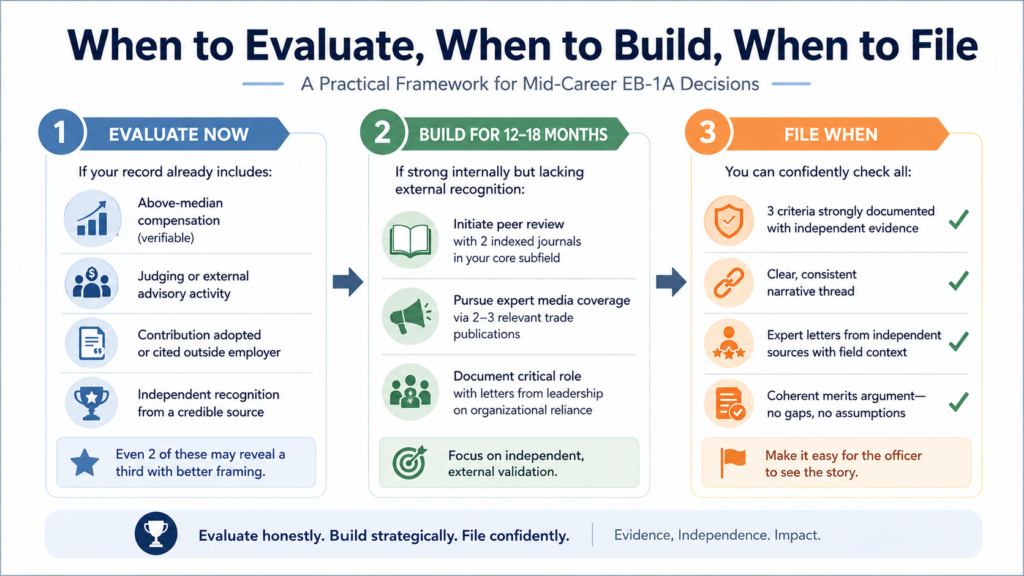
The practical framework for mid-career EB-1A decisions follows three stages.
Evaluate now if the record already includes: above median compensation (verifiable with comparative data), some judging or external advisory activity, at least one contribution that others outside the employer have adopted or cited, and any independent recognition from a credible external source. Even if only two of these are present, an honest assessment of the full record may reveal a third criterion that is documentable with better framing.
Build for 12-18 months if the record is strong within the employer but lacks external independent recognition. The most efficient activities: initiate peer review with two indexed journals in the core subfield, pursue expert media coverage through targeted outreach to two or three relevant trade publications, document the existing critical role with letters from leadership who can speak to organizational reliance specifically.
File when three criteria are strongly documented with independent evidence, the narrative thread is clear and articulated, expert letters are drafted by genuinely independent sources who can contextualize the evidence in field terms, and the final merits argument is coherent without requiring the officer to infer connections the petition doesn’t make explicit.
Frequently Asked Questions
Can mid-career professionals qualify for EB-1A?
Yes. The standard evaluates current documented standing within a specific field segment relative to peers not lifetime achievement or public profile. Mid-career professionals who have developed recognized expertise in a specific area and can document that recognition through independent sources regularly satisfy the extraordinary ability standard.
Do you need to be famous for EB-1A?
No. The standard requires being among the small percentage at the top of the field, as demonstrated by documented independent recognition. Fame public profile, name recognition outside professional circles is not the measure. Documented field-relative standing is.
What does "field" mean in EB-1A adjudication?
USCIS evaluates standing within the petitioner's specific area of expertise, not their broad professional category. An engineer specializing in photonic integrated circuit design is evaluated relative to that specific subfield, not relative to all engineers. This narrower comparison group makes above-average standing more achievable for professionals who have developed genuine depth in a specific domain.
Is mid-career actually a good time to file, or is later better?
Mid-career is often optimal, not just adequate. Recognition currency the extent to which current professional activity generates active external recognition tends to peak in mid-career when practitioners are most active and their contributions most recently relevant. Later-career professionals may have more accomplishments but weaker current evidence if their activity level has reduced.
What if my professional reputation is mostly internal to my employer?
Internal reputation does not establish EB-1A extraordinary standing not because internal recognition is not real, but because it does not demonstrate standing relative to the broader field. The strategy is to build external recognition through judging, expert media presence, advisory roles, and contribution evidence that external parties can document. Most professionals need 12–18 months of deliberate external-facing activity to create the independent recognition base that EB-1A requires.
What is the most common reason mid-career EB-1A petitions fail?
The most common failure is building a threshold case satisfying three criteria technically without building a merits case. The final merits determination asks whether the evidence as a whole demonstrates extraordinary standing. Three criteria that each barely qualify, supported by weak documentation from insider sources, satisfies the threshold and fails the merits review. Three strong, independently documented criteria that all point to the same coherent narrative typically succeeds.
Can I file EB-1A and NIW at the same time?
Yes. Pursuing both simultaneously is common and strategically sound. Filing an NIW I-140 immediately captures an early priority date that can be ported to an EB-1A petition when it is filed. The EB-1 India queue is substantially shorter than the EB-2 India queue for Indian applicants, making this dual-track approach particularly valuable.
What is the difference between a "leading" and a "critical" role?
These are legally distinct under Criterion 8. A leading role means the petitioner was at the forefront of the organization a director, principal, or head. A critical role means the petitioner's contribution was essential to organizational success regardless of formal title. Both satisfy the criterion; both require documentation that establishes the specific nature of the standing, not just title or employment history.
How does this differ from what the EB-2 NIW requires?
The NIW is a forward-looking standard it evaluates what the petitioner's proposed work will do for the United States. EB-1A is a backward-looking standard it evaluates what the petitioner has already achieved and how that achievement has been recognized. A strong NIW petition leads with the proposed endeavor's national benefit. A strong EB-1A petition leads with documented evidence of extraordinary current standing.
How long does it realistically take for a mid-career professional to go from assessment to filing?
For professionals who already have documentable evidence across two or three criteria, three to six months of organization and documentation preparation is realistic. For professionals who need to build evidence particularly judging history twelve to eighteen months is the typical timeline for developing a credible record. The most time-efficient investment is usually initiating peer review activity immediately, as this is the most deliberately buildable criterion.