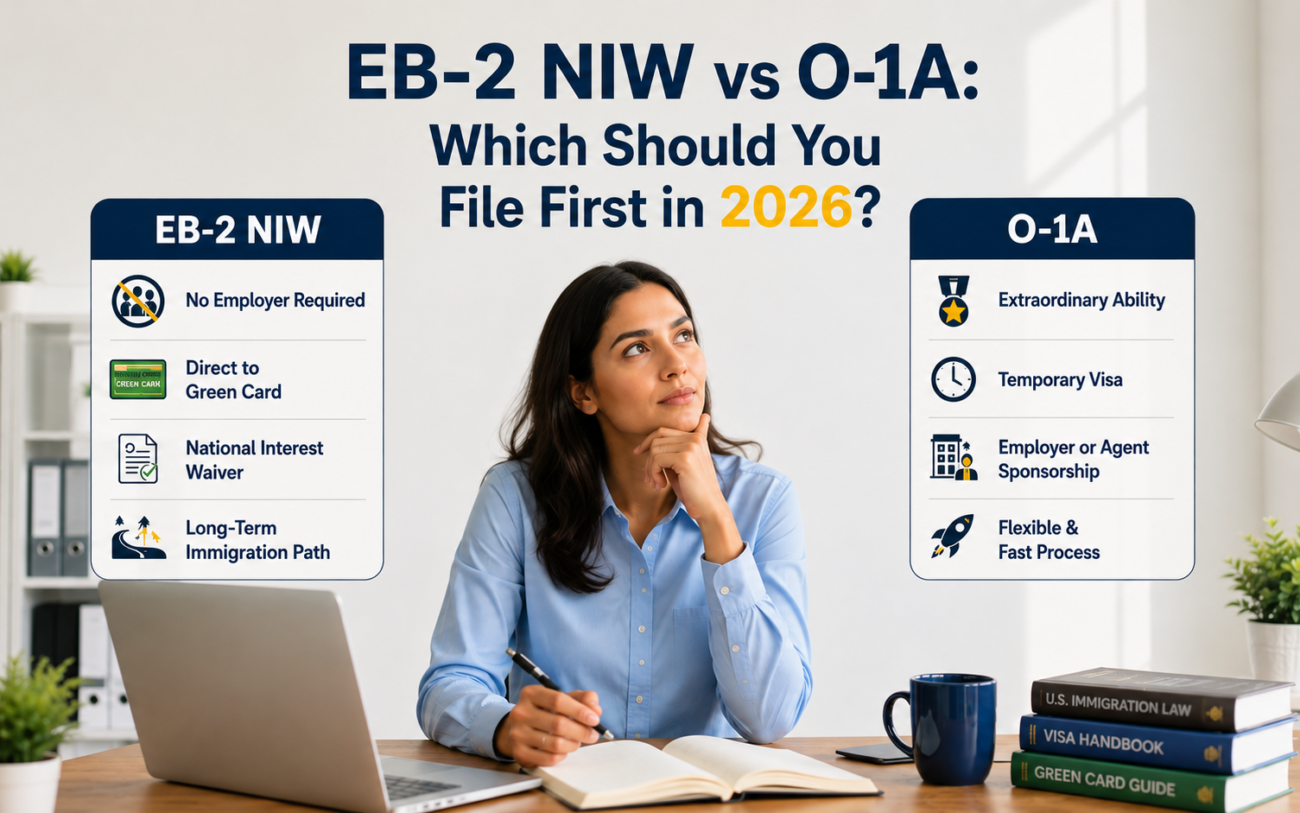
EB-2 NIW vs O-1A: Which Should You File First in 2026?
Two of the most frequently compared pathways in high-skill U.S. immigration serve fundamentally different purposes yet most professionals approach the EB-2 NIW vs O-1A comparison as if they are choosing between two routes to the same destination. They are not. The O-1A is a temporary work status that provides immediate employer flexible authorization. The NIW is a self-petitioned immigrant visa that establishes a path to permanent residency. The question is not which one to choose. For most professionals who qualify for both, the question is how to sequence them and whether EB-1A belongs in that sequence as well.
This guide explains how each pathway actually works, where the standards overlap and diverge in ways that matter for petition preparation, how the same career evidence gets framed differently for each, and how to think about sequencing across all three.
The Structural Distinction That Drives Everything
The most important thing to understand about the O-1A and the NIW is that they operate in different legal categories entirely.
The O-1A is a nonimmigrant classification under INA §101(a)(15)(O). It authorizes a specific person to work in the United States for a specific employer or agent, for a defined period. It requires a U.S. employer or authorized agent to file Form I-129 on the worker’s behalf. It is not self-petitioned, it is not permanent, and it does not by itself create a path to a green card.
The EB-2 NIW is an immigrant visa classification under INA §203(b)(2)(B). A successful petition results in an approved Form I-140, which establishes a priority date in the EB-2 preference category. When that priority date becomes current under the Visa Bulletin, the petitioner can file for adjustment of status or proceed through consular processing to receive permanent residency. It is self-petitioned no employer involvement is required.
These two pathways solve different problems. O-1A answers: how do I continue working in the United States now, with flexibility, without PERM? NIW answers: how do I establish permanent residency on a timeline I control? A professional who needs both immediate work authorization security and a self-controlled green card path often needs both filings.
O-1A Eligibility: What the Standard Actually Requires
The O-1A requires demonstrating extraordinary ability in the sciences, education, business, or athletics defined as sustained national or international acclaim. USCIS evaluates this through eight regulatory criteria, of which the petitioner must satisfy at least three:
-
- Nationally or internationally recognized prizes or awards for excellence in the field
-
- Membership in associations requiring outstanding achievement, judged by recognized experts
-
- Published material in professional or major trade publications about the petitioner or their work
-
- Evidence of judging the work of others in the same or allied field
-
- Original scientific, scholarly, or business related contributions of major significance
-
- Authorship of scholarly articles in professional journals or major media in the field
-
- Critical or essential role in distinguished organizations or establishments
-
- High salary or remuneration relative to others in the field
If no prizes or awards have been received, the petitioner must present comparable evidence demonstrating a similar level of recognition through alternative means.
The advisory opinion requirement what it actually is: Most O-1A petitions require a written advisory opinion from a peer group, labor organization, or person with recognized expertise in the field. This is not a standard recommendation letter. It is a formal written statement from an industry body or qualified expert specifically addressing whether the petitioner possesses extraordinary ability and whether their entry into the United States is in the interest of the field.
In practice, for fields without a relevant labor union or formal peer group, the advisory opinion typically comes from a recognized expert who can speak to the field as a whole a senior academic, a prominent industry figure, or a professional association officer. The opinion must address the petitioner’s extraordinary ability specifically, not just their qualifications. It is submitted as part of the I-129 package alongside the standard supporting evidence.
The advisory opinion requirement is one of the most practically distinct features of the O-1A compared to both NIW and EB-1A. It must be coordinated in advance and requires identifying an appropriate source, which takes time.
NIW Eligibility: The Forward Looking Standard
The NIW first requires qualification for the EB-2 category: an advanced degree (master’s or equivalent, or a bachelor’s degree plus five years of progressive experience in the specialty), or exceptional ability in the sciences, arts, or business. After that baseline is established, the Dhanasar three-prong test applies: the proposed endeavor must have substantial merit and national importance, the petitioner must be well-positioned to advance it, and waiving the labor certification requirement must benefit the United States on balance.
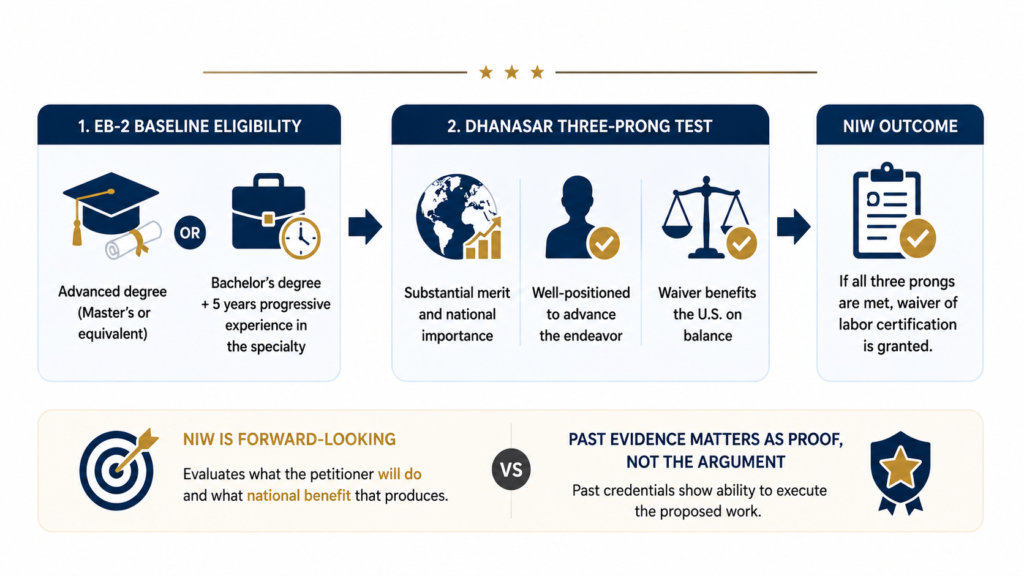
The critical structural difference from O-1A: the NIW evaluates what the petitioner will do and what national benefit that produces. Past credentials and achievements matter as evidence that the petitioner can execute the proposed work but they are not the argument itself. The NIW is inherently forward-looking.
The Evidentiary Comparison: Same Facts, Different Framing
The same career achievements often support both O-1A and NIW petitions but how those achievements are presented differs in ways that matter for petition preparation.
| Factor | O-1A | EB-2 NIW |
| Immigration status | Nonimmigrant (temporary) | Immigrant (permanent residency path) |
| Self-petition? | No employer or agent files | Yes applicant files directly |
| Primary standard | Extraordinary ability; sustained acclaim | National interest; proposed work benefits the U.S. |
| Evidence direction | Backward-looking: what have you achieved? | Forward-looking: what will you do? |
| Evidence focus | Personal recognition, reputation, standing | National benefit of proposed endeavor |
| Employer required? | Yes | No |
| Advisory opinion | Required in most cases | Not required |
| Premium processing | 15 calendar days (Form I-129) | ~45 business days (Form I-140) |
| Path to green card? | No requires separate immigrant petition | Yes I-140 approval establishes priority date |
| Evidentiary overlap with EB-1A | Substantial similar criteria | Partial Prong 2 overlap only |
A worked example of the same achievement framed differently:
Achievement: A data scientist developed a federated learning framework that has been adopted by three major hospital systems and cited 280 times in clinical AI literature.
Framed for O-1A (Criterion 5 Original Contributions): “Dr. [Name]’s federated learning framework represents an original contribution of major significance to the clinical AI field. The framework has been independently adopted by [Hospital A], [Hospital B], and [Hospital C] institutions that selected it after benchmarking against competing approaches. Its 280 citations within three years of publication place it in the top 5% of cited work in the clinical informatics literature for that period, as established by the expert letter from [Expert Name], who explains the significance of this citation rate within this specific subfield.”
This framing demonstrates recognition and standing in the field what the O-1A standard evaluates.
Framed for NIW (Prong 1 National Importance): “Dr. [Name]’s proposed endeavor is to develop next-generation privacy-preserving federated learning infrastructure for multi-site clinical trial coordination. Her prior framework, adopted by three health systems and cited 280 times, has established the technical foundation and demonstrated the approach’s viability at scale. The proposed work addresses a gap explicitly identified in the NIH’s 2023–2027 Strategic Plan: enabling multi-institutional research collaboration without privacy violations. Unlike her previous work focused on diagnostic AI, the proposed framework will be designed as open infrastructure deployable across research institutions nationwide, directly establishing the portability required under Prong 1.”
This framing uses the same prior achievement as evidence for a forward-looking national importance argument what the NIW standard requires.
The same achievement. Completely different evidentiary function. Letters drafted for O-1A should not be reused verbatim for NIW, and vice versa, even when the underlying facts are identical.
O-1A Mechanics: Duration, Renewals, and the Agent Model
Practical O-1A information that matters for strategic planning:
Initial duration and renewals: An O-1A is initially approved for the period of the event, activity, or employment, up to three years. Extensions are available in one-year increments, and there is no statutory cap on the number of extensions. Unlike the H-1B, which has a six-year maximum (extendable only under specific AC21 circumstances), the O-1A can theoretically continue indefinitely as long as the petitioner maintains extraordinary ability and has a qualifying employer or agent petitioning on their behalf.
The employer termination problem: When an O-1A holder’s sponsoring employer terminates the employment relationship, the O-1A status is tied to that petition. The petitioner has a grace period generally 60 days or the end of the authorized status period, whichever is shorter to find a new employer willing to file a new O-1A. This employer dependency is the O-1A’s most significant practical vulnerability for professionals who value career flexibility.
The agent model for founders and independent professionals: For professionals who are self-employed, freelance, or whose work involves multiple engagements rather than a single employer, the O-1A can be petitioned by an agent rather than an employer. The agent model requires a specific evidentiary structure: the petitioner must provide an itinerary of engagements, the agent must establish their capacity to act on the petitioner’s behalf, and the agent assumes certain responsibilities typically held by employers. For startup founders who are employed by their own company, the company can serve as petitioner but the founder cannot self-petition for O-1A the way they can for NIW.
H-1B to O-1A: A Common and Underused Transition
One of the most practical uses of the O-1A is as an H-1B alternative or successor for professionals who have reached or are approaching the H-1B six year cap without an approved I-140, or who want to reduce employer dependency.
Why professionals consider this transition:
H-1B status is employer-tied and subject to the six-year cap, with extensions beyond that cap requiring an approved I-140 under AC21 provisions. For professionals who have been in H-1B status for several years without a path to an approved I-140, the six-year cap creates a deadline.
O-1A status, once obtained, does not have the six-year limitation. A professional who qualifies for O-1A can transition to that status and extend indefinitely while building the NIW or EB-1A case that will eventually establish permanent residency.
Practical pathway: File NIW I-140 to capture a priority date. File O-1A to establish status not subject to the six-year cap. If the O-1A is approved before the H-1B cap is reached, the cap issue is resolved. If the NIW I-140 is approved before the H-1B cap, AC21 extensions become available and the O-1A transition may become less urgent.
For professionals approaching H-1B year four or five without an approved I-140, the O-1A represents a meaningfully different status option worth evaluating proactively.
Dual Intent and Immigrant Intent with O-1A
One practical concern for professionals filing O-1A and NIW simultaneously: the O-1A is a nonimmigrant status, and in principle nonimmigrant status requires the petitioner to intend to depart the United States at the end of the authorized period. Simultaneously filing an immigrant petition (NIW I-140) could be seen as evidence of immigrant intent that conflicts with the nonimmigrant O-1A.
In practice, O-1A is generally treated as a “dual intent” category by USCIS policy meaning that having a pending or approved I-140 while holding O-1A status is not inherently disqualifying. USCIS does not typically deny O-1A extensions or change of status requests solely because an I-140 is pending. However, applying for an O-1A visa stamp at a U.S. consulate abroad while an I-140 is pending involves a different analysis, and some consular posts apply stricter scrutiny to visa stamp applications from applicants with pending immigrant petitions. Traveling internationally while simultaneously holding O-1A status and pursuing NIW I-140 approval should be discussed with an attorney familiar with the specific consulate’s current practices.
O-1A as a Steppingstone to EB-1A
This is the strategic connection that most comparison articles miss and the one that makes the O-1A most valuable for professionals at the mid-career stage.
The O-1A extraordinary ability standard and the EB-1A extraordinary ability standard are closely related both evaluate sustained national or international acclaim through a similar set of criteria. Critically, the O-1A’s evidentiary standard is sometimes considered slightly more accessible in practice, because O-1A adjudication involves an employer advocating on the petitioner’s behalf and the advisory opinion provides additional expert testimony. Building and winning an O-1A creates a documented, USCIS-approved record of extraordinary ability that directly supports a subsequent EB-1A petition.
The practical steppingstone pathway:
A professional who currently qualifies for NIW and is working toward EB-1A can use the following sequence: File NIW I-140 for the early priority date. Pursue O-1A for immediate status security and to document extraordinary ability recognition through the USCIS approval itself. Use the O-1A approval and the evidence package supporting it as a foundation for the subsequent EB-1A petition. File EB-1A and port the NIW priority date into the shorter EB-1 India queue.
The O-1A approval does not automatically translate to EB-1A approval they are separate adjudications with different requirements but a well-documented O-1A with a strong advisory opinion and comprehensive criteria evidence creates a directly relevant foundation for the EB-1A filing.
Who Benefits Most From Each Pathway
O-1A Is Most Strategic For
H-1B holders approaching the six-year cap without an approved I-140 and without a viable PERM pathway. O-1A provides a status alternative not subject to the cap while NIW or EB-1A petitions develop.
Professionals in transition between employers who need work authorization that is not tied to a single organization. O-1A allows for agent-model petitions and can be transferred to a new employer more flexibly than H-1B.
Mid-career professionals building toward EB-1A whose record is not yet at the extraordinary ability threshold for EB-1A but who can satisfy three O-1A criteria now. The O-1A approval establishes recognized extraordinary ability and provides the status stability needed during the EB-1A build period.
Startup founders whose company can serve as petitioner and who need visa status not contingent on a traditional employer-employee relationship. The agent model is specifically designed for these situations.
Professionals whose NIW is still under preparation and who need work authorization that will not expire before the NIW I-140 is ready to file.
NIW Is Most Strategic For
Any qualified professional who wants permanent residency on a self-controlled timeline. The NIW’s self-petition nature means no employer can control, delay, or revoke the petition.
Backlogged-country applicants for whom capturing the earliest possible priority date is the single most important strategic action. Every month of delay is a month added to a queue measured in years.
H-1B holders who want employer independence from their immigration future. An approved NIW I-140 means the petitioner is no longer entirely dependent on their employer’s willingness to maintain sponsorship.
Entrepreneurs and founders for whom the PERM labor certification process is structurally impractical PERM requires an employer to test the U.S. labor market for a specific job, which does not describe most founder situations.
EB-1A Should Be Evaluated Alongside Both When
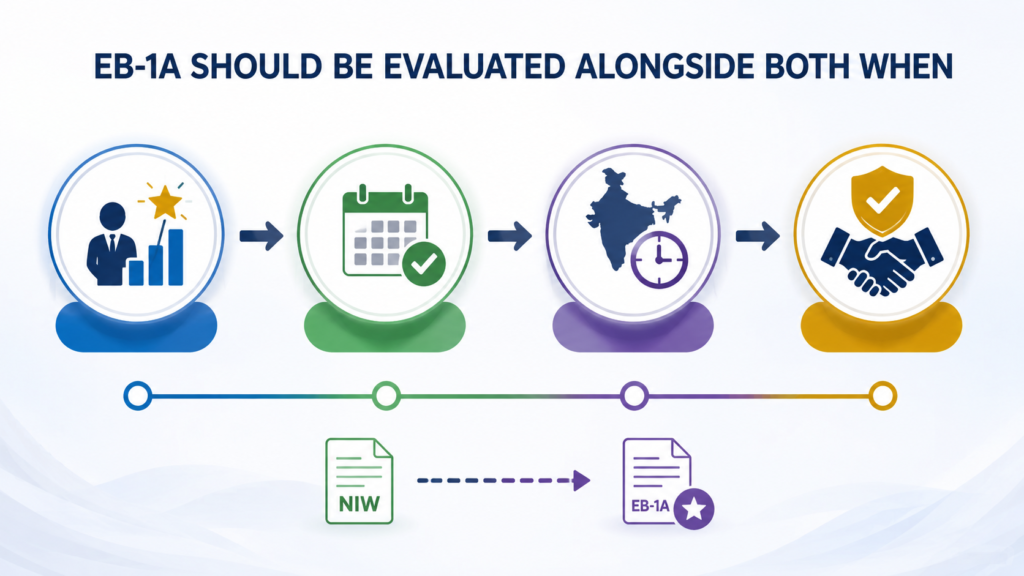
The professional’s record may satisfy the extraordinary ability standard, or can be built to satisfy it within 12-18 months. The India queue differential makes EB-1A strategically valuable regardless of whether O-1A is in the picture. The NIW priority date portability strategy makes early NIW filing + later EB-1A filing the highest-value combination for most qualifying Indian professionals.